Downtown

Things will be great when you’re
Downtown
No finer place for sure

The Playground, a market only open on Saturdays, is listed among a number of sights to visit in Johannesburg. My South African colleagues were not aware of the place, asking me to be more precise about the location. When I showed the map, they classified the immediate area as orange: safe to visit, just remember to be careful, typical precautions of a big city. You might also consider visiting an area call Maboneng, a fledgling new hotspot. I am sure they assumed Uber would be my form of transportation because there was no mention of the space in between.

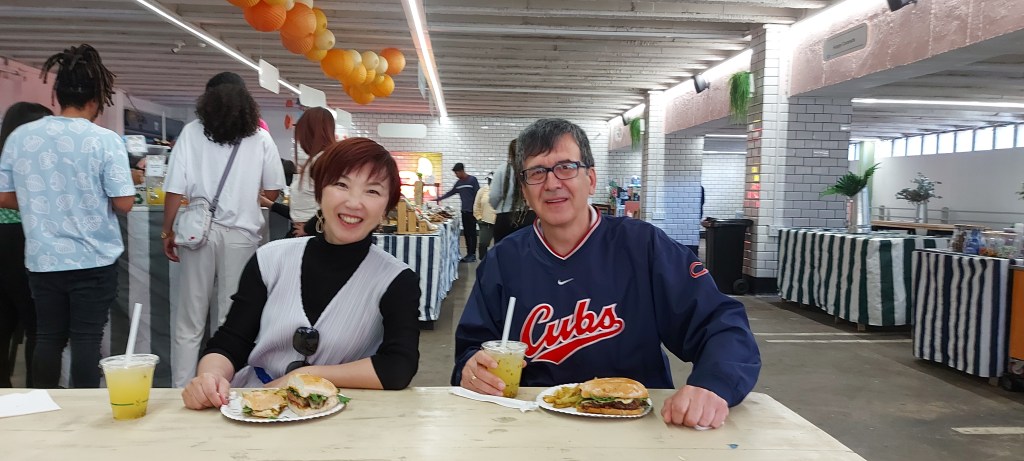
The Uber driver let me off at the requested address, a twenty minute ride from the hotel. I recognized the building from the website and eventually found the entrance. Greeted there by a jovial black man and a young white woman providing guidance, I inquired about food, asking for their recommendation. Both immediately pointed to the Argentinian stall serving the most delicious steak sandwiches. I sat with my order at a nearby table and engaged in a conversation with a couple originating from China who have lived in Johannesburg for 17 years. The crowd at the Playground consisted of white tourists and South Africans, checking out the wares, marveling at the variety of food, enjoying a drink, bouncing to the beat of the DJ, absorbing the warmth of the sun on the wrap around balcony. It is a hub of diversity and activity.

Rather than hang around, however, I decided to venture to Maboneng as suggested. I entered the address of a district store into Google Maps, which estimated a 45 minute walk. The sun was shining, the temperature was a pleasant 20 degrees Celsius so I eschewed another car ride for a self directed sightseeing city stroll.

As I marshalled along the prescribed route, smartphone in hand, the conditions began to worsen. Garbage was heaped in every corner, brown water pooling in all the crevices, bodies hidden under mounds of material. The streets were in upheaval, blistering walls, boarded windows, hangers on at each corner, evidence of poverty abound. The tourist guide book didn’t mention these parts, except as a place to avoid, especially at night.

I was the oddity, the interloper, the only white person in the maze from The Playground to the Maboneng Precinct, wearing a Cubs pullover jacket, a brown felt Indiana Jones style hat atop my head. Stalls of fruits, and vegetables, open cooking fires, cheap wares and material for the inner city residents lined the streets. I garnered some curious looks, eyes observing as I walked, assessing the surroundings, stopping only to check the GPS on my phone. The occasional vendor sought my attention, the rest sat slumped on the ground awaiting any semblance of interest. I was not accosted at any time, although a couple of idle taxi drivers offered a ride, one who explained I was not safe and he could drive me out of the area. I would rather put faith in the street than in his vehicle.

Sporadic cell coverage silenced the familiar computer generated voice, constantly recalculating my position, consistently lagging my progress. I walked through intersections where I was supposed to turn, headed west instead of east, turned circles around searching for unmarked streets. Forty minutes in and I was still forty minutes away. There were moments when I was becoming apprehensive. Where am I? Which way do I turn?

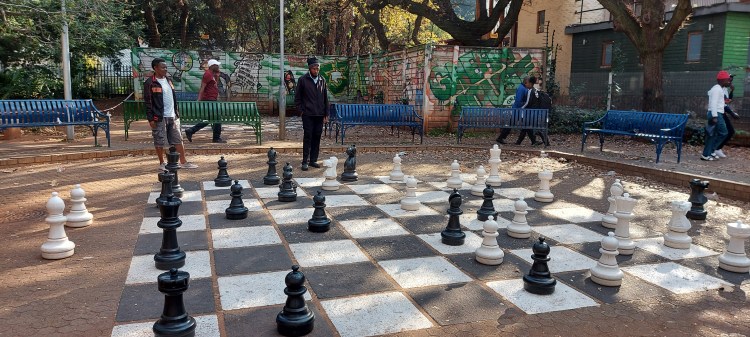
Finally, I found Joubert Park which immediately became my respite from the streets, an opportunity to settle and regroup in the sun. Worn from usage and neglect, the oldest park in Johannesburg appears to be a refuge for the locals, with people lounging on the grass, mothers and children strolling the grounds, pairs of men playing chess.

Somewhat rested, determined, I continued, exiting onto the street, moving parallel to the park, the stench of urine soaking the outside walls. I became a one man gauntlet through several blocks of people amassing in a Saturday market, a turn into the half empty street of shuttered buildings, down to the underpass, dodging traffic crossing to the other side when the scenery noticeably changed. Metal sculptures spelled out the name of the Maboneng district, buildings were refurbished, the people better dressed. Two blocks later I am at it’s heart. The main intersection flooded with young, hip people, music pumping out of vehicles, exuding the vibrancy of this gentrifying section of the city’s core. I had arrived.

Tired, thirsty, I settled into Mama Mexicana restaurant for a Marguerita before ordering a plate of Nachos. It was now approaching five o’clock. In a half hour, darkness would descend upon Johannesburg; time to beckon an Uber back to the hotel. The owner and the staff recognized me as a foreigner and helped confirm the location for me on the app. One waitress suggested waiting inside because phone snatchers will take advantage. Compared from whence I just came, this section of downtown was a safe zone. I had no concern although I was touched by hers. With the car nearing I stepped outside; she accompanied me, watching the progress on my app, escorting me to the corner where the car awaited, ensuring it was the correct vehicle. The ride back to the hotel was quick. Today’s adventure was over.

I have found myself in similar situations during my travels in the past. I recall a walk, totally unbeknownst, from the hotel in Atlanta, Georgia to the Martin Luther King Memorial through one of the poorest and most dubious sections of the city. I have witnessed places and people normally left off the map. Downtown Johannesburg reflects that of most every major city. Although unplanned, I am richer for the experience.

And you may find somebody kind to help and understand you
Someone who is just like you and needs a gentle hand

Wild Thing

You make my heart sing

There was an understated anticipation on the mini bus. We exchanged the obligatory polite hellos, names and where are you from questions. Gerald travelled 30 hours from his home in Seattle to arrive in Cape Town before making a last second decision to join this tour. Sean is originally from South Africa, currently living in England, while his companion, Mary, lives in Wales. This journey was billed as the Ultimate Pilanesberg National Park Safari Tour – A guided safari of Pilanesberg National Park to spot the ‘Big 5’ and other species. The price and the timing fit my schedule. And like my travelling companions, the decision was last minute, for the same reason: How could one travel to South Africa without exploring the wild life.

Sean and Mary sat a couple rows to the back for the two hour ride; I was behind the driver, Dennis, and Gerald was ensconced in the passenger seat. Gerald and I relayed stories of our other travels, spoke of sports, and bandied thoughts on colleges, as Dennis navigated through some very early morning fog, the three of us sharing my massive take away continental breakfast courtesy of the hotel. Occasionally we included Sean and Mary with intermittent questions, however, they were content with their own company.

Our van met five more vacationers at the park and were introduced to our guide at 9:00 am, before piling into the open air jeep. Desmond introduced himself and the basic rules: don’t leave the vehicle at any point in time, lest a waiting lion leaps from the grass and haul you away; don’t hang your arms out the side because that same lion may rip it off for a snack; and think of the bumpy ride as a bonus massage of your bottom. His humour established, Desmond popped into the driver seat and we were off.

In 2017, Olga and I embarked on a grand safari to the NgoroNgoro Crater and Serengeti National Park in Tanzania, collecting pictures and memories of numerous birds and animals. So I was not as excited when the rest on the jeep jumped at the sight of some grazing small antelope. I didn’t even take a picture. “We will move on”, says Desmond, “there will be many more throughout the park. We guides refer to them as McDonalds because the lions can find them everywhere. “

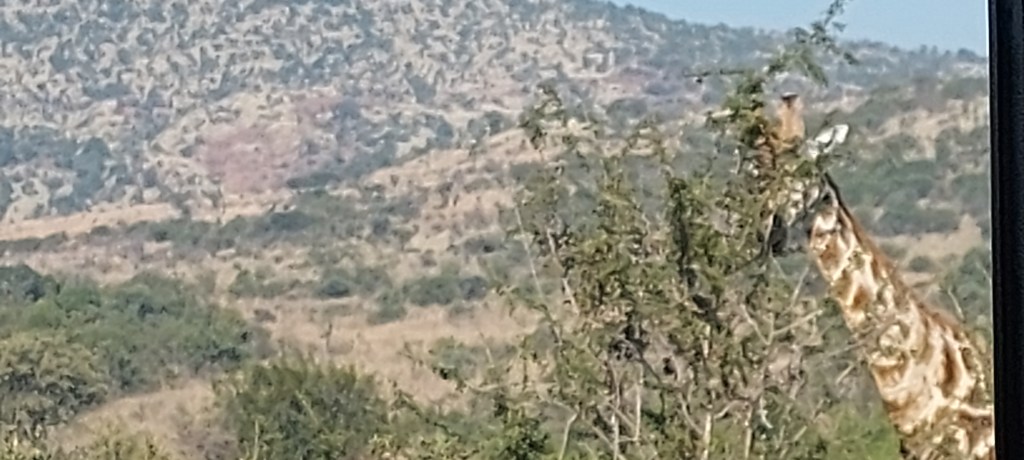
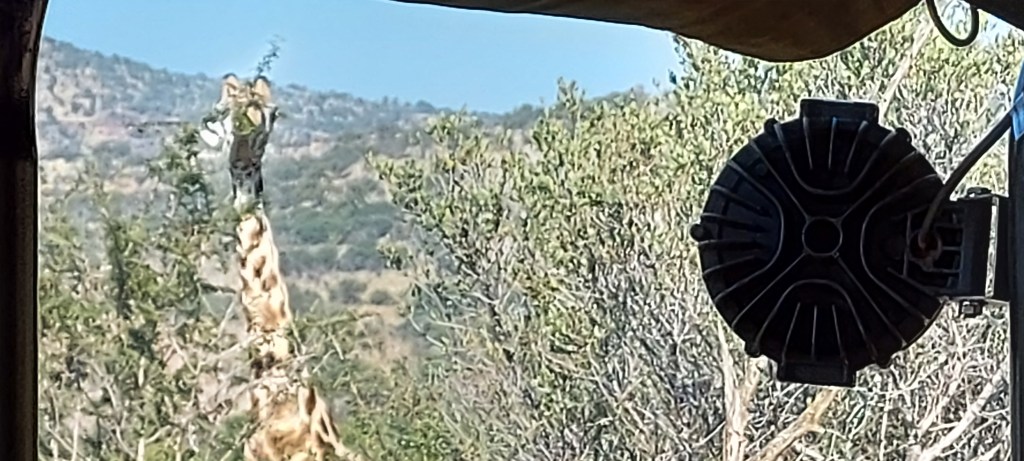
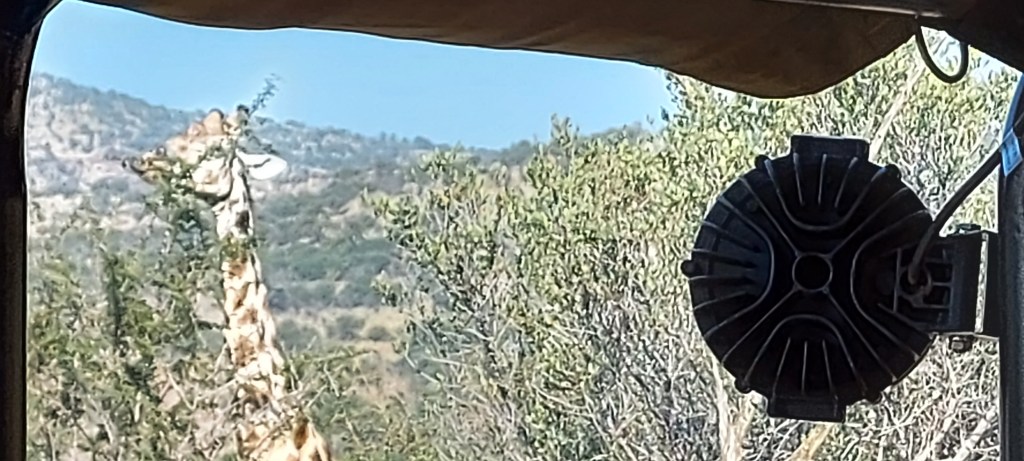
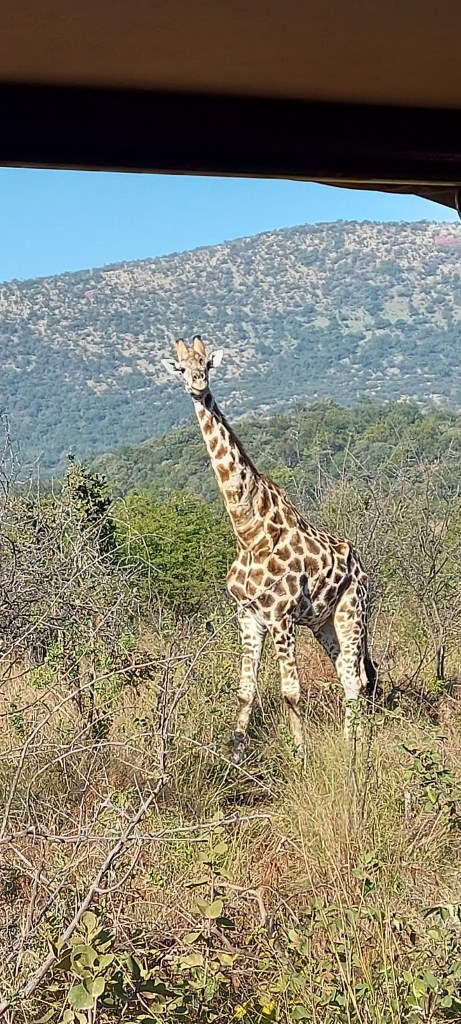
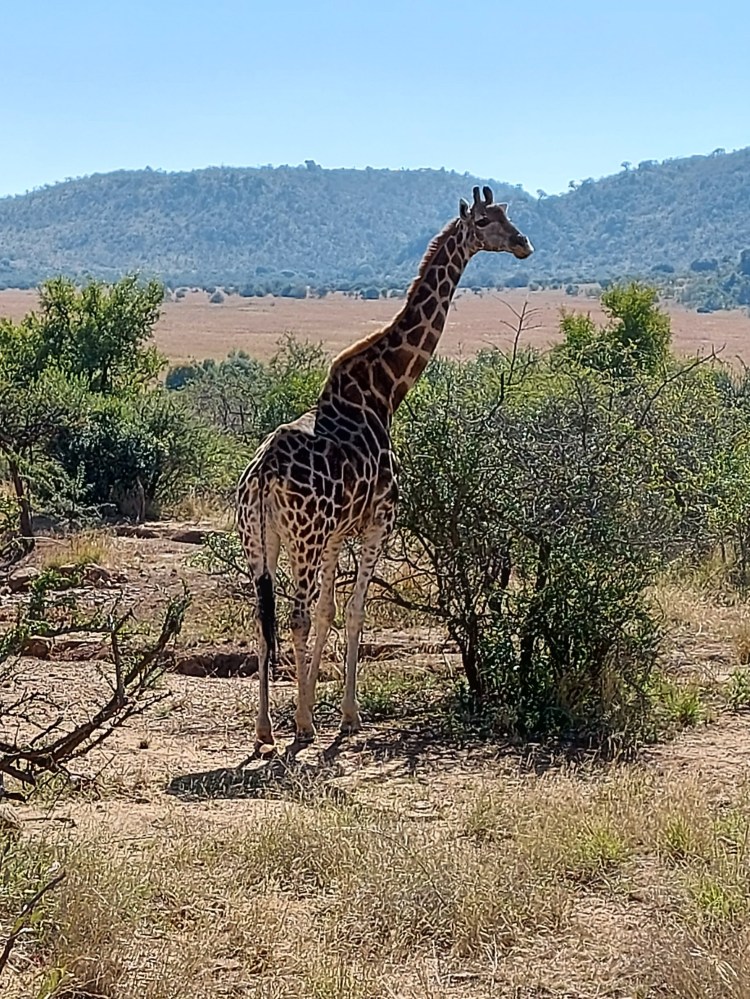
Five minutes later, just around a bend, a male giraffe was chomping on some leaves, twenty feet in front of us. I rose to my feet, snapped out my phone, twisted my body for the best angle and clicked away until I achieved the perfect shot.

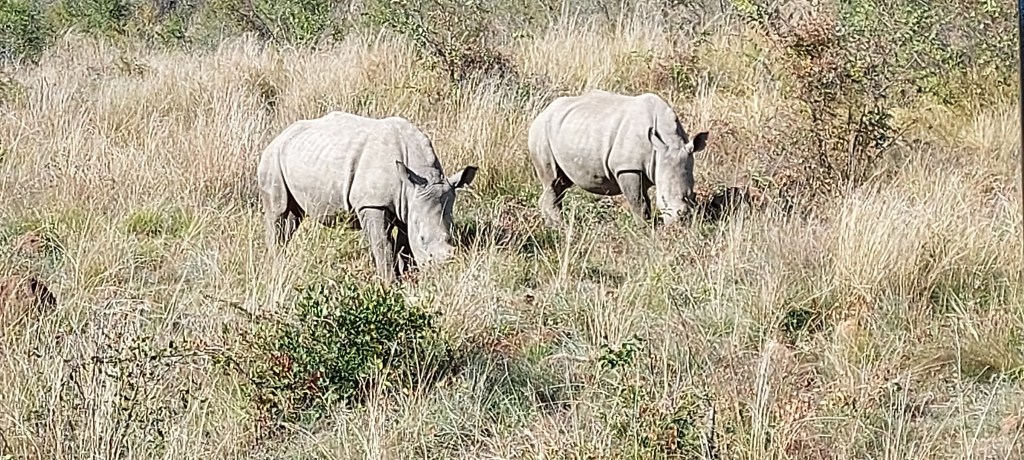
I was surprised at my own excitement. Thirteen pictures in total. Half a kilometre down the road, after a detailed explanation of the significance of rhino dung, we spotted two white rhinoceros. I snapped away again. Zoom in, raise the camera, wait and click, and click, wait some more as they move around, another dozen photos and we are done.

This pair was my first close look at a rhinoceros. I was hooked. Again.

Wild thing. You thrill me.

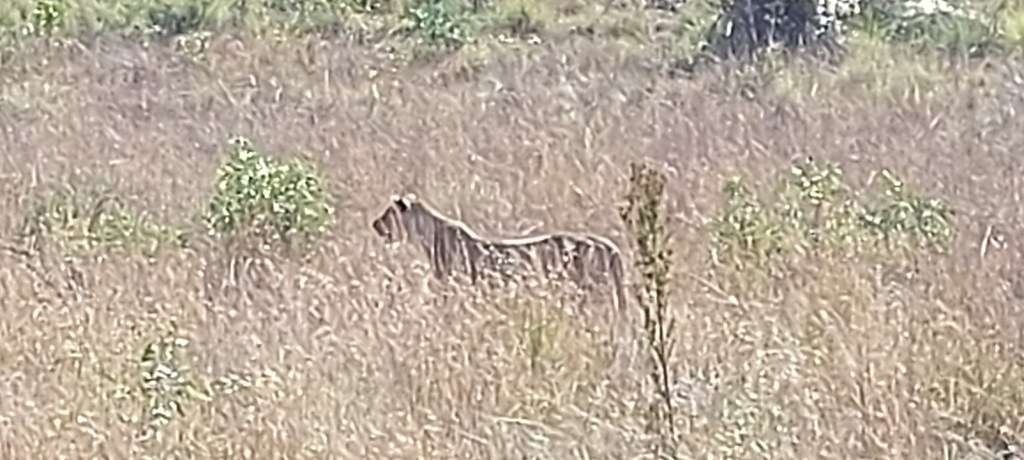
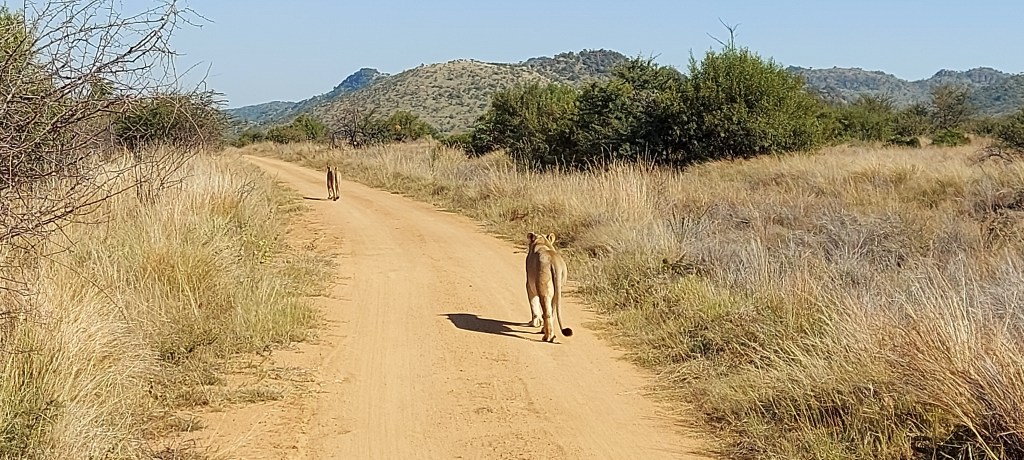
The remainder of the day was in pursuit of all the other inhabitants of nature’s zoo. The most challenging proved to be the lions. Radio exchanges between guides about a possible pair on the next road turned out to be a false alarm. Skepticism on the sighting of a herd was vanquished when a game ranger informed Desmond of sime on the other side of the range, far end of the park. “Let’s go hunt the hunter.”

And there they were. Two. Snaking through the grass in a stealth crawl, a herd of small antelope ahead. The beginning of a low trot raised everyone’s expectation, silent, watching. Perhaps it was the sight of two vehicles which twigged a careful assessment by the antelopes; the herd appeared to have caught wind of the lions’ presence and began bounding away. The lions abandoned the pursuit and slowly walked past the paparazzi, up the dirt path, and onto another private road with a sign forbidding any human to enter.

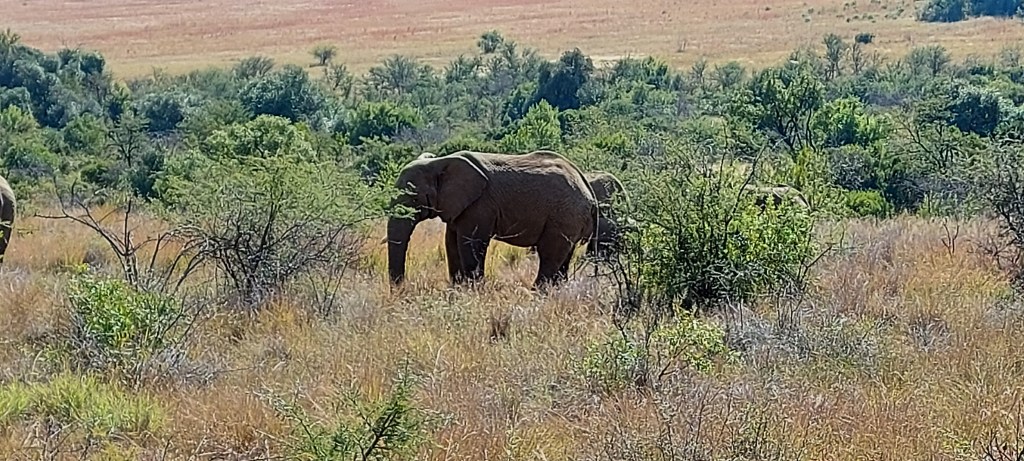
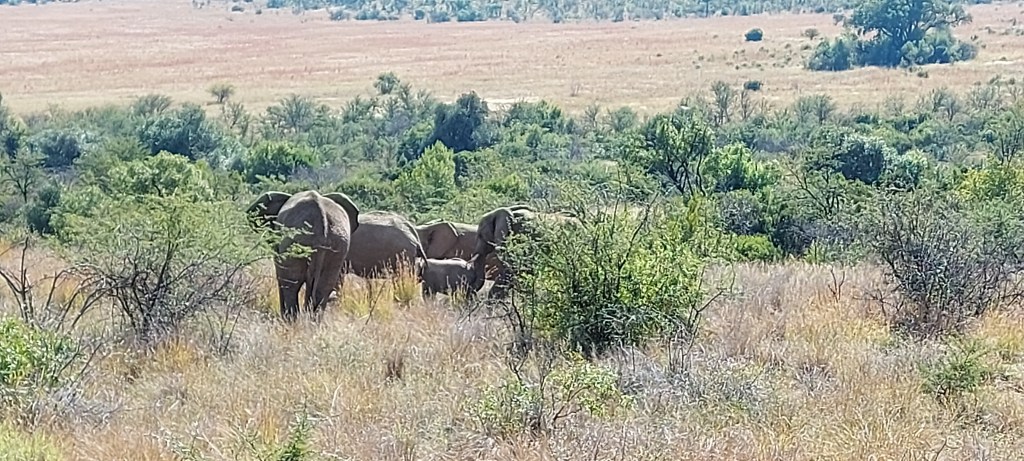
By lunch we had managed to have found two and a half of the big five – lion, elephant, white rhino (as opposed to the black rhino) – spotted a leopard hanging in a tree, too difficult to see with the naked eye and too far for a smartphone camera. The prospects of encountering an African water buffalo appeared slim.

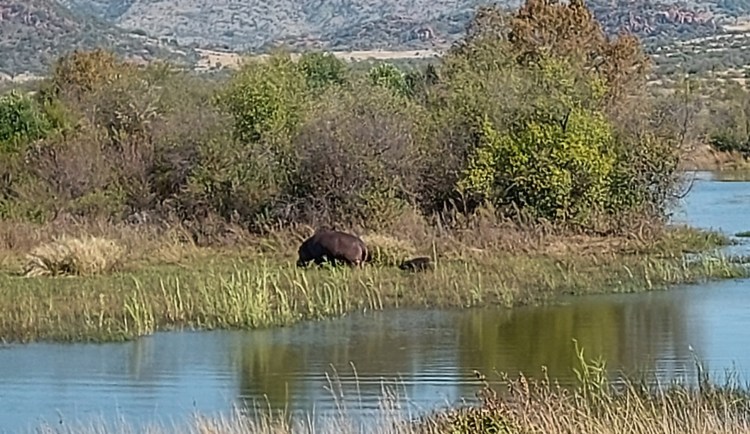
The most adorable sight was a mother hippopotamus and her baby lounging in the water, meandering to the shore. Raising her heft onto land, massive body supported by short stubby legs, the mother began her stroll inward. Baby hippo lingered behind, chomping on fresh foliage before realizing it was being left behind, scampered it’s cannon body in a rush to catch up.

Wild thing, you move me.

Another giraffe, zebras, a brown hyena, king fisher birds diving for fish, two more white rhinos. The tour ended by 3:00 and we headed back to Johannesburg.

The ride home was quiet, tired from the 5:30 am start, each of us sharing our good day on social media. I continue to marvel at the wonder of nature.

I realized after this visit the importance of taking advantage of opportunities. They are a connection to ourselves, to the wider world. They help me appreciate how fortunate I really am.

Wild thing, I think I love you.

5 Days in May

My accent gives me away.

People then leap to the assumption I am American, which I quickly correct before they ask if this trip is my first time in the country. My response immediately induces a smile and the understandable question: “So how do you like South Africa so far”?

With a sheepish grin I confess to having seen very little beyond the boundaries of my hotel, a handful of government buildings, their internal workings and whatever sights observed through the window of the vehicle transporting us between locations in Pretoria. For these past five days in May, my experience has been limited to meetings and conversations within the confines of business rooms, hotel restaurants and the adjacent bar. The sun drops below the horizon by 5:30 in these winter months, when the working day is over, further reducing the opportunities for sight seeing. Save for the people themselves, I could have been in any small city in Europe.

There are some differences, systemic and quirky. Driving on the left hand side of the road, for example, confounds me every time I step into the vehicle. As a passenger, I find the ride disconcerting. Of course the driver navigates the streets with ease while I cringe thinking he is proceeding into the wrong lane and we are going to crash. Right turns appear too wide; left turns feel as if taking a short cut. When it is the only car on the street, I assume it is a one way; and I startle whenever another zips past in the other direction, on our right. Perhaps I would acclimatize more quickly if I were driving myself. Or not!

Had I been at the wheel when the blackout started, my response may have been questionable. On two occasions, retuning to our hotel after dark, the power kicked out across the city without forewarning or apparent cause. The South Africans did not blink an eye. Another day, another power outage. Moments later a scattering of buildings and business flickered into full illumination because they had invested into a generator for these regular occurrences. The street lights and the traffic lights (‘robots’ as per one colleague) remained unlit as drivers proceeded, traversing each intersection as a four way stop. No fuss, no horns, just carrying on. Slower movement and some longer waits, all in keeping with the expected norms. Eventually power is restored. The next day, at almost the exact time, power went out again on our trip. Yawn.

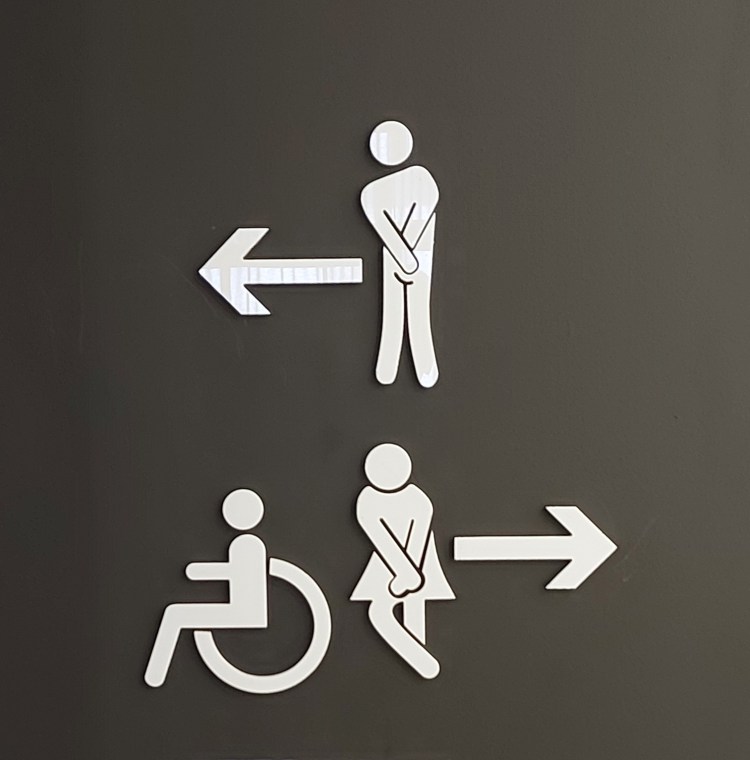
Some of the quirkiness was noticed at the hotel, my home for these five days. It operates as a small conference center with numerous public bathrooms. The set up is familiar, the bathroom signs were not.

I smiled when my search for the facilities uncovered them. Perhaps the designers were remembering their experience in meetings and conferences where coffee is consumed one after another after another out of habit and availability. All that liquid needs to be released at some point.

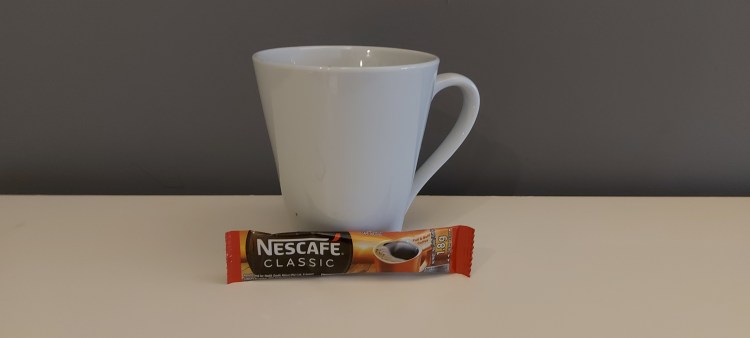
The predominance of instant coffee in Africa is amusing. During my time in Tanzania and again here in South Africa, instant coffee is common. And not just your regular freeze dried version, but powdered as well, all flavoured with chicory specifically for the continent.

The coffee “machine” in the room is a kettle.

My African colleagues recalled how the testing by large purveyors of coffee products had shown African’s preferred the additional taste and consumed it in larger numbers.

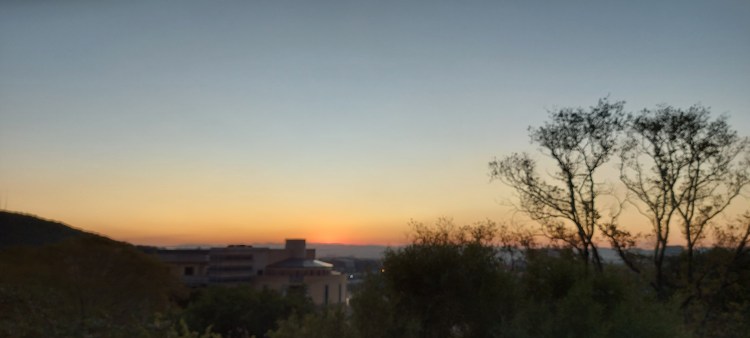
The days had been melding together and then Friday happened. At four o’clock I was officially “off the clock”. One colleague had family in Pretoria and we were invited for dinner consisting of oxtail, stump pot, roasted vegetables and salad. We left immediately to the home situated above the city to catch the sunset for the first time.

We had a very enjoyable evening of drink and conversation, exchanging stories and laughter from each of our respective countries and perspectives. Indeed, everyone with whom I have encountered has been welcoming and warm, genuinely interested in my well being and comfort. Sure there is an element of novelty, someone from Canada tends to prompt a number of questions about geography and weather, economics and politics. The interest is also in you, as a person, ensuring your time in their city, their country is enjoyable.

My remaining time will include sightseeing in Johannesburg and a one day safari, the standard itinerary of international travelers here. In these 5 Days in May I have enjoyed my interactions with the people of South Africa and with them have come to learn a great deal more of the country, one where I would excitedly return.


How will you ever know
The way that circumstances go
Always gonna hit you by surprise

Jet Airliner

Ridin’ along in this big ol’ jet plane
I’ve been thinkin’ about my home

I was thinking about my inaugural plane ride when the family travelled to the Netherlands in the summer of 1967. The trip was Mom and Dad’s first time back, almost ten years after their arrival in Canada, to celebrate Dad’s parent’s golden wedding anniversary. It was a highly anticipated event, years saving the money, months in preparation. Mom wanted to make every aspect perfect.

The four boys were dressed for Sunday church, white shirts, black pants, bow ties; eight, seven, six and two. Michael was young enough to be deemed a baby, not requiring a separate ticket, no seat, sleeping at my parent’s feet, in economy class. The neighbour across the street chauffeured us to the Toronto airport, traversing the 401 highway, three hour return, to save on the cost of long-term parking.

We arrived at the requisite two hour advance time for the 7:00 pm departure only to discover the Martinair flight was delayed for some imprecise mechanical repair that stretched to midnight. It’s hard to keep a white shirt clean when you are bored and hungry and tired, squirming to find comfort on utilitarian seats. The meticulous outfits lost to the vagaries airline travel. The entire De Cock and van Rooij families greeted a bedraggled couple with their disheveled four boys in tow.

This trip to South Africa is my first since March 2020, days before the world began to shut down, precipitated by contract work accepted because it would involve travel. All elements are organized and paid by the International Finance Committee of the World Bank, featuring the luxuries of business class with the concomitant priority lines and free lounges.

China and glass and silverware. Wine and liquor and beer. Napkins and comfort and service. Individual pods and sleeping seats and noise-reducing headphones.

This trip is me, alone.

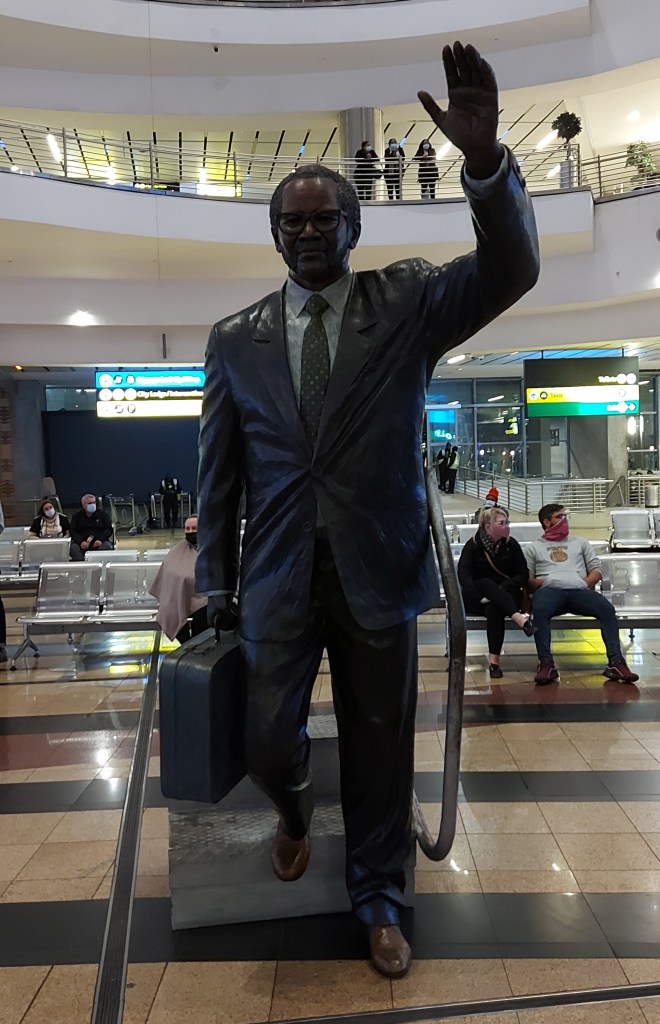
Statue welcoming passengers at Johannesburg – OR Tambo International Airport

This experience is not that first one to the Netherlands almost 50 years ago. My world has changed and taking opportunities to opt for convenience becomes an important goal in planning our growing list of desirable destinations. The prospect of spending seventeen hours in a plane, squeezed into seemingly small spaces with diminishing quality frightens me.

Yet I would travel in any manner, any time, any where if it meant travelling together, with Olga.

Big ol’ jet airliner
Don’t carry me too far away

I got loaded

Last night. On a bottle of gin.

Not really, but I savoured every ounce.

KLM, Royal Dutch Airlines, Flight number 692, Toronto to Amsterdam. First leg of a 24 hour journey to Johannesburg, South Africa.

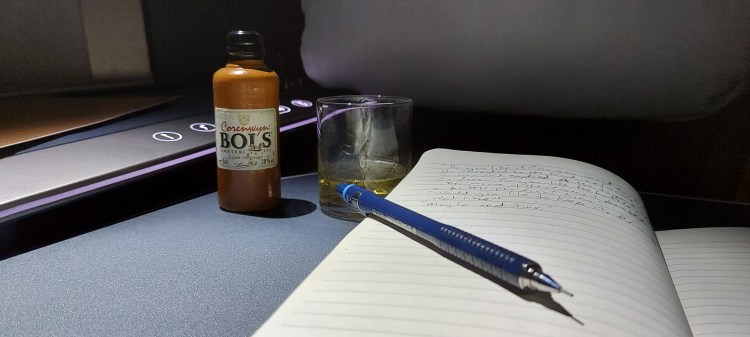
I noticed Bols Corenwyn – Aged Dutch Genever at the top of the spirits list on the menu as I settled into seat 2G, getting comfortable with the luxuries. In taking my dinner order, the attendants had already established I could not speak Dutch in spite of my name. When asked about a liqueur with my sweet dessert, I stumbled over the pronunciation and pointed to the words.

“Oh! but of course” beamed the server, abandoning her cart and disappearing behind the curtain, returning some moments later with a tiny brown bottle.

“We don’t get much call for this anymore. It is a special one. Corenwyn.”

She twisted off the seal and passed over the classic crockery.

“I cannot buy it in Canada. A Dutch friend would bring me back a bottle whenever he visited the Netherlands.”

“You must visit the distillery in a small town outside Rotterdam whenever you visit Holland” she encouraged before smiling broadly and moving on to the next passenger.

Later, a different flight attendant stopped her cart to clear away the dinner dishes.

“Did you like the Genever?”

“Yes, I love it.”

“Oh! you have tried it before.”

A few minutes later, moments after the lights dimmed, she returned to my pod with an unopened crock. “Save this one for later” she whispered. I slipped it into my bag.

A third attendant noticed my glass, reached in to clear it away before realizing I had not finished.

“I am sorry. Would you like some more whiskey?”

“I am drinking Genever”, sounding more Dutch.

“Oh! Do you like it? Do you want another?”

Excited, she retreated to the front of the plane, returned with a refill and emptied the light amber nectar into my glass.

“Do you like the bottle?”

“It was one of the reasons I bought one the first time.”

“Would you like to keep it? Or maybe next time?”

“Maybe next time.”

Celebration

… There’s a party goin’ on right here
A celebration to last throughout the years
So bring your good times and your laughter too
We gonna celebrate your party with you
Come on now

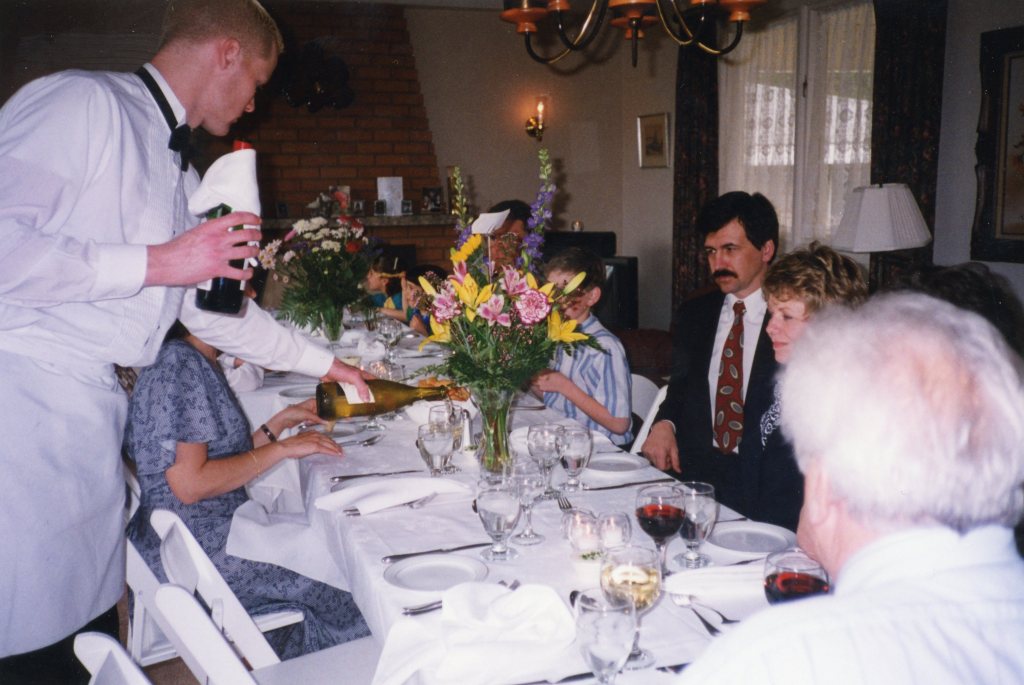
Yesterday would have been Mom and Dad’s 64th wedding anniversary; given Dad would have been 89 and Mom 93, the chances of celebrating the occasion were slim. Mom’s untimely death in 2005 meant they did not make it to number 50 either, a milestone which would most certainly have been marked with a party.

My parents did not let a special day pass without a card, a telephone call, a visit, a cake or a drink. Their own birthdays were treated as merely another year, just don’t dare forget it. April 30th was an all together different matter, especially the milestone years. And when they celebrated, it was with gusto.

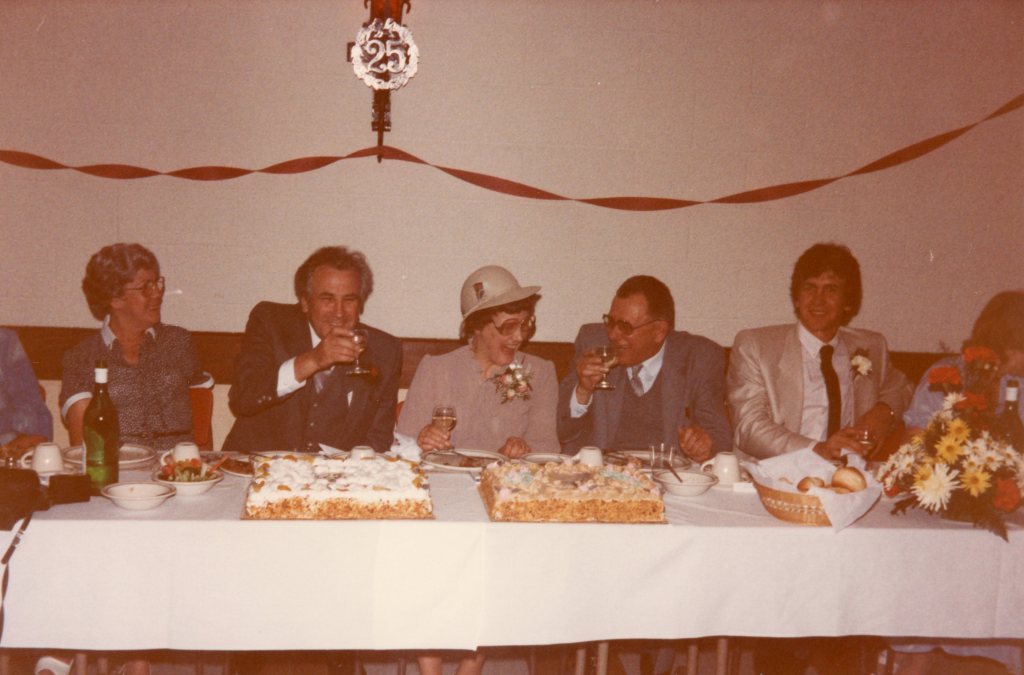
The first recorded collection of photographs stem from the silver wedding anniversary in 1983. I remember the planning, the preparation, the people, and the late night. A review of the picture collection reveals a very proud couple, enjoying the day and the company.

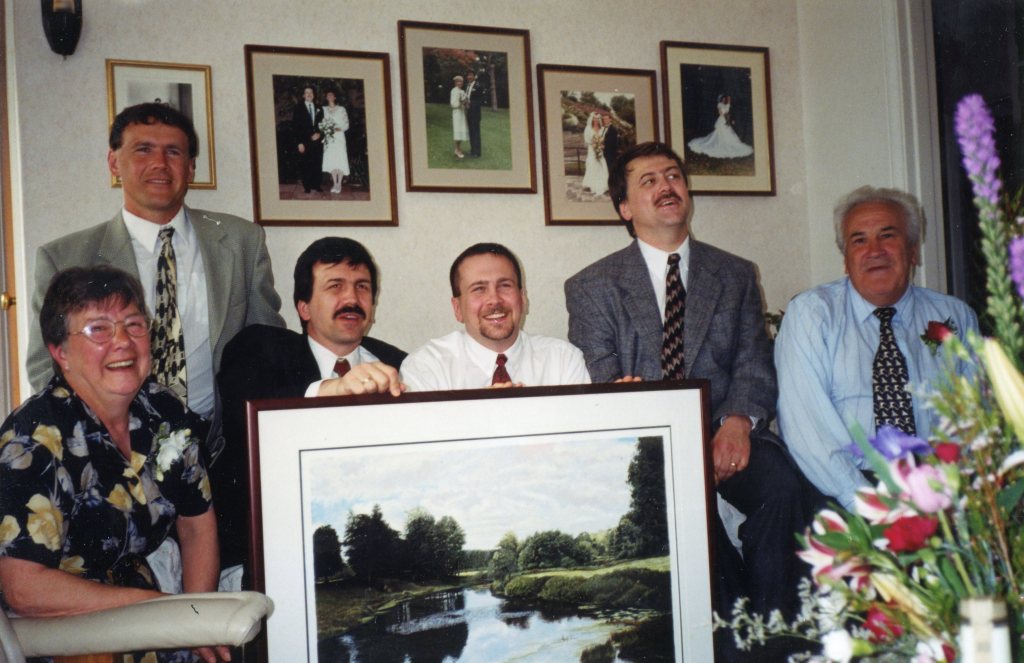
One of many toasts. From left to right, Tante Toos, Dad, Mom, Uncle Herman and me.

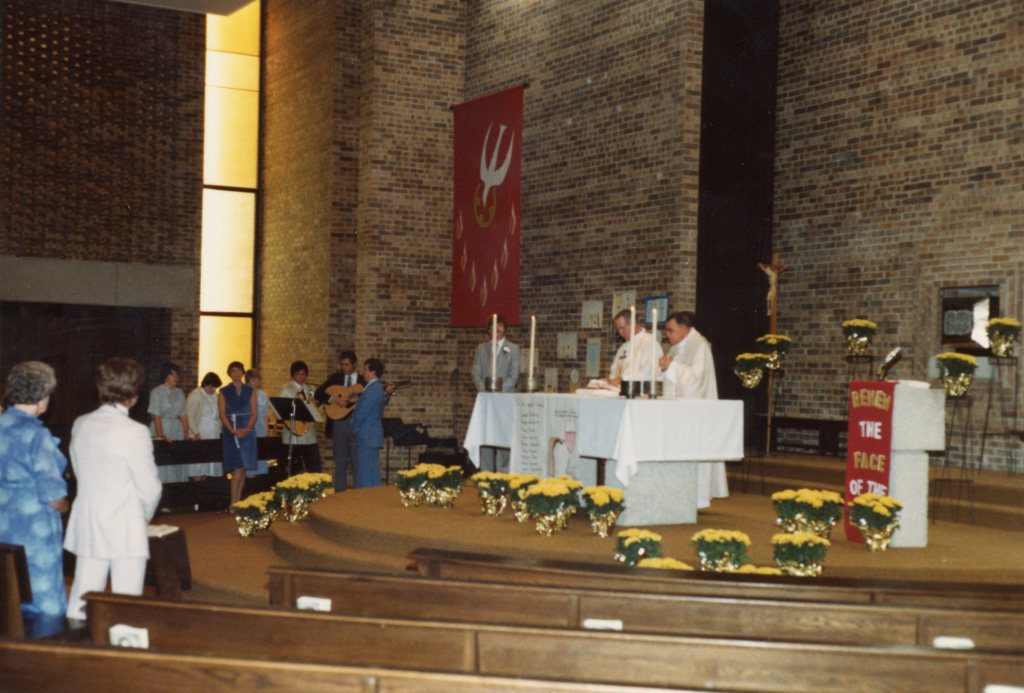
The measure of it’s importance was reflected in the visitation of relatives. Dad’s two older sisters, Anne and Toos, were in attendance along with Mom’s eldest sibling, Fr. Herman van Rooij, flying in from the Netherlands. The day started with a special Mass at Mary Immaculate, led by Uncle Herman, Gary and Peter as altar servers, Michael delivering the readings, Olga and myself singing and playing in the folk choir. It was a very special event.

Five years later, I remember a spontaneous and somewhat raucous night of drinking and dancing with all the boys and their partners after a celebratory dinner at Kostis Avenue. A very young Nicholas and baby Olena upstairs asleep while the adults played, loudly.

Couples in the Netherlands don’t wait until the Golden anniversary for the next major wedding celebration. The 50th might not happen so they begin with number 40, then number 45 and then the big one. By the time of my parents’ 40th, the clan had grown considerably with a boat load of grandchildren. Mom and Dad hired a catering company to cook and serve within their home, a family friendly event enjoyed by everyone. Even though the partying was subdued, the gathering itself was remarkable.

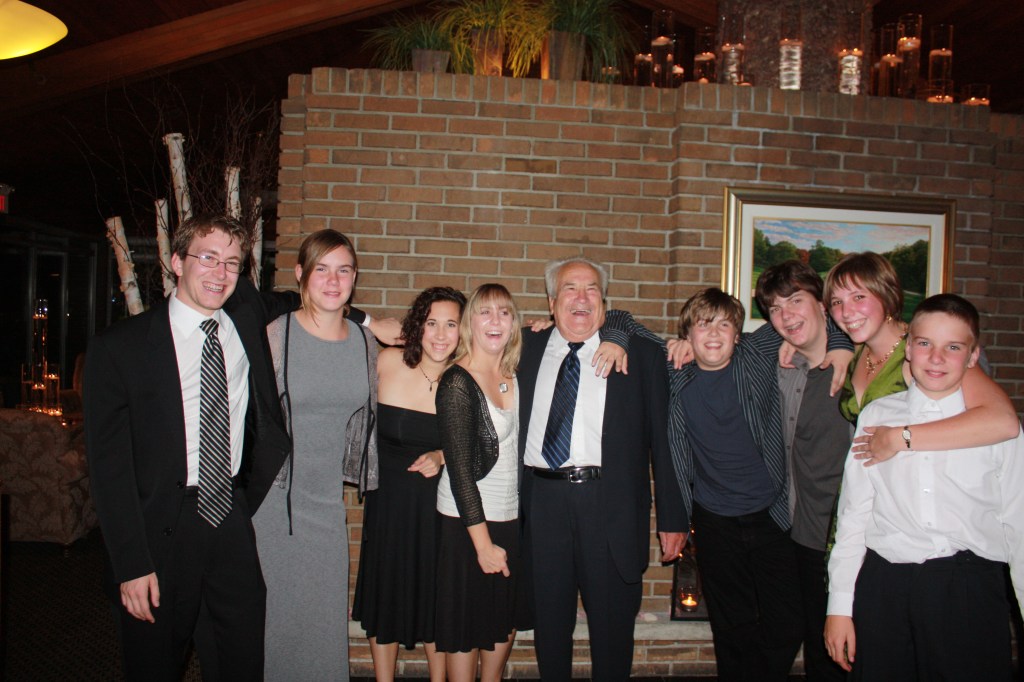
In 2008, Olga and I celebrated our 25th, the same year which would have marked my parents 50th. Learning from them, we wanted to honour the auspicious occasion with a party of family and friends. Mom had passed away three years earlier. We wished she could have been there; I know Dad missed her dearly. Despite her absence, he made the day feel extra special and enjoyed the company of everyone, especially the grandchildren.

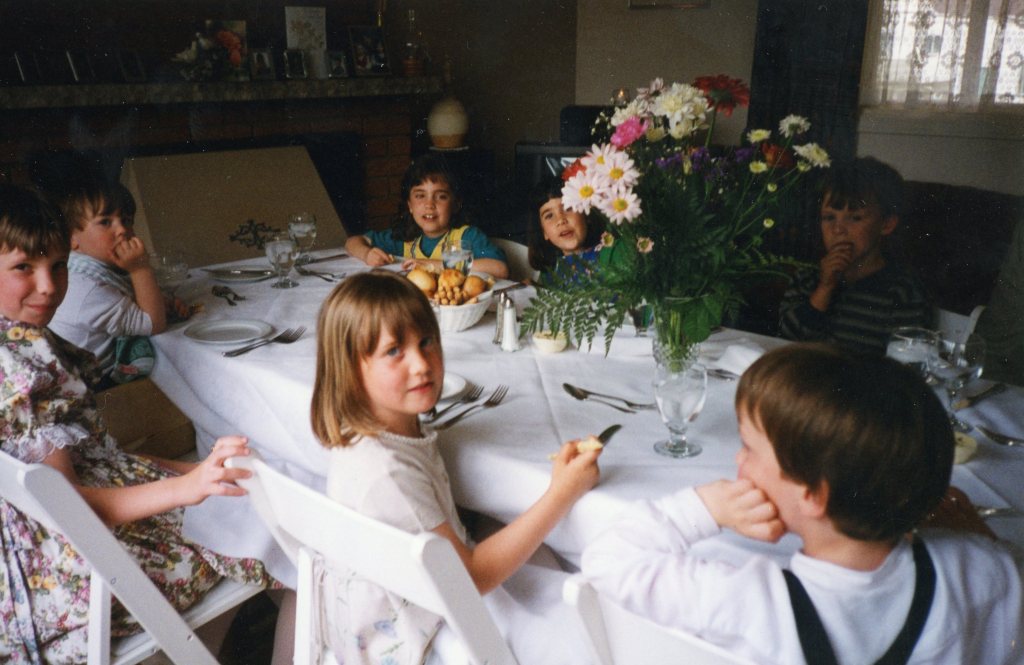
Dad enjoying himself with the grand kids at our 25th anniversary

The gathering of entire families seems increasingly rare. People reside in different cities, live divergent lives, occupied by all encompassing matters. The reasons not to get together are easy to count, the excuses not to make the effort recited effortlessly. And maybe not everyone can attend, or the measures are simpler; nevertheless, whatever the day, the event, the moment, it is important to celebrate. You may not get another opportunity.

May we all find occasions to celebrate and share our blessings with others.

Ahead by a century

“Your uncle would have been a product of his time.”

The statement weighs heavy as the last line of my notes from an afternoon of conversation with Fr. Cor Schilder, appointed as our host on a visit to Mission House Vrijland, a retirement home for Dutch Mill Hill missionaries in Oosterbeek, the Netherlands.

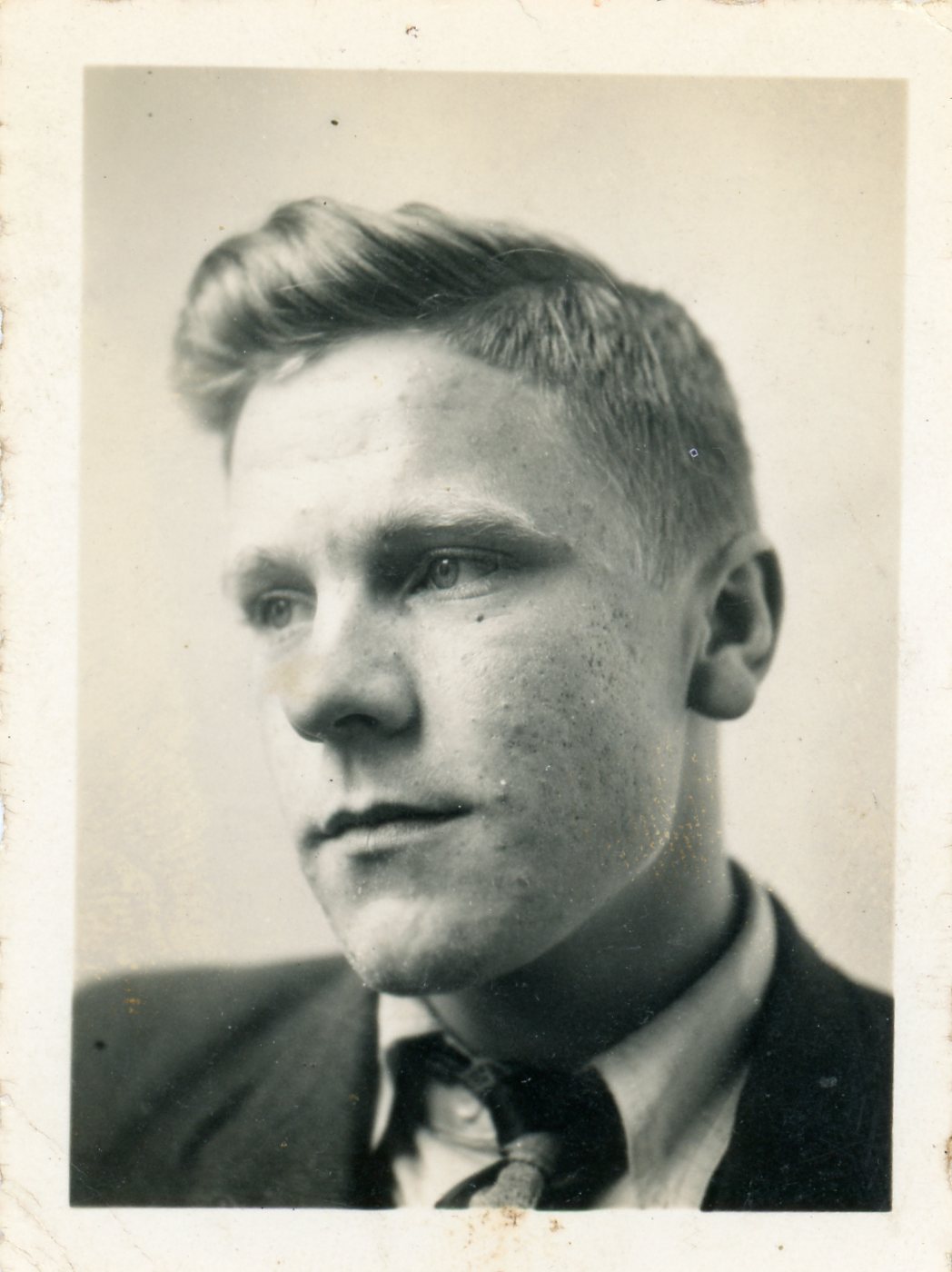
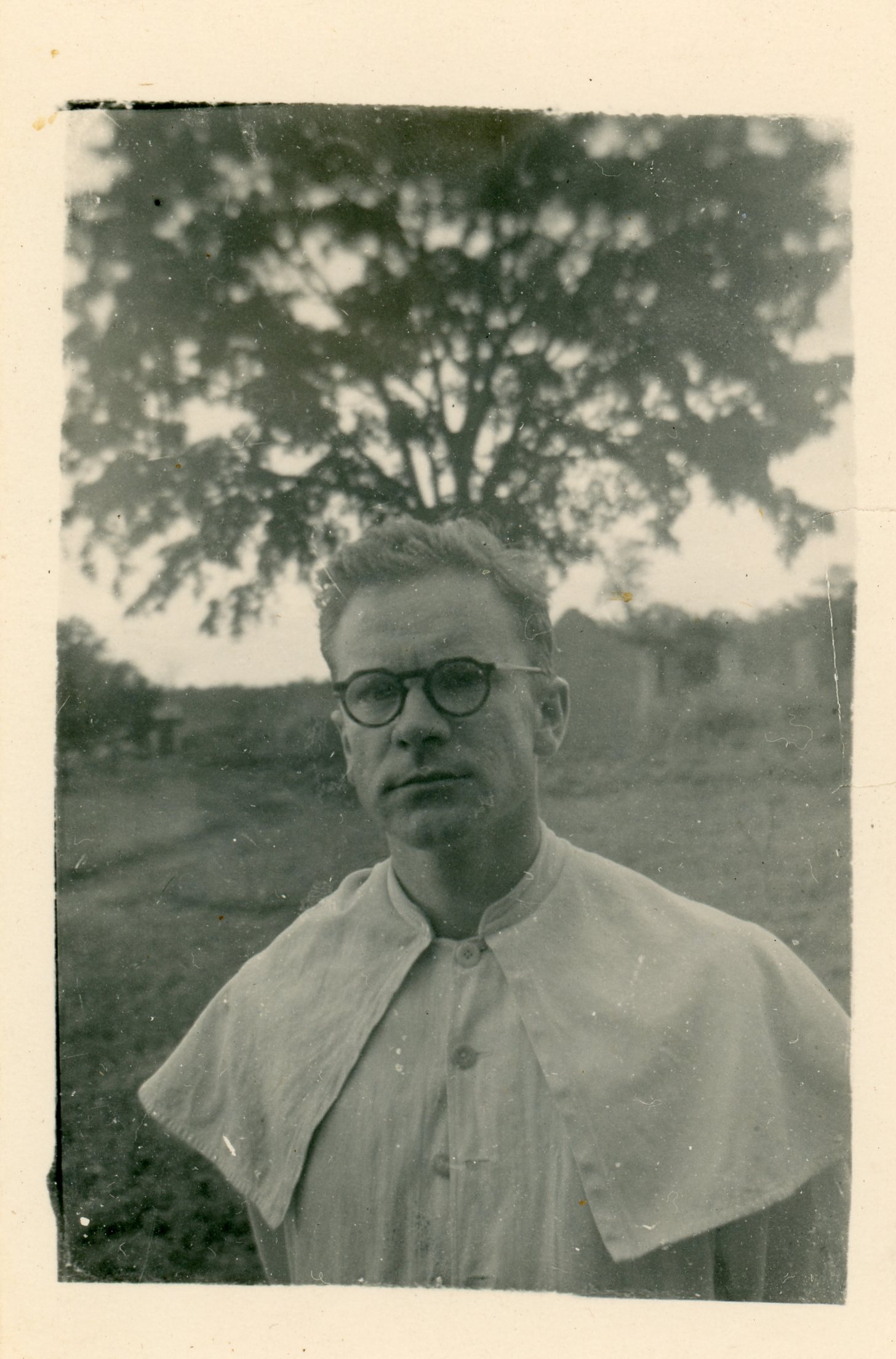
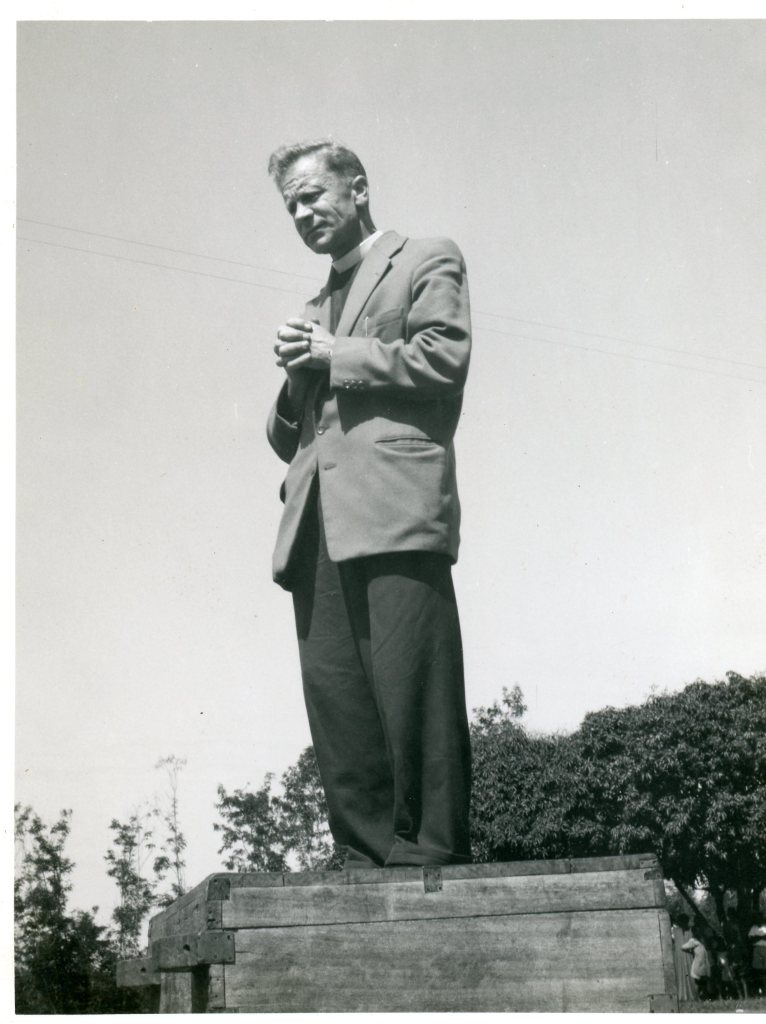
Fr. Kees de Cock was ordained July 6, 1947 in the immediate post war period, his studies interrupted by the German invasion of the Netherlands. An earnest young man, eldest son of a weaver, living in row housing adjacent to the textile factories of working class Tilburg, his only window to another world through the teachings of textbooks and priests, one would expect his views to reflect those of the immediate elders and surroundings.

Yet, I don’t know. How do I write about a life of which I have little understanding, about a time period distant and foreign or about a person who I met last as an eleven year old?

My attempt to delve into the mind of Uncle Kees has been informed indirectly through the experience and voices of his extended family in the Netherlands, of his fellow seminarians and priests, of people who worked with him in Uganda, of his parishioners from the church in Kamuli, and of archival documents buried in the libraries of the remaining Mill Hill holdings.

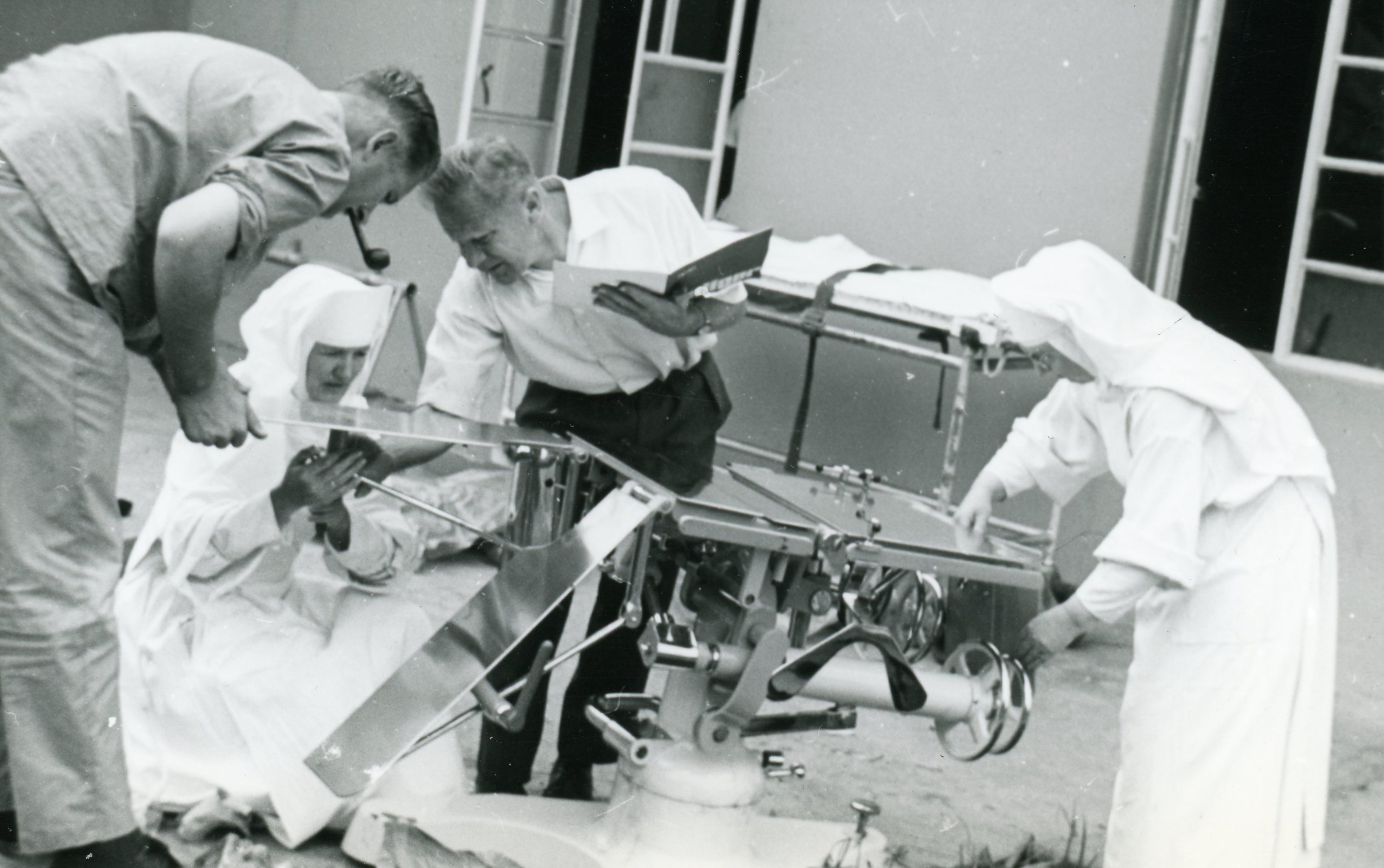
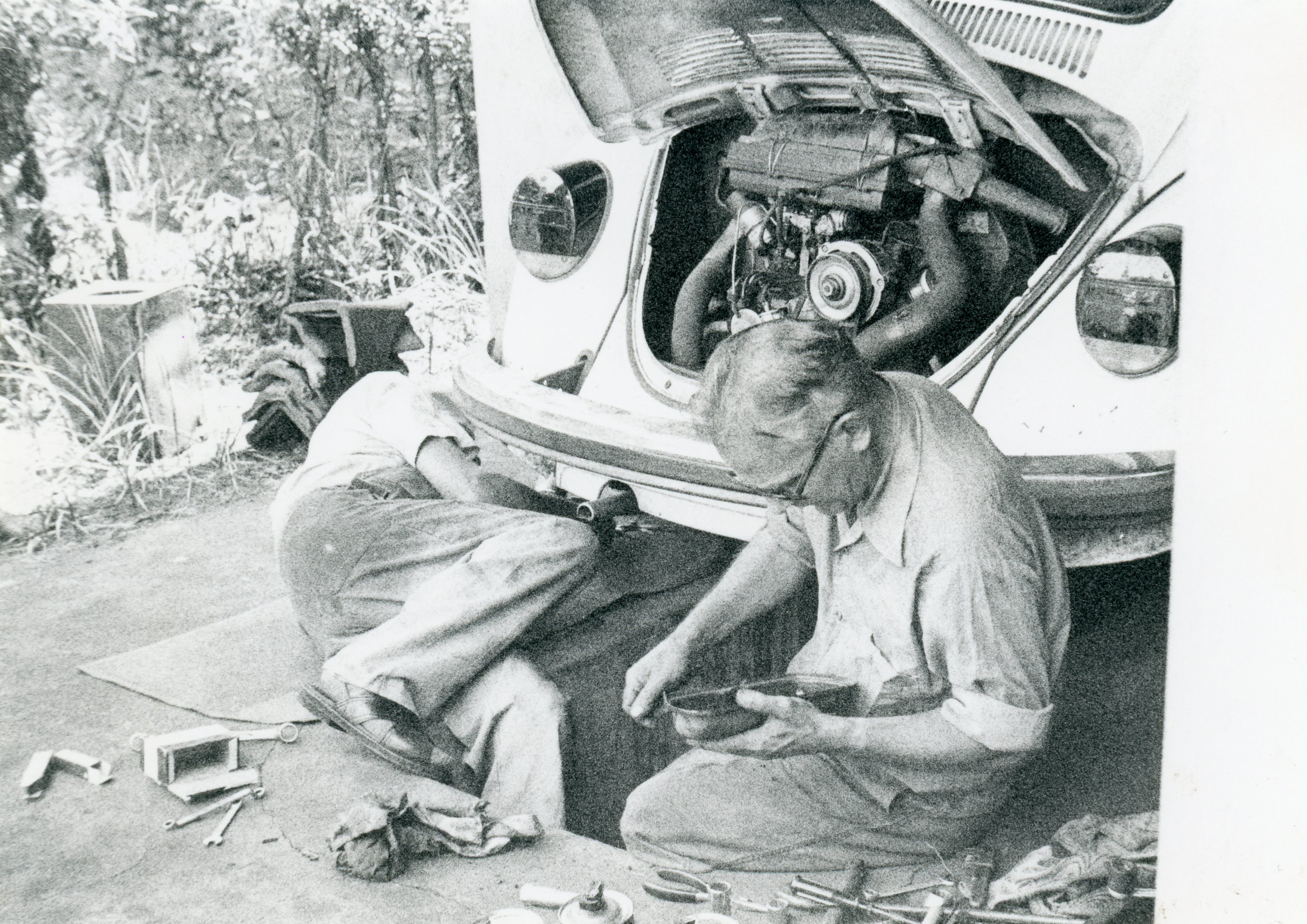
Fr. Herman Hofte was a classmate of my Uncle at the seminary and travelled with him to Uganda in December 1947. I stumbled upon an interview with Fr. Hofte as part of an oral history project of Dutch missionaries housed at Radboud University in Nijmegen, The Netherlands. Eventually I was able to acquire the 180 minute recording conducted entirely in Dutch, a dilemma since my level of understanding the language is rudimentary. Through another fortunate encounter, I have befriended Dr. Cees van Deursen, now retired, living in the Netherlands, whose first assignment as a young physician was to work in the mission hospital in Kamuli from February 1978 to March 1981. Cees agreed to listen and translate.

On the accompanying permission form, Fr. Hofte questions his own importance and wonders why the interest in his experience: You may skip me, it seems all very scholar like. I have not done anything special. I have no idea what to tell you in 4 – 6 hours. I am sure you can use your time in a better way. When asked, he could not formulate a concise reason for becoming a missionary, appearing to have evolved into the vocation after an initial feeling, recalling visitations and presentations from returning priests at his school. His attraction to Mill HIll was the apparent freedom in comparison to monastic orders. Once in Uganda, Fr. Hofte described the missionary work as conveying the message by example, being there when needed. His was a “welcoming” church to anyone interested. The teaching of the catechism did not focus on the moralistic but more about loving one’s neighbour. In his teaching and his actions, Fr. Hofte concerned himself more to the intention rather than the letter of the rules. Fr. Hofte’s own spiritual life was enhanced through the work of a practical person who put his trust in God.
In an earlier letter exchange with Cees, I had asked what he recalled as my Uncle’s approach to Catholic theology. Dr. van Deursen couldn’t answer directly except to compare Fr. de Cock’s approach to his own uncle. A Benedictine monk, he preferred working to praying, adapting St. Benedictine’s adage, “ora et labora” (pray and work) to ‘my working is praying”. My Uncle, according to Cees, operated in the same manner.
“I hope you enjoy reading this translation/summary [of Fr. Hofte’s recording] and that it helps you to picture your uncle, Fr. Dikoko. I think an interview with him would have been quite similar.”

In describing his own motivation for priesthood, Fr. Cor Schilder talked of his attraction to adventure, with a desire to get away from home, be heroic and save people from going to hell. Even when he was ordained, he still believed the best way to heaven is to be a Catholic. God, he said, has strange and different ways of attracting people, eventually molded them into His word. Clearly Fr. Schilder’s own thoughts about Catholicism were enlightened by his experience and listening to him expound on an alternative way of approaching religion made one believe again in the power of faith.

Fr. Schilder was very much impressed with letter from Fr. Joseph Willigers, the bishop, announcing my Uncle’s death in 1981. Fr. Schilder responded saying Fr. de Cock was a “hero” in the ordinary, in the everyday, reflecting the future of the church, less of a spectacle, more to being of the people.

Uncle Kees would have been a 100 years old 2022. Memory is what we want it to be, so I wonder how my ongoing research will alter the existing images. For now, however, I will think of him as being ahead by a century.

This is Why we Fight

As you may have surmised from my recent posts, music and lyrics comprise an important element of my thinking process. The train of thought travels in both directions where an action or a phrase sparks a song; and, a song will forever represent a person, a situation, an event. Images and music are intertwined, joyously, happily, memorably.

I cannot hear an ABBA song, especially I Believe in Angels without thinking of Olga with her trust in people and their inherent goodness; I cannot listen to Message in a Bottle without reminding me of a late night pizza run with Ron and his steadfast friendship; I cannot sing I Never Promised You a Rose Garden without memories of my mother’s life wisdom.

Now, the Russian invasion of Ukraine has engendered a darker realm of musical triggers: for fight, for struggle, for survival. The Decembrists anthem, This is Why We Fight, will forever be associated with Ukraine in their heroic battle to win the war inflicted upon them.

Come the war
Come the avarice
Come the war
Come hell

Come attrition
Come the reek of bones
Come attrition
Come hell

This is why
Why we fight
Why we lie awake
And this is why
This is why we fight

When we die
We will die
With our arms unbound

And this is why
This is why
Why we fight
Come hell

Bride of quiet
Bride of all unquiet things
Bride of quiet
Bride of hell

Come the archers
Come the infantry
Come the archers
Of hell

So come to me
Come to me now
Lay your arms around me
And this is why
This is why
We fight

Come hell
Come hell
Come hell
Come hell

President Zelensky addressed the annual Grammy Music awards. His words spoke of music and musicians, of citizens and soldiers, of the need to continue fighting, of the need for uninterrupted support.

Our loved ones don’t know if we will be together again. The war doesn’t let us choose who survives and who stays in eternal silence.

Our musicians wear body armour instead of tuxedos. They sing to the wounded. In hospitals. Even to those who can’t hear them but the music will break through anyway.

We defend our freedom to live, to love, to sound. On our land we are fighting Russia which brings horrible silence with its bombs. The dead silence.

A victory for Ukraine, for the people, for democracy, for the rule of law, for self determination, for freedom; this is why we fight.

Waka* this way

The sun shone brightly

On our daily morning walk

The first day of spring

Of flowers we now can talk

Songs of birds, small tufts of green

Signs of hope before unseen

* a Japanese poem consisting of 31 syllables in 5 lines, with 5 syllables in the first and third lines, and 7 syllables in the others.

Blowin’ in the Wind

March 20, the 25th day since Russia invaded Ukraine, and the war rages on. Closing in on four weeks and the images of destruction accumulate, worsening, disturbing.  Each morning I wake to read the BBC news feed on the latest developments, peruse the stories in the Globe and on the CBC, scroll through Facebook. Today Bohdan shared yet another collage of the devastation, this set from  Mariupol. The scenes are unimaginable.

Olga too is consumed by the war, following events, reading the stories of bravery, of determination, of courage, of heartbreak. We just finished listening to Andre Rieu introduce a Ukrainian singer at a March 1st concert in the Netherlands. “Music puts people together”, he said. “If the world would make music together the world  will be a better place.” The problem is that Putin is tone deaf and sings from his own sheets.

Olga discovered a Spotify playlist of songs about the war in Ukraine, some new, some original songs of the partisan army, some remakes to capture a new generation. Occasionally she sings along with the words, taught by her father who fought in the insurgent army for an independent Ukraine, as tears roll down her cheek. I don’t understand the language, yet the anguish, the commitment, the sorrow is clear.

Daily images of the atrocities confound a belief in progress, of learning from our past, of faith in the process. The Peter, Paul and Mary version of Blowin’ in the Wind is the song on continual play in my mind.

How many roads must a man walk down
Before you call him a man?

How many seas must a white dove sail
Before she sleeps in the sand?

Yes, and how many times must the cannonballs fly
Before they’re forever banned?

The answer, my friend, is blowin’ in the wind
The answer is blowin’ in the wind

Yes, and how many years must a mountain exist
Before it is washed to the sea?

And how many years can some people exist
Before they’re allowed to be free?

Yes, and how many times can a man turn his head
And pretend that he just doesn’t see?

The answer, my friend, is blowin’ in the wind
The answer is blowin’ in the wind

Yes, and how many times must a man look up
Before he can see the sky?

And how many ears must one man have
Before he can hear people cry?

Yes, and how many deaths will it take ’til he knows
That too many people have died?

Dead bodies are placed into a mass grave on the outskirts of Mariupol, Ukraine, on March 9. (Evgeniy Maloletka/AP)

The answer, my friend, is blowin’ in the wind
The answer is blowin’ in the wind

Vietnam, Afghanistan, Iraq, Palestine, Georgia, Yugoslavia, Syria.

Ukraine.

And how many times must we sing this sad song,

Before the music is no longer played?

The answer, dear world, is take some action now,

The answer is take some action now.