Welcome to my world. Whether it be the documentation of some family history, a stop on the train of thought or a travel to parts of the globe, this blog is a reflection of the sights and sounds and thoughts of my interaction with it.
The Ones Beatles show began with three questions for the Roy Thomson audience:
Where were you when John F. Kennedy was shot? Where were you when man first landed on the moon? Where were you when the Beatles played the Ed Sullivan show for the first time?
November 22, 1963. I have no clue, the tragedy not registering for at least another decade. July 20, 1969, 10:56 pm. I was asleep on the floor in front of the television. My parents had allowed us to stay up to witness the historic event except I could not keep my eyes open, relying on replays on the CBC news in the following days.
However, images of the Ed Sullivan show which aired February 9, 1964 flash into my head, the four lads from Liverpool, live, barely heard above the din of screaming fans. I would have been only 3 years, 9 months, most likely in bed, an improbability that I could remember anything from such a young age. Yet, the visual persists. Was the memory a function of repeated broadcasts years later? Did we own a television given that my parents took out two mortgages to buy the house on Kostis Avenue? My mother had always been a woman fascinated with gadgets, interested in acquiring the latest, particularly in appliances. The infancy of mass television programming would have been the experience she craved as a stay-at-home mother of three boys under four, the proof of succeeding in a new land, what her siblings back in the Netherlands would not have owned.
As the program proceeded, nostalgia overwhelmed me. The band performed, in order, the songs of the Beatles which reached Number One on the American Billboard Hot 100. Photographs displayed on the screen accompanied the note-for-note rendition beginning with “I Want to Hold Your Hand,” which vaulted to the top spot on February 1, 1964, remaining there for seven weeks. I recall the song being a favourite for Mom.
I could hear her voice singing to each subsequent hit.
She loves you, yeah, yeah, yeah She loves you, yeah, yeah, yeah
Say you don’t need no diamond rings and I’ll be satisfied Tell me that you want the kind of things money just can’t buy.
When I’m home everything seems to be right, When I’m home feeling you holding me tight.
Baby says she’s mine, you know She tells me all the time, you know She said so I’m in love with her and I feel fine
Hope you need my love babe, Just like I need you. Hold me, love me, hold me, love me.
After 1966, it was time for intermission. Her voice continued to play in my mind. We have a tendency to forget our parents were young once. Mom listened to the radio, and she loved to sing out loud to the latest, and the Beatles were the band of the 60s. I don’t recall her being as fond of their studio albums from 1967 onwards. Those songs I eventually discovered on my own.
It was her recitation of the words while engaging in the necessary tasks of parenting, focusing on the lyrics of love, of family, of home, that evoked the memory of that historic Ed Sullivan show.
I watched it, I remembered it, through my mother’s voice.
We were delayed in leaving for our very first trip together.
Not thinking, our car was left unlocked, exposed to the shenanigans typical of weddings at the time; confetti jammed into the air vents, Vaseline smeared on the steering wheel, the door handles, the gas tank. It all had to be cleaned before we could drive away for a five day honeymoon. A resort in the Caribbean or a European vacation was not in the cards. We did not have the money for that kind of a trip, nor could we afford the time away from work and from school.
We left without concrete plans except to stop briefly in Ottawa before our destination, Quebec City, because it was the closest we could experience that old world charm. It would be a trip we could manage given our constraints. We did not confirm any reservations in advance, thinking we would find something at each stop. And those were the days without the luxury of GPS, necessitating a reliance on paper maps and signs and intuition to guide our way.
We decided on a scenic route to Ottawa in order to view as much of the fall landscape as possible. A picnic along the route meant we needed to find a motel in Renfrew.
In Ottawa, we hoped to meet with Fr. De Witte, a friend of the family who helped my parents and other Dutch immigrants in the London area. He had moved to the nation’s capital to continue priestly work comforting patients in hospice care. When we finally arrived at the home of the Priests of the Sacred Heart, we were greeted with joy. Fr. De Witte was a priest who understood life beyond the strict doctrine of Catholic church rules and blessed our marriage in the accompanying chapel. Our wedding ceremony was complete.
We found a motel in Ottawa, outside of the downtown, which appeared suitable on the surface only to exude a cold and dank and gloomy atmosphere on the inside. At three o’clock in the morning, Olga insisted we could not stay any longer, there was something spooky about the room. She needed to leave immediately. I did not think it possible to check out at such an ungodly hour. By 3:30, we were back on the road, navigating unfamiliar streets until we escaped the city limits. The highway sign proclaimed 250 km to Montreal when I looked across the bench seat. Olga was asleep. It was a quiet drive, mostly highway, until 7:00 am. I waited until we were on the other side of the island before nudging Olga awake – “Good morning, Sunshine. Time for coffee and breakfast.” Next stop: Quebec City.
The Chateau Frontenac was beyond our price range, so we settled for a boutique hotel within its shadow. The room was typical, albeit on the smallish side, queen bed, dresser with a television, overlooking a small park, where we watched the miserable weather on that first day. No problem. There is a ball game on the TV – parlez-vous francais – and we brought our own popcorn maker.
Bombs bursting in air, first pitch, rain delay – want some more popcorn – seventh inning stretch, extra innings, home run for the victory.
We wandered the streets the next day, taking in the shops, sampling the delights, surveying the crafts for an appropriate souvenir, toured the Citadel, and strolled the Plains of Abraham. It did not matter what we did.
Off-season meant much fewer people, no crowds to battle, easier to get a reservation at a fancy restaurant. I don’t recall the name or the location, but I distinctly remember that it had more waiters than customers, each one performing a specific function. They did not come back with the change when I handed over the cash. I guess they were accustomed to generous tippers.
Our time was up by Saturday, back on road home at 6:00 a.m., for a non-stop drive to the Toronto Airport to wish Ron safe travels to New Zealand. Then, the last stretch of the 401 home to the apartment on Victoria Street.
The trip came to an end, the honeymoon would go on.
It would be 14 years before our next adventure, this time to Europe, with some semblance of a plan – The Netherlands France and Belgium; Tilburg, Paris, Bruges; the Efteling, the Eiffel tower, the Normandy Coast – by car, with our kids, just a map, and only one reservation.
We haven’t stopped traveling since – lounged in the Caribbean on the French side of St. Maarten; bounced around the islands of Greece; toured the golden triangle of India; safaried in Tanzania and Botswana; rode the San Francisco trolley cars. Halifax, Puebla City, Barcelona, Washington D.C., Cape Town, Budapest, Amsterdam.
We are anticipating a train ride through Italy, a walk along the Camino Primitivo, a cruise through the far East.
We may finally set forth on that California road trip to watch baseball.
Or we will spend another night at the cottage watching the sunset and eating popcorn.
“I am going to work. Some of us have a job, you know!”
I suppose that is an excuse to rush into a left-hand turn while someone is crossing the road on a green. I had just stepped into the intersection as the walk signal began its countdown. He saw us. How could he not; I was with Odin, our big fluffy white dog in the lead. I am sure it was an intimidation tactic. He was thinking I would relent to let him zoom past. He didn’t know he was dealing with a college boy who once patrolled the picket line as a faculty member. Just keep walking. They won’t ram you. Most of the time.
The window was open of the non-descript car, a 30ish driver staring in disgust. I looked at him directly and pointed to the illuminated signal, “You know that is a walk signal,” His angry retort followed. I kept walking.
If only he had given some kind of warning to let me know he was on his way to work, a light atop his vehicle perhaps, lit up to declare his intention, I might have relented to shave off ten seconds from his journey. Mind you, the other vehicles behind were probably on their way to work as well, given the time of day. I would need to let them all pass and wait for the next light, hoping there isn’t another string of vehicles going to work needing to make a left hand turn. Serves me right for taking my dog out, crossing a busy street on a work day during rush hour. What was I thinking? I can venture outside at any time so as not to inconvenience this harried, poor working soul. I am guessing he has another 35 years of waiting for pedestrians to cross at the stoplight before he can barrel down the road, late again.
At first, I was peeved, thinking of missed responses to this entitled piece of…. But no. I am thankful. Later, when I needed to run an errand with my car, I found myself being more conscious at the intersections, watching for people on the corners, driving with more care, allowing vehicles to merge when they signaled, not cursing when my patience meant waiting my turn. His lack of consideration brought out mine.
I also want to thank him for the compliment. Clearly, my appearance is one of an able bodied male, working age, capable of being gainfully employed rather than living off the system. How was he to know I have been retired for four years, having put in my time, continuing to pay taxes, still using my purchasing power to keep people like him employed. I am thankful he didn’t view me as that stereotypical elderly man and his dog, biding my time. He made my day.
I am grateful for my good health, my wonderful life, and the means to engage in activities of my choosing on my time.
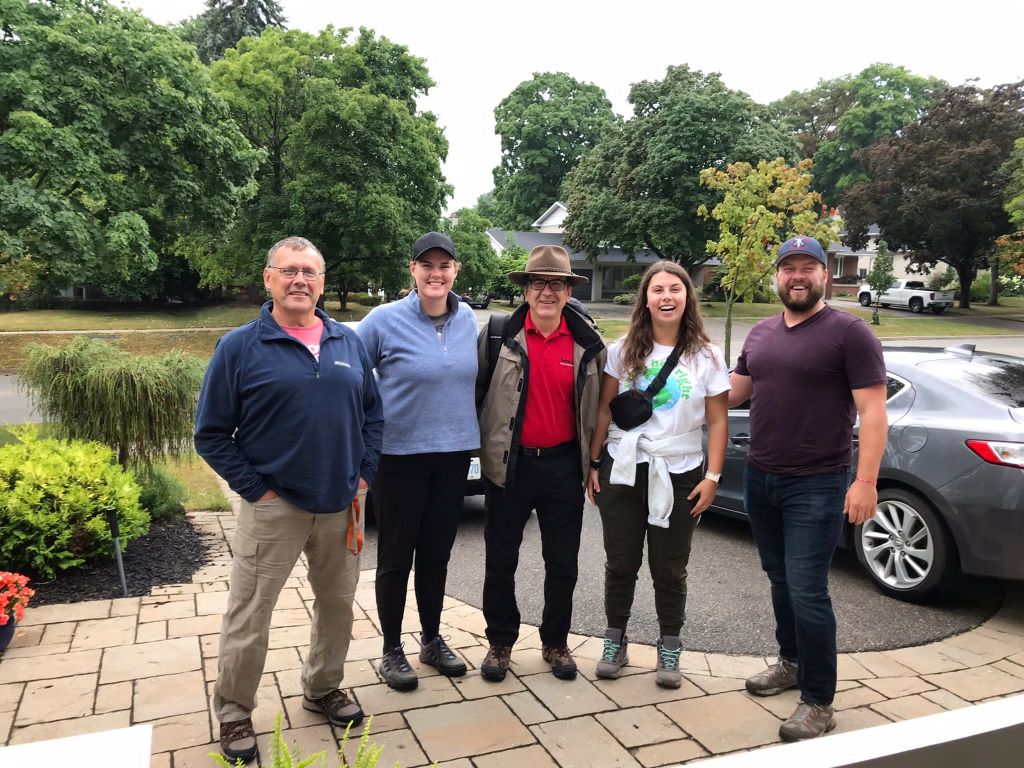
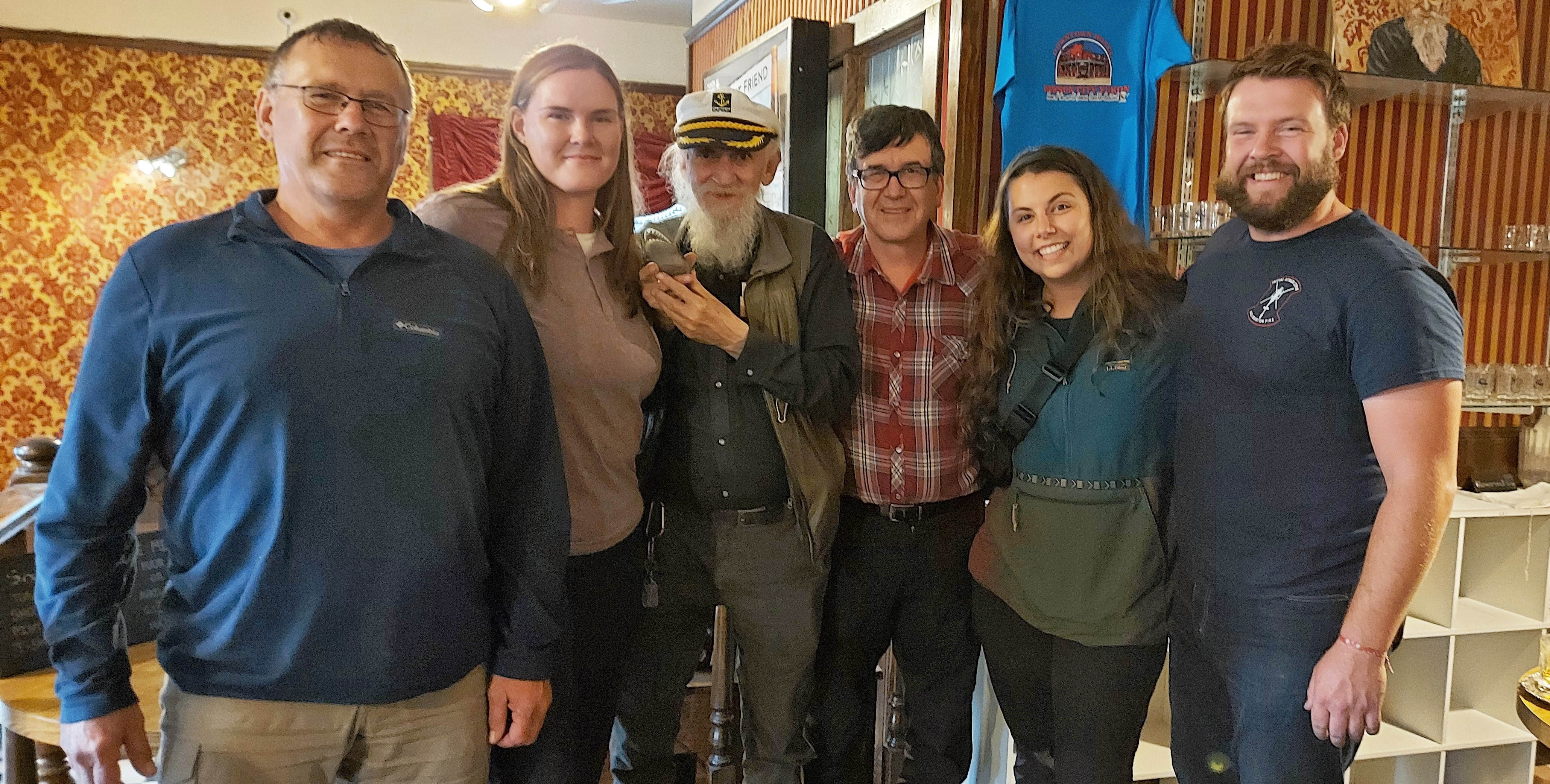
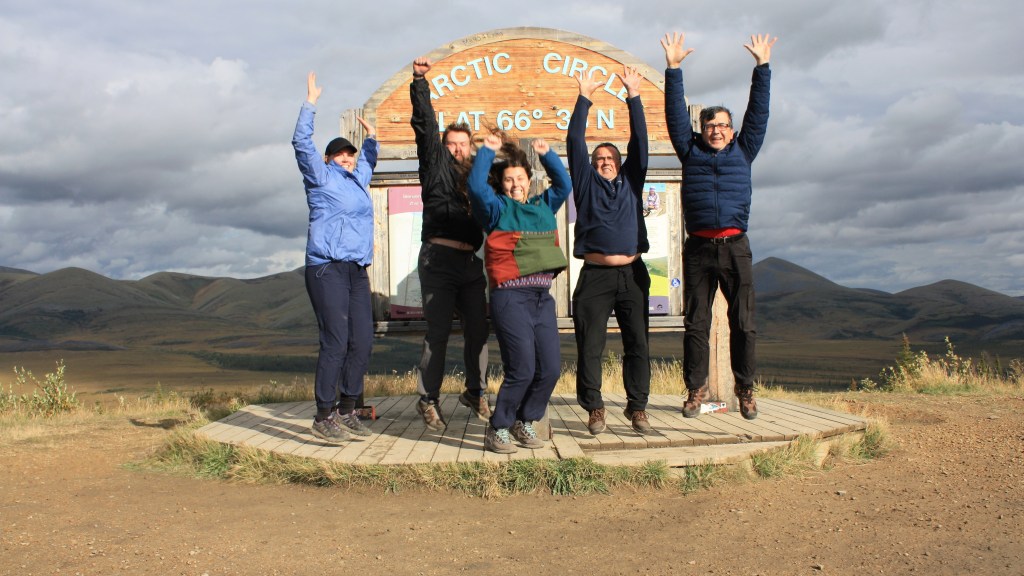
The five of us were together again, dressed in different gear, celebrating the beginning of another journey, cherishing the memories of our previous adventure to the Yukon almost two years ago to the day.
August 17, 2024August 21, 2022
Emily is the bride in the 2024 picture, and the person responsible for the planning of our Yukon adventure. Peter is Emily’s father, my younger brother by thirteen months. Zachary is Peter’s son, eldest of five other siblings. Rachel is Zachary’s partner. And by process of elimination: me.
I felt fortunate to have been invited. Peter and I had been musing about travelling to the north. He is more of a camper; I wanted to experience the environment before it was gone. They approached me after another person dropped out. I jumped at the opportunity. The plan was to fly into Whitehorse via Vancouver, drive to Dawson City, then up the Dempster Highway, camping in Tombstone and north of the Arctic Circle, back down to Kluane National Park, before heading to Whitehorse for the flight home. It would be a combination hotel/camping adventure by SUV. I brought a camera stand for those group photos of everyone together in places where there would be no one else to do the favour. It would be a trip to remember.
I remember arriving in Whitehorse and watching a beautiful red fox scurrying through the parking lot, thinking we are going to see four footed animals of all kinds in our journeys. We saw none save for that same fox who came to say goodbye when we left 10 days later.
I remember that first night at the infamous 98 Hotel, where the locals drink and hang out, a number taking their turn on the music stage and one noticeably drunk woman, tight dress, platform laden feet, tinkling on the piano, turning to me, pointing, “Don’t you f@&k with me red shirt”.
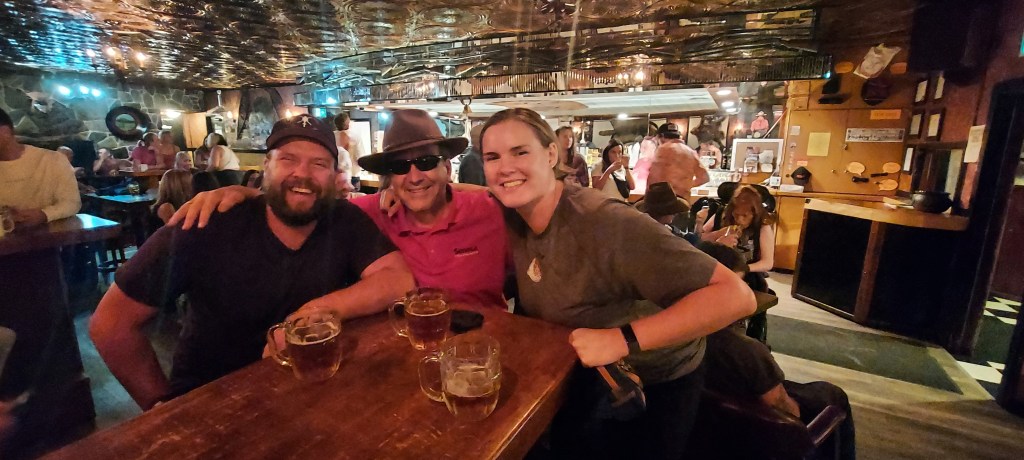
I remember the 98 had just two kinds of beer, draft, including our soon to be favourite Yukon Gold, purchased only in cash from a middle aged waitress who brought over a round, cleaned my glass and said “Now you can say you got your bottom wiped at the 98”.
I remember the night to be an excellent beginning to our Yukon adventure.
I remember packing the vehicle, crammed with equipment and people, thinking we will have a long eight more days on the road. I volunteered to sit in the middle and discovered the view to be one of the better and made for wonderful camera pictures through the front windshield.
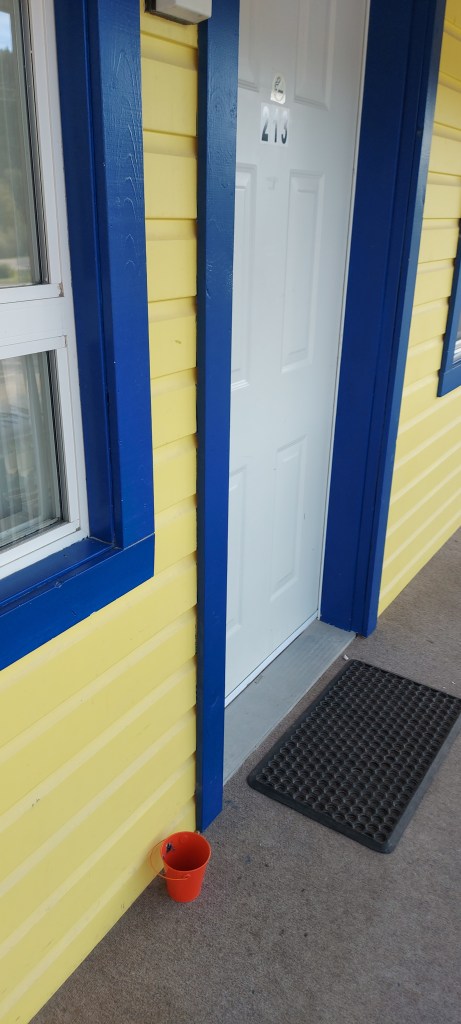
I remember that first motel, the Bonanza, two levels, located on the outskirts of Dawson City because everything else was booked. The can for cigarette butts on the floor outside each door was the added feature one received for the inflated price of the room.
I remember Dawson City resembling a living museum with long abandoned buildings intermixed among local and tourist businesses on dirt streets lined with wooden sidewalks, harking back to the gold rush days to the turn of the 20th century.
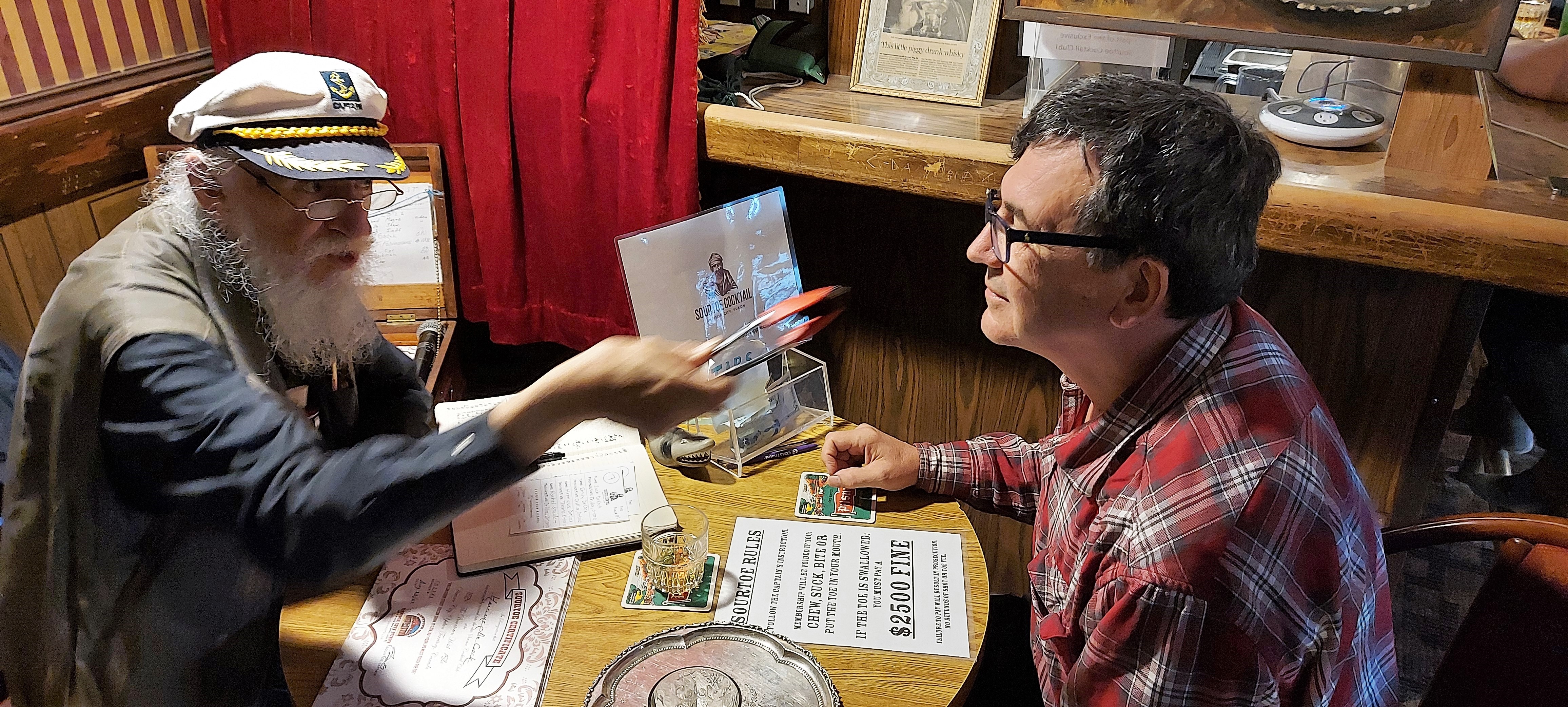
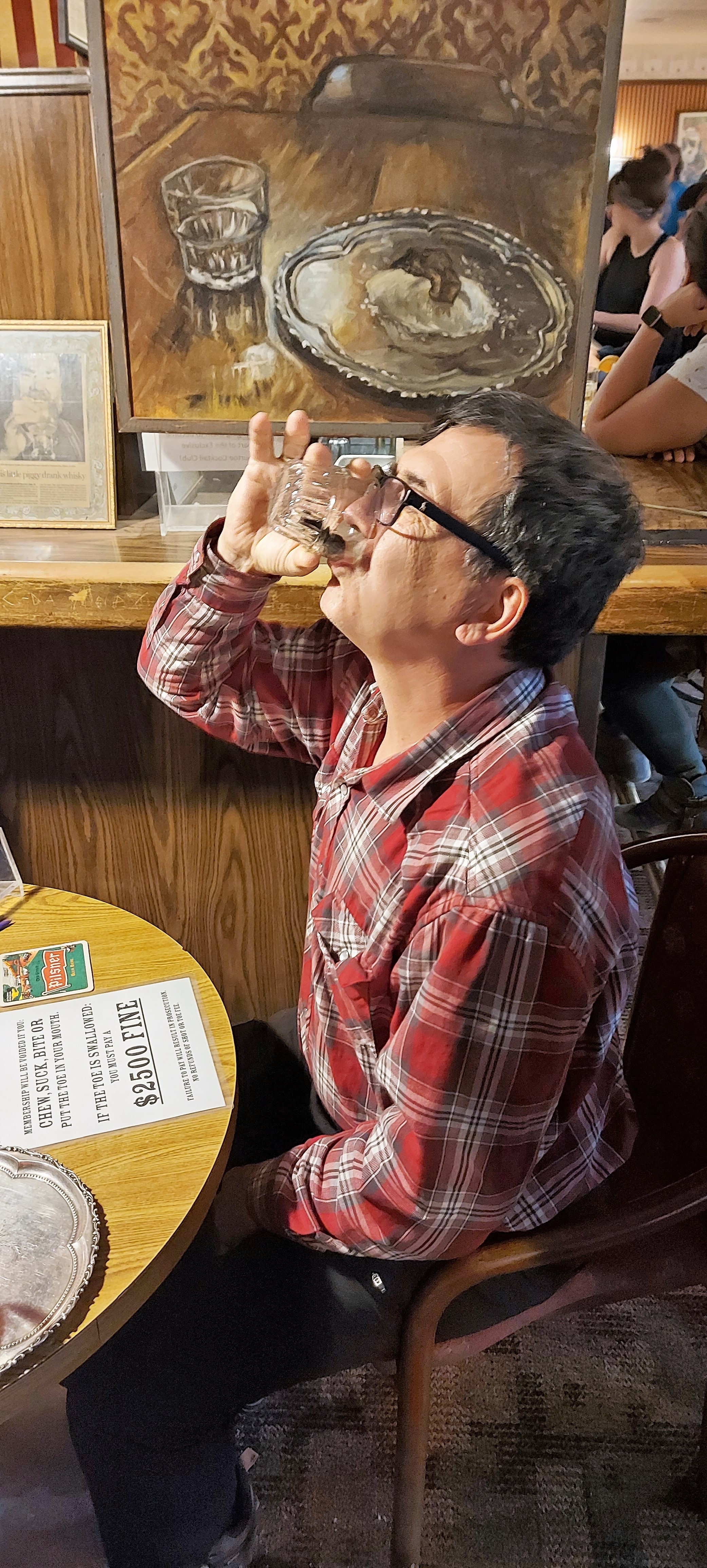
I remember agreeing we must all participate in drinking the sour toe cocktail, overseen by the Captain who hailed from Orillia. He undertook his responsibilities seriously, repeating those same words to each brave soul, signing your certificate and posing for pictures with his pet shark.
“You can drink it fast, you can drink it slow, but your lips have gotta touch the toe”
I remember finishing the evening at the Pit, Dawson’s oldest bar, on the recommendation of a waitress if we wanted to drink with the locals, but warned us not to take any pictures if we intended to leave unscathed.
I remember the first time my tripod came in handy as we posed for the cover of our upcoming album, should we decide to make one.
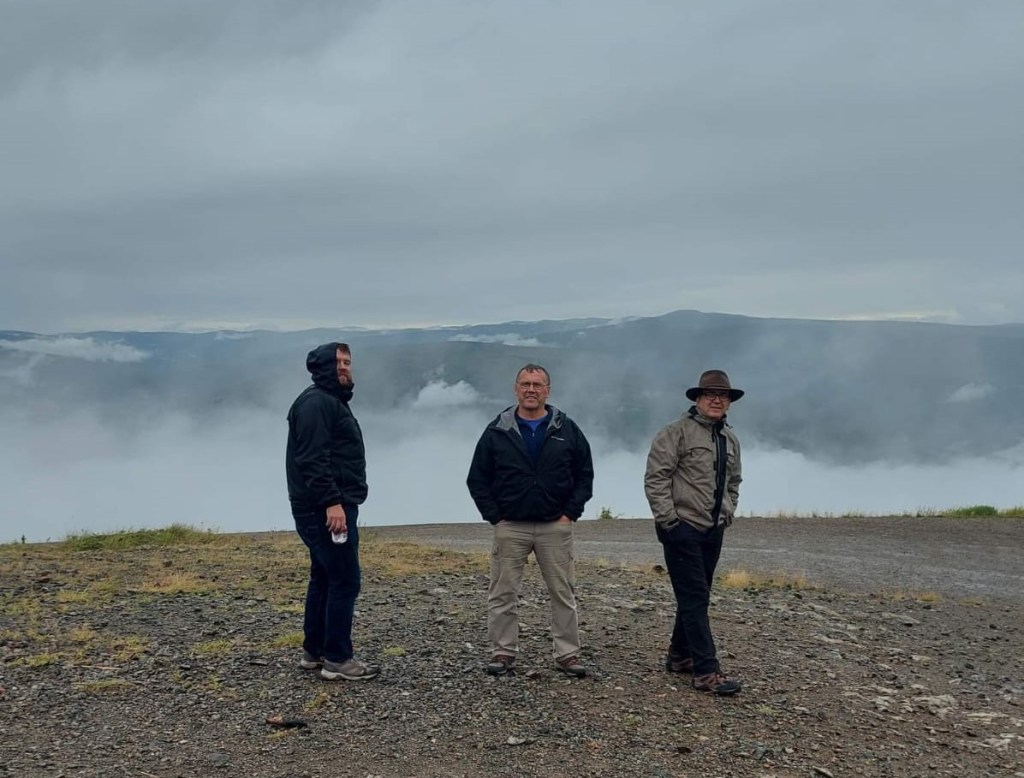
I remember standing atop a hill, overseeing Dawson City, after the rain, above clouds parading around along the paths of the river, as if inhabiting another world.
I remember stopping to savour the world’s largest cinnamon buns enroute to our next destination. The leftovers tasted great with coffee three days later.
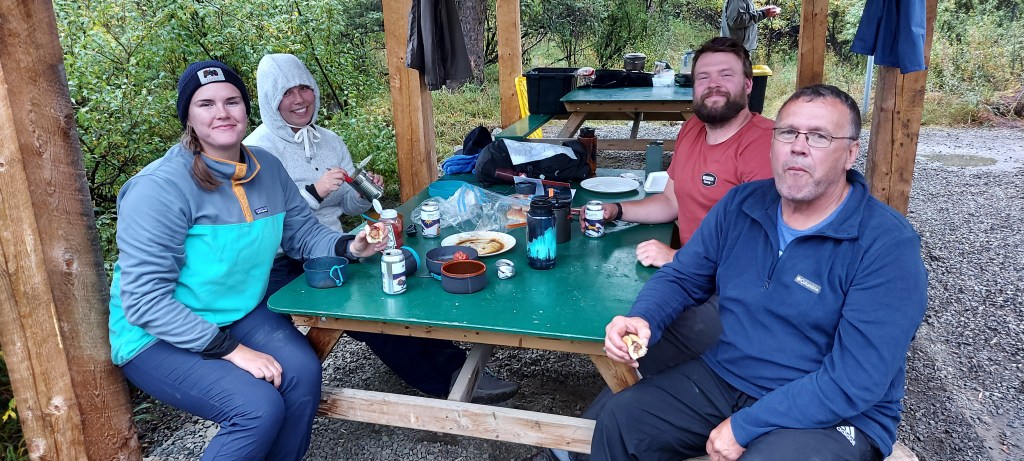
I remember the first wet and cold days in Tombstone, camping, cooking our gourmet meals of sausages and beans, eating out of cans because it saved dishes.
I remember walking up this long hill to a site which I no longer recall, in the pouring rain, heads down against the wind, determined because we might never come back.
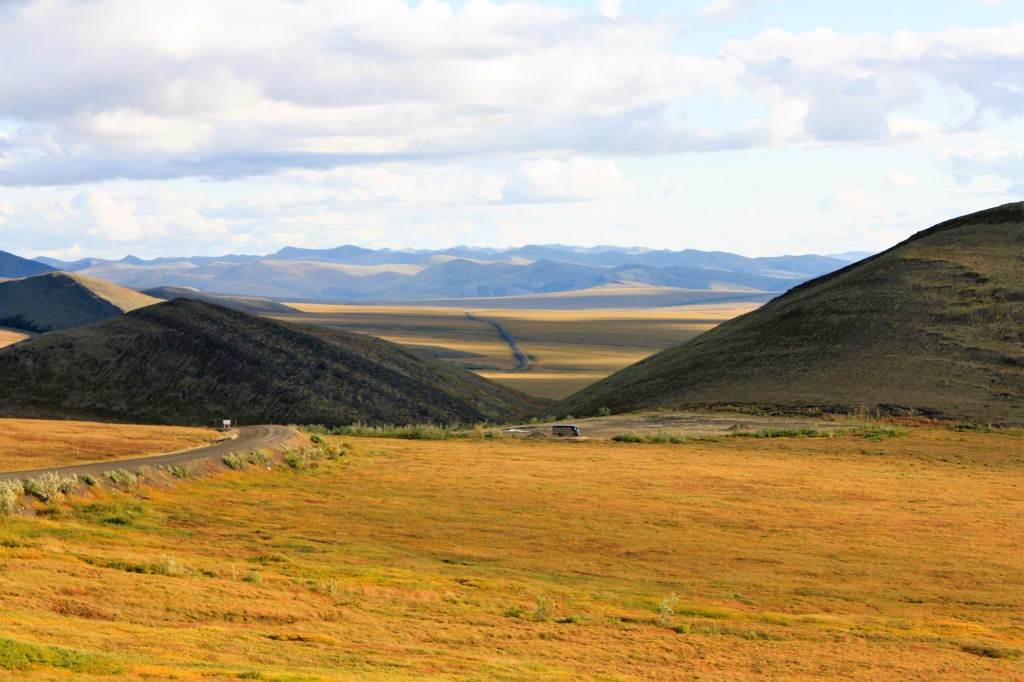
I remember the drive up the Dempster Highway, hard gravel, wide open spaces, vast expansive skies, thinking to myself this was unlike anything else I had ever seen all the while listening to the Pukka Orchestra sing, You’re disappearing in the distance, Of this alien terrain.
I remember taking my turn behind the wheel just to be able to say, “I drove the Dempster Highway”.
I remember the excitement of reaching the Arctic Circle.
I remember that first cold night, camping, north of the Arctic Circle, staying up late because Rachel was convinced the conditions were right to catch the Aurora Borealis. We kept looking to the sky, trying to stay warm, eventually crawling into our sleeping bags without witnessing a flicker.
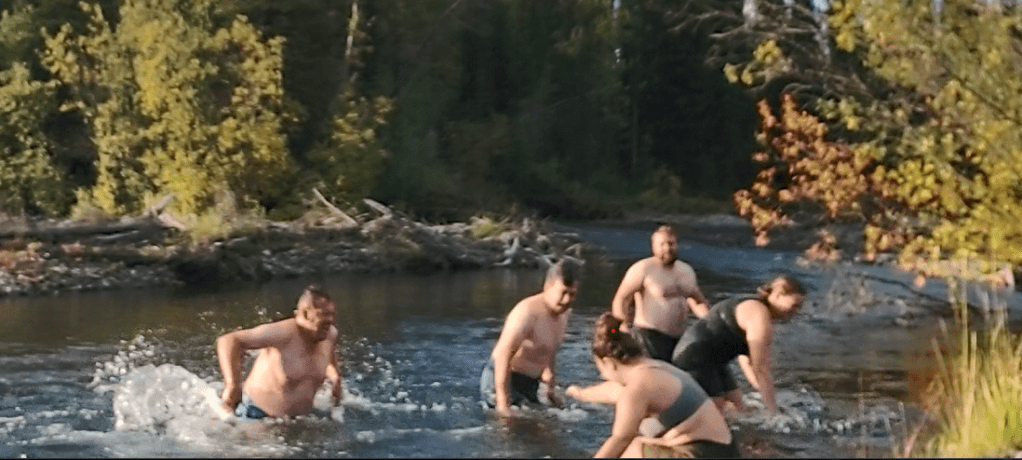
I remember standing in the frigid waters of the river, with just my shorts, shivering, saying to myself, “I can’t do this”, before finally dunking below the surface with everyone else because we all committed to go “swimming” north of the Arctic Circle.
Screen shot from the video – proof of our “swim”.
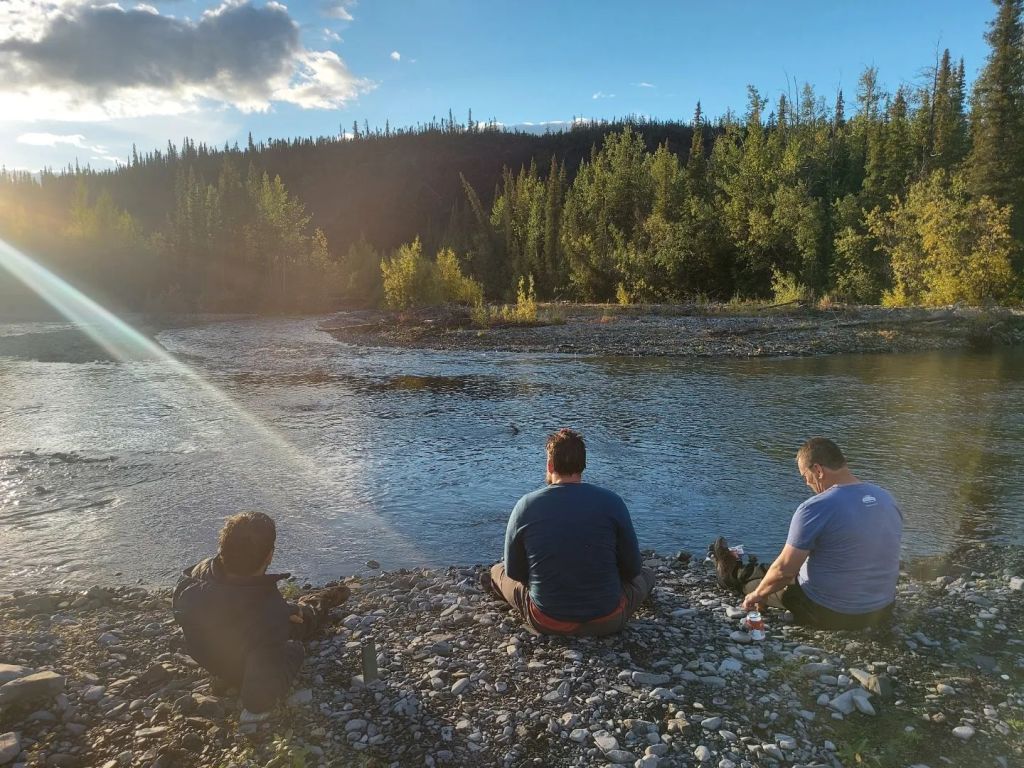
I remember lounging on the shore afterwards, sipping from my flask of Yukon gin, thinking, “We did it”.
I remember the drive south, same route because the Dempster Highway is the only road, soaking in the same spectacular scenery, snapping pictures at every turn, because we could not believe our eyes.
I remember the beauty of Kluane National Park, the stark contrast of the Carcross Desert, the mountainous road to the British Columbia border. We had traveled the full length of the Yukon Territory.
I remember fishing along a quiet river, off the main highway, on a barely passable road, away from everyone and everything.
I remember a silent ride back to the airport.
I remember thinking Peter and Zachary and Rachel and Emily were the perfect companions for this Yukon adventure.
I remember wanting to come back, needing to come back, to drive all the way to the Arctic Ocean next time.
I remember the words to perhaps the most inspired tune on our Spotify music list, playing over and over in my head:
I might as well be on Mars I’m already that far away from you.
The recent passing away of Alice Munro and the subsequent scandal reminded me of a story.
I was Chair of General Education, a department responsible for teaching English and Liberal Studies to students in all programs. The diploma requirements for graduation included completion of at least one literature course, a bone of contention for many, and the subject of numerous complaints.
On this particular occasion, a couple sat in my office to lodge a grievance against the professor teaching Canadian literature. They showed me a short story that depicted a sexual encounter. I read it, thinking to myself the passage contained vivid descriptions, not graphic, well written. Then, I turned to the beginning of the story to discover the author was the famous Alice Munro.
I attempted to explain how she was a well renowned author, not just here but around the world. (She had not yet won the Nobel Prize for literature.) They didn’t know and didn’t care. They wanted some action taken to stop the purposeful spread of perversion. The professor was eventually exonerated.
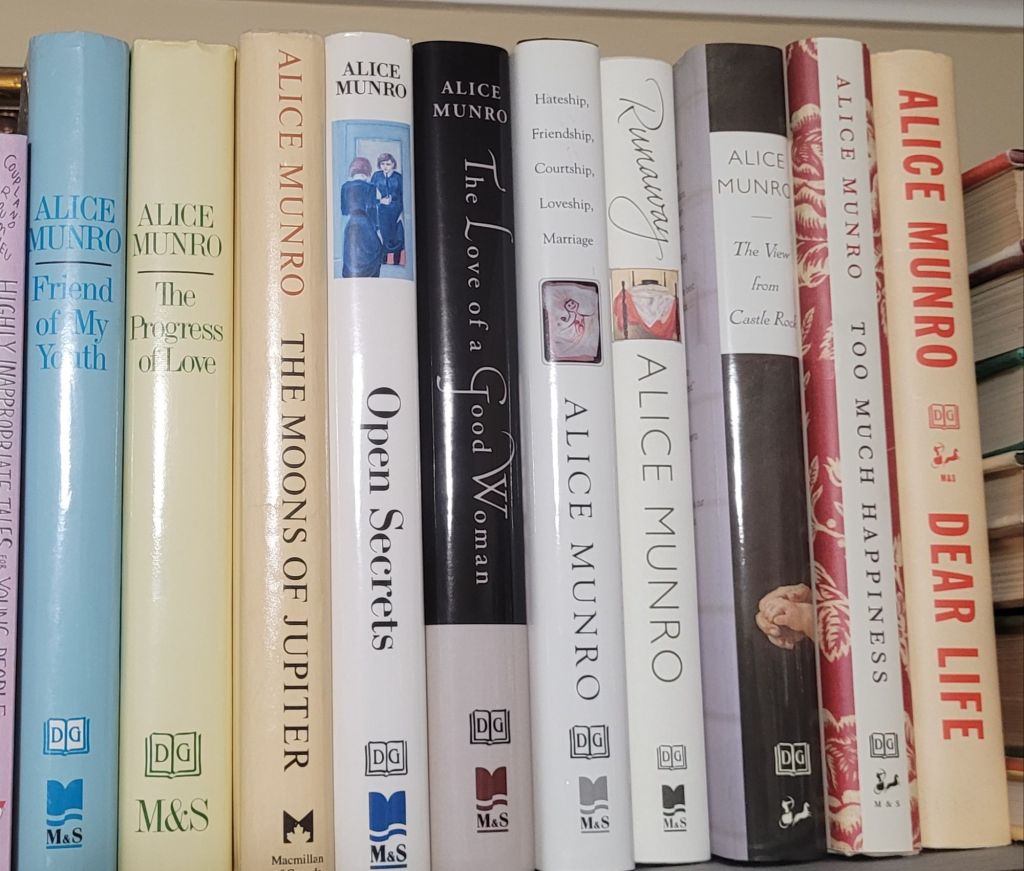
True confession: I have never read a complete book of Alice Munro despite owning ten first printings of her short story collections. It is not my favorite genre and besides, I have 1,265 other books, primarily novels, on my shelves, of which I have completed half. Maybe.
Ten of Alice Munro’s fourteen published works.
I have always been an avid reader of all genres. As a young teenager I was plowing through movie books – Jaws, The Toweing Inferno, The Omen; biographies of hockey players and hockey stories – Derek Sanderson, Bobby Orr, Hockey Showdown: The Canada-Russia Series ; true crime stories like Helter Skelter and selected political biographies such as The Northen Magus. In later years I began gravitating to literature, paperback classics I could pick up cheap at the second hand bookstore.
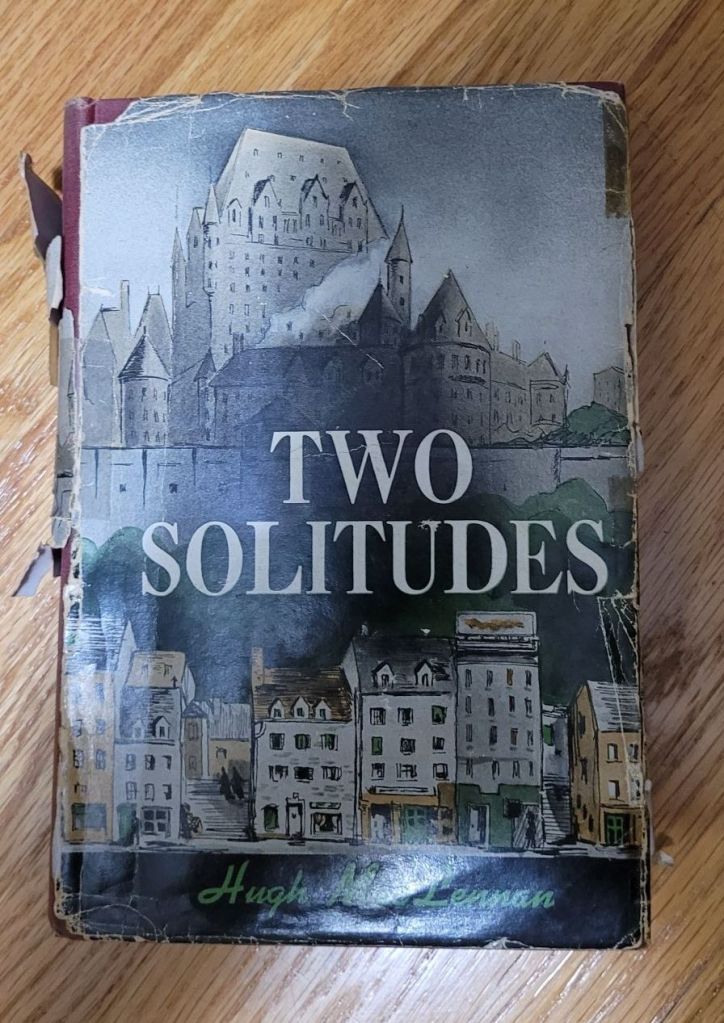
My foray into Canadian literature began with a used hard copy of Hugh MacLennan’s Two Solitudes, a primer of English-French relations in Canada. I kept searching for his other works, discovered The Watch that Ends the Night from my high-school English course, and eventually acquired every one published by the Governor General Award winning author. I did read them all.
A tattered first printing from 1945.
Robertson Davies was next, although his early works were difficult to find and expensive. Margaret Atwood, of course, and Douglas Copeland and Alice Munro. The turning point to my near obsession happened in 1994 with the first awarding of the now annual Giller Prize. It became the largest monetary prize for Canadian literature, catapulting the winner to the top of the sales chart and rendering books as sexy. The Book of Secrets by M.G. Vassanjii was the inaugural winner. I managed to acquire only a second printing but the purchase was the beginning of a need to obtain the Giller winner each year and all the other nominated works.
I was aided in my “hobby” of buying books by two colleagues and friends, Mark and David, who consumed even more. They did not limit themselves to only Canadian, broadening to highly reviewed American and British writing. The discussion sometimes amounted to a series of one upmanships – “I have the first printing of Michael Ondaatje’s The English Patient.” “Yea, well, I have a signed copy.” “But do you have a signed British version where it was first released.” We also shared our love of reading, exchanging our discovery of new authors.
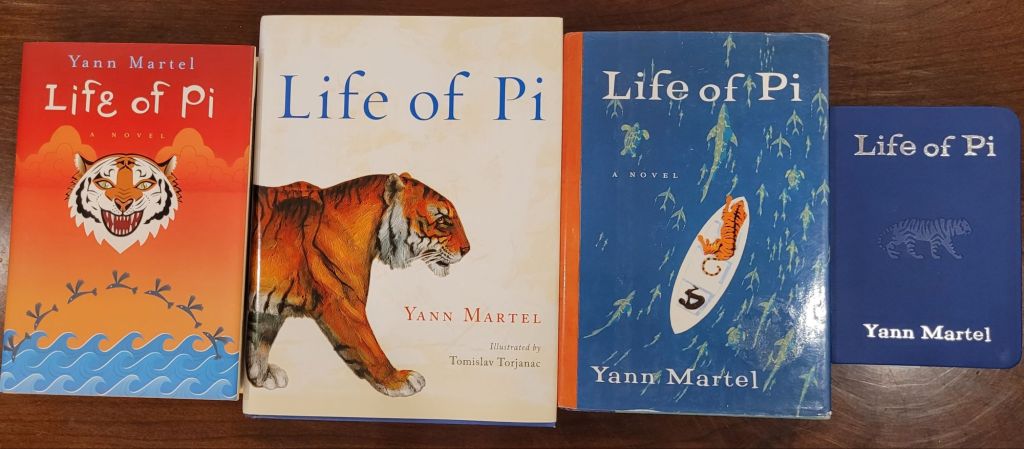
My jewel in the crown is a signed, first Canadian printing of Yann Martel’s Life of Pi, winner of the Man Booker Prize in 2002, turned into a movie in 2012 winning four Academy awards, translated into over 50 languages. I pulled it off the bookstore shelf, by chance, thinking to myself that I seemed to have read a review, didn’t recognize the author, but since it was signed, I should purchase it. Now I have the signed, illustrated Canadian and American edition and the American first printing. It is probably the single most valuable book on my shelves, should I ever decide to sell my collection.
The different versions of Life of Pi in my collection. The one on the left is the first Canadian printing, 2001
Did you know Lawrence Hill’s Book of Negroes was published in the U.S. as Someone Knows My Name ? Yes, I scoured American airport bookstores during my work travels. I have found the first U.S. printings of Miriam Toews’ All My Puny Sorrows and Alex Ohlin’s Dual Citizens. I have done the same in Dutch bookstores and was excited to stumble upon De Gebroeders Sisters by Patrick De Witt.
Dutch translation of The Sisters Brothers
Okay, if you are still reading, I can imagine your eyes rolling back, thinking Henry has a problem. He can’t read Dutch. This “hobby” had become an obsession. Where does he keep all these books? Olga would ask the same question, even stating we need a new house every time I returned home with yet another. It is cheaper to buy another shelf and leave money left over for more books.
Compounding my addiction, I taught Nicholas and Olena how to identify a first printing. The book may be a first edition, but still be a second or third or heavens forbid a double-digit printing. They wanted to buy books for me as gifts. The first step, I strongly suggested, was to peruse the bookcase before considering. There was a good chance it was already in the collection. In the month before Christmas, I was not allowed to buy any books. In the meantime, I pulled out the pages of the Globe with its top 100 books for the year, circling the ones that were not yet on my shelves.
Signed copies of the first printings are the most treasured. I would attend book launches so I could purchase one directly from the author. If a favorite author was reading at a book festival, I would bring copies of every title I owned for a signature. In the case of Helen Humphreys, I mailed a box of her books to an art store owner in Kingston, an apparent friend, so he claimed, promising to send them back….and he did!
Don’t think I am simply name dropping big time authors and their famous novels. There are plenty lesser known works – Douglas Ord’s Tommy’s Farm, Richard Scarsbrook’s Cheesburger Subversive, Margaret Sweatman’s The Players – bought because they could be popular some day. Maybe. Hopefully.
I have slowed down since retirement, deciding to focus on my favorite authors, understanding the limitations of this hobby, obsession, addiction. I have begun reaching back into the early years, cracking open previously unread novels. My interests now include memoirs, hoping to improve on my own craft, learning the art of writing, aiming to publish my own some day.
I have come to realize, in retrospect, how much of the world I have discovered and the people I have met, past and present and future. I have survived the slums of India, endured the Chinese cultural revolution, sailed the Drake passage, washed ashore on a Greek island, suffered the indignities of a reserve, scrounged for work during the depression, and marauded through an apocalyptic America. I have lived the life of a soldier, a mother, an artist, a boxer, a Mennonite, a miner, a cowboy, a refugee, a slave, and a priest.
“A literary work is thus a living and ever-fruitful text, always capable of speaking in different ways and producing an original synthesis on the part of each of its readers. In our reading, we are enriched by what we receive from the author and this allows us in turn to grow inwardly, so that each new work we read will renew and expand our worldview.”
LETTER OF HIS HOLINESS POPE FRANCISON THE ROLE OF LITERATURE IN FORMATION
I used to be embarrassed to talk about the number of works in my collection. Not anymore. I view my books as a window into the lives of others, a reflection of my own, a gift to be shared.
Let me know if you are interested in a recommendation or wish to borrow one.
My book collection became accessible again so I began a slow survey of those shelves which had been blocked for a couple years. I happened upon a thin memoir entitled, alfabet/alphabet, winner of the Governor General award in 2022. It reminded me of a specific passage forever stuck in my memory because it explained a particular image of my parents. I flipped through the pages in search of the exact words.
In the Dutch city of Tilburg, Ria van Dijk has made an annual visit to the shooting tent of the kermis, the travelling fair, for more than three quarters of a century. With unfailing aim, she has fired the air rifle, and activated a mounted camera that takes a portrait of her and whomever else is inside the frame. p. 113.
Instantly I understood the context of that endearing photograph of my dad engaged in the same activity, mom at his side, probably in 1956 or 1957, before their marriage. I sought it out again amidst the number of other photographs documenting my mother’s life in the Netherlands.
The kermis photo, circa 1956/57
The author, Sadiqa de Meijer, a Dutch Canadian born in Amsterdam, continued to describe the series of photographs by Ria van Dijk, how they represented the change in fashion of those who “stand on the photo”, marked the passage of time and the aging shooter/photographer. I began a trip down a rabbit hole searching on-line for the book of images, hoping to discover the ones taken in the 1950’s to compare directly to this one of my parents. Eventually I uncover a few, and at least one from that time period, thinking the material would form the content of a blog posting. I abandoned the idea because I could not envisage the outline. There wasn’t a story no matter how you looked at it.
Nevertheless, I was enthralled by the kermis photo, staring at the screen, commenting out loud how little I know of my parent’s courtship. I know vaguely how they met; I know when they married; I know they left for Canada two weeks later; I know they landed in Montreal and rode a train to London, Ontario before departing for their first rented apartment in Belmont because a “girlfriend” of my mother lived there.
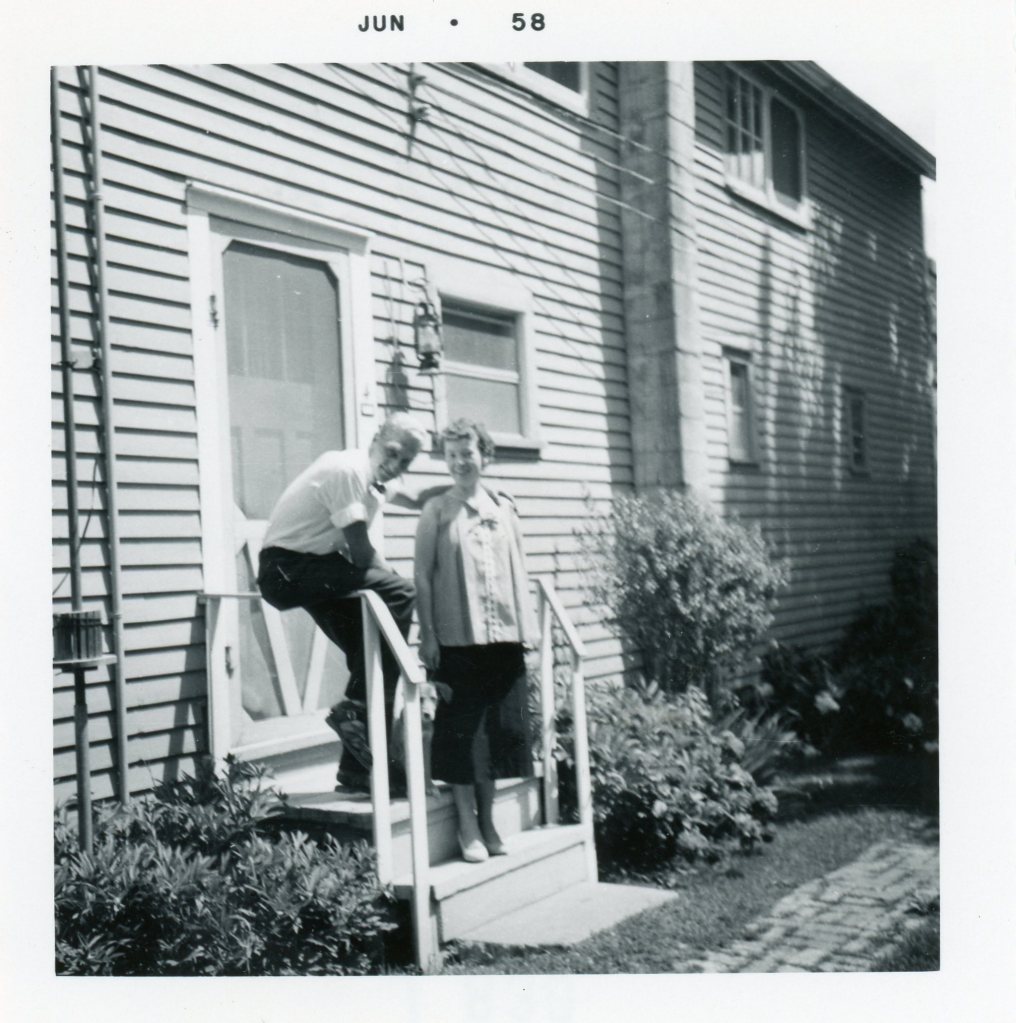
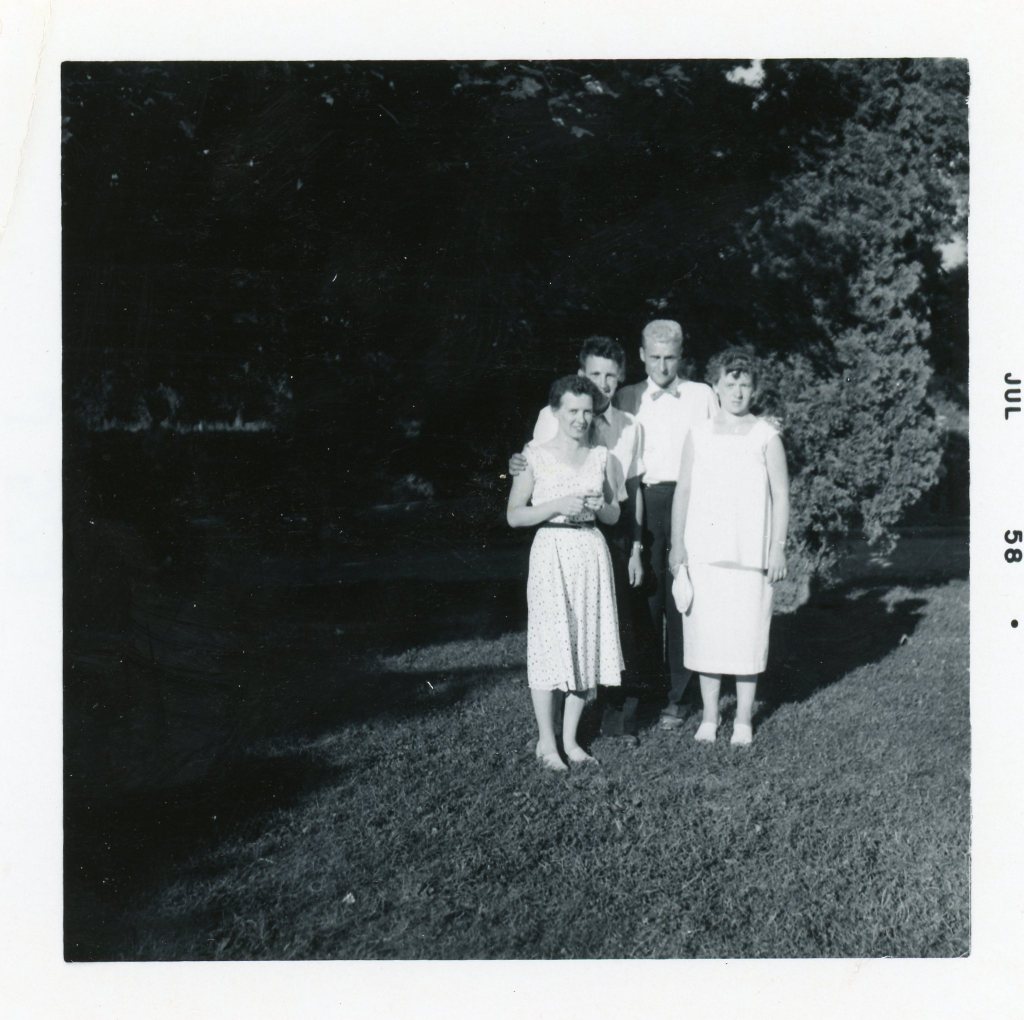
Is that couple standing behind my mother’s right shoulder in the kermis photo the same as the couple in the Belmont pictures? Were they on a double date at the Tilburg fair? I zoom in on the woman, the man, then scrounge through the “early years”, revisit the black and white photographs from 1958 to approximately 1963, starting with Mom and Dad’s arrival in Canada. A couple who clearly live in the same building are featured in numerous images, sometimes alone, others with my parents, sharing drinks and smokes and laughs. They are not the couple in the kermis photo.
Belmont, 1958. The unnamed couple.
The man, however, looks familiar. The blond hair, the angular nose, taller than everyone else. Is he the person standing behind my father, dressed in a suit looking directly at the target, looking more Dutch than Dad? A closer look at several more Belmont photos confirm the discovery; but who is this “blond guy”, what is his name, how is he related? I begin searching through my mother’s nursing years, looking for the face of the woman in the Belmont pictures thinking Mom’s “girlfriend” would have been a fellow nurse from either school or work, who had accompanied the “blond guy” but was outside the frame of the kermis photo.
I identify a few possibilities focusing on the short curly hair, the round face, the smile. Olga is my second set of eyes. Enlarge the picture, flip between the two time periods; nope, that is not her. The look is different, the face too thin, the mouth crooked. We cannot find Mom’s “girlfriend” among the nurses. Maybe the “blond guy” is really a bud of Dad, so I embark on another search through his photo album, the navy years and the handful of his twenty-something period. No, the “blond guy” is not there either. Maybe he is not the same person in the Belmont pictures; possibly I am scurrying down another rabbit hole, probably imagining a story that never existed. The pictures remain on the computer screen, left for another day, for another perspective, in need of a fresh pair of eyes.
A new day, a new look, and suddenly there he is, or more precisely, there they are. By chance I had been perusing my mother’s album and had left it open to a photograph used in an earlier post about the ubiquity of smoking. That photograph from Breda in 1957 shows my parents posing with an unidentified couple except now I recognize them as the pair in the Belmont photographs of 1958. It is the “blond guy” in the kermis photo and Mom’s “girlfriend”.
Breda, the Netherlands, 1957Belmont, Canada, 1958
Immediately, I begin reviewing Mom’s pictures, yet again, but with a different set of eyes. The “blond guy” does not show up save for the two already identified. The “girlfriend”, on the other hand, is more prominent than previously thought. Is she the one in the wedding dress in between my parents? The makeup and the attire can be deceiving but the eyes and the mouth look like the “girlfriend”. The placement in the photo album lends credence to the possibility and now on closer examination, some photos which I had mistook for my mother are more likely her “girlfriend”. There she is peaking through the snowy branches, with that coat, which shows up again standing on the beach, looking at the photographer, staring out on the water. With clearer glasses I can see the vacation at Wiijkaan zee was actually a girls trip in 1953, not a secret rendezvous, repeated again in 1956 to Zoutelande. I now believe some of the images during Mom’s time at Nicholaas hospital in Tilburg, previously dismissed by me, include her “girlfriend”, laughing and smoking and drinking, sharing in the comradery of nursing colleagues.
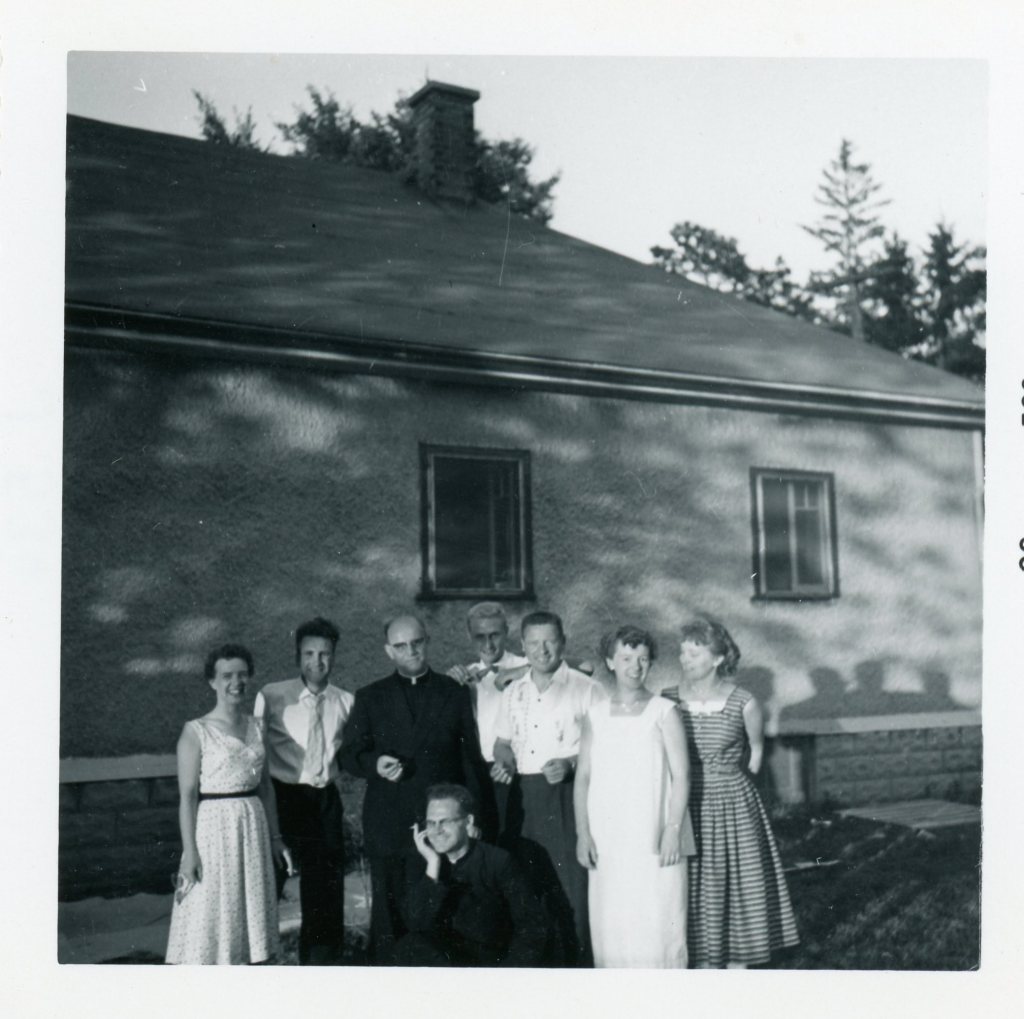
A new story emerges and with it another mystery. Mom appears to have known this “girlfriend” since 1953 at least, attending her wedding, double dating at the kermis, leaving the Netherlands in the same time period, meeting up to share an accommodation in a new land. There are pictures at the Delaware picnic hosted by the Fathers of the Sacred Heart specifically to support Dutch immigrants. Mom and Dad are with the couple, the “blond guy” and a “girlfriend”.
Mom and Dad on the left. Father De Witte standing and Father Aliens crouched. The “blond guy” and the “girlfriend”. The third couple looks to be Janus and Joanne Gooyers, life long friends.
They appear to have been happy, joyful times. Olga and I even believe the “girlfriend” is pregnant given her attire and mildly puffy face.
And then nothing. There is not another picture involving the “blond guy” and the “girlfriend”. They disappeared without a name, without another mention, without a trace, except it was the reason my parents settled in Belmont in 1958. By 1959 Mom and Dad are in London seemingly without the “blond guy” and the “girlfriend”. How does a person who warrants six individual photographs in my mother’s album, kept all these years, vanish from a person’s history? Another story, another mystery? Or maybe not.
One could go down another rabbit hole chasing explanations. The couple could have moved back to the Netherlands, not an uncommon response for immigrants missing family, especially when you are starting your own. Witnessing my mother’s stubbornness and her ability to hold a grudge, there may have been a falling out which was never repaired. Or it may be as simple as moving away to another town, far enough to make excuses as life gets in the way with children and jobs and stuff. They may have unwittingly drifted apart, not knowing how to bring themselves back together.
Were one to look at my wedding pictures, the same questions could be asked about some of the individuals in the photographs.
On the last evening of our Netherlands adventure, it was time to recount the events of the two week trip. Glass of wine in hands, Olga, Bohdan, Danya, and myself, were asked to identify our highlight. The response was swift although difficult to reduce to only one.
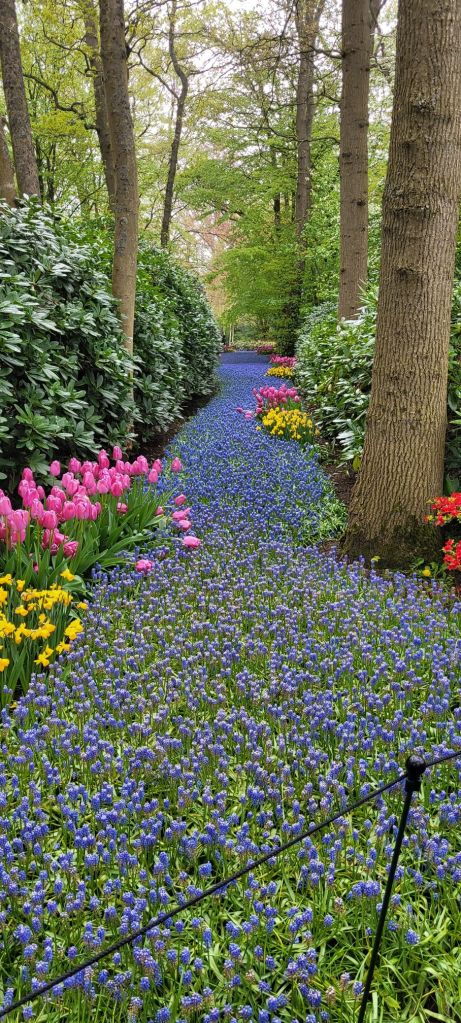
The Keukenhoff with its magnificent display of spring bulbs in artistic splendor throughout a vast park of lush greenery topped the list. Our timing to the northern part of the Netherlands was intended to coincide with the accompanying flower parade during the prime of the annual festival. This year, 2024, was the 75th rendition of the 47 km. long extravaganza.
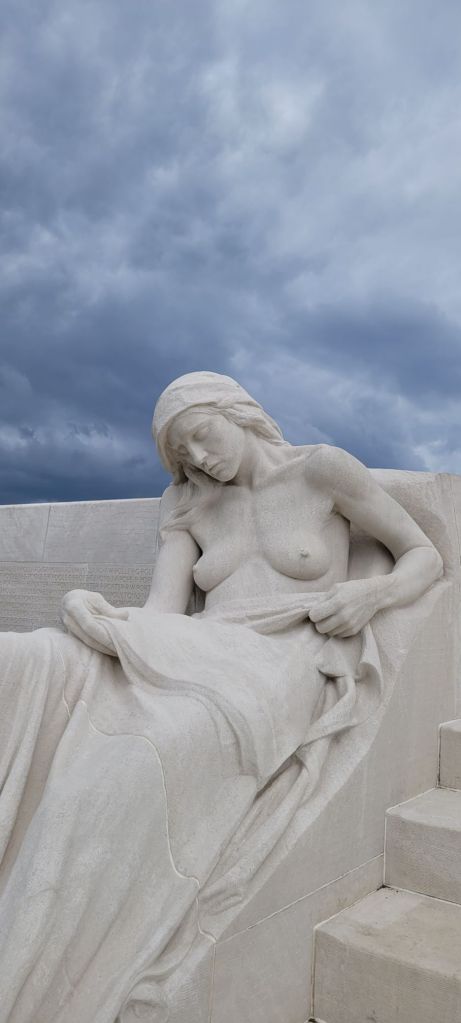
The pilgrimage to Vimy Ridge was next, site of Walter Allward’s stunning memorial to the 3,600 Canadian lives lost in a pivotal battle of WWI that helped define the country. Each step towards the massive monument induced another look upwards to the heavens, the destiny for the fallen, their names permanently inscribed at the base below.
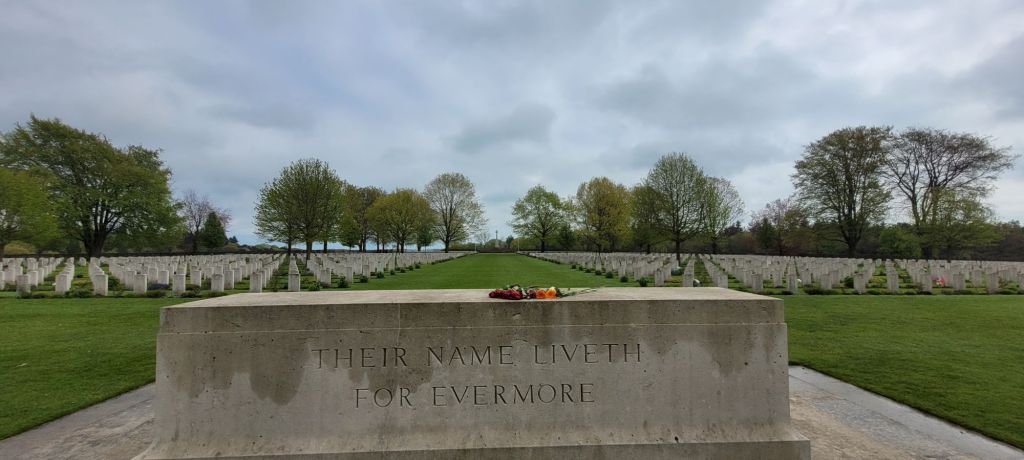
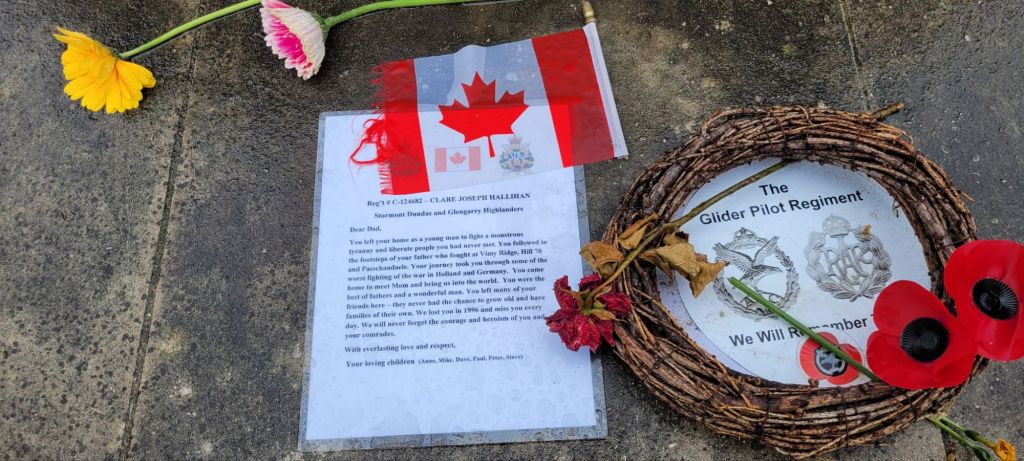
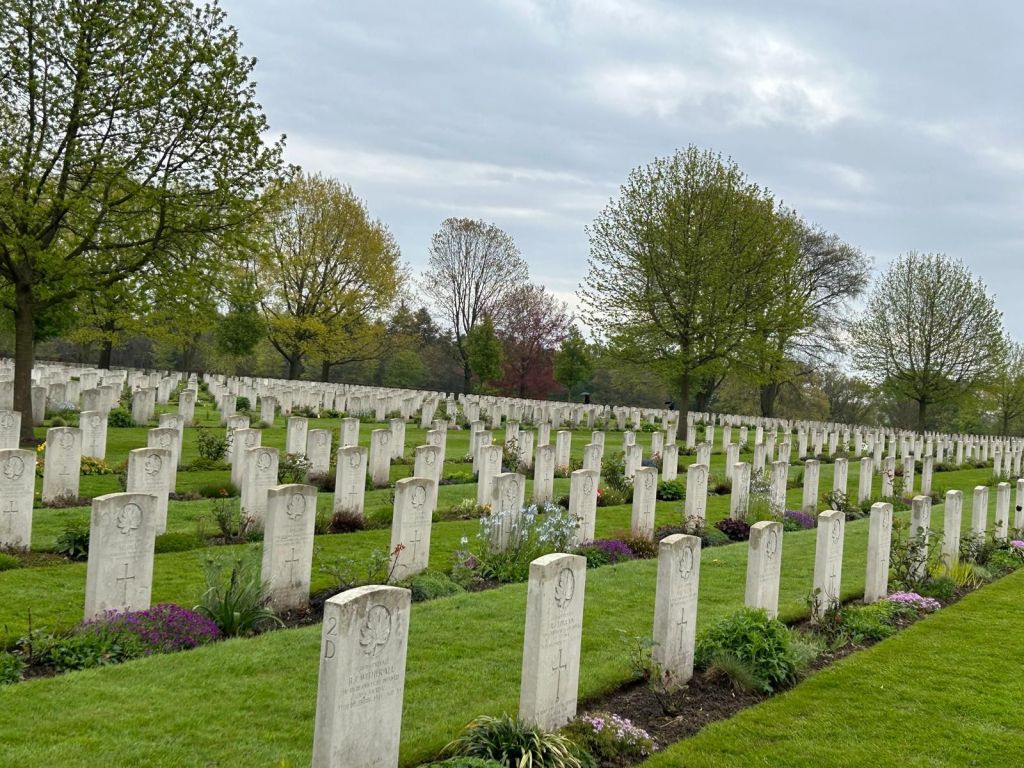
Then there was the solemn visit to the Groesbeek Canadian War Cemetery, homage to the soldiers that liberated the Netherlands in World War II, just outside Nijmegen with its understated stones, personalized with the messages of grieving families. “Some Time, Some Where, We will Understand”.
I relished all of these places and more, enjoyed viewing them again for a second time, recalling earlier trips with Nicholas and Olena, with Dad, driving through the countryside from one site to the next. The cumulative experiences remind me of the history, the culture, and the beauty of this part of Europe. Yet, for me, the most memorable, the highlight of this trip, was meeting with a number of cousins over dinner and drinks and stories and song. For those able to attend, the conversation flowed in Dutch and English, picking up where we had left off eight years prior, everyone a little older, families growing up, parents since passed away.
Remember when? Do you remember? I remember.
Riet pulled out her parent’s photo album after dinner at her home in Tilburg. She had digitized the content to share with her siblings after their mother had passed away. I began flipping the pages, intently staring at each, attempting to recognize members of the van Rooij family, specifically scouring them for my mother.
And then I discovered this one.
Ages at the time, from left to right: Nico – 18; Jozef – 28; Ria – 23; Herman – 31; Piet – 21.
It is 1951, two years after the first flower parade, six years since the end of World War II; the country is rebuilding, dormant lives brought back to life. A time for hope, a time of youth, a time when the future is yours, when the possible was real.
Smiling faces of siblings relishing the moment, enjoying each other. Mom in the middle, Herman to her immediate left, the oldest of the surviving children, Joseph on her right. The youngest, Nico, is one bookend; Piet, Mom’s favorite, in uniform as part of the obligatory military service, is the other.
Mom would have been embarking on her nursing career, a secular vocation, never having considered service to the church, unlike all her other siblings.
1953
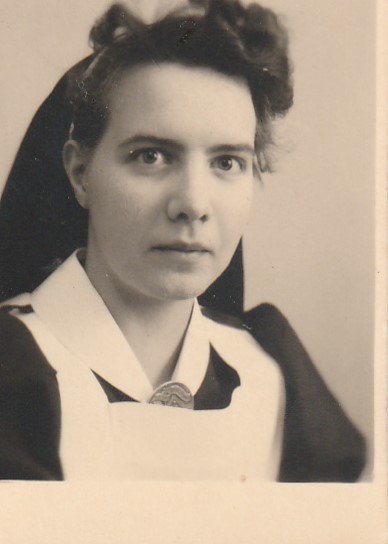
A headshot of her in the nurse’s uniform, adorned with the medal, is also part of the photo album. She would have been in her 25th year when it was taken. Subsequent images suggest it was the year of graduation. Official looking, an outward pretense to seriousness, quietly restraining a smile, eyes of accomplishment, a look of achievement, The future was beginning.
I now have my own digital copy
My Dad’s side of the family was represented by the children of his oldest sister, the van der Wiel clan, and Henriette, from his youngest brother, hosted at Margaret’s house in Waalwijk. I strained to keep up with numerous exchanges across the table, loud and boisterous, full of enthusiasm. My rusty, limited Dutch enabled a general understanding, sometimes acting as an interpreter, occasionally responding with a butchered Tilburgs phrase. Suddenly Geert breaks out into song, explaining my Dad was the originator, a ditty he learned while in the Navy. Did I know it? Did I remember?
The past was further explored when I showed him the pamphlet, in Dutch, commemorating Uncle Kees’ ordination. Harriet was giving it to me as a gift. The others had never seen it before. They sang the tunes, laughed at the songs. They needed to have a copy.
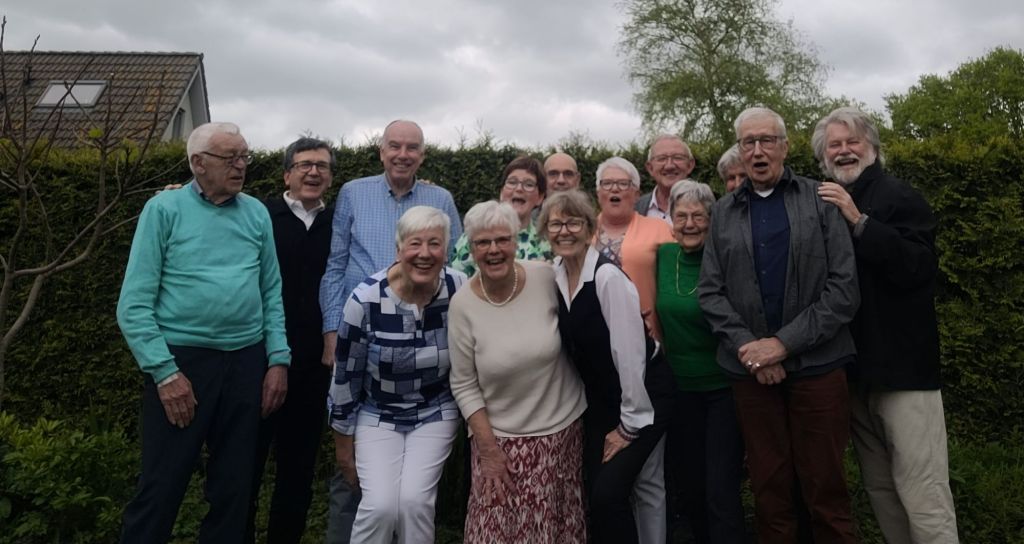
This group photo captures the spirit of the afternoon.
I am very comfortable being in the Netherlands. Olga and I enjoy this part of western Europe so were delighted to act as tour guides for Bohdan and Danya.
I will remember the sites and family on our journey; moreover, I will cherish the small things such as the local pub in Haarlem, the friendliness of the people, grocery shopping for Dutch delicacies, playing card games in the evening drinking our favorite beverages. When we return….and I will be back…the memories will be fodder for the next conversation, remembering when.
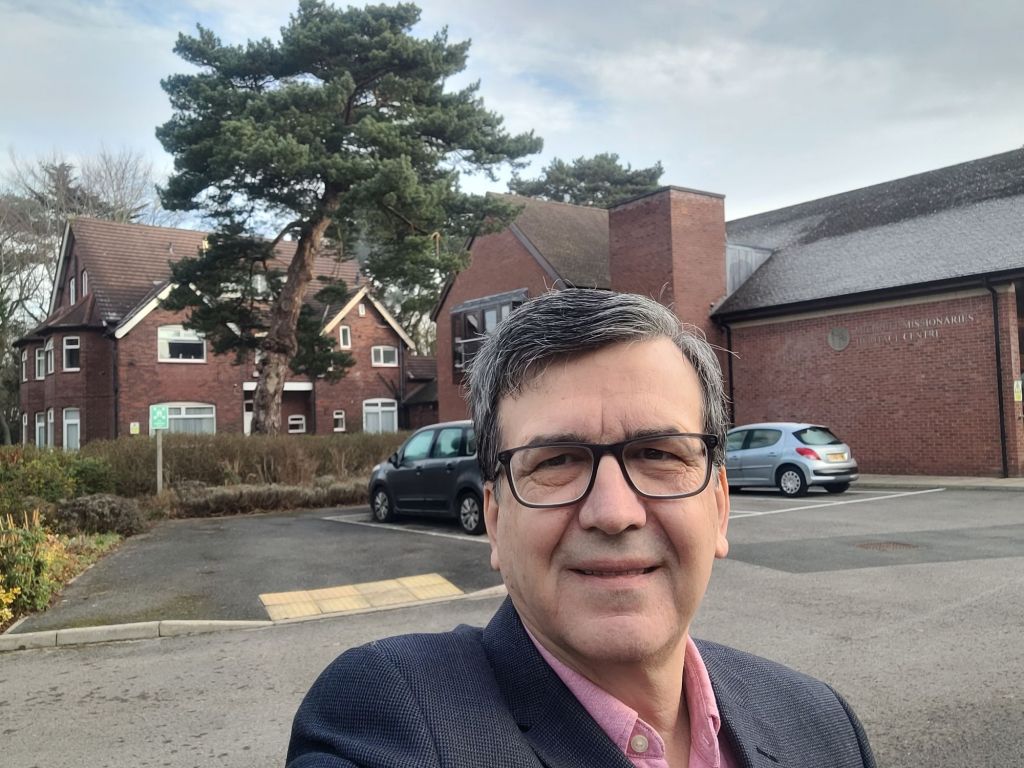
Alight at Freshfield and turn right onto Victoria Road. DO NOT cross the railway line. It is a 200m walk to Herbert House on the left.
These are the last words of instruction on this now four and a half hour convoluted 354 km train ride from Heathrow airport involving six transfers and three different rail lines, with the purchase only one ticket. I spied carefully all 26 stops on the Underground afraid I was on the wrong train or would miss Euston; for the two and a half hours on the National railway train to Lime Street, I was nodding on and off, scrolling through Facebook, Sportsnet and CBC news in between before I embarked to find Central station and board the Mersey rail for the last leg of the journey into the suburbs of Liverpool.
Fr. Stephen Giles is waiting at the entrance, anticipating my arrival based the email message sent earlier. We had been in correspondence since last December talking about the content of the archives, how much it contains of documents relating specifically to my uncle, Fr. Cees de Cock, a Mill Hill missionary ordained in 1947 who died suddenly on January 2, 1981. He had spent 34 years in Uganda save for scheduled and ad hoc home leaves. I have been in search of material to uncover his work there, to produce a document to illuminate a life of service.
Stephen wasn’t aware of anything more than what his predecessor had sent me and suggested there may be value in sifting through the archives myself. The background material for Mission to the Upper Nile, a book on the history of Mill Hill in Uganda which mentions Fr. de Cock in a handful of places, was available along with 70 other boxes specific to the country. I was welcome to stay at the Freshfield facility for my research. I booked my flight in mid January.
Here I am. I made it.
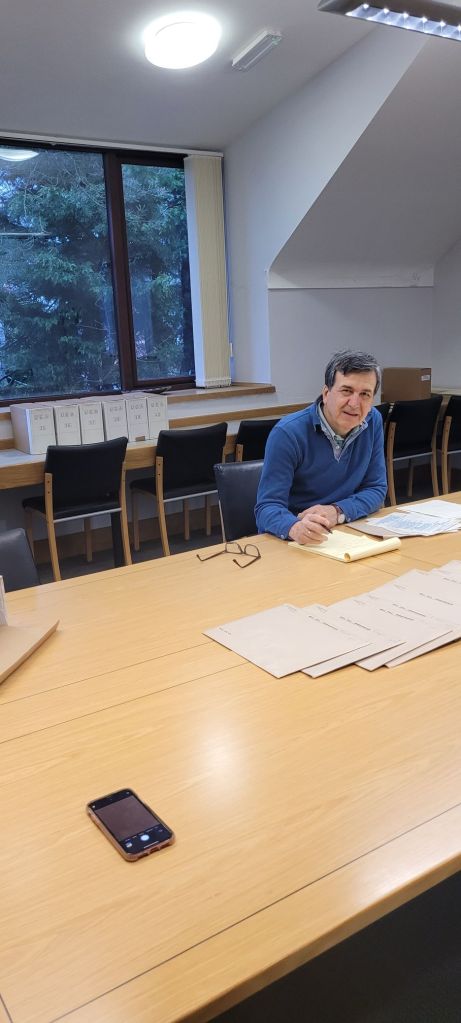
Stephen walks me to my room where I will stay for the next week, invites me into his mini apartment for a welcome cup of coffee and an acquainting conversation. He then tours me through the retirement home for Mill Hill missionaries and brothers, before I am introduced to the archives themselves, the dozen boxes Stephen has pulled aside and the reading room where I can examine the contents. Time to unpack the suitcase into my spartan room before supper at 6:00 pm, sharp.
I arrive five minutes early. A number of people are in the lounge, outside the dining room, waiting. Stephen introduces me to the rector, some priests, some brothers, explaining how my uncle was a Mill Hiller and I was here on research in the archives. I can overhear new arrivals inquiring about the outside person in their midst. The doors open at exactly 6 and everyone crowds into the room, lining up immediately at the food stations before heading directly to their seats. Those residents requiring a wheel chair are already in their place, food delivered to their spot, pills in a cup with their name on the label.
Father James Daley, Jim, is one who needs assistance. He sits at the opposite end of the rectangular table from my location, a spot at Stephen’s table. Fr. Frank Smith is the fourth. Greetings all round, questions back and forth, and it all wraps up by 6:30. The room is near empty as I say good night and then crash into bed until my alarm the next day.
After breakfast it’s time to begin digging. Stephen has provided me with a key to gain access to the building and the reading room at any time. I can work as long and as late as I wish. He had shown me Uncle Cees’ personal file and pulled from it his grades from the equivalent of secondary school and the first two years at the seminary. The paper got me excited for the possibility of even more revealing information so I eagerly open it for a closer examination. There are a handful of new documents, material regarding the cost of his medical care, letters of gratitude from the family for the care surrounding his death, correspondence with the necessary authorities to approve a compassionate leave to attend to his father’s, my grandfather’s funeral (I don’t recall my parents returning to Netherlands at that time). The remainder includes copies of obituaries and a death certificate, the same as what I had discovered in Uncle Cees’ file in the tiny archives at the retirement home in Oosterbeek several years ago. Alas, there is very little to advance my knowledge.
The background material to the Fr. Tom O’Brien’s book commemorating 100 years in Uganda also bears little fruit. Fr. Cees de Cock is mentioned in several places, always in relation to another priest, Fr. Jan van de Laar, a friend and a classmate. They travelled together to Uganda immediately after their ordination, they learned the Luganda language in the first six months, they were used as “spare wheels” bouncing from one assignment to another, and they travelled again together for the first home leave. All this information is based on Jan van de Laar’s correspondence with the author. Given the nature of the relationship between my uncle and Jan, (I have numerous pictures of them together) I was convinced there would be more than what was included in the final edit. I was hoping something similar would be discovered with Fr. Herman Hofte who was also a classmate. He travelled with Uncle Cees to Uganda and mentions as such in his story to Tom O’Brien. I find the correspondence from Jan van de Laar. It is a lengthy description including the many years after Uncle Cees’ death. There is no additional reference to Fr. Cees de Cock. I cannot find any material specific to Fr. Herman Hofte.
I begin to wonder if the trip here was based more on wishful thinking than real possibilities.
The next days are a repetition of the first. Breakfast at 8, lunch at 12:30, supper at 6, with Stephen, Jim and Frank for each meal. In between, I am alone in the reading room, poring through papers, managing two boxes a day because I am working after dinner until 9:30 pm before I retire to my room. The weather is cool and wet and damp, an easy excuse to spend all my time indoors. Every day, Stephen brings me coffee at 10:30 and 2:30, asking if I have found anything, sometimes answering a few questions, staying to chat if he is not busy.
There is no pattern to the content. Material found consistently in early years are missing in the next batch of documents. The Regional Superior appears to conduct a visit to all the missions and issues a report to the Superior General describing the overall context and commenting on each priest. The individual assessments are pithy, sometimes only one word for Fr. Cees de Cock of Kamuli parish:
1959: an excellent and popular worker 1961: inclined to work too hard, put up several buildings for the Sisters 1962: happy 1963: a popular priest and worker 1965: a good humble priest Nothing again until 1975 with a new Regional Superior: Cees de Cock has to take it calm on account of his heart. He is a very pleasant man who likes to tell his Tilburg jokes. He is very much liked by the people and he hopes to stay in Kamuli as long as possible. No more reports are in the files as I work towards the 1981 box.
In 1966, a decision had been made to rearrange the boundaries for the existing dioceses to create the Jinja diocese. The move corresponds to Uganda’s independence in 1962 and the growing Africanization of the church. The question of whether an African priest should be appointed as the inaugural Bishop, in the same manner as the Kampala diocese is openly discussed. The priests of Jinja were asked their opinion by completing a ballot. Curiously, each returned ballot was signed, many times accompanied with a reasoning for their vote. Fr. Cees de Cock voted in favour of the appointment of an African bishop. His reasons were simple: the church had been moving in this direction and this change reflected the will of the people he served.
Fr. Cees de Cock was in the minority. I need time to consider the meaning, how his reasoning speaks to my Uncle’s mind, his beliefs, his thinking. I can find little else to help in the analysis.
I am into the late seventies files, nearing the end of my time at Herbert House. Like clockwork, Stephen walks into the room with two cups of coffee for the afternoon break. He asks about the work and sits opposite to me at the table. I explain how I have scanned quite a number of documents about the church in Uganda, the political and economic context, the extreme challenges of living through the Idi Amin period. There is a paucity of items specific to Fr. Cees de Cock.
Stephen listens and then tells a short anecdote. The Superior General from 1947 to 1962, the Very Reverend Father Tom McLaughlin, was known to send the newly ordained priests off to the missions around the world with the words, remember to keep your files thin.
I thought how brilliantly that statement spoke to what the files did not say.
In combing through all these boxes, I have read more files than was necessary, including accounts of where priests and brothers were behaving in manners unbecoming the clergy, a small number of whom crossed the line. In the early years of my research time frame, those handful of situations correlated with the amount of memos or letters from the priest, the bishop, the Regional Superior, the Superior General discussing the allegations, the responses, the actions and the conclusions. It very much reflected my career as an administrator at a large post-secondary institution, in that 80 percent of your time was entangled with only 2o percent of the faculty or staff. The vast majority conducted themselves and their work in a manner becoming of their profession. I was not going to uncover the essence of Fr. Cees de Cock, the priest, the man, from these files. I need to learn from the people he touched, the parishioners he served, the friends he supported, the family he knew.
In the last box, there is a letter dated two weeks after his death which speaks about his last couple days and the loss to the community. It reads, in part,
Kees was really loved by everyone and his death is a great loss to our group of men in Uganda, and especially also to his parish and to the diocese…….He was in good form while he was here and enjoyed his Christmas very much. Everyone took to his unassuming manner and good-hearted way…..He was last seen by the nurses at 11:00. He was sitting in a chair, reading, and seemed quite normal. When the nurse cam to se him again at 11:45 he was sitting dead in chair.
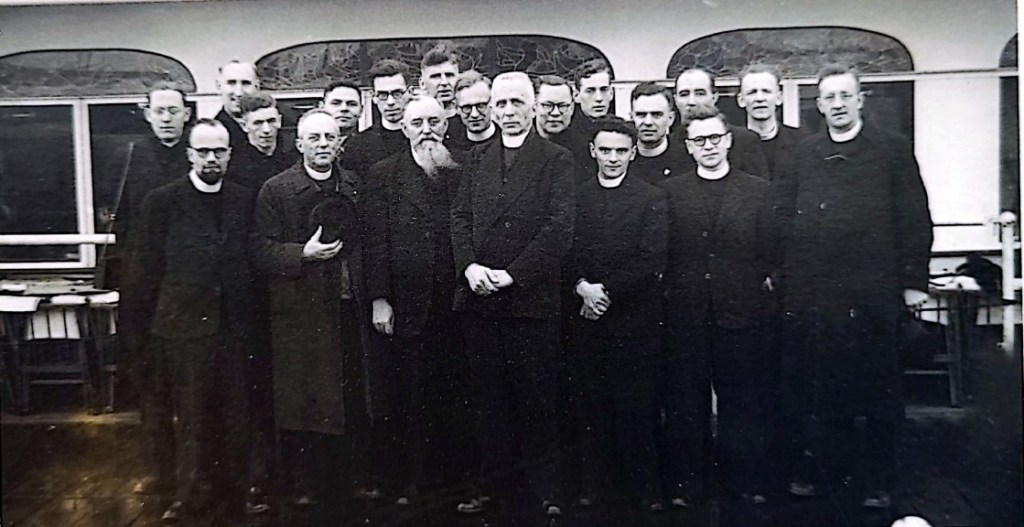
My final day is spent skimming through boxes of photographs, scouring for an image which include my Uncle, a virtual needle in a haystack. Fr. Herman Hofte’s album includes photographs from his journey in 1947 aboard the Boschfontein passenger freighter and a group shot of returning and new priests. Fr. Cees de Cock is among them.
The priests and brothers aboard the Boschfontein, December 1947. Fr. Cees de Cock is standing far right, front row, with glasses.
Stephen, Jim and Frank ask questions about my next travels, will I return to Herbert House, was my visit a success. I do hope to come back, meet with them again, listen to their stories. I also think there may be more to discover from the archives related to Uncle Cees’ schooling. I leave with a much better understanding of Fr. Cees de Cock’s movements during his time in Uganda. There was not as much as I had expected, but I have learned more than when I began, from the items that were found and those that were not.
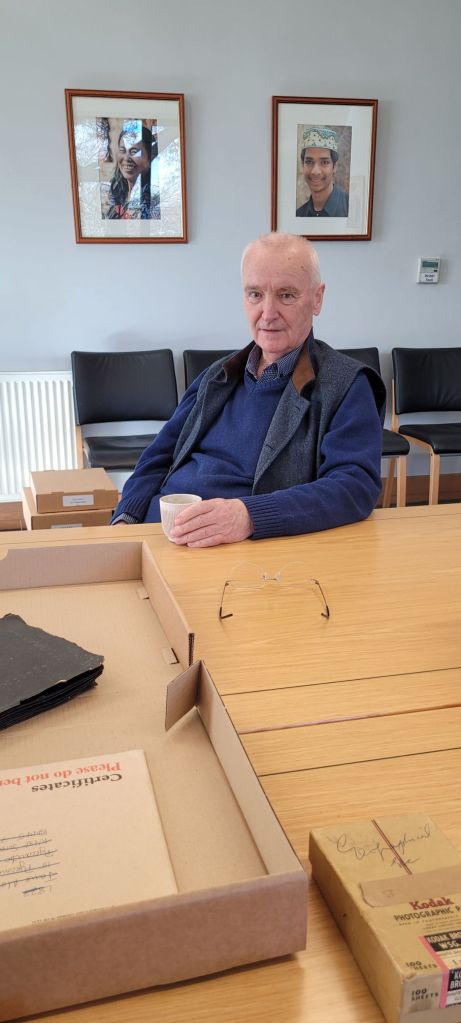
Herbert House retirement home, February 2024. In order from left to right, Frs. Stephen Giles, James Daley, and Frank Smith.
The words are expressed in the aftermath of the trial where Zarko Dragic was found guilty by the International Criminal Tribunal for the former Yugoslavia for crimes against humanity in the systematic rape of women in the Bosnian War. The protagonist in Kim Echlin’s fifth novel, Speak, Silence, is a female travel reporter assigned to witness the testimony of 16 women, three generations, describing and reliving their nightmare to three judges in a courtroom in the Hague. The author is circumspect in avoiding the graphic details while masterfully conveying the raw emotions of the victims. The event is real, the characters fictitious. Kim Echlin’s novels are suffused with pithy observations, memorable in their succinct capture of emotion and insight.
A human is human through others.
The profundity of the sentence was dramatic this past week with the loss of one life and the beginning of another, the death of a young adult and the birth of a new born, the numbing reality of a sudden departure and the unbridled joy of a welcome arrival.
Our despair, our hopelessness, our questions, our unimaginable pain, felt through our others. A child, a parent, a spouse, a relative, a friend. We hurt, we feel, and hope for the strength to continue. Not to forget, always to remember, except with less tears.
A human is human through others.
A smile, a laugh, a moment of pride, a song of rejoice, experienced through our others. A birth, a wedding, an anniversary, an accomplishment, a reunion. We beam, we boast, and celebrate the moment for as long as we can. Revel in the now, when we are able, with all the exuberance our hearts can muster.
A human is human through others.
Be with your others, be there for your others. It is in our caring and our sharing when we will be human through others.
The minus 18 temperature is not going to deter me. I have spent the last week coddling the ice, keeping the snow from accumulating, shoveling everyday, defining the contour with scrap wood, flooding the rink at dusk to take advantage of overnight cold. Grab the skates, stick and puck, pull down the toque a little further, head to the bench with Odin in tow. Time for a skate.
My brothers and I spent hours outside seeking adventure. In the winter we became Guy Lafleur, Bobby Clarke, Tony Esposito, and Paul Henderson, searching for patches of frozen water for a hockey game. We weren’t interested in a leisurely skate of endless casual circles. Our goal was a robust, vigorous entanglement of thrashing swings and bodily inducements, flailing arms and legs chasing pucks and combatants to jubilantly yell out “SCORE” and gloat in victory.
A popular spot was the creek, a trek of less than a kilometer across a snow strewn farmers field, close enough for a quick game after school before darkness settled in and it was time for supper. No shelter, no bench, no lights, no Zamboni. You sat on the banks to pull the laces tight of a used pair of skates, discarded clothing was tossed aside, the taller boots employed as goal posts at each end of the narrow passageway. A kid could get lost in all the excitement, unawares of the temperature. I remember being so cold once, my toes were frozen, my hands were frozen, I could not take off my skates. I was crying. Roger, an older boy from across the highway came to my rescue.
On Saturdays we carried along shovels and pails to clear accumulated snow and smooth out the surface. We hacked a hole in the ice, close to the edge, at a distance from the activity. Each boy would inch close to the opening, dip in the pail, port it to the rough spot and pour out the contents. Back and forth. On one occasion the ice collapsed, my left leg falling in up to my hip, becoming entirely frozen as I limped home to thaw out. It was all part of the experience.
I had not skated inside an arena until I was 15, the year Dad began working for 3M and we attended the Christmas party. In later years, a dozen boys from the neighbourhood would rent the rink behind Clarke Road Secondary School at two o’clock in the morning because that was the only time the ice wasn’t being used. I never played organized hockey until I was 19 when I signed up for the no body contact league in Dorchester. My first pair of new skates were bought as a young adult when Gary and I began playing in a league here in Toronto. Most of my skating and hockey occurred outdoors in my youth. It was accessible. It was available. It cost nothing.
I was inspired by the open-air experiences to build a rink in my own backyard when Nicholas and Olena were little. The yard behind our house on Sigmont Road looked level enough until I laid out the plastic within the wooden frame, and filled with water, half an inch on one end, six on the other. On Mill Road, I built a temporary extension to the deck, incorporated higher boards and connected the plastic sheets with red duct tape precisely at centre ice. As long as the thermometer read below zero, you could run the hose at night for a perfectly smooth surface to shoot a few pucks around. We enjoyed the freshness of the air, the tumbling down which comes from learning how to skate, the laughter of our success. The kids have grown, the winters are warmer, the yard is more garden than grass, hockey days are over, my skating escapades had disappeared.
Our newly built, four seasons cottage opened a whole new world of opportunity when we visited it for the first winter, January 2008. The temperature is typically five degrees colder than Toronto to the south. The lake was frozen, thick enough to be safe. I was excited to attempt a rink again. The conditions leading to that eventful day were ideal. The snow tends to be deeper and lasts much longer, although not a lot in that first year. I cleared what could be reasonably accomplished by one person, approximately 25 by 40 feet, to uncover a wind designed surface, rough but passable. Those early skates were reminiscent of the creek only this time I unraveled the garden hose from the external water tap to gradually smooth out the terrain. With my stick and my puck, I laced up my skates on the wooden bench each afternoon and circled within the tiny confines, forward and backward, dipsy doodling around and around solo, no opposition, raising my arms in the silent celebration of another imaginary goal. The joy of outdoor skating had returned.
The irony of making a rink on the lake is that it can be more difficult than the ones in your backyard. The trick is to not allow the snow to build up on the surface while the ice is safe enough to walk. Otherwise the surface is slush making snow removal difficult and impossible without your boots leaving a crater filled mess. My subsequent winters at the cottage have been lessons in how to manage the conditions. If we arrive later, then the task becomes too difficult for our usually short stay. The trickle of a garden hose was no longer sufficient so I graduated to a submersible pump with two and a half inch plastic piping, a fifty foot extension cord, and a manual ice auger. Last year the timing of our arrival and length of our visit meant a rink was not even attempted.
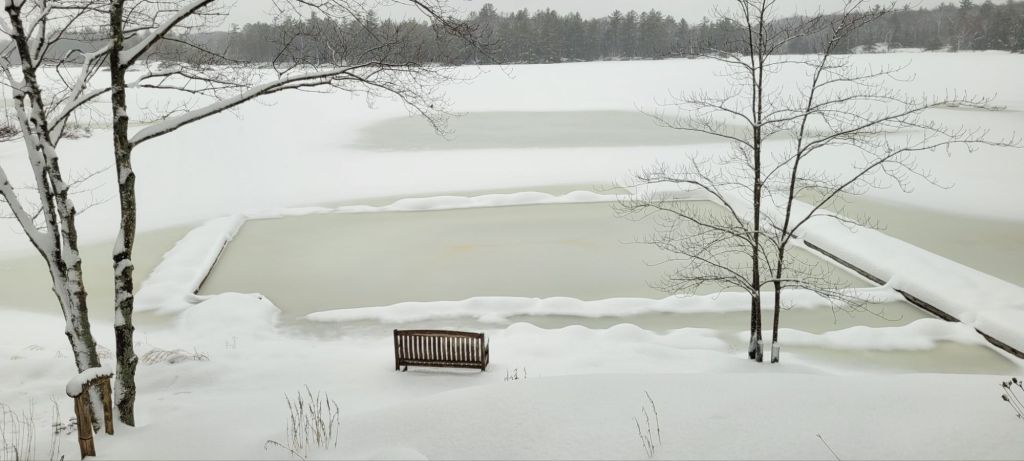
Our timing was impeccable this season. The lake had frozen before a significant amount of snow had fallen so when we arrived, there was only a couple inches. When cleared, the ice was solid and surprisingly smooth. I could skate the first day.
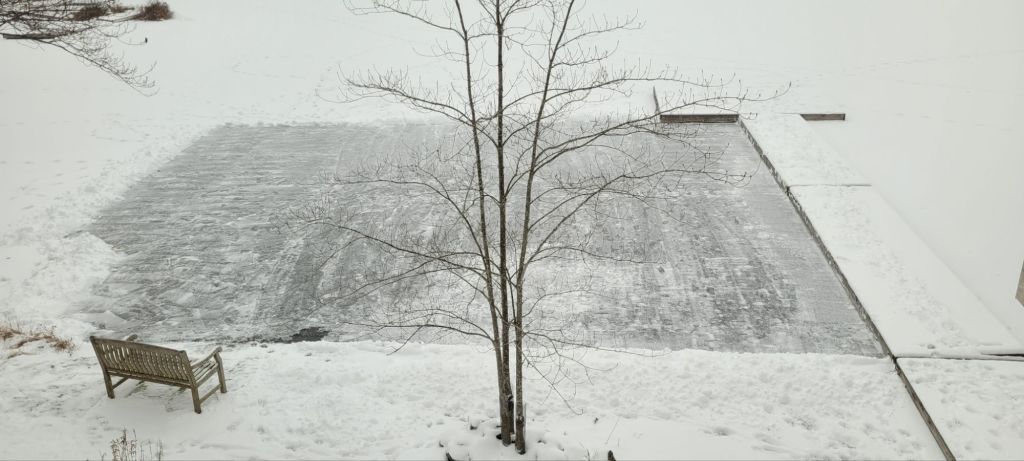
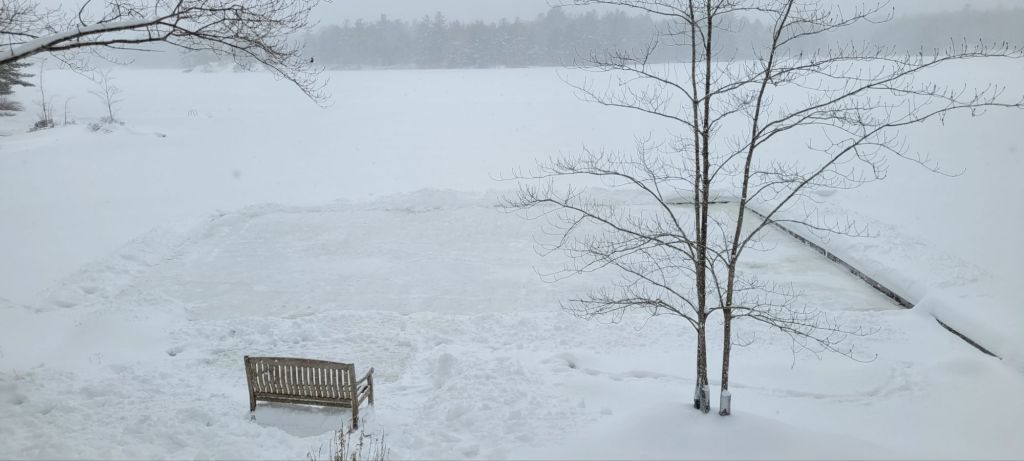
Top Left: first day. Top middle: after a dumping and rising temperature. Top right: colder and more snow. Large image: shape of rink after first coat of water.
Then the first winter storm of the season arrived. The snow was deep and heavy, the temperature went above zero melting portions, reeking havoc on the ice. Lake water was exposed in spots although the shape of the rink remained. Freezing on the following day began to solidify the surface again while the snow kept falling. Each morning I woke to yet more of the white stuff, and another hour removing it to avoid slush building. Finally a break. The forecast was for minus 12 overnight with no precipitation. It was time to flood the rink.
A tour of the results showed a marked improvement. Water finds its level, and given sufficient quantity will eventually level out the entire area. The corners were smooth as glass while the centre exhibited rough patches. It would need at least one more flooding. The temperature was dipping down even further, yet another ideal opportunity for improvement, nine days after our arrival.
I am wearing snow pants to cushion the cold. I have replaced my cap with a woolen hat. There is a gentle dusting of snow drifting down, not a sound except for the breathing, Odin’s and mine. He is a little curious, sitting, waiting patiently while I tighten the laces. Then I am off.
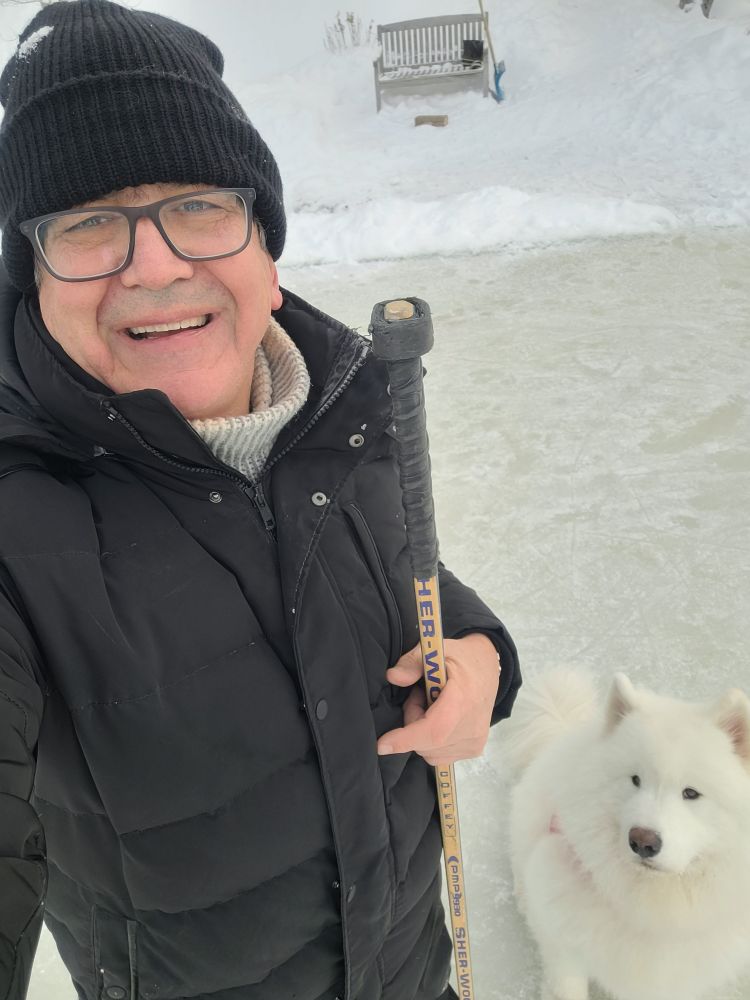
The ice is magnificent. Swish, swish, swish. Lean and turn, leg over leg. Swish, swish, swish. Pick up the puck, lean and turn, head up and fire the puck into the end board. The thud catches Odin’s attention and he slips onto the ice in pursuit of the black circular biscuit. Sharper turn, quicker movements, wind brushing my face. Odin barking, sliding when I make a sudden move. He is determined to grab that disc. Clack, clack, clack. Back and forth and back and forth. Odin lunges and misses. I slide the puck through the five hole and drag it to other end, Odin giving chase. He reaches out his paw, I attempt to slip it between his legs again except he has caught on and stops the puck, picks it up and parades around the edge of the rink in celebration before plunking the puck at my skates. I reward him with a snack, laughing, encouraging him for another round.
Olga has braved the elements to make an enthusiastic audience of one. Odin and I circle and chase and slip and slide. What he lacks in hockey abilities, he makes up for in effort. Him and me, me and him, up and down and around our little rink.
The snow keeps falling. Olga has since retreated to the cottage, Odin’s attention is waning and I am getting cold. It is time call it a morning, time to pack it in.


















 Wonderings