Borje Salming

The first winter in Belmont, Ontario would have been an eye opener for my parents in 1958. I expect they understood Canada was colder, the winters longer, and the snow more abundant; yet that inaugural snowy season was not exactly in line with what they would have imagined.

Nevertheless, Mom and Dad adapted to their new home with the exuberance of original settlers, skating on the frozen waterways, building backyard ice rinks, and adopting hockey as their sport of choice. Their endurance of the season, shoveling the snow, bracing against the minus temperatures, claiming hockey was better than soccer became bragging points to relatives back home and a badge of honour for their decision.

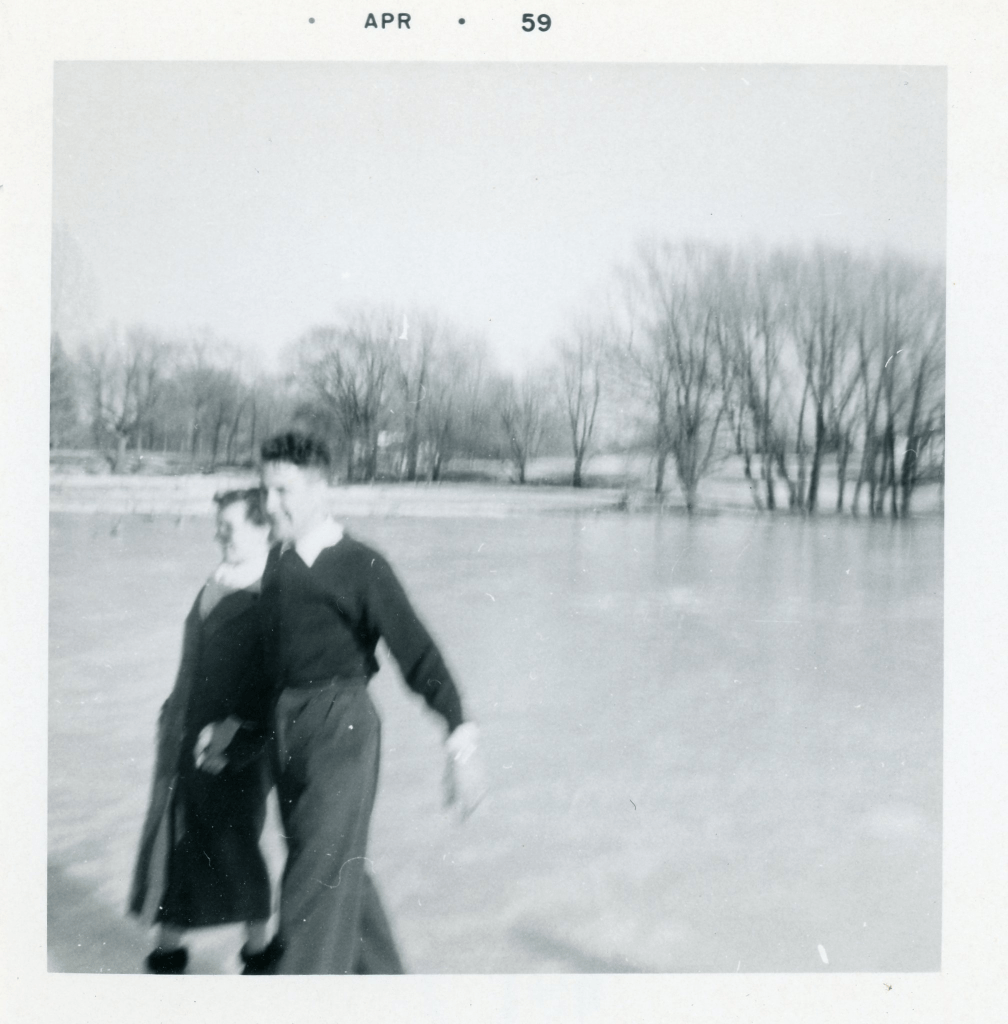
Winter of 1959

Indeed there was some obvious enthusiasm with the weather, early photographs capturing escapades on ice. Several emanated from an afternoon spent on a large expanse of ice, a frozen field with open space to test your balance. The saved pictures show Dad displaying his prowess in one, another of him skating with a group joined together by hands, and this one above with Mom. The tops of her footwear suggests she was in boots, escorted by Dad, across the ice, hopefully very carefully given she would have been as much as three quarters of the way into her first pregnancy.

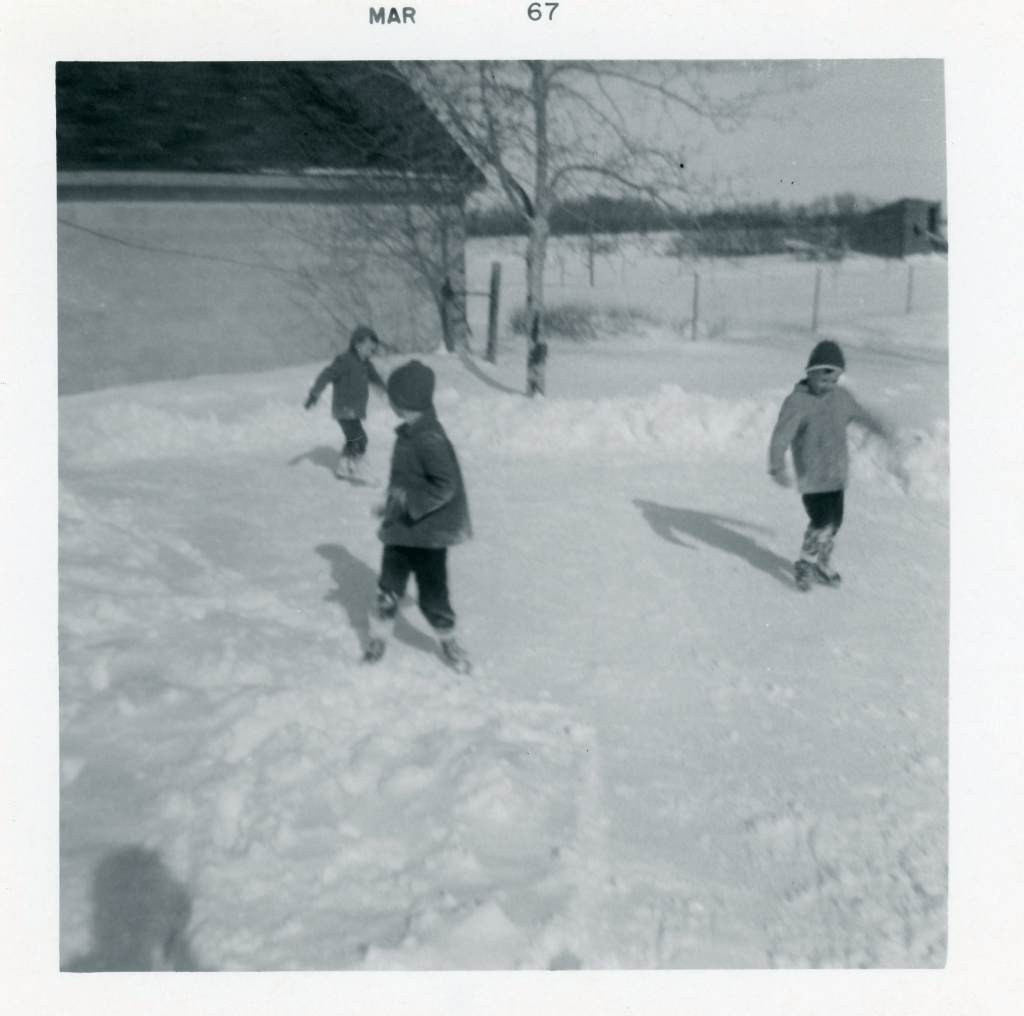
By the time they moved into their first house in 1963, there were three boys, ages four, three and two. In 1965, the family grew by one more son. With the small house, we spent alot of time outdoors. In the winter it would be playing hockey on the street and learning to skate on the home made ice rink in the large backyard.

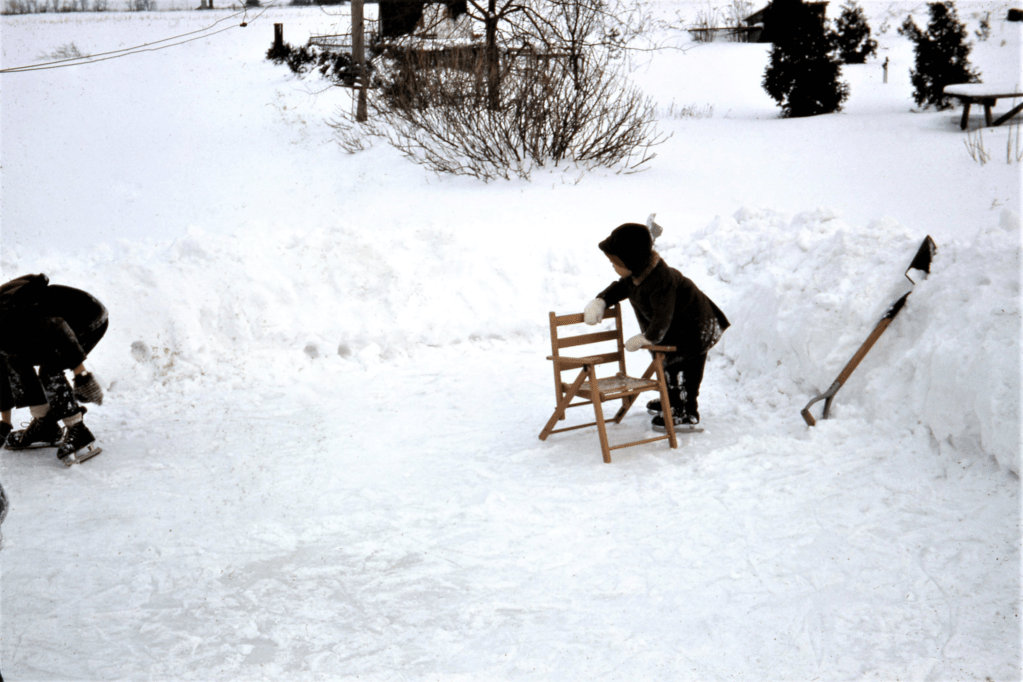
Every winter when the temperature stayed cold for any length of time, Dad tamped down the snow, patiently soaked the pad, smoothed out the bumps and cleared the snow to create walls for the boys to play within, skating circles and more often, engaging in a spirited game of hockey. My parents were practical, not seeing the value of new skates which would be outgrown by the following season. I don’t recall ever having a new pair until I bought my own as a young adult. Mine were most likely to be hand-me downs from my older brother Gary, purchased second hand or rummaged from a neighbour or work colleague.

That same sensibility and the realistic constraints of a working class single income meant none of us were enrolled in organized hockey as kids. If one of us were to begin, then the others would need to join and how would the family manage the time or the money. My parents bet the odds of success were with an education rather than a career in the National Hockey League playing for the Maple Leafs.

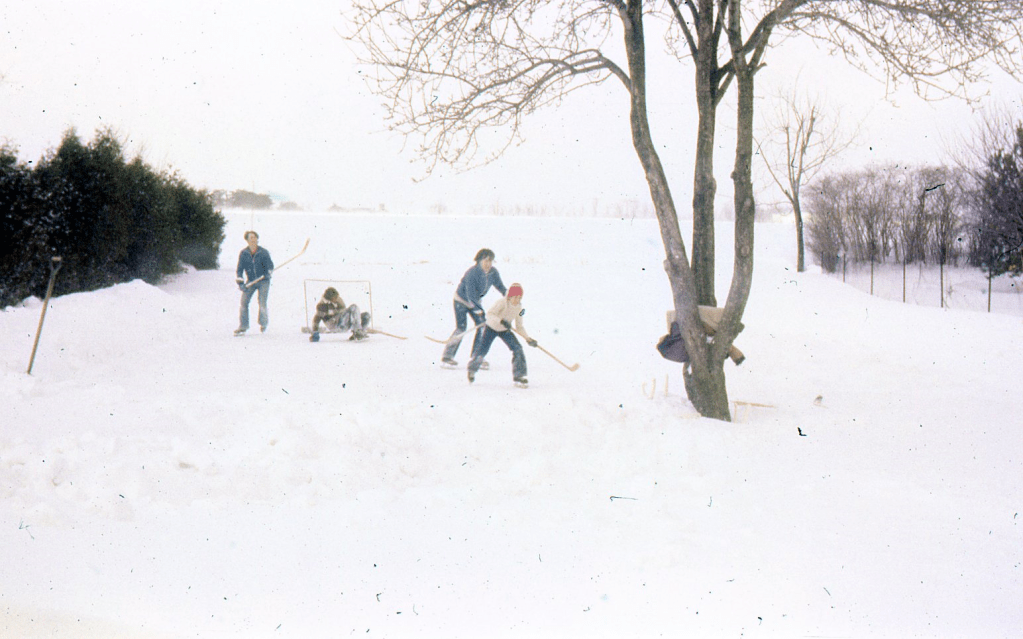
As we grew into teenagers, we built the rinks ourselves, bigger to accommodate our size.

Watching hockey was akin to religion in our household. Every Saturday night we plunked ourselves in front of the TV for the next edition of Hockey Night in Canada, accompanied by loud commentaries on the action, arguments about the merits of fighting, and yelps of SCORE!, in unison, when the puck crossed the goal line for the home team. Bobby Orr was Dad’s favourite hockey player despite being a griping fan of the Maple Leafs. Mom, on the other hand, proudly cheered the blue and white, remembering the last time they won the Stanley Cup, ever hopeful this year would be the next. Her favourite player was Borje Salming. Mom would not countenance any utterance of disrespect or negative assessment of the man or his abilities. She simply ignored any reports of Salming snorting cocaine, believing the stories were the construct of a media biased against Swedish hockey players.

I think she identified with Salming as a pioneer to the NHL, a foreigner in a strange land, the first successful European to break into the ultra macho world of North American hockey. Mom would spit the name of Mel Bridgeman who badly bloodied Salming in a one-sided fight during one playoff game with the Broad Street Bullies. Her boy would persevere, stay in the game, and eventually be inducted into the hall of fame, not like that Bridgeman bum.

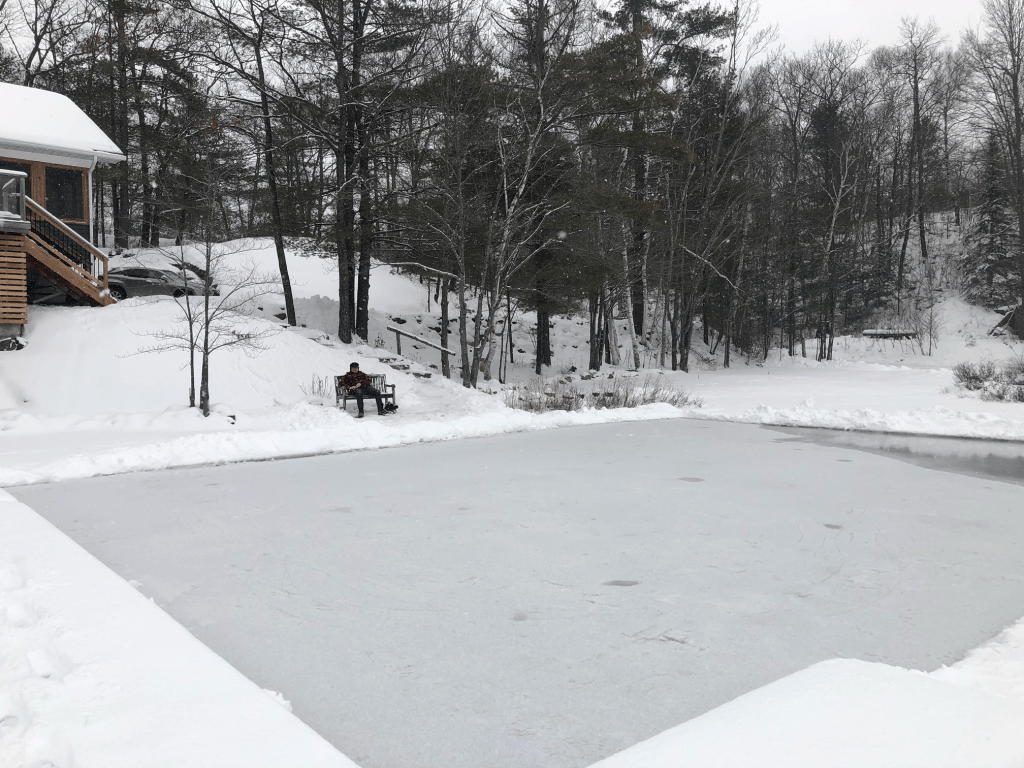
Early rendition of this year’s ice rink, waiting for a frigid cold to perfect.

These stories all came back to me the last couple days as I shoveled the lake snow to uncover my own ice rink, remembering the endless hours outdoors playing hockey in the back yard, on fields, on the narrow creek, or between the trees dodging branches and my brothers. Our rebuilt cottage is winterized and I look forward to every new Year’s day to build the rink and recall the joy of skating outside in the brisk, fresh air, firing pucks at the net, falling into the snow from exhaustion, laughing as the flakes float down from the sky. The physical exertion to shovel the snow, dragging the hose at night in the ongoing challenge to smooth out the bumps, experiencing again all for the simple pleasures of childhood when my parents embraced their new world.

A good rink and a vigorous skate always makes for a promising start to another year. I have more opportunities this time round to make this one better than the previous year, hopefully boding well for 2021.

Happy New Year everyone.

What can we give them?

When my parents moved to Canada, they were the only ones who ventured more than a 100 kilometre radius away from Tilburg. With the exception of my missionary aunt and uncle who left for Africa, everyone else stayed in the city or established homes in nearby Waalwijk, or Goirle, or St. Michelsgestel. Uncle Herman was in a Belgian parish less than an hour ride from family.

Distance from the Netherlands made Christmas particularly special for my parents. There was no gathering up of the kids to visit grandparents, or welcoming uncles, aunts or cousins for a drink and a meal, or exchanging of gifts among relatives. Christmas was contained amongst ourselves, celebrating only with our immediate family, and a nod to the relations abroad.

Mom and Dad relished the opportunity to express their joy of family with the sharing of gifts; simple when we were young, more expensive when their own fortunes improved. Regardless of the financial circumstances, my parents ensured there was always something to open in the morning. Some of these memories are etched forever, others rejuvenated from photographs of those very early years.

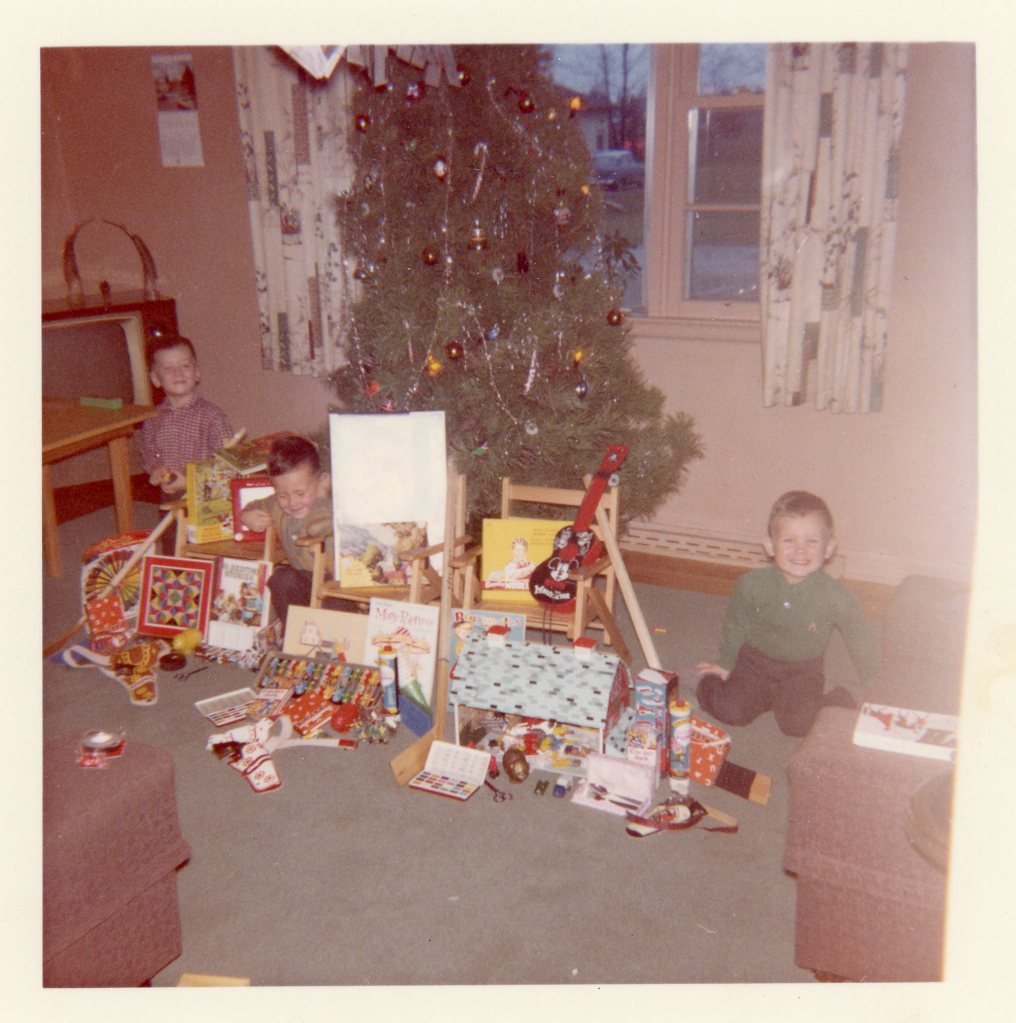
A polaroid shot of Christmas morning.

I stumbled on this picture from 1965. From left to right, in order of age, Gary, Henry and Peter. Michael was an infant, just born in the late summer. The tree was real, bought from a man encamped in his trailer parked in the Woolco lot, spiritedly negotiated to it’s lowest agreeable price, nailed to a wooden Coca-Cola crate and propped in front of the living room window on Kostis Ave. I don’t recall this particular Christmas although Gary reminded me of the chairs and the accompanying table. It was part of the gift for the three of us; we were positioned beside our haul for the photo. The quality of the image limits the zooming capabilities in an attempt to identify some of the bounty; nevertheless, humorously, one cannot help but notice how a number of the presents came in threes: a box of Cracker Jacks; a paint set; a holster with a toy gun; a balloon pump; a hockey stick; and, a piggy bank. Clearly, our parents were encouraging us to be savers.

The display also includes individual items foreshadowing an aspect of our current reality. Gary drew on an Etch-a-Sketch to practice for his career in structural steel drafting; Peter delighted in a barn to help identify the animals he would foster on his hobby farm; and I played with a xylophone to hone up on my musical talents for guitar and bagpipe performances.

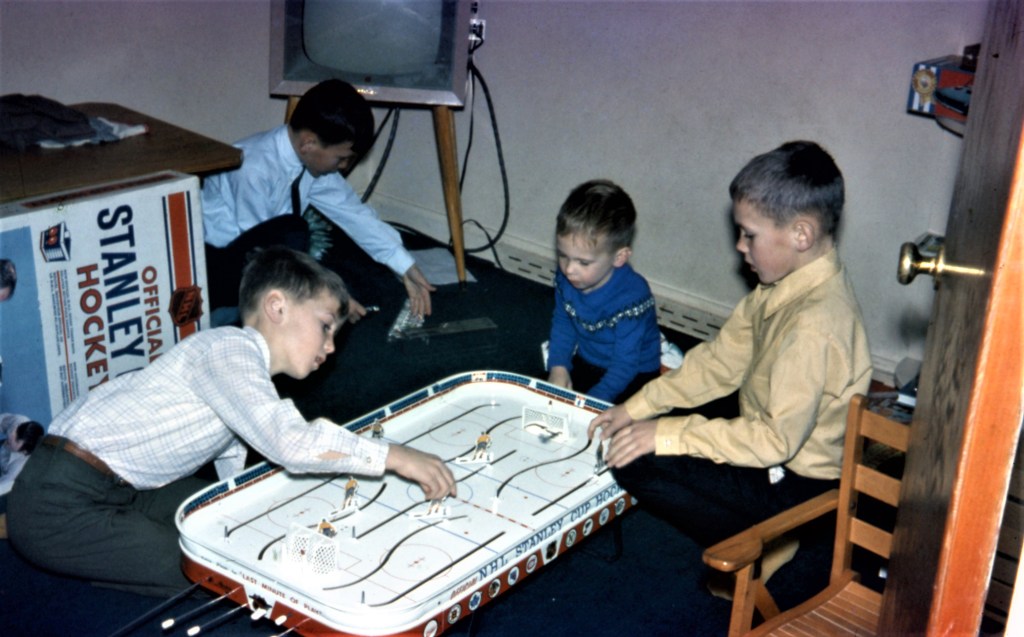
The receipt of presents related to Canada’s official sport was common throughout the years. At another Christmas, pictured below, a hockey game was the prominent feature.

Putting the hockey game together Christmas Day, 1968.

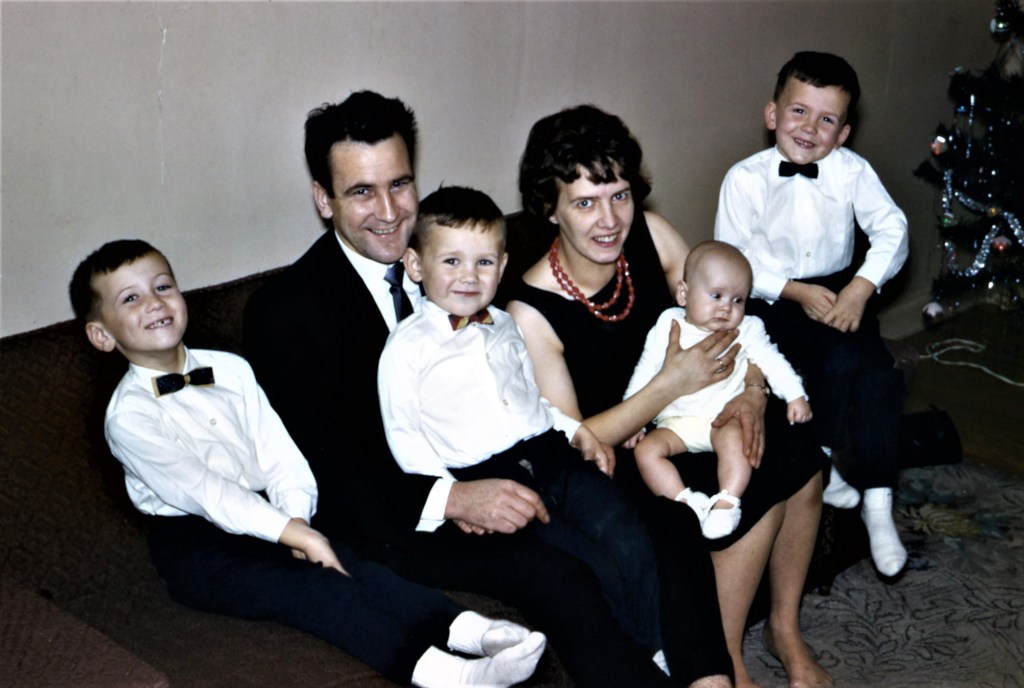
Notice me in a tie (clearly a signal of my working days ahead) while the others had already abandoned theirs after mass. Attending church was important to my parents and played a significant role in the festivities. We dressed up special for Christmas mass, decked out in our best shirts and tie; bow in the early years, necktie in the latter. Midnight mass was a highlight, after which we were allowed to open one present as a teaser before heading for bed till the morning, rising first for breakfast, then opening the remainder of the gifts – a lesson in delayed gratification. As we got older, our parents would allow us to stay up longer. My mother prepared blindevinken, a special Dutch meat dish, eaten after midnight mass, followed with present opening to three o’clock in the morning. I devoured my chocolate letter before going to bed, not risking it getting stale by the morning.

All dressed up for Christmas.

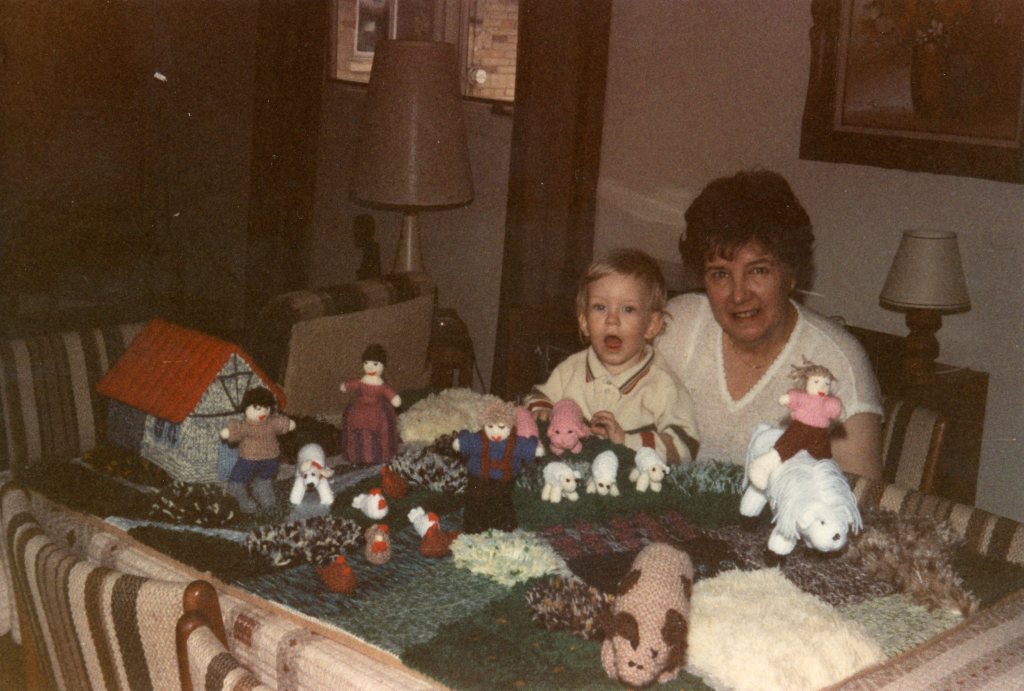
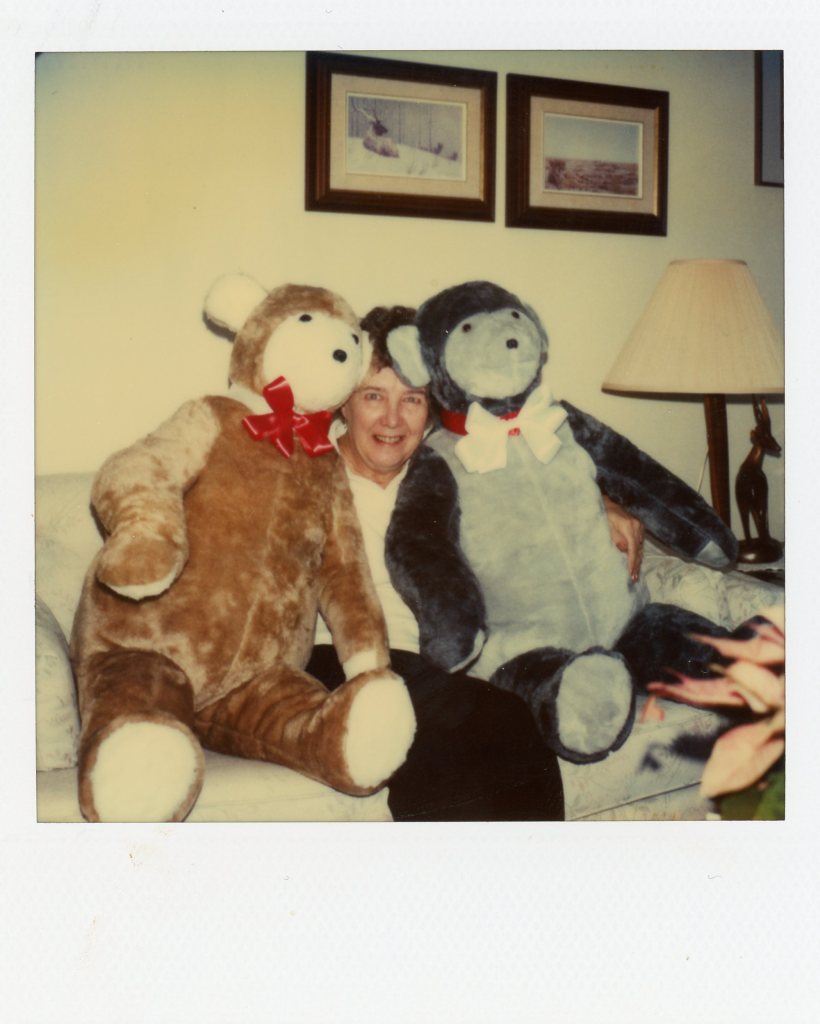
Over the years, some presents stick out as memories: a toboggan leaning against the wall, as tall as the tree, greeted us at the bottom of the stairs one morning; the wooden “sjoelbak” (shuffleboard), too big for wrapping, and providing hours and then years of enjoyment. Not all gifts were store bought. My mother was an avid seamstress and knitter, making coats one year for each of us and sweaters in another. She carried on this love of making and giving with her grandchildren, creating one-of-a-kind gifts, never to be forgotten.

The knitted farm for Nicholas.
Teddy Bears for our daughter Olena and her cousin, Justine

My parent’s joy of giving and sharing and celebrating together remains as their most important legacy. They relished the company of their immediate family: eating, singing, rejoicing in the season. My mother loved Boney M’s version of Mary’s Boy Child, the perfect combination of reverence and fun, embodying her approach to the holiday. While I struggle to recall the individual gifts, I will never forget the feeling of Christmas, the joy of giving, the importance of being together. The day has become my favourite time of the year, to express my love with a thoughtful gift that induces a smile, a hug and a kiss. I am grateful our children were able to enjoy Christmas with their Oma and Opa, Baba and Dido, and a growing, extended family. As I sit by my lighted tree each day with my morning cup of coffee, I miss the phone call from Mom or Dad about preparations, the arrival of that special card, the questions about about when we would be in London and what did we get the kids this year.

Olga and I have attempted to retain their fun and joy and celebration through different activities over the years. We hosted a gingerbread baking fest in our small apartment for our first Christmas as a couple, inviting my brothers and parents to participate. We continued this tradition with our children until they were no longer at home. In another year we suggested, and others reluctantly accepted, decorating the tree with hand-made ornaments. Dad had some difficulty with the concept but finally succumbed to the collective insistence for his contribution by stapling some tinfoil together in the shape of a star.

For several Christmases we drew names from a hat to select the lucky recipient of a hand made gift. Gary fondly remembers carving Olga’s name into a wooden cutting board while receiving placemats and oven mitts from Mom in the same year. When the ideas for making gifts waned, we switched to assembling the package to reflect the person receiving the present. The idea stemmed from Dad’s story of constructing a cardboard needle to deliver his gift to his beloved, my Mom, a nurse. You get the idea.

In this year of COVID, we refuse to allow the limitations to dampen our celebration. Olga and I have devised a treat for our children and their special loved one which we hope will bring the same smiles and memories and fun and joy with their families. As we sing about what we can give them, we pause and remember to relish the moment, rejoice in the present, be grateful for what we have and give them our heart.

Merry Christmas.

A Life Lived

*reposted with permission of the author, Dr. Bohdan Kordan

Obituary

A Life Lived

Fenna (Kapeluch) Kordan

Wife. Mother. Grandmother. Survivor. Born on April 6, 1918 in Vyslik Velykyj, Galicia, Austro-Hungarian Empire; died December 13, 2020, in Toronto, under COVD conditions.

Fenna Kapeluch was born in the Carpathian mountain village of Vyslik Velykyj during the 1918 flu pandemic, the end of the Great War, and the dissolution of the Austro-Hungarian Empire. The daughter of Chrystyna (Drozd) and father Andrij, she was one of eleven children. Compelled to work as an itinerant worker at a tender age because of poverty, she was left unschooled. However, she was not without a book or pen in life, having learned, unaided, to read and write through strength of will and purpose.

Fenna would marry before the onset of the Second World War. The German invasion of Poland introduced turmoil to her life. She would lose her husband to war, who was seized by Nazi authorities and sent to a concentration camp. She was transported as forced labour to Germany and, from there, taken to Austria. Alongside French prisoners of war, she was compelled to work as an agricultural worker on a farm near Klagenfurt, Austria, labouring for four years under harsh and trying conditions.

Fleeing at the end of the war from servitude, Fenna returned to her mountain home on the Polish-Soviet frontier. There she found chaos, the result of conflict between the anti-communist Ukrainian insurgency and government forces. The conflict led to untold suffering among the population, culminating in the forced resettlement of the local Ukrainian inhabitants by Soviet and Polish authorities who sought to defeat the rebels this way. In the cycle of violence that ensued, in her arms, Fenna’s mother would die of starvation. Fenna would flee and take refuge in the mountain forest wilderness, making her way eventually to Czechoslovakia and onto Western Germany. In 1948, she would migrate to Canada as a displaced person.

The memory of conflict was never far away, shaping her worldview, state of mind, and personality. Nevertheless, despite the cruelty of war, she sought normalcy. Fenna remarried (Andrij), made a home, raised children (Olga [and Henry]), Bohdan [and Bohdanna]) and cherished her grandchildren (Nicholas [and Hung Chiu], Olena [and Daniel], Christian). She took great comfort in family, speaking lovingly and with admiration of their achievements. She valued her garden, delighting in dahlias and going gaga over geraniums. The munificence of her vegetable harvest served to remind her of the bounty and richness of life.

Fenna took pride in the dignity of work: first, as a nursing assistant at St. Joseph’s Hospital in Toronto, but then, wanting freedom in work, chose to be a domestic. Cultural identity was also dear to her. She celebrated holy days and family gatherings with the dinner table groaning under mounds of Ukrainian food – borscht, holubtsi, varenyky, patychky. As a believer, she kept her faith close by, never losing sight that through God’s love we might find peace and salvation. Widowed for thirty-four years, she knew loneliness, but found strength in her perseverance and accomplishments. She maintained her garden until she was 98 years of age and lived alone in her home until 99. At 102 years of age, she survived an operation on her broken hip, but not the isolation of the pandemic – the second in her life.

In the end, Fenna was disciplined, uncompromising, and even fearless in her approach to life. Above all, she believed that no matter how simple her life, her life was deserving of respect. When she received restitution from the government of Austria for her mistreatment during the war, she gave the money away. What she simply wanted was for there to be a record and an acknowledgement of what happened; to have others know that she mattered – that, in fact, we all mattered.

We bow our heads before her in remembrance and with love and respect.

Sisters

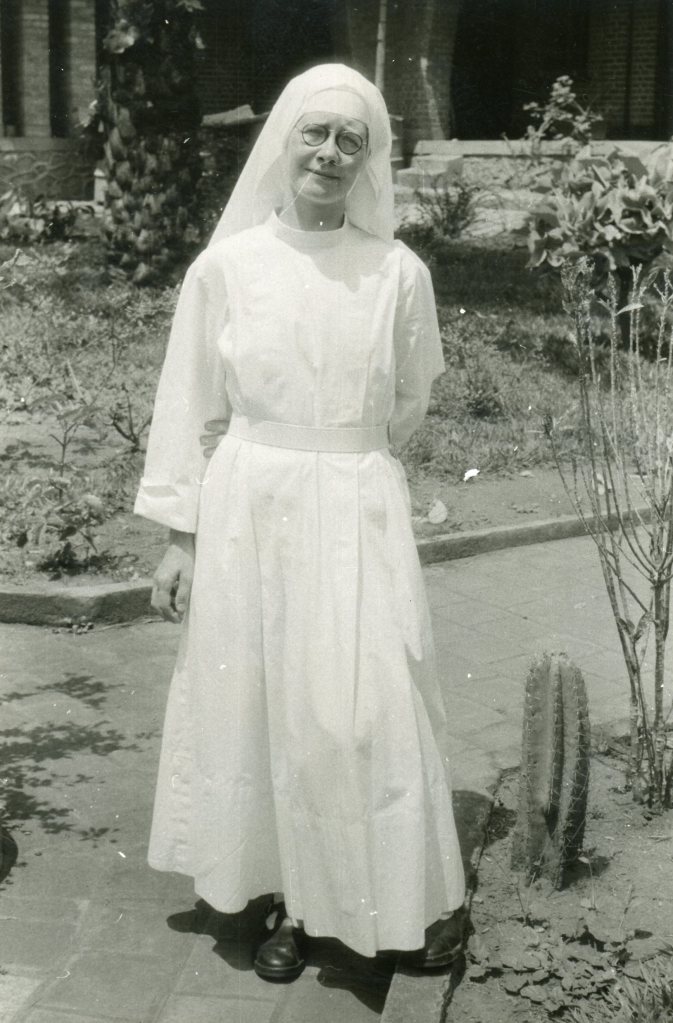
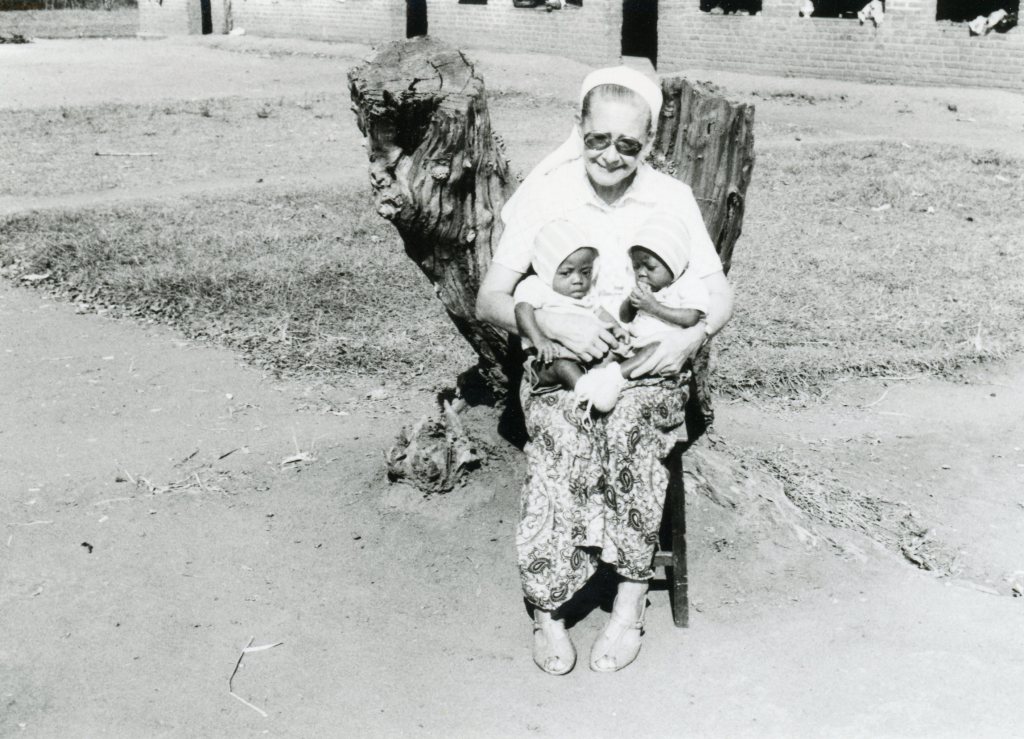
Several pages in a photo album dedicated to my mother and her siblings is populated with photographs of my Tante Lina from her time as a missionary nun in the Congo.

Whereas my father would describe particular stories of my Uncle Kees related to his time in Uganda, I cannot recall anything similar about Tante Lina. I have been questioned about my interest in documenting my uncle’s life rather than my aunt’s even though both dedicated their lives to missionary work. The lack of information and subsequently minimal knowledge would be the biggest factor. In digitizing the photographs, however, I have developed a renewed interest and I am also reminded of the power of family dynamics.

Angeline van Rooij, born in Loon op Zand, the Netherlands, May 15, 1922, was the third child of an eventual eight in total and the first daughter of Nicolaas and Maria van Rooij. My mother would become her only sister as the sixth offspring, born in 1928. Two more sons ensued to complete the family. Tante Lina would follow the lead of her two older siblings into the Salvatorian religious order, as did the next to be born. All of the last four pursued secular careers. My aunt completed her final vows and became a nun on May 1, 1948. Why the van Rooij family chose to follow the Salvatorian order, with its roots in Italy and a base in Belgium, has never been explained to me. The Netherlands appeared to be an active recruiting ground for international missionary societies at the time and with the Belgium border a short distance from Kaatsheuval, where the van Rooij family settled, another country with the same language would not have been a barrier.

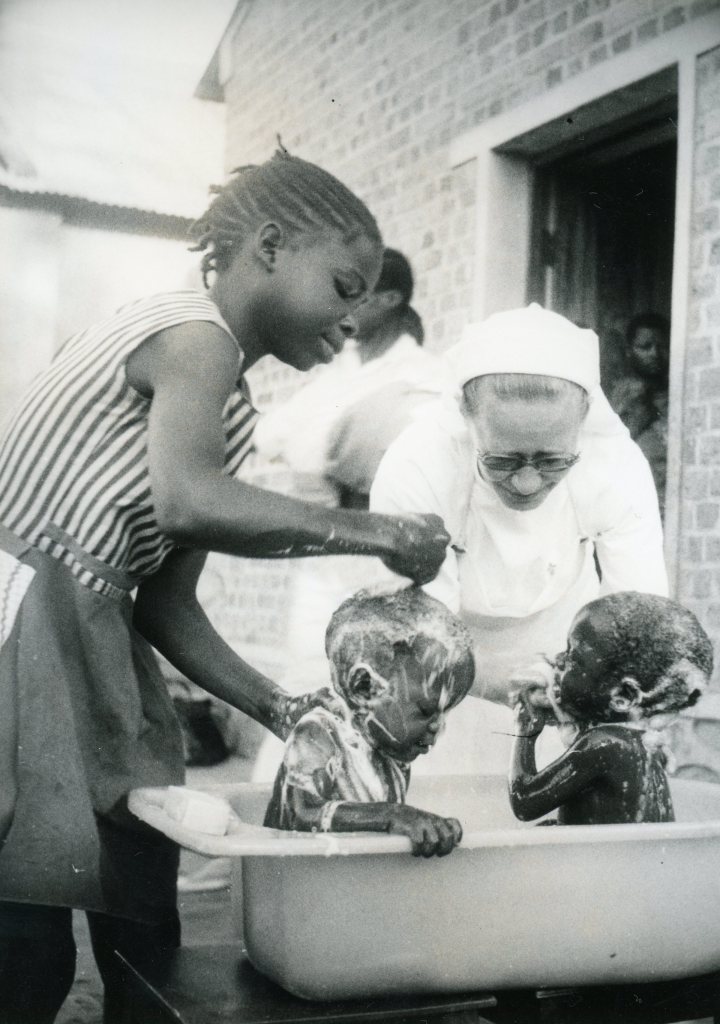
The vast number of pictures with Tante Lina appear to be in the late 1950’s. Tante Lina was among the original four nuns of the Belgian Salvatorian Sisters to be appointed to the very first mission in Kapanga of the Belgium Congo, September 7, 1958. My Mom and Dad will have already left for Canada, so Tante Lina would have sent the photos to them, many with a description on the back, in Dutch, in her own handwriting.

Perhaps my mother knew more and may have even attempted to convey additional information but I can only remember her saying Tante Lina worked at an orphanage in the Congo. The pictures appear to bear out that description as does the mission of the Salvatorian Sisters as listed on the website. I only just discovered the name of the place in the Congo, not realizing the massiveness of the country. The Democratic Republic of the Congo is the second largest country by land mass in Africa, double the size of South Africa, and eleventh in the world. With 90 million people it boasts the largest speaking French population on the planet, and it’s capital, Kinshasa, dwarfs Paris.

I first met Tante Lina when she visited Canada. Unlike other relatives, she had only a rudimentary understanding of English so communication was difficult. I imagine she would have been better in French but alas, my grasp of Canada’s other official language was lost years ago.

She measured only 4 foot 11, lean and always stood erect. Her size belied a strength born from a life of frugality and hard work in a difficult country. Possessed with a strong grip, she would greet you with a broad smile and a vigorous handshake that threatened to dislodge your arm from its shoulder socket. Tante Lina eschewed elaborate meals, relying on simple servings despite my parents efforts to introduce her to some of the luxuries of the western world. My mother spoke of her naivety to the everyday aspects of modern living we all took for granted.

Perhaps the most telling story of Tante Lina’s experience was a visit to the University of Western Ontario’s new hospital. My mother being a nurse, was curious about the new building on campus so they proceeded to drop into London’s newest hospital, like a tourist site. It already had a reputation for possessing the latest in new building design and surpassed the quality of the older Victoria and St. Josephs hospitals. My mom equated the entrance to the lobby of a fine hotel. Tante Lina cried when she witnessed the opulence, especially compared to her experience in the Congo.

Curiously the pictures of her time in Canada are scarce. My mother had organized the photo albums into themes. There is one album devoted to the times my parents visited the Netherlands; another combines all the pictures of family coming to our home. Tante Lina has disappeared from the visiting Canada book even though she has prominence in the van Rooij family album. I suspect the absence was intentional, a possible victim of family politics.

Sisters together in 1983 at the home of Uncle Herman on one of their trips to the Netherlands.

There is a rigid hierarchy within the church, including between priests and nuns; there has been traditional hierarchy within families, with males favoured over females, and those in a religious order ranking above all others particularly in a time period where children going into vocations raised the family’s status within the community. For the poor and the working class, the choice of religious life provided an opportunity to be university educated, escaping the determination of their position.

I have a sense my mother’s parents exhibited favourites and she was not among them, perhaps not living up to the accomplishments of an elder sibling of the same gender who made the family proud by becoming a nun. How those feelings played out in the dynamic between the two sisters is unclear. The differential treatment probably played a role in the decision of my parents to move to Canada, which I expect was initiated by my mother who wanted to exert her independence. The distance from immediate family came at a cost and may have further exasperated the differences among sisters. Although time and distance generally heal wounds, my mother was particularly stubborn and held onto grudges, never forgetting any transgressions, refusing to acknowledge mistakes. I have no knowledge of how Tante Lina’s actions will have played a role. People who join the clergy are human too, not always the saints we associate with the vocation. What Tante Lina contributed to the apparent tension or how the personality of youth influenced responses remains unspoken.

My intent here is not to conjure up ghosts; rather, my hope is to tell the story as a cautionary tale for you, for me, for all of us. The friction in their lives should serve as a reminder to understand the circumstances of others and to understand our own role in a relationship. It is a call for reflection, an honest look inward, an objective assessment of our own actions and inactions. I recognize in myself my mother’s tendency towards stubbornness and a penchant to be unforgiving of certain actions, summarily dismissive sometimes. I expect this trait will have had a negative impact in different areas of my life. I cannot alter what has happened; I can only affect how I respond and how I will learn to be a better person.

Tante Lina passed away in 2010. My Mom left this earth in 2005. Both were accomplished in their own worlds and I prefer to think they both found peace with each other in the end. I believe it is our family which will endure as we nourish our relationships with our parents, our extended family, our close friends, our brothers;

And our sisters.

All I’ve got is a photograph

One of my projects in retirement has been to digitize and organize our family collection of photographs.

The idea arose after my Dad’s passing last year. Everyone in the family had gathered their favourite pictures for the screen display at the the funeral home, played on a loop for all the visitors. At the same time, the albums with physical photographs were available at the tables for people to turn through the pages of my parent’s lives. There is only one copy and the question of distribution to the four boys would be simplified if everyone were to receive a digital copy and one person would retain the original version.

After purchasing a quality scanner and setting up a dual monitor display on my desk, I have begun with my Mom and Dad’s photograph albums, ten in total, which will give me the practice to turn my attention at another point in the future to tackle those from Olga’s and my life together.

My Mom’s birthday was this past October 7 which would have been her 92nd; she passed away in 2005. Today, November 27, would have been my Dad’s 88th birthday. The date felt like an appropriate time to begin a series of blogs about their life together, as told through the pictures they retained from before their marriage in 1958 until my father’s passing in 2019. The series will be entitled, Honeymoon Sweet, because they always maintained they immigrated to Canada for their honeymoon and never left.

My mother was the person who sorted the photo albums. She created individual collections for each of the four children, showing pictures from their birth to that of their own children. My Mom put together something similar for herself and my Dad, including pictures before their marriage and of each of their respective siblings. There is a separate album of the their early years in Canada which is of particular interest. To this point I have managed to scan the albums specific for each of my parents.

The album for my Mom has dates and markings, sometimes illegible, for quite a number of the pictures. On a few she had written what appear to be songs, liedjes, which would have been sung for the occasion captured in the photograph. The detail and organization reflects her training as a nurse. My Dad’s on the other hand is notoriously lacking in dates; those showing his time in New Guinea as part of the Dutch navy clearly were extracted from another album but without any description, as if he would always have been around to explain for anyone interested. I have chosen a select few from each, a taste of their content.

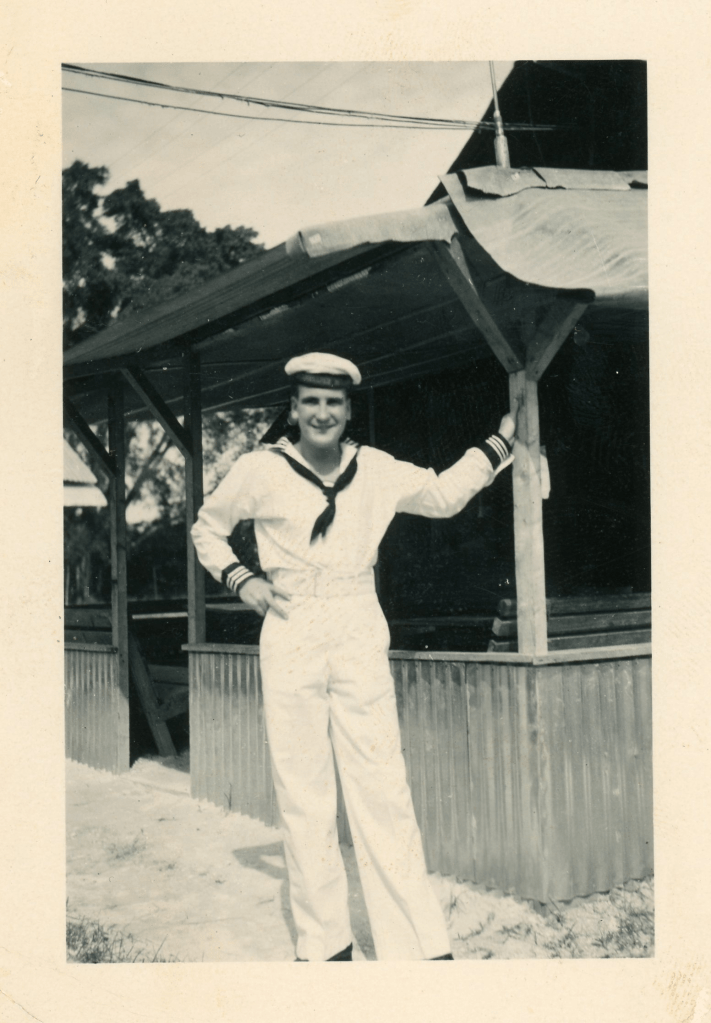
My Dad was stationed in New Guinea while serving in the Dutch Navy as part of the mandatory military service in the Netherlands.

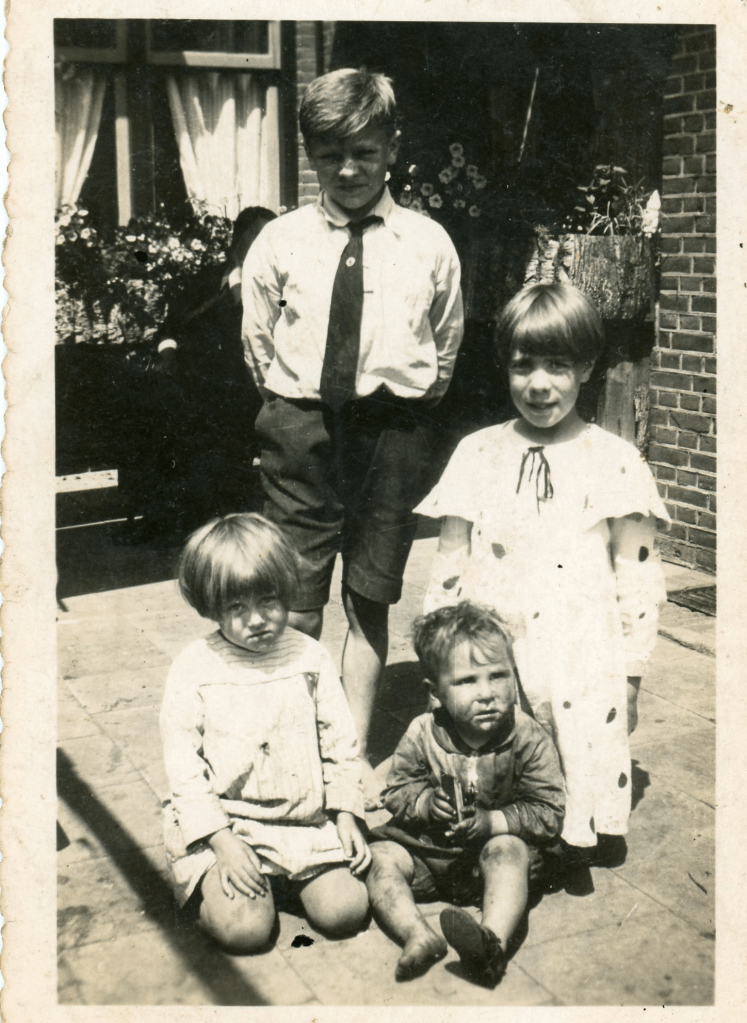
One of my favourite pictures of my Dad as a child shows him sitting on the ground, at the feet of three other siblings (the eldest missing, the youngest not yet born), grubby from playing in the dirt or quite possibly coal. My Uncle Kees stands behind, dressed as if he just came home from school; Tante Toos is the child on her knees with that ever present smile; Tante Jo sits beside my Dad, not enthused by the picture taking. Given my Dad’s age, the picture is likely from 1933, perhaps at the back door of the family row house in Tilburg. Each child reflects a bit of their personalities from what I can recall. My Dad was a boy’s boy who seemed to relish the rambunctious moments.

The same four are pictured as adults, probably from 1956 based on my understanding of when Uncle Kees, the missionary priest, had returned to the Netherlands for a scheduled vacation from his station in Uganda. My Dad cleaned up well, but the laugh on his face exhibits a delight captured in this photograph after some unknown, off-camera mischievous lark.

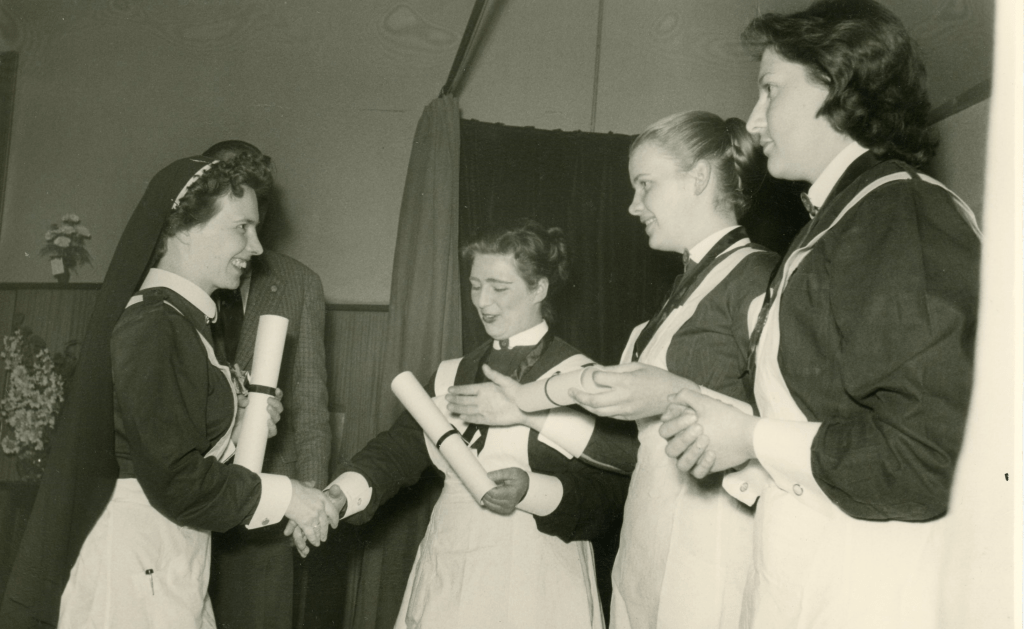
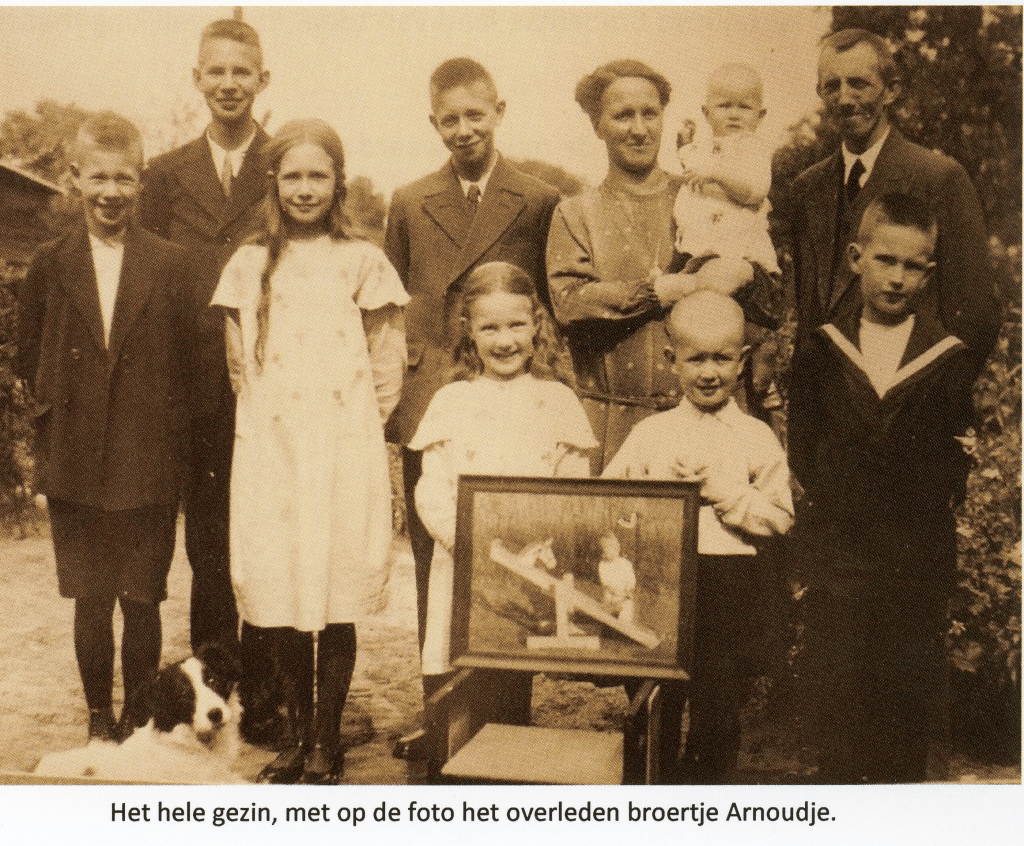
Finding pictures of my Mom as a child has proven difficult. She possesses only a handful; worn, unclear and unflattering. The van Rooij family appears to have very little from that time period. In Uncle Nico’s biographical, self-published book, there is a picture of the family at it’s fullest when he was born in 1933 (two of the brothers died later, before reaching adulthood). My Mom is the young, smiling girl in the middle. The remainder of Uncle Nico’s book is equally bereft of photographs of my mother but does provide some more background of her upbringing in Kaatsheuvel. In my Mom’s photograph album, there are numerous pictures of her nursing training with fellow students and colleagues; none with her standing alone. The pictures clearly show her pride in this accomplishment.

My Mom receiving congratulations for completion and/or graduation for her nursing training in 1954.
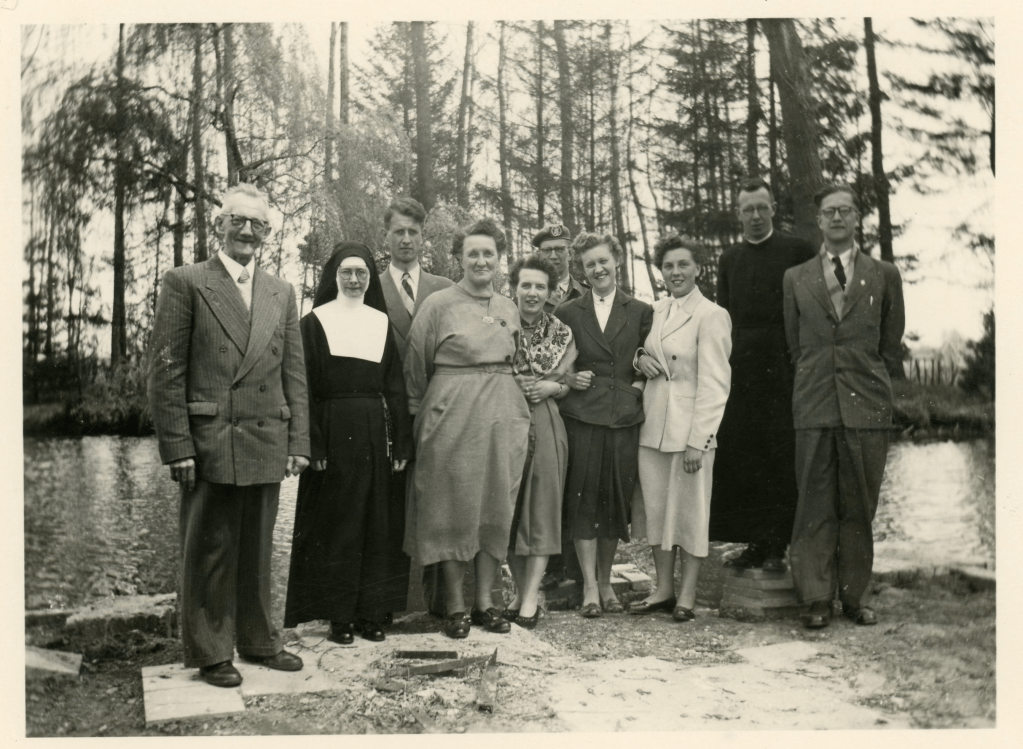
The van Rooij family in 1954, including two sister-in-laws.

The shadow of family looms large for all of us, and in the case of the van Rooijs, their moniker as the Holy Family is evident from the 1954 family photo and my Mom’s photo album which features numerous pages devoted to Tante Lina, a missionary nun in the Congo and of Uncle Herman, a parish priest in Belgium. Despite my mother being physically taller, she appears shorter than Tante Lina in this photograph, a symbolic representation of her parents’ behaviour, a hurt which manifested itself in unforeseen future decisions.

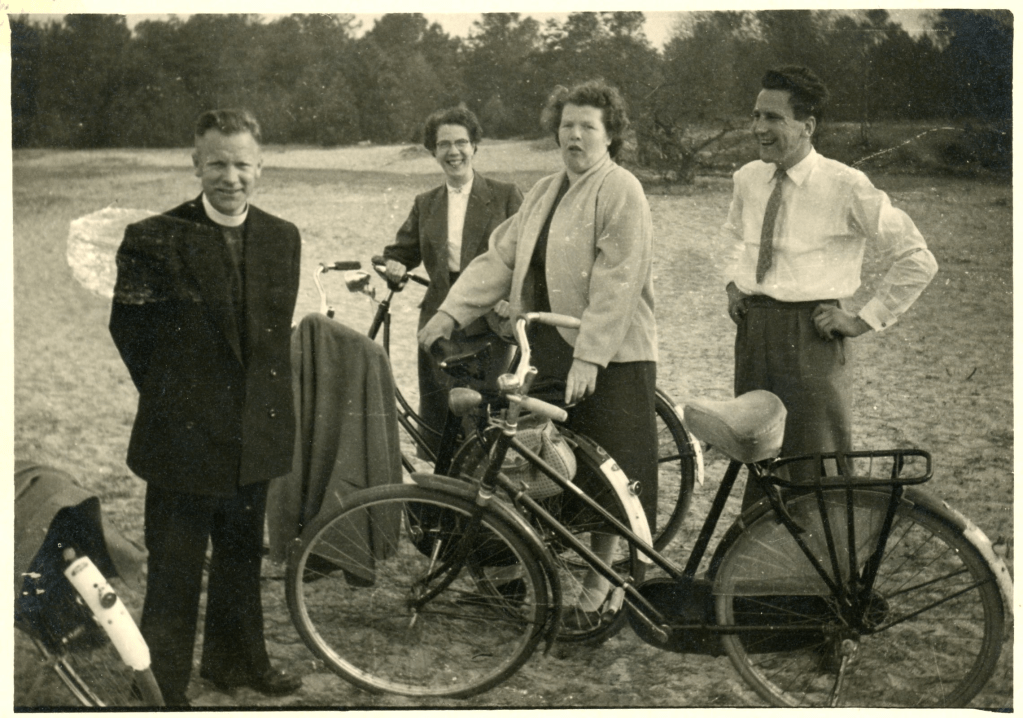
Very few pictures of my parents as a couple before their wedding, dating or engaged, appear in any of the albums. I recall each of them telling the story of my grandmother, Oma on my Dad’s side, being in the hospitable where my Mom was a nurse. If memory is correct, Oma may even have encouraged the linkage. The earliest picture of them together is dated 1956, looking to be in the kitchen of the house in Tilburg. I know little else about their courtship.

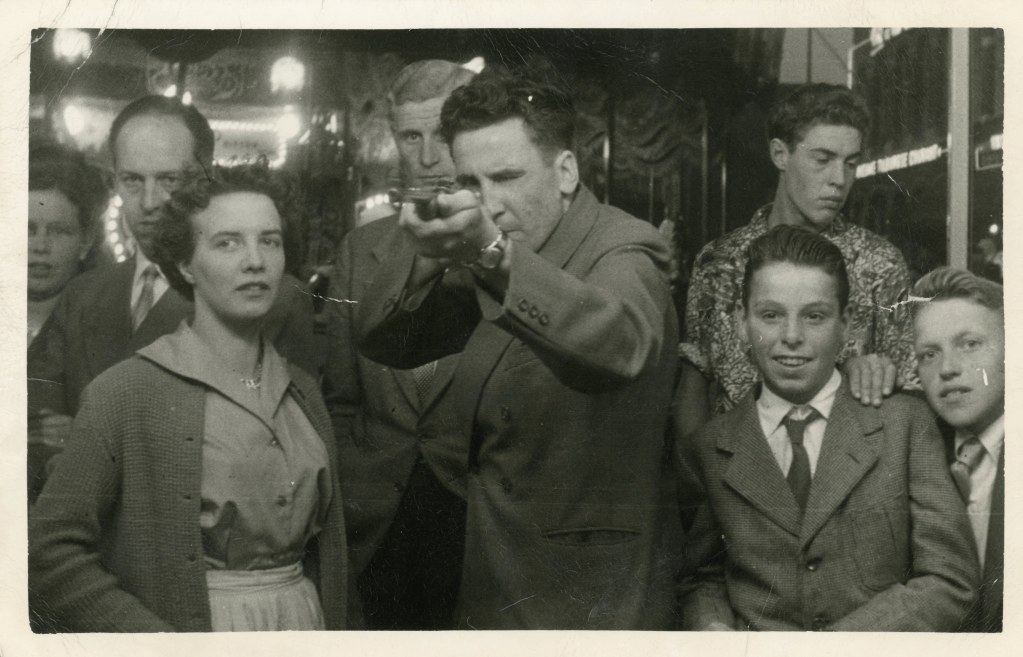
Undated photo, probably from the annual fair in Tilburg.

One remarkable, untold story is depicted in this photograph of my Dad showing off his marksmanship at a booth at the annual fair (kermas?) in Tilburg. The photo probably accompanies the price for the opportunity to shoot at the targets and win a prize. I expect the printed copy was given to my mother for keepsake as it can be found in her album. The full details of the photograph are unknown and are now subject to conjecture and interpretation all these years later.

My parents lives and that of their immediate families are those of the ordinary people seldom discussed in the history books or eulogized in documentaries or glamorized in the movies. Yet story after story emerges from the photographs as I wade through the collection; some from my own memory of the event or from my recollection of my parent’s telling. I am reminded of the 1999 Giller award winning novel, A Good House, by Bonnie Burnard, described in the flaps as a novel about an “ordinary” family where “each character must live out his or her own destiny, not knowing what triumphs or tragedies lie ahead”. In one critics view at the time, “Burnard spins her engrossing debut novel, a traditional saga that unfolds with quiet grace and measure…the book traces the upheavals and affirmations of the very ordinary Chambers family…There are no saints, no Jobs, no Hamlets in Burnard’s tale, just flawed people making the best possible choices given the passions and options of the moment…”. https://www.publishersweekly.com/978-0-8050-6495-7

Now that my Mom and Dad have both passed, I will have to piece together what I can glean from the pictures, many with people I don’t recognize or in places I don’t know. My parents are no longer here to explain and I did not take enough time to ask when they were with us, when I had the chance. I expect my brothers will be able to fill in some of the gaps but many stories will remain buried.

For now, all I have is a photograph to piece together their life with the hope to capture it with accuracy and dignity.

The streets have no names

Verifying the third “fact” about Fr. Kees de Cock proved to be the most difficult challenge as I embarked on a hunt to discover the street bearing his name.

My first step was to conduct a Google map search of Kampala, the city where my Dad believes the street is located. I have employed Google maps on innumerable occasions to obtain a picture of a building for many of my destinations. If someone were to visit my home, for example, they would receive directions spoken over the phone and could retrieve a picture of our house to ensure arriving at the correct location. I recall with great fondness how my Dad, from the comfort of our home, was able to show his grandchildren the house where he lived in Tilburg, the Netherlands, and walk them down the street to explain the various buildings, the school he attended, the church where he was a member. As a tool it is mind boggling.

I had expected, naively perhaps, the default map view of Kampala within Google would reveal my Uncle’s street; zooming ever closer to see increasing detail, I found most of them unmarked. I systematically and methodically surveyed squares of all parts of the city, moving from the northwest corner down to the southwest, back up north, eventually to the southeast section. I could not find any street even remotely labelled in a manner to suggest it might bear Fr. Kees de Cock’s name sake.

There are roads and streets named after people: Wilson Road, Ben Mali Road, Prince Luswata Road and probably more but I am unfamiliar with the language and the history. My search also revealed large inconsistencies in what Google displays. Sections of Kampala show areas with an abundance of labels and where names are common: Oakland Lane, Mango Tree Lane, Valeria Road, Dream Home Road, Semukuutu Road, Murihira Land; and others are clearly numbered: B17, A31 C25. The roads around and within Makerere University all bear an appellation.

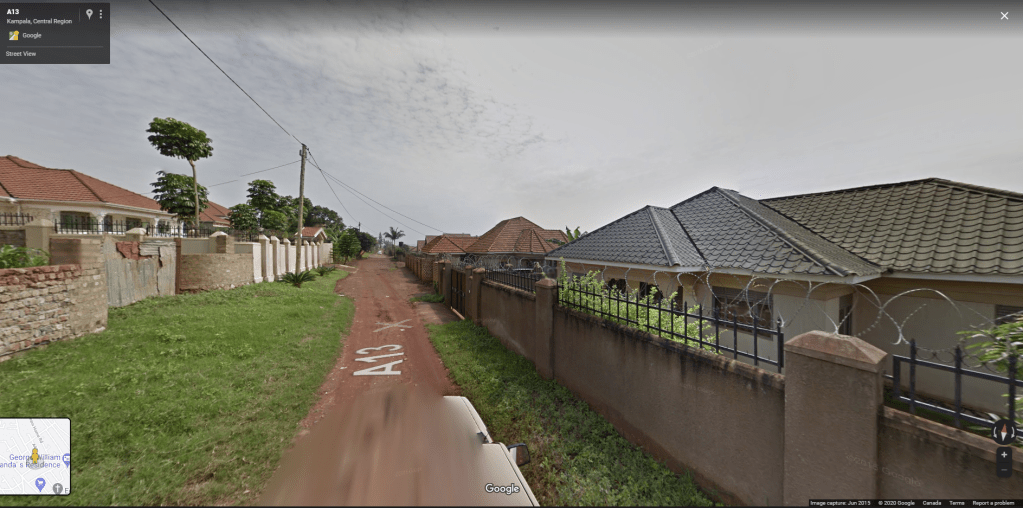
Street view of a section of Kampala where the streets are entitled Oakland Lane, Mango Tree Lane, Valeria Road, etc.

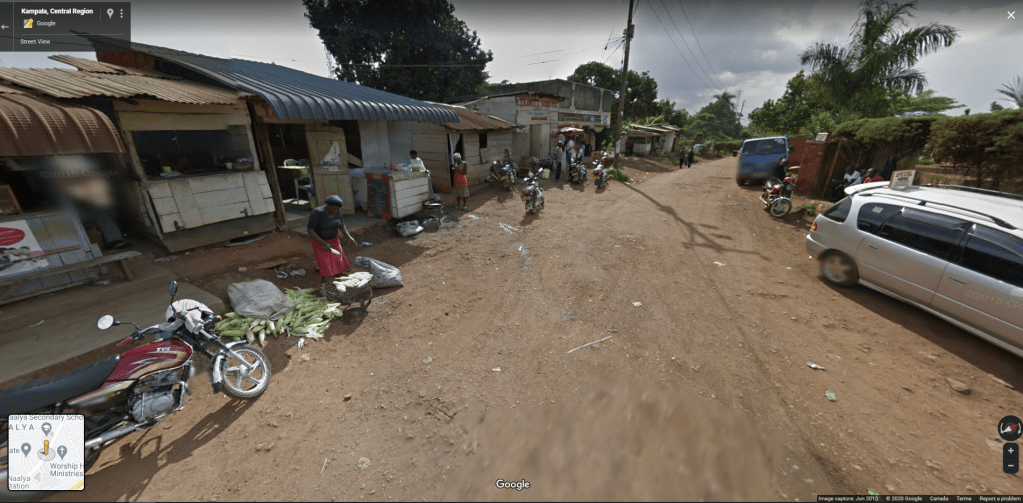
In numerous corners of the city, however, whole sections are untitled, showing only the curves and bends of neighbourhoods without a sense of place. The satellite view provides an overhead look at the roofs of houses and buildings, the trees and greenery, the paved and dirt roads. When you add the street view option, the limitations of Google maps to find very specific locales are revealed.

A street view of a random section of Kampala unmarked by Google or obvious signs

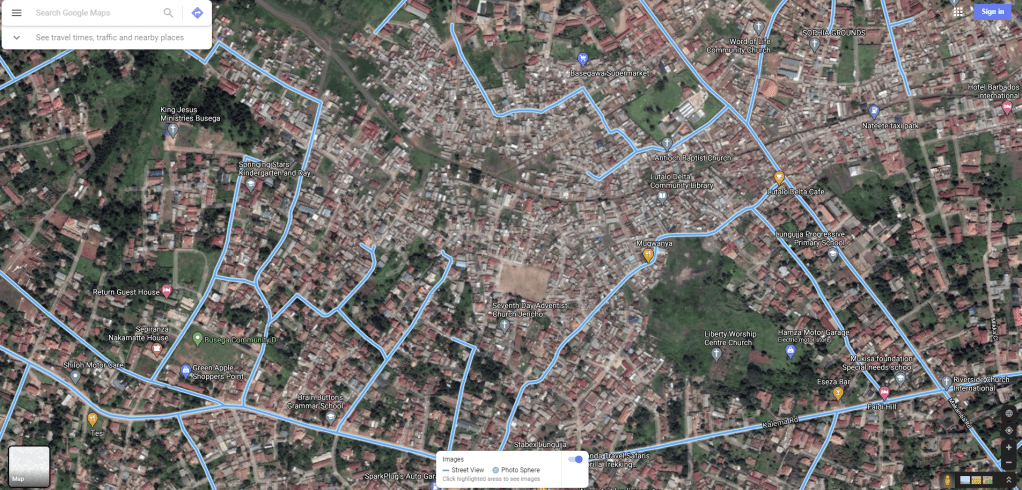
Any city of significance in the western world where all dead end streets, each court, and every lane way are displayed, you can locate the address of your choice; Kampala, the capital of Uganda, home to 3,280,000 people has been photographed selectively. You cannot get any more specific than major intersections; the maps are bereft of considerable detail.

Satellite and street view map from a random section of Kampala

The logic of Google maps in determining which landmarks to display can be mystifying. A search shows the location of religious buildings, schools, and municipal buildings, all which make sense for the interested. Paradoxically, Google also decided to mark “Kisa day one old chicks”, “Happy Boyz Bar” and “Ani alemesa pork joint”, examples of the obscure and curious to be found perusing maps of Kampala or those of other towns.

A search of Kamuli, thinking possibly my Dad mixed up the location, proved even more fruitless. Kamuli Road and Gabula Road, the two main thoroughfares in and out of the town (population between 15 and 54,000 depending on who is counting) are labelled; and curiously, a small artery, Temple Road, is also marked. Names of other streets do not appear to exist. Furthermore, not a single spot on the Kamuli town map and for miles around it have pictures in the street view look.

The lyrics for U2’s song, Where the Streets Have No Names, were intended to represent an ideal world where a person is recognized for themselves rather than be judged by the location of their home and street:

The lyrics were inspired by a story that Bono heard about Belfast, Northern Ireland, where a person’s religion and income were evident by the street on which they lived. He contrasted this with the anonymity he felt when visiting Ethiopia, saying: “the guy in the song recognizes this contrast and thinks about a world where there aren’t such divisions, a place where the streets have no name.

https://en.wikipedia.org/wiki/Where_the_Streets_Have_No_Name

Google has turned Bono’s intention on its head. Not having a name attached to your street reflects a lower rung of the hierarchy in a world of consumers and users; and is concomitantly, emblematic of your perceived global importance.

The absence of a street bearing the name, Fr. Kees de Cock Boulevard/Road/Avenue, in itself is not evidence of its non-existence. It may not be in an area to meet Google’s standards for inclusion; it may have been an adopted name rather than an official designation. My father may have mistaken the place and instead, the street is a humble lane in Kamuli where only the major roads are marked.

Rather than dismiss his assertion, I choose to believe the street exists without seeing it, holding faith in my Dad’s repeated recollections. He was correct in the other two “facts” and therefore, likely was accurate in this claim as well; the proof is just not as easily found. I expect the street is close to my Uncle’s parish in Kamuli, known only to its inhabitants because of the enduring influence of Dikoko and the pillars he helped build. It would be populated by the ordinary people he served. Not being identified by Google maps may indeed be a badge of honour.

And if the street has no name, then it reflects Fr. Kees de Cock, because he treated everyone equally.

Please don’t call me Sir

I had more faith in my father’s second “fact” about Uncle Kees being recognized by the Queen. I had doubts, however, having never seen any evidence.

I am unclear about the basis of my father’s faith, whether or not my parents had seen any pictures or were simply repeating the information as relayed to them from the other relatives in the Netherlands. The honour certainly makes for a good story, but uncovering the details is problematic without some more concrete details.

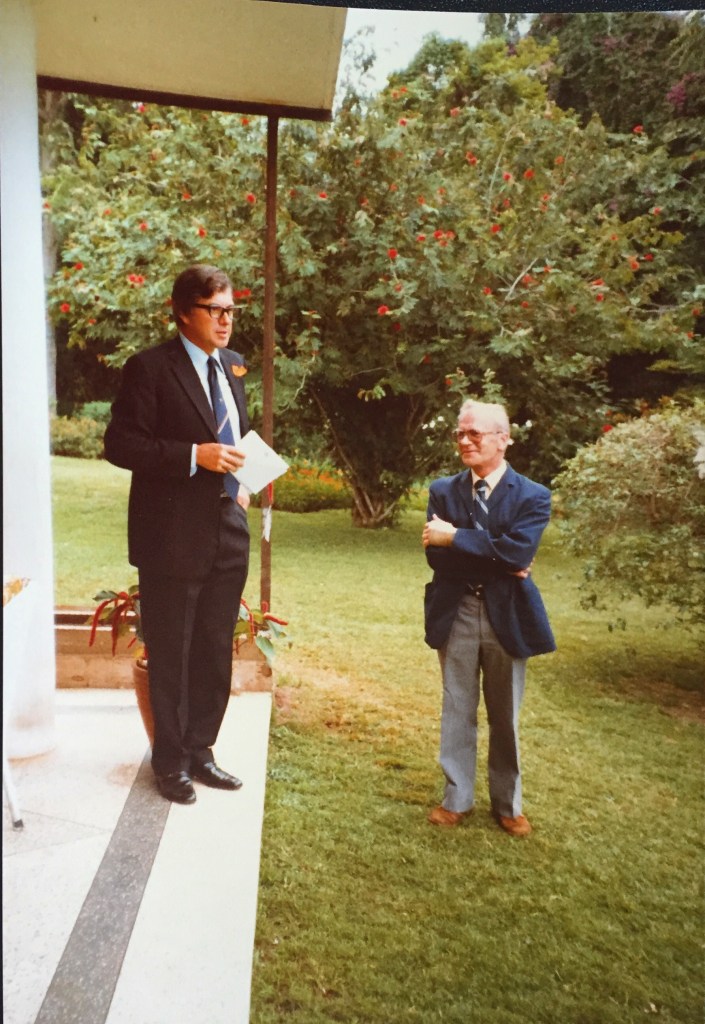
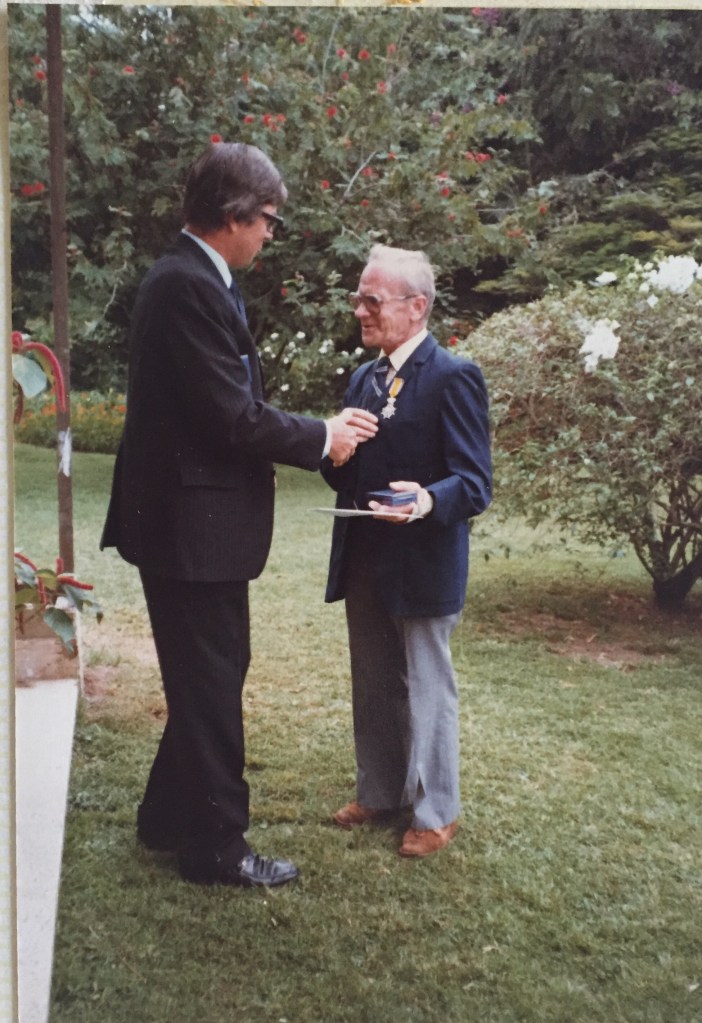
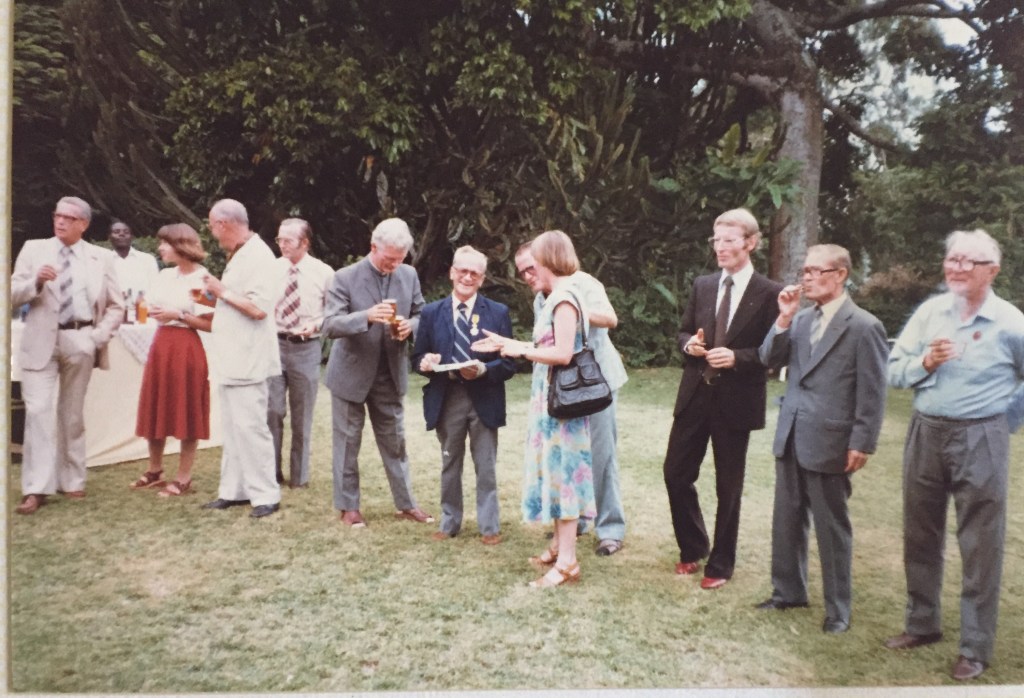
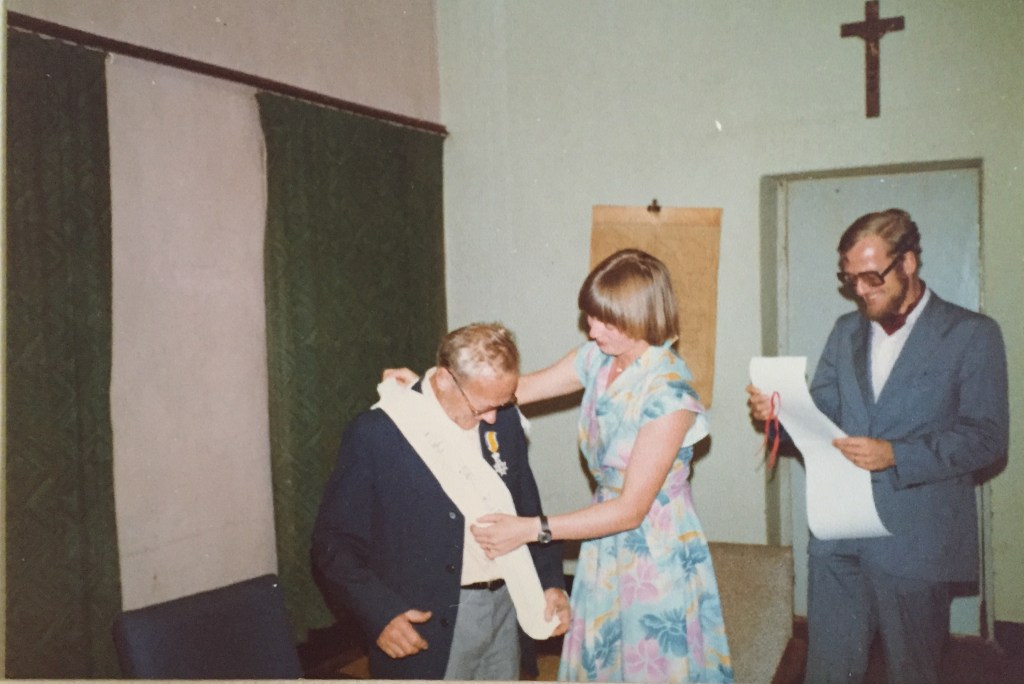
During my last trip to the Netherlands, the picture became more clear when Dr. Cees van Deursen displayed his collection of photographs from Uganda while working at the hospital in Kamuli. A very officious looking gentleman appears to be pronouncing the accomplishments, congratulating Uncle Kees after the medal is pinned to his left lapel, followed by a small reception of friends and co-workers.

Uncle Kees looks uncomfortable, almost embarrassed, standing alone, at the front, hearing a litany of praise about his work from a representative of the Dutch consulate in Kampala. His look turns to pride in the second picture after a congratulatory handshake, exploding into relief and joy when the ceremony is over, awaiting a welcome beer to share with colleagues and friends.

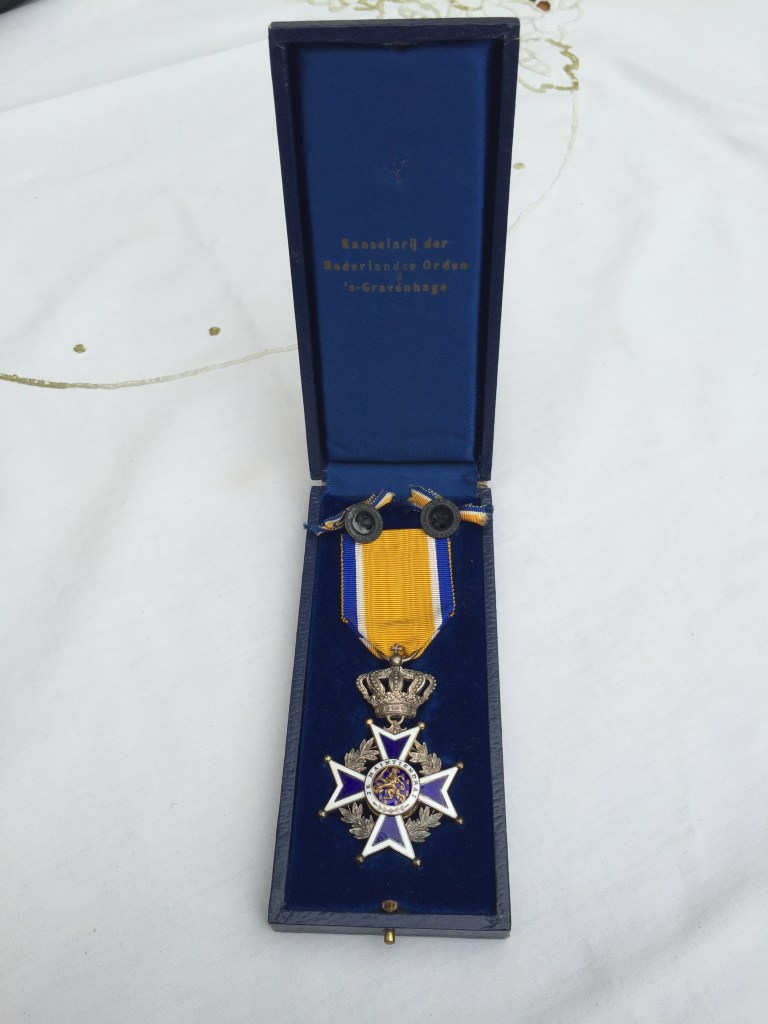
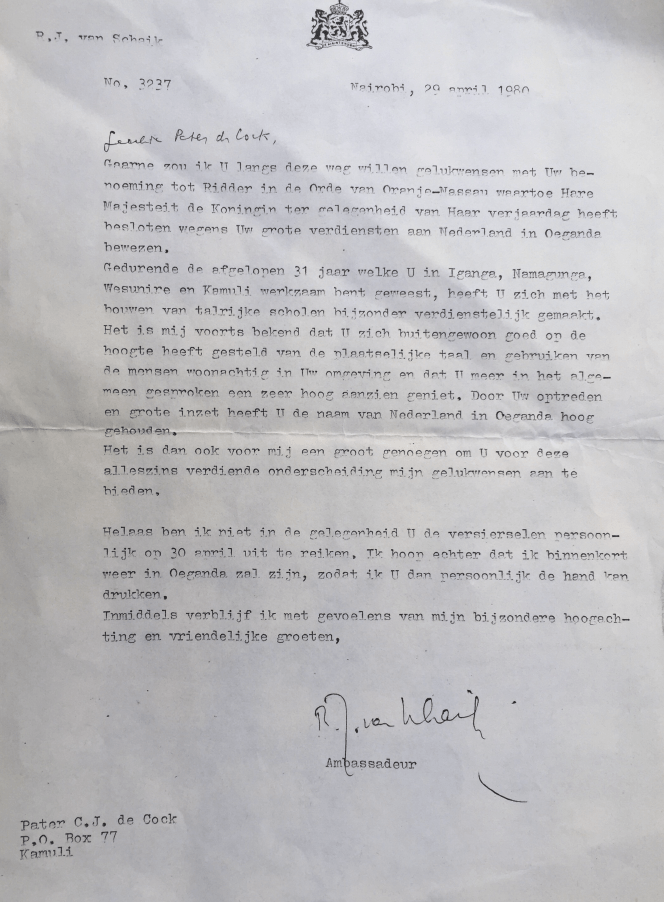
The evidence was complete when I was able to touch the medal itself, hold its weight in my hands, feel the intricacies of the craftmanship; and later, listen to the words of the proclamation itself as read from the original letter (copied below).

Fr. Kees de Cock was appointed as a Knight in the Order of Orange-Nassau, awarded by her Majesty the Queen, on the occasion of her birthday on April 30, 1980. The order was created in 1892 to recognize foreign diplomats, as well as Dutch citizens, for their service to the nation. Knight is the fifth class of six categories.

The letter itself speaks to a few of his accomplishments, the places where he was stationed and the schools he built. It notes Uncle Kees’s acquisition of the language and adoption of the local culture, understating the love of the people he served. Every conversation about Fr. Kess de Cock is imbued with words of praise of him as a person, adored by all those with whom he interacted. All of us wish our legacy will remembered with the same fondness.

I wonder how he would have reacted to the lines which praised his work as “great merits to the Netherlands in Uganda” and how his “actions and great dedication have kept the name of the Netherlands in Uganda high” (as per the Google translator which can miss language nuances). The question is pertinent given my own father’s disdain for the monarchy, royalty of any nation not just the Netherlands. Such incredulity must emanate from experience and an upbringing which fostered these views, which I expect, were part of the de Cock household (passed down here in Canada to myself and my siblings; my own is more nuanced now). My Dad claimed Uncle Kees did not tell him directly about the honour because, quoting his older brother, it was “just the queen”.

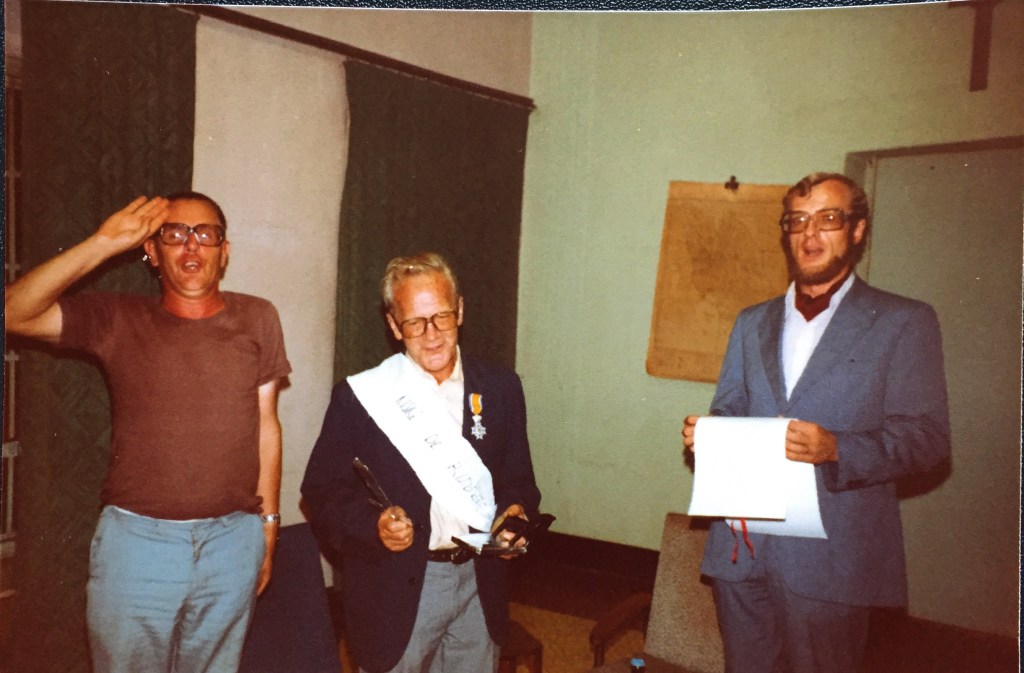
The photographs above depict an after party of sorts, another ceremony back in Kamuli, without the pomp and the ties. Uncle Kees was presented with a sash which reads, Kiske de Ridder (Kiske the Knight) and an accompanying sword, for what is a knight without one. After the proclamation, he then received the customary salute before the night was capped with beer and ground nuts. An evening of laughter, suffused with a hint of mockery, intended as a celebration among friends. The scene reminds me of the line from the movie, Michael: You gotta learn to laugh; it is the key to true love.

I wonder, as well, if the actions are a form of modesty, a deflection away from him so he could focus on the work and the urgent needs, letting the attention flow there rather than to himself. The photographs with him receiving the medal suggests a man proud of the recognition and certainly of the attention given to the work. Uncle Kees was devoted to the people of Uganda and not concerned with how his efforts situated the Netherlands in the eyes of the world.

The knighthood he received is analogous to the Order of Canada, for the Canadian readers. The rest of the world can compare the honour to the Order of the British Empire, where recipients are knighted and can use the title, Sir. Such is not the case for those in the Order of Orange-Nassau.
Regardless, I know Kiske* would insist, please don’t call me Sir.
*Kiske is the diminutive version of Kees; a term of endearment.

You too could be President

It’s after eight o’clock on Friday evening, November 6, three days after the close of the polls and we still do not know who will be President of the United States.

I have been following the numbers since Wednesday morning, watching them change as the mailed in and absentee ballots are being counted. I started with the CBC tracker which was sufficient until I realized the Globe & Mail also had an interactive map which not only provides the percentages but also the actual count for every single candidate, not just Biden and Trump. You can even narrow the analysis to individual counties for a breakdown. For numbers junkies like myself, this treasure trove of information was nirvana.

Consequently, I kept checking every couple hours on the swing states: Wisconsin, Michigan, Pennsylvania, Georgia, North Carolina and Nevada. I watched as slowly the Trump leads in Wisconsin and Michigan were whittled away to an eventual declaration for Biden as the winner. I clicked onto Georgia and Pennsylvania every couple hours to witness the painful pace of additional votes added parsimoniously, eventually giving Biden the lead. North Carolina does not seem to change.

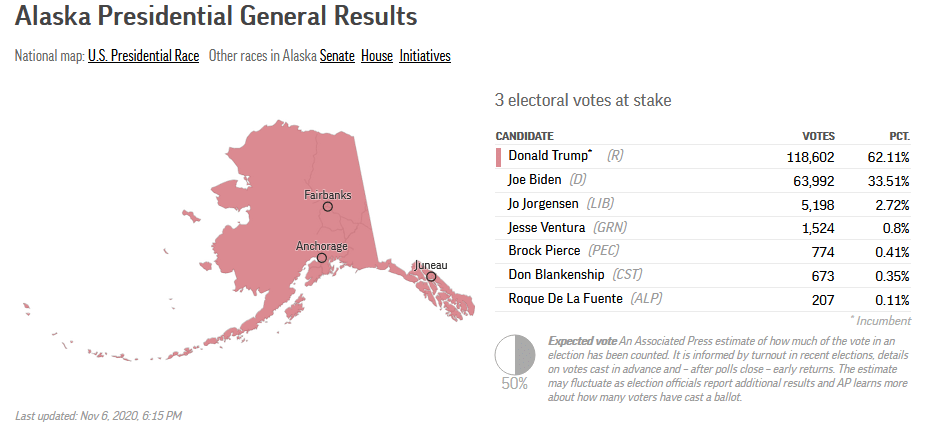
Can someone please explain Alaska. It is never mentioned in any news feed on my smart phone. Not considered a swing state, it continues to be shaded Republican red because it is too close to call even though Trump has 62 percent of the vote with an estimated 50% of the votes counted. The vote for the remaining votes would have to be a complete reversal to change the results. What do they know and are not sharing?

Globe & Mail, November 6: https://www.theglobeandmail.com/world/article-us-election-results-map-watch-donald-trump-and-joe-bidens/

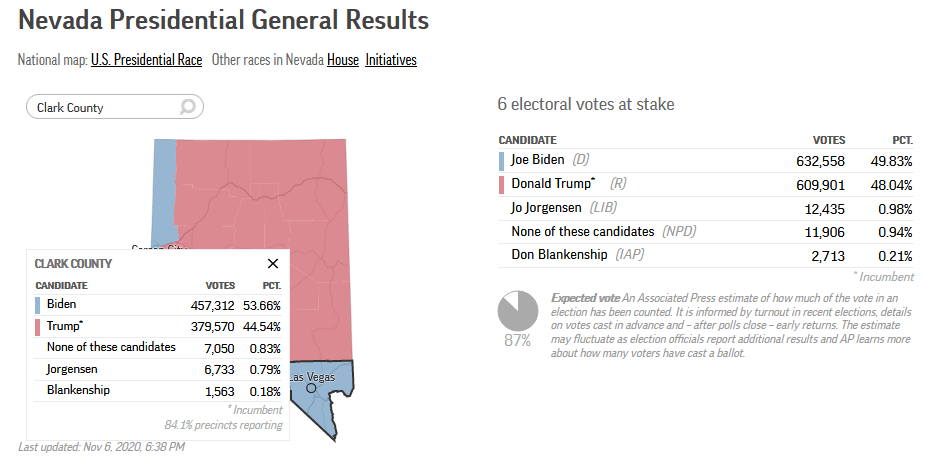
And then there is Nevada.

They are proudly taking their time and will not likely finish until Sunday. I keep returning to the state as the percentage of votes counted ekes upward with only a marginal change in the gap between the two front runners. As well, Jo Jorgensen, presidential candidate for the Libertarian party has not moved out of third spot but is only 500 votes ahead of “None of these candidates”.

What a novel concept. As a citizen of the Nevada you don’t have to spoil your ballot or hand it back to the scrutineer as a protest against all the candidates; rather you can check the box, “none of these candidates”, so the choice is officially recorded. Indeed, Jo Jorgensen, who was born in Libertyville, Illinois (clearly destined to be a Libertarian) was behind “none of these candidates” in several counties including the largest, Clark County which encompasses Las Vegas. I expect her message was deemed to be as unappealing to 7,050 voters as was Trump’s and Biden’s.

Globe & Mail, November 6: https://www.theglobeandmail.com/world/article-us-election-results-map-watch-donald-trump-and-joe-bidens/

The inclusion of “none of these candidates” raised my curiosity so I began to randomly select other states wondering if the option was available elsewhere. Alas, I could not find another example; however, my search uncovered a variety of seemingly odd elements that had me wondering the strategies of presidential candidates in what I originally thought was a very straight forward electoral process.

Jo Jorgensen is on the ballot for all 50 states and as such, can legitimately claim to be the third candidate. She has managed to garner 1,700,912, or 1.2% of the popular vote so far; the counting of ballots continues and the incumbent has yet to concede.

Howie Hawkins, presidential candidate for the Green party has only managed 340,386 or 0.2% to remain a distant fourth. I don’t how he expected to have challenged Jorgensen for third, let alone the other candidates since Hawkins was not on the ballot in 30 states by my count, including the so-called battlegrounds. I would have thought, given the propensity for those states to select a different president from the previous election, Howie might have had an opportunity to convince them he was their man. Rather he stood for election in those jurisdictions with the highest electoral vote counts: California, Texas, New York, Florida, Illinois and 15 others. He could lose Maine, Deleware, Arkansas and Iowa and still exceed the minimum 270 to become President. If he lost California there would no path to the White House. California was called for Joe Biden one minute after the polls closed. Howie Hawkins’ night ended just after 11:00 pm EST even though I don’t recall any broadcast of his concession speech.

The other presidential candidates, and there are many more, must have had a different strategy. Kanye West was on the ballot for 12 states, including the influential Oklahoma, Utah, and Vermont. If he managed to win in each jurisdiction where his name appeared, Kanye West would have accumulated 84 electoral college votes. His night would have been over by 8:00 pm when New York polls closed and five minutes later was declared for Joe Biden along with the rest of the northeastern seaboard. Maybe Kanye thought to win these 12 states and his electors would convince another 186 to pick their candidate for President instead of the person with the most votes in their respective states. These so-called faithless electors are rare but according to the Globe & Mail, there was a record number in the last election. This extraordinary year of 2020 could have been the one to break the mold. There is nothing in the constitution to stop faithless electing so anything is possible.

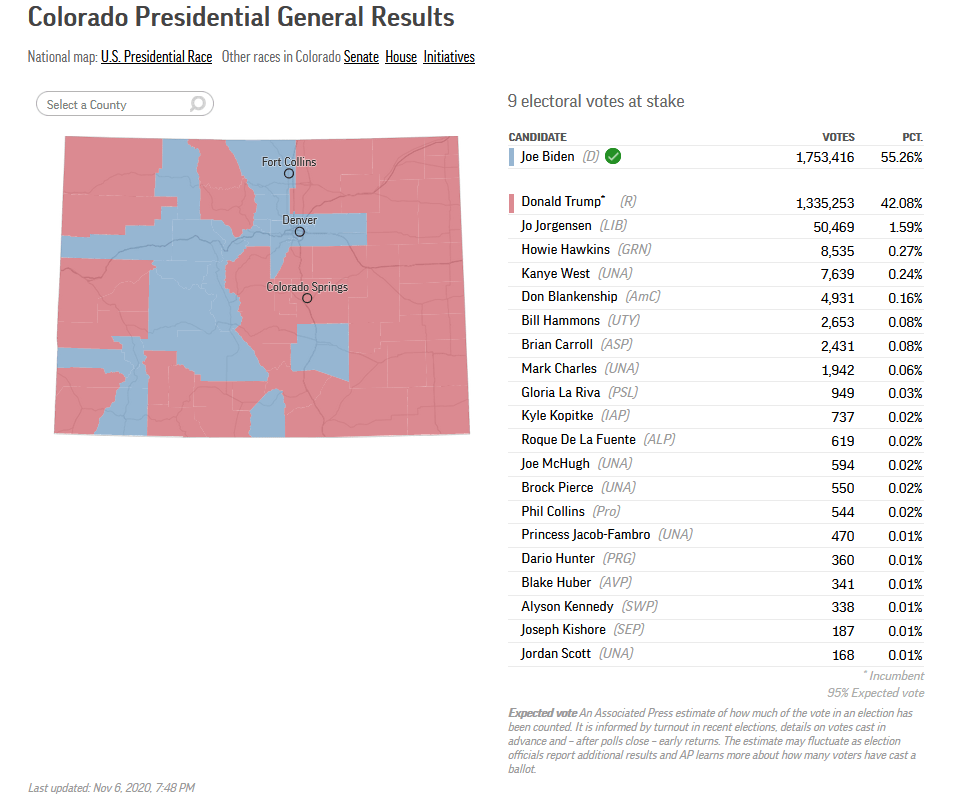
In order to win Colorado and Vermont, Kanye would need to accumulate more votes than 20 other candidates on the presidential ticket. Aside from Trump and Biden and Jorgensen and Kanye, there are 17 other people who are vying to be president of the United States. The names are not identical on each list so the number of contestants is even higher. Zachary Scalf who has thus far managed 31 votes in Vermont is not on the list in Colorado. Good thing because he probably would have fared worse than Jordan Scott, last in terms of number of votes there with only 168.

Globe & Mail, November 6: https://www.theglobeandmail.com/world/article-us-election-results-map-watch-donald-trump-and-joe-bidens/

I am unclear what they envisioned as their path to the White House. Perhaps these long-shot candidates were looking at precedent. If someone like Donald Trump could become the President of the United States, then anything is possible. They too could be president.

Post-script:

By noon of November 7, the Associated Press had seen enough, calling Pennsylvania for Joe Biden and thereby proclaiming him the 46th President of the United States. Nevada was also declared for Joe while conclusions about the winners for Georgia and North Carolina are still pending.

What of Alaska? The numbers have frozen. An update check at 2:30 pm today shows not a single digit has been changed and Trump’s 62% of the counted ballots remains still “too close to call”.

Jo Jorgensen managed to pick up some more votes, squeezing another 26,000 votes nation-wide. I think she should call it quits.

Based on his track record, I expect Kanye is still holding out for a miracle conversion of unfaithful electors.

Beware the electoral college.

Building pillars

The information about Uncle Kees arrives in dribs and drabs, in no particular pattern and from a variety of sources. The stories from my Dad were the beginning, leading to different forms of inquiry with little basis except that Uncle Kees was part of the Mill Hill Missionaries, stationed in Uganda in the town of Kamuli. As material is uncovered and discovered, ever so slowly, I attempt to link the information to create narratives in my mind, much of which will find its way into these blog posts.

I thought to start by tackling the three “facts” identified in my previous posting, beginning with my father’s assertion there was a building named after Uncle Kees. My Dad did not specify where this building was located (Uganda, of course, perhaps Kamuli) or the nature of the building; nor did he possess any pictures. I did not know what to look for, expect or imagine, hampered by my poor knowledge of the country and ignorance of the life or circumstances of the people.

In May 2016, Olga and I visited the Netherlands, part of a regular connection with family in Europe. On this occasion, I had arranged in advance to meet with several cousins in order to learn more about Uncle Kees. The visit included a dinner with Corrie, daughter of my Uncle Gert (youngest in the Decock family), who visited Uncle Kees in Uganda in 1979. She also connected with Dr. Cees van Deursen, and arranged for him to join us for a the meal and some reminiscing at Uncle Gert and Tante El’s home (this occasion would be the first the two have gotten together since their respective return more than 30 years earlier). Dr. van Deursen was a young physician who worked with Uncle Kees in Kamuli for three years from February 1978 to March 1981. The Doctor brought with him and shared stories, film and pictures from his time. The evening was filled with laughter and fond memories and a few tears with the recall of my uncle’s passing.

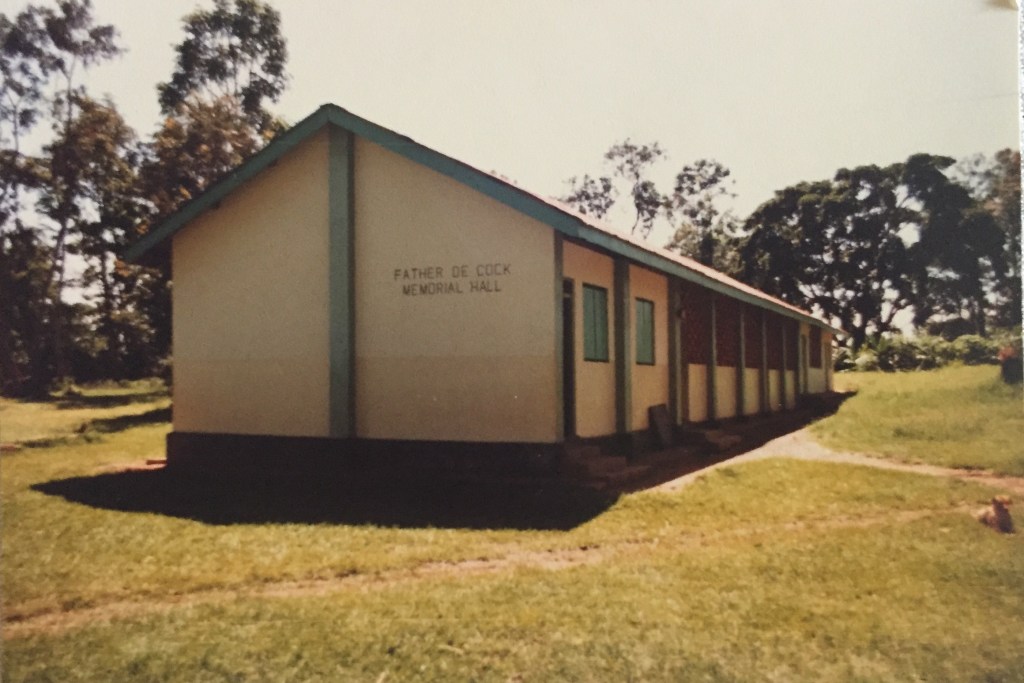
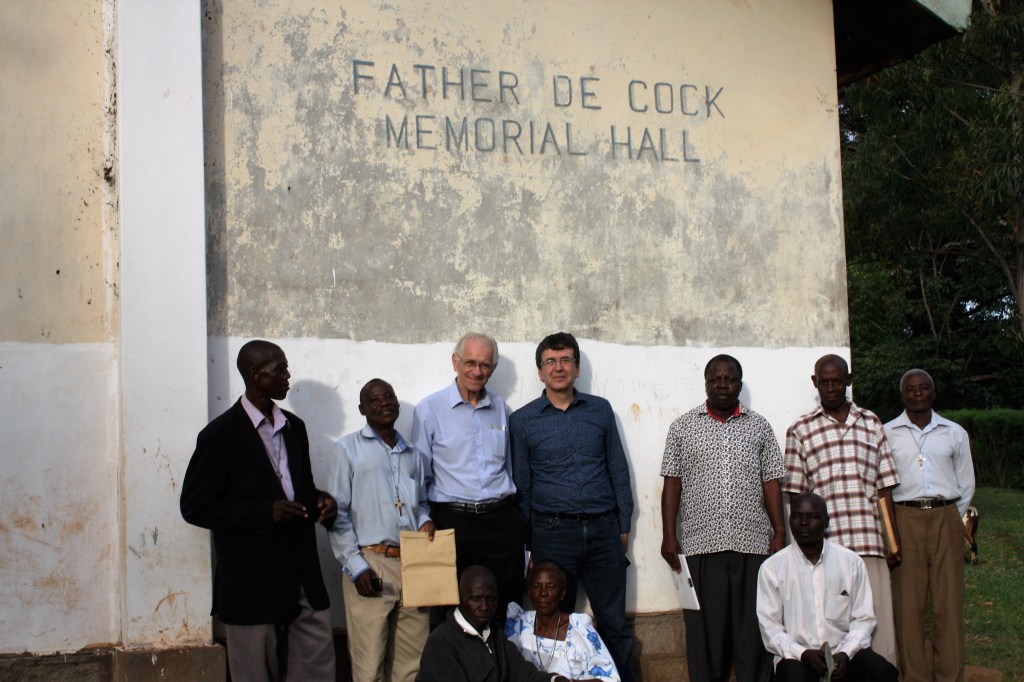
Among the doctor’s collection of photographs was one of the building: FATHER DE COCK MEMORIAL HALL.

It was true. There was a building name after Uncle Kees, in memory of his life’s work in the parish. The precise location still eluded me but the image eventually became my proof of legitimacy when I wrote to the Mill Hill office in Kampala a year later making inquiries and arrangements for a visit in May, 2017 when I was able to witness for myself the structure bearing his name. It was situated behind the church, a stone’s throw from the rectory, the hospital and a school house.

Picture from early 1981

The hall as taken during my visit in May 2017. Father Wijnand Huijs (third from left, standing) was my guide.

The hall was very simple, in need of some sprucing both inside and out. There were no windows. The walls were largely made of blocks, checkered with spaces for air flow to manage the heat. At the front was a small stage, with a table facing a long, solid dirt floor. It showed signs of regular use and typified other structures within the compound.

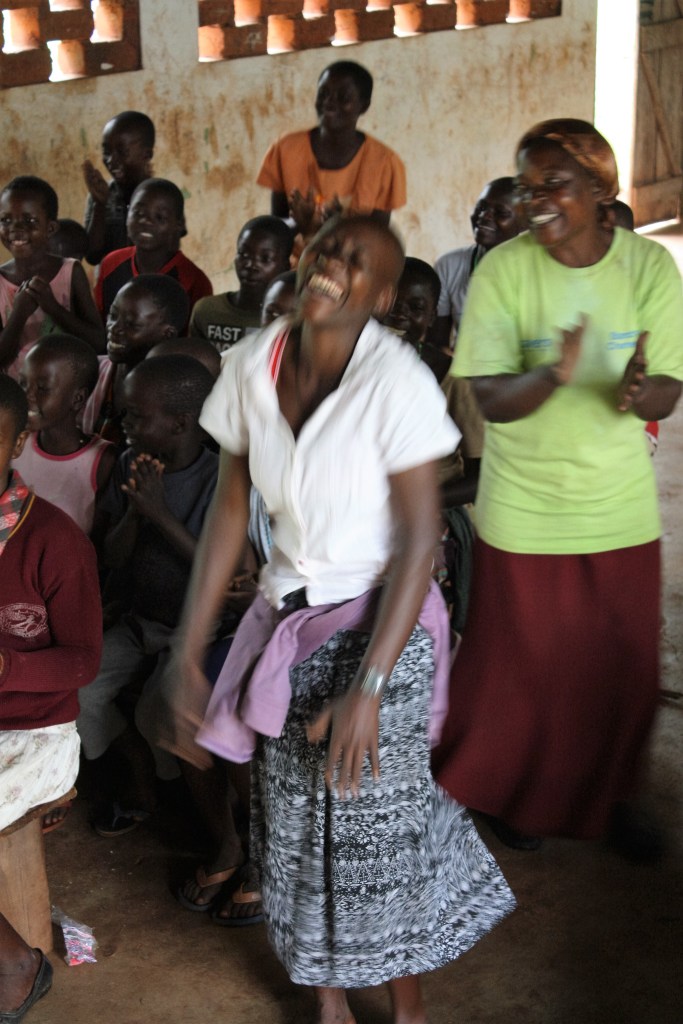
Inside, in the morning of the next day, we encountered a group of children who feted me with a rousing song, celebrating the visit of the “son” of Fr. de Cock. They welcomed me with the enthusiasm for a royal visit, ironically, the kind of recognition my uncle would have shunned. The entire experience was humbling and overwhelming.

My Kamuli hosts, members of the church and people who had worked with my uncle in some capacity in the parish, informed me that Fr. de Cock built the hall. In fact, he was responsible for a number of buildings in the surrounding area: several churches in other communities; Lubaga Boys Primary School; St. Pius X Junior Secondary School; the St. Francis ward in Kamuli Mission Hospital; the first permanent house for the Headmaster of St. John Bosco Secondary School; the water pipes and tanks for the hospital; and he personally physically fitted the bell to the top of the parish church.

Indeed, he was renowned for his practical skills, in particular the seemingly profound form of construction by beginning with concrete pillars, then mounting a roof before completing the walls. My hosts emphasized this point about first establishing pillars, one also explained to me in an interview a year earlier with Fr. Karel van der Horst* who was stationed at Kamuli parish for three years in the latter part of the 1970’s.

“His great idea was always pillars. Pillars, you know, I mean corner pillars of the house. A pillar here, a pillar there, a pillar there, a pillar there, then a few in between. And then the walls had to be connected to all these pillars and that was the church. So he put strong pillars, standing, made of cement and iron, the proper thing because he knew all that was needed, and then a roof on it and the rest was for the people to finish.”

Fr. Kees de Cock established pillars for education, for health, and for the spiritual well-being of the community, the foundation for their future. The affection with which people still passionately speak of his time in Uganda and his passing almost 40 years later are a reflection of his skills as a builder and his life as an “ordinary” person.

I found a second building bearing his name, a testimony to the love for my uncle by the people in Kamuli parish.

*I interviewed Fr. Karel van der Host at his residence at the Missiehuis Vrijland, Oosterbeek on May 12, 2016. Father Karel passed away two years later on May 7, 2018. I very much appreciate his willingness to share his experience and allowing me to tape the morning discussion.

Life is a highway

I want to drive it all day long.

Alas, all good things must come to an end. It was a gorgeous fall day; temperature hit 21, sun and cloud, warm breeze. The forecast was calling for single digit highs and below freezing nights for the next week. It will not be long before we will see snow activity. The riding season was coming to an end for me, and today was the perfect opportunity for that last ride before storing the bike in the cottage basement for the winter.

With each ride I have attempted to extend my learning to the real road, apply the training lessons to achieve greater comfort with riding and with my specific machine. On this occasion, I wanted to go faster, take the bike onto the highway, get ‘er into fourth gear. So, out to Highway 28 I headed.

Heading out

A train of vehicles awaited me at the junction with the municipal road. I hesitated, thinking, it is busier than anticipated and maybe not the best time. And I stood by until there was a BIG gap and out on the highway I rolled. Up to third gear, 60 km/hr for this stretch until we were past the town and the speed limit increased to 80.

More throttle as the engine revved higher, popped ‘er into 4th and we had accelerated to 90 km/hr, moving with the traffic in front. Keeping up with the vehicles meant edging faster to eventually cruise at 100 km/hr … a new league record! Well, a record for me at least.

I have now earned having this graphic emblazoned on my gas tank.

I was struck by the amount of wind. The windshield reduces much but I still felt jostled, threatening my balance, at least in my mind. I was keeping my eyes straight ahead, looking in my mirror on occasion but less than good practice would expect. I viewed oncoming traffic as an intrusion, one which I wanted to avoid, so I moved more to the middle of the lane violating another best motorcycle practice. Then it happened.

A motorcycle was approaching and as we got close together, the driver dropped the left hand to a 45 degree angle, two fingers showing, giving me the wave. Carefully taking my hand off the handle bar, I reciprocated. And with that simple gesture, I became a real biker, part of the fraternity.

The motorcycle wave

On the way home to the cottage after confirming the local golf course closed for the season, there were a number of bikes on the road , providing numerous opportunities to show I belonged. I was feeling proud of myself, excited with accomplishing the next milestone. Slowly rolling around the corner for the last descent down the cottage road, the bike veered off the beaten left tire track and the front wheel gave out on the gravel. Down I went. Welcome back to earth. I propped ‘er onto two wheels again; with a scraped elbow and knee, I hopped back in the saddle to finish that final leg. All in all, a wonderful final ride, ready to put the bike away with a sense of accomplishment.

Thank you to Mike and Michelle, my videographers for this last hurrah.

Knock me down and back up again. I love it now and will love it again. This is the road, and these are the hands that will drive me again, when the spring rolls around for another season and we pick up for more entries into the motorcycle diaries.

The wave to end my biking season.