Welcome to my world. Whether it be the documentation of some family history, a stop on the train of thought or a travel to parts of the globe, this blog is a reflection of the sights and sounds and thoughts of my interaction with it.
“The destination we find ourselves drawn to reflects an underlying sense of what is currently missing or under-supported in our lives. We are seeking, through our travels, not just to see new places but also to become fuller, more complete beings”, so says the chapter, How to Choose a Destination, found in the book, How to Travel, published by The School of Life.
India was presented as one option for Olga to complete the two workshop portion of her yoga teacher training program. We assumed one had to be international. While the other locations promised sun or novelty or European culture, the Esther Myer Studio was going to make just one more jaunt to India, so what better place to fulfill that requirement. For myself, India represented another part of the world where my knowledge and understanding was very limited. I was ready to jump at a chance when it presented itself, professionally or personally. As our lives and the world have evolved since, another opportunity probably will not happen again. This trip had to be India.
In some respects, India chose us.
We were fortunate to have experienced various aspects of the country, realizing full well our journey merely touched a tiny portion of the vast land and the people. We returned more enlightened about the world, their world, and ours.
People have asked whether or not we would visit again. We would not hesitate to recommend India given the sights and insights of our small incursion. Any return would be to another part of the diverse country we did not experience. The world is even bigger with places yet to be explored to help us continue to grow and understand and appreciate the people within their culture. We have many more places yet to travel.
“Travel accedes to its true nobility when we ensure that the physical journey can support a well-defined inner journey towards maturity and emotional health.”
From Toronto to Delhi over the Atlantic; Delhi to Vancouver by way of the Arctic, then across Canada back to Toronto. Oh yeah, we stopped in India for 22 days in between.
For those following along, the journey is chronicled in daily posts up until our night in Mcleod Ganj. The subsequent days were the most hectic of the journey with plane delays, hotel changes, long car rides, packed itineraries, head colds, long flights and recovery time.
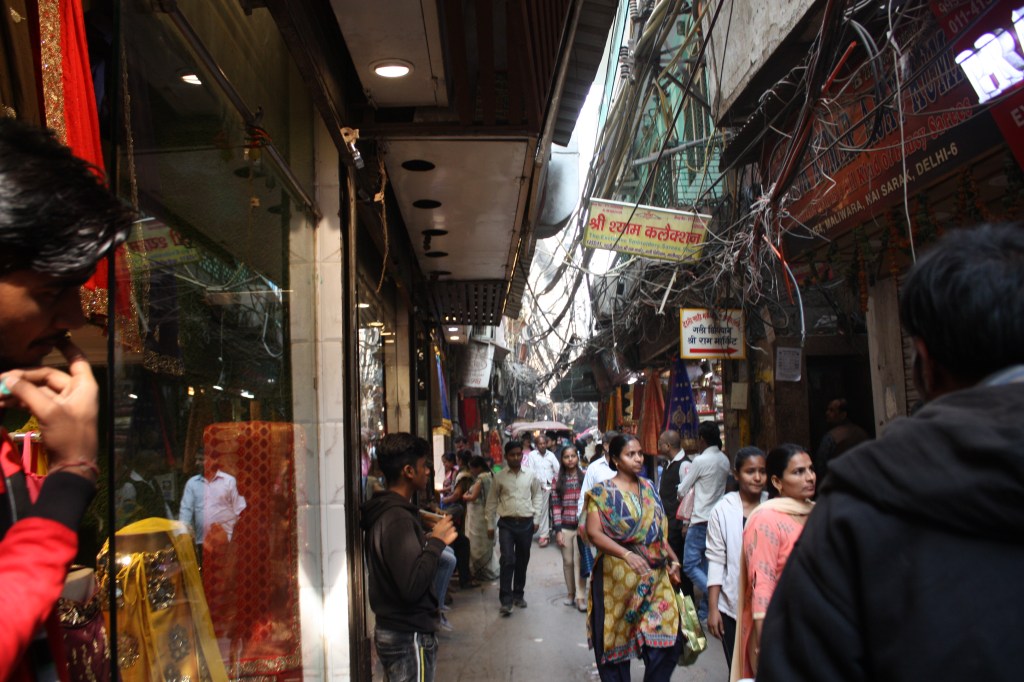
We flew back to Delhi, where we were escorted through the new and the old, taking in some of the sites making up this historic city. Our excursions ranged from the wide boulevards of the new, designed by the British, now holding the embassies of the world in a lush, prosperous environment, to the narrow, cramped charm of the old with its alleys of small shops jammed with traffic amongst its sometimes-decrepit buildings.
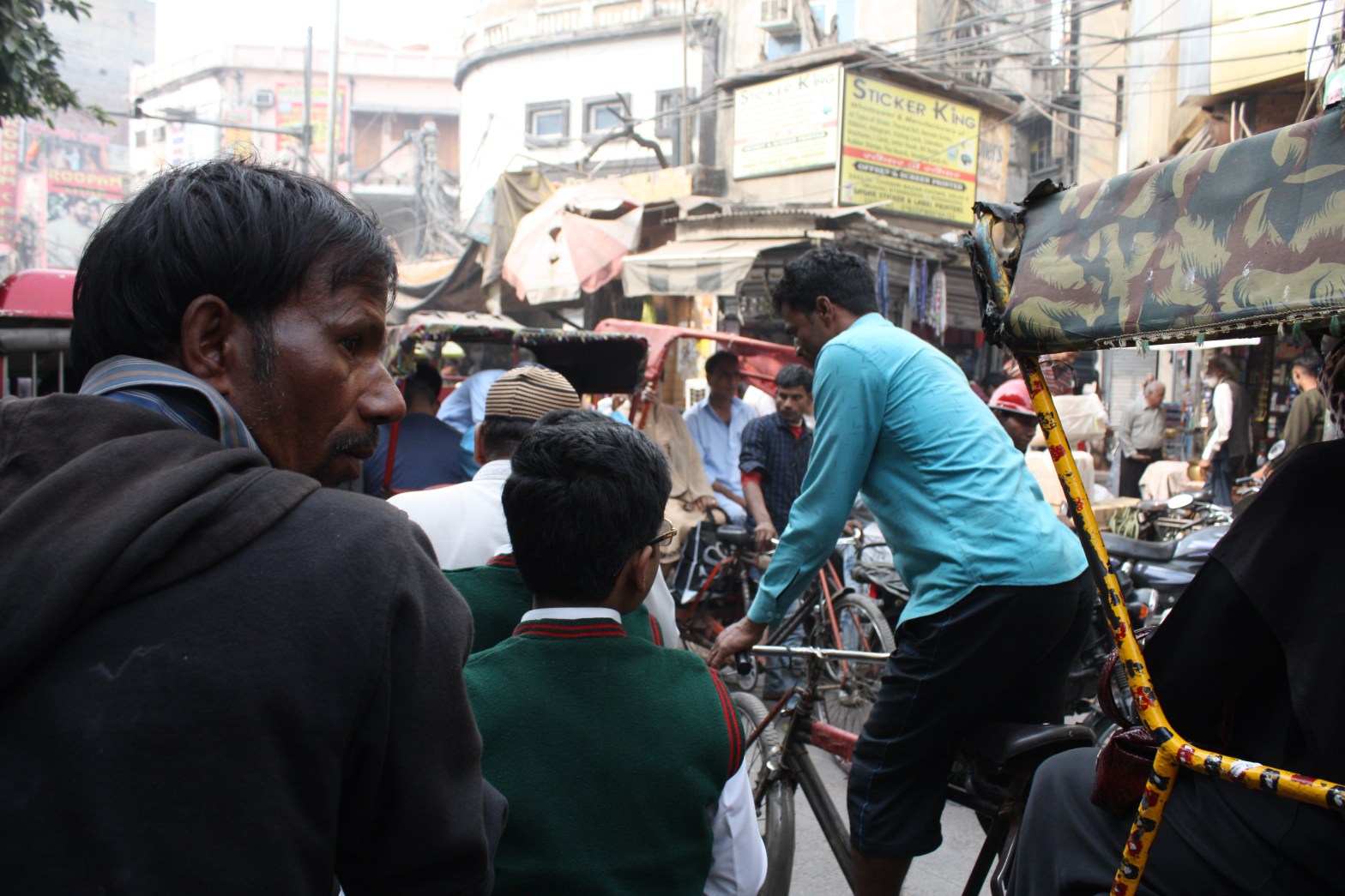
a tranche of our rickshaw ride in Old Delhi
A rickshaw ride personified all the images of India; pedaled by a skinny, grizzled driver strenuously pumping the pedals, yelling out warnings of impending collisions, pushing against the stream of traffic and into passages teeming with shoppers and other intrepid travelers. We were jostled by the conditions of the roads, swaying with each dip and bump, pushed by bystanders to help steer the impasse, smiled at by fellow riders who our driver out maneuvered. The tuktuk experience was a wild motorized ride; the rickshaw was an even closer encounter with the elements of the Indian city.
The ride was bookended by a trip to the Humayun Tomb where school children greeted Olga like a celebrity, and a pilgrimage to the Bahai Temple with it’s lotus flower shape; the day was capped with a dinner of fellow yoga retreat travelers at a distinctly middle class restaurant, giving us yet another view of the diversity of India.
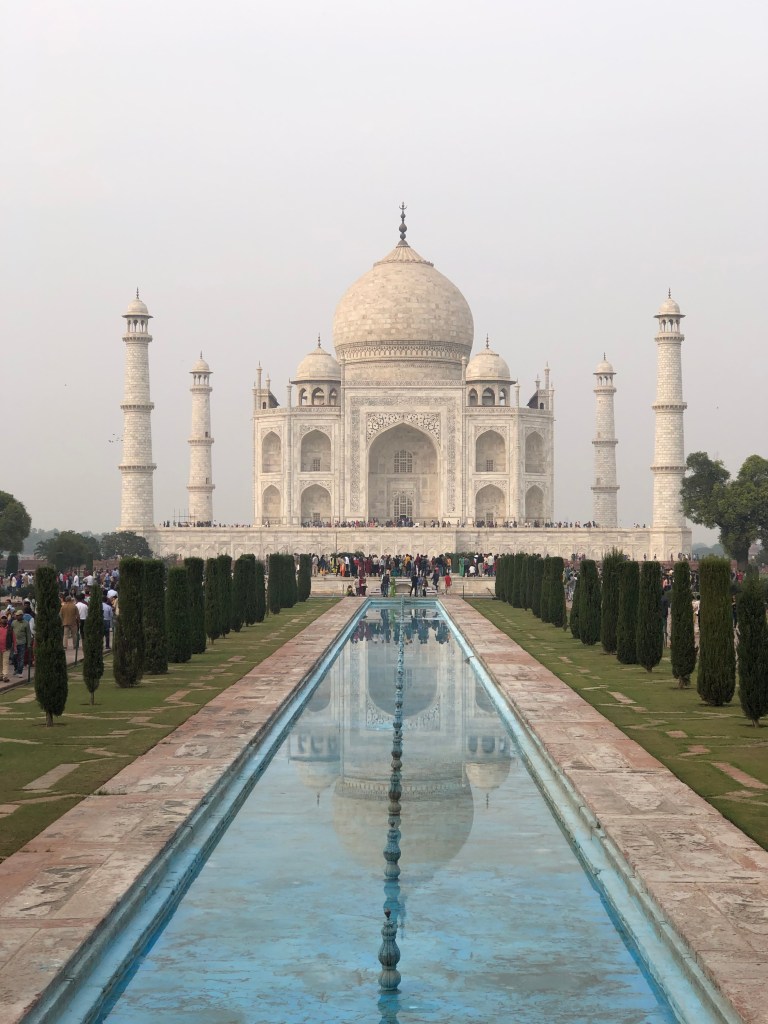
No time to luxuriate in our five star, security controlled hotel as we were on the road by 8:30 the next day getting out of Delhi in order to be in Agar for the afternoon to visit the most famous site in India and perhaps one of the most universally recognized buildings in the world: the Taj Mahal.
the picture needs no descrption
In preparation for our trip, at least one person suggested the Taj Mahal would be a disappointment because of the crowds and the ill kept city. I will say here, unequivocally, the Taj Mahal is truly a wonder of architecture with details not likely to ever be matched again. This standard photo masks the beauty of each marble stone with inlay precious jewels and the attention to detail unimaginable for a building of this size. Every aspect of the structure is planned with precision, every layout symmetrical, every element with a purpose. The four towers around the main building lean outwards to ensure they fall away should an earthquake hit the area. The 22 steps to the main entrance reflect the number of years to construct this homage to the Moghuls wife by 20,000 people, among whom the families of the artistic craftsmen continue to be financed by the Indian government to reproduce and maintain the intricate stone.
The crowds were there, but wading with them throughout the gardens and into the building was part of being in India. If you have issues with the number of people, you don’t come to India at all.
During our day long visit, which included an earlier visit to another fascinating historical accounting of the Agra Fort by our clever and informative guide, I had picked up a bad head cold. By the time we crashed into our Agha Khan award winning hotel, my day was done….I needed the comfort of the bed. We were off early again the next morning, heading for Jaipur with a stop at another fort along the way built by yet another Moghul. By the time we arrived in Jaipur, the cold was passed to Olga and we were both under the weather till the end of the trip.
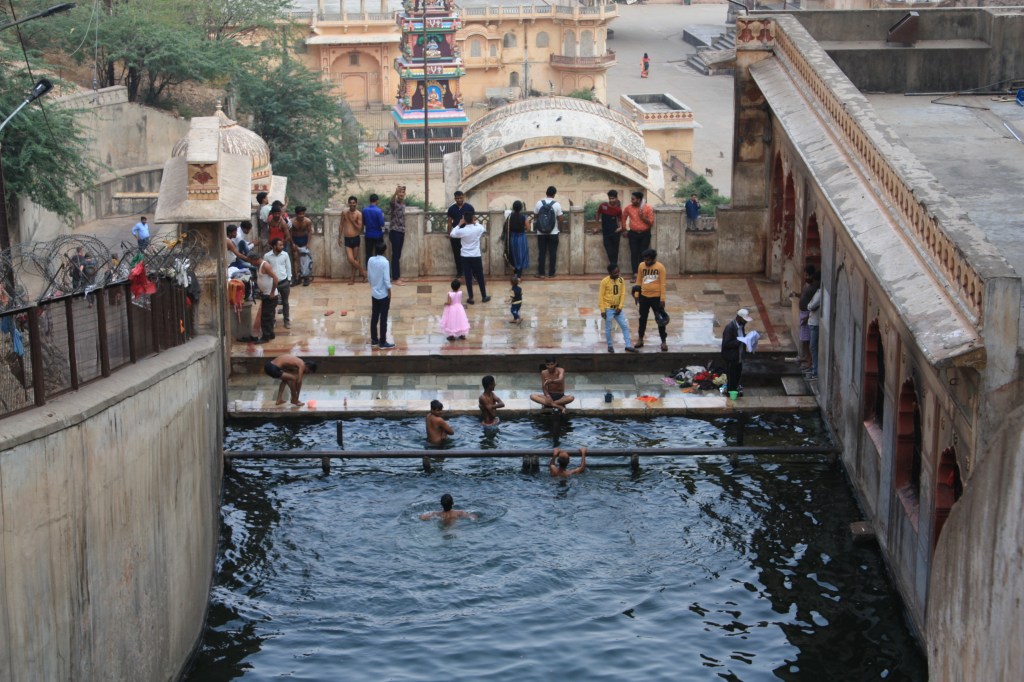
Our hotel in Jaipur was formerly the home of a minor prince, who could not continue the upkeep in its form after independence so it was converted into a luxury hotel, the rooms and courtyards an historical site of its own merit including a small step pool. Jaipur itself is known as the Pink City and by a cursory, external look appears a little more affluent than Agar. We started the day with an elephant ride to the top of the Red Fort and then toured with our third guide through the well preserved palace and a visit to a sacred Hindu temple. A subsequent visit to the observatory and the museum was rounded with perhaps the most surreal scene I have ever witnessed.
the hallowed monkey temple
The monkey temple is situated on the outskirts of Jaipur, a relatively short ride in the hillier sections, through villages where our driver steered through crowds of cattle, along deteriorating roads past wild peacocks. We pulled into what looked like an abandoned parking lot and started walking towards the eerie gate straight out of an opening segment of a horror movie. Before you enter there is on old man sitting cross-legged, draped in ragged clothing, engulfed in flies, selling peanuts. For 50 rupees he digs two scoops into your newspaper funnel and you take them through the creaking turnstile into a street lined with empty, decaying buildings from a bygone era of splendor sitting in the valley of mountains.
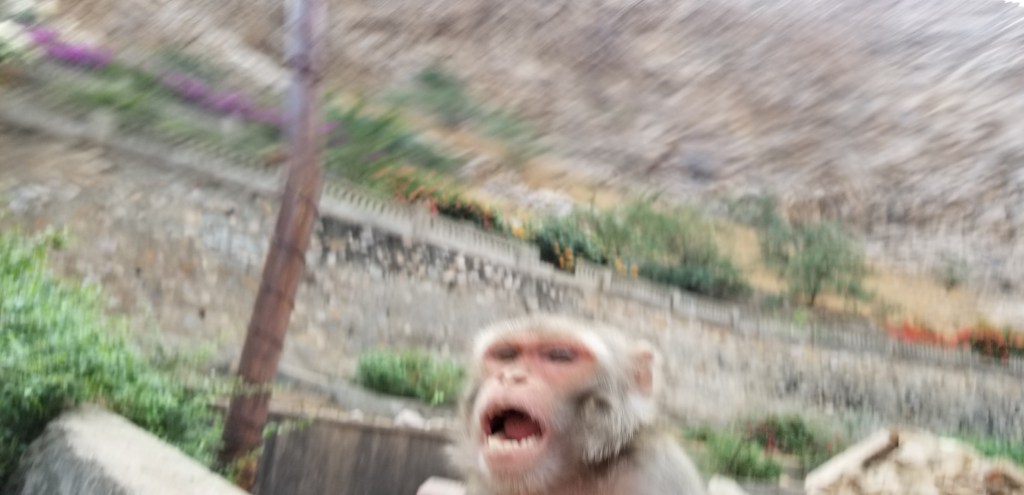
As you meander further the number of monkeys increase, not shy, looking for handouts, craving peanuts. They climb around, follow you, chase each other, sometimes fight among themselves, but people are not an issue to them. You (or at least us) tread somewhat cautiously, looking all around, seeing what appear to be a small number of residents, wondering how their existence is possible or even why. Olga and the guide dutifully feed the monkeys while I continuously snap photos, one time getting too close as it snarled and grabbed at my camera…. Lesson learned.
the wrath of the monkey
We finally reached the pool, built between blasted rock, filled by mountain streams. Here young boys were playing in the designated watering hole, the remainder fenced with barbed wire festooned with scraps of old clothing. The guide tells us this is the most sacred part of the temple and sincere prayers to the monkey god can be made with an expectation to be granted. Try it… you have nothing to lose.
No more wishes or more peanuts, we head back to our hotel, crash again because of our worsening colds. The next two days would be travel; six hour drive back to Delhi; the next day a 2:30 am wake up call for a ride to the airport and a 5:45 flight back home, a full 24 hours of travel.
The Basunti Lodge included a book entitled, How to Travel. I discovered it on our second evening and read a portion of it aloud to the whole group. In a future blog, I will expound more on the section describing how to choose a destination. In the meantime, I will leave you with this quote: “The place we go to should, ideally, help to teach us certain lessons that we know we need to hear.”
We loved our time in India, excited we had made the trip, and were exhausted by the end traveling the circumference of the globe; but, and this conclusion has been the lesson of all our travels, there is no place like home.
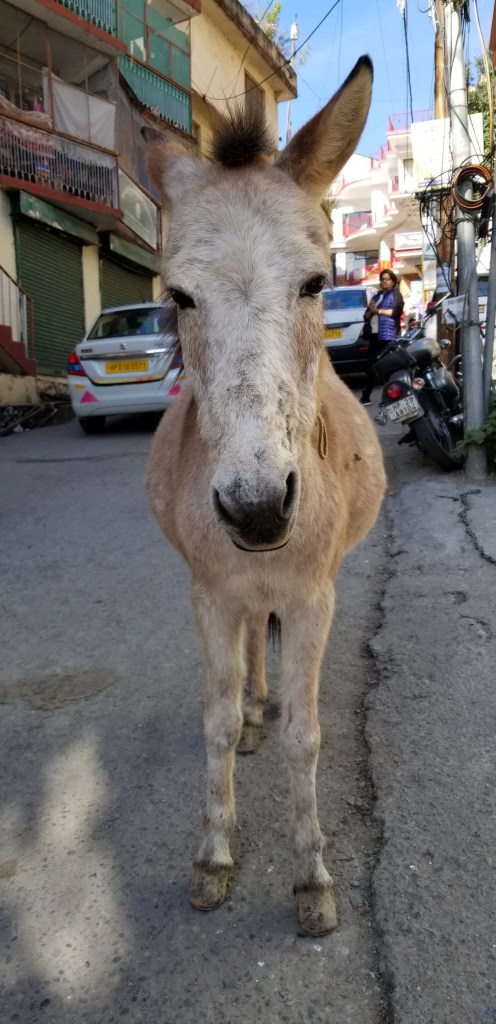
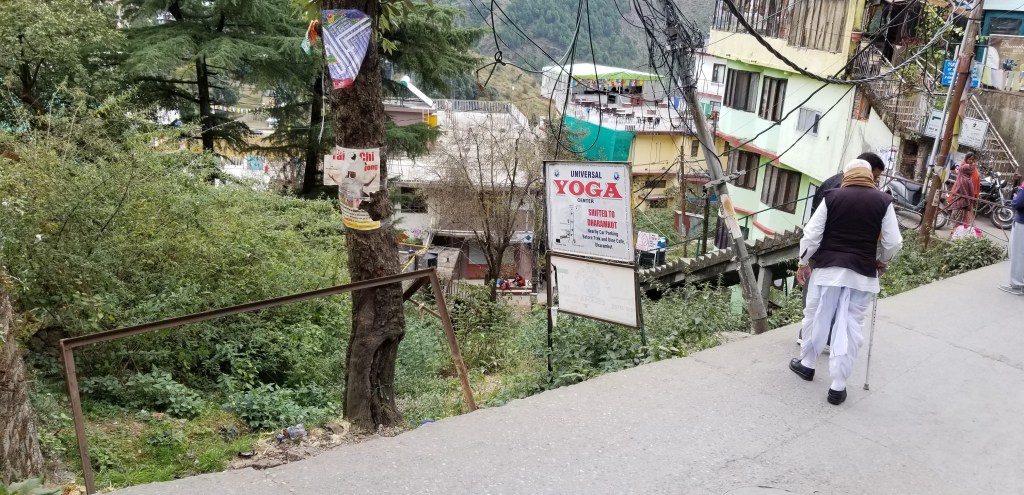
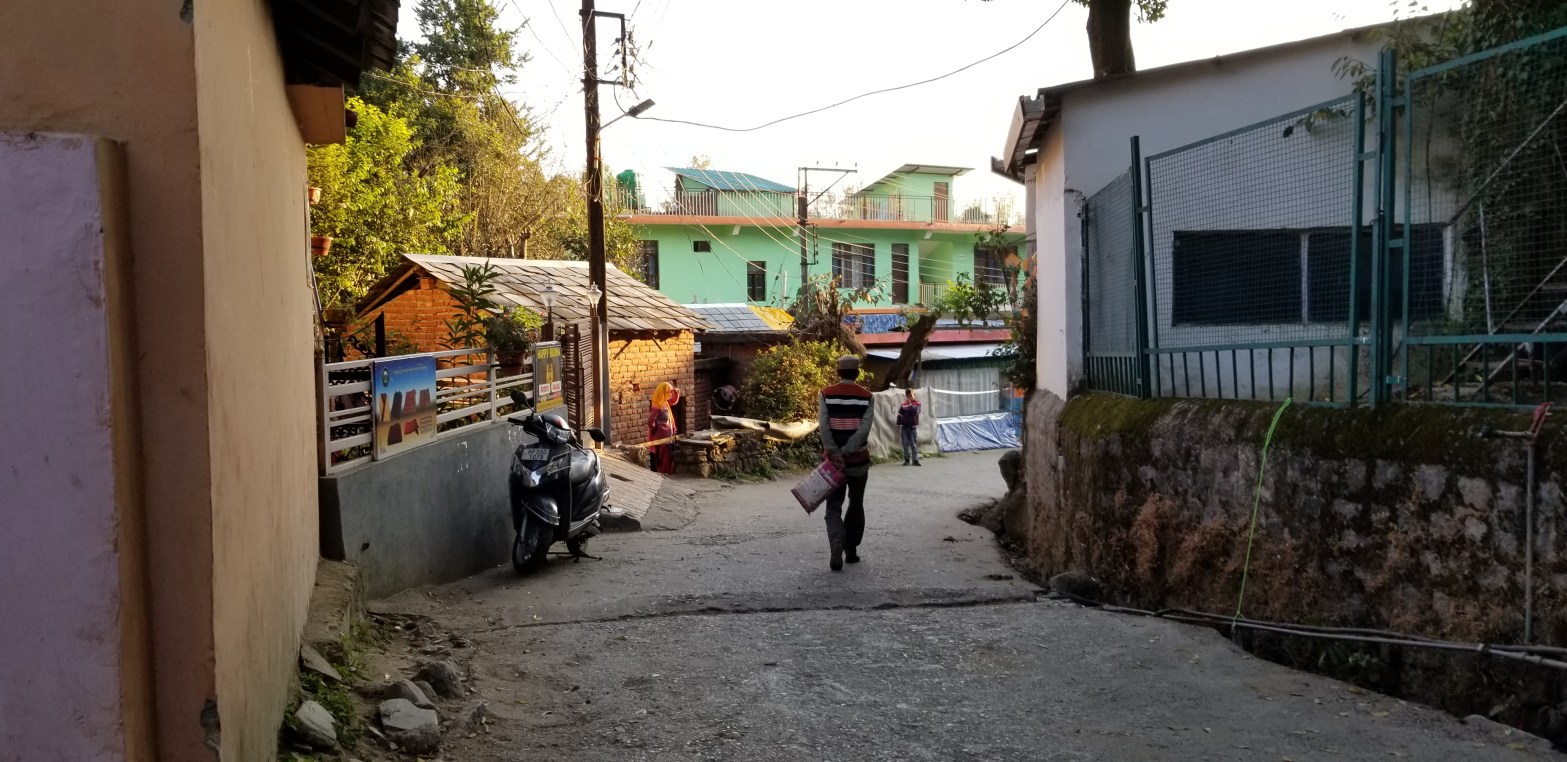
We have walked up and down this road from our guest house to the centre of the commerce district an innumerable amount of times. We have grown accustomed to sharing the streets with the sellers, the buyers, motorcycles (with whom you stand shoulder to shoulder in a jam), cars (keep your elbows in or they could get clipped by the mirror), oxen, yaks, the occasional donkey, monkeys (although they are climbing above only appearing at street level to steal something), and dogs.
One of the animals you can meet on the street
Dogs are everywhere, roaming the streets freer than the two
legged population. Dogs walk into shops, sit on stalls and benches, sleep on
the doorsteps and the stairs, wander at night barking and howling in the very
early hours. You see a variety of man’s best friend, largely mutts I assume,
collar-less, tag-less, ownerless, limping, scarred, mangy, old and youthful. It
is a phenomenon I do not understand.
Almost equally curious is the construction of the streets. They are all lined with trenches from 5 to 25 inches deep, allowing filthy water to run down to some ignominious ending. Avoiding vehicles means balancing around these gaps, or in at least one spot, keeping from falling down a precipitous drop of two hundred feet of a trash infested hill. There are no rails in Mcleod Ganj.
Don’t step in the wrong direction
One of the shops along the way sold handmade, uniquely designed children’s clothing, although it is beginning to expand the repertoire to women’s attire. The owner is one of five siblings, the four others being girls. He recalls their treatment and with three girls of his own, wants to give back. He hires village women, many of whom would have no other means of income, teaches them the trade of sewing, and produces the wares for his shop. The prices are non-negotiable and not inexpensive relative to what is available throughout Mcleod Ganj; the style is not Tibetan or particularly Indian, appealing to other clientele looking for very reasonable, by North American standards, attractive clothing.
Every shop keeper will have a story and would be happy to
explain if their English was better. Most speak in single, staccato sentences
of fact; work all day, very good quality, morning price just for you, you buy
more I give special price. In the initial stage of a first visit you are
attracted to the Tibetan merchandise, and are enthralled by the items thinking
you found something different or special. A couple days of wandering in and out
of shops, being welcomed and encouraged to just have a look, the stuff all
starts looking the same and you cannot recall the price of a similar item three
shops ago.
So you start looking for the shop which is selling items
different from the rest, such as the woman knitting, on the stool, with here
finished socks hanging in her tarpaulin stall; or another woman still sewing at
9:00 pm, making the clothes right in front of you; or the carpet weaver shaving
the excess wool off the carpet in the co-operative.
And then there is Prakash.
Prakash
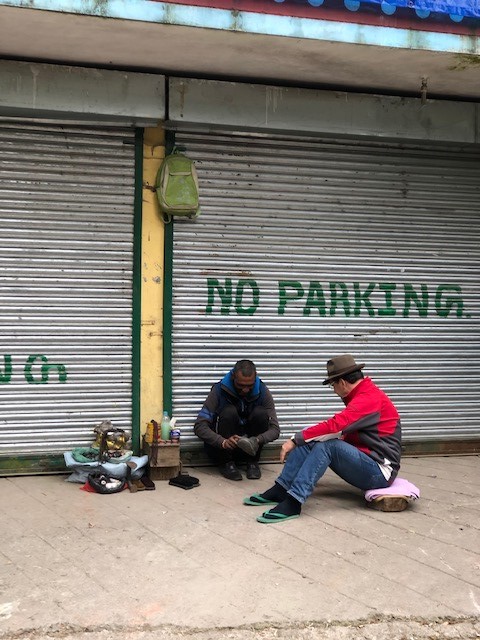
He introduced himself on one of the many times we walked past his spot traversing back and forth into the centre of town. I was accosted by every other shoe shiner, all pointing to my dirty shoes, suggesting a quick brush-up, no obligation. Each shiner has their area, Prakash’s happened to be close to our guest house. Every time I passed, he invited me; and each time I declined. He asked “maybe later?” to which I naturally said, maybe. When I inquired about the price, he answered, anything I would like. Finally, I made an appointment with him for the following morning because it would be my last day in Mcleod Ganj.
So on our way back from yet another round of perusing the shops, and making another purchase, I entered his makeshift location on the street. With a big welcoming smile, Prakash set me down on a towel covered pad, and provided a pair of flip flops so I wouldn’t put my stocking feet on the concrete. He then proceeded to clean my shoes with some mysterious liquid and a toothbrush, followed by a wipe, and then a vigorous brushing regiment. All the while, he asked questions about my country of origin, my age, family, wife (Olga was watching from across the street) and sharing details of his life, including the number of kids, his home in the province of Rajashtan, and his time in this job.
The shine in Prakash’s spot on the side of the street
The shoes were finished after about twenty minutes, shiny and clean, considerably better. Then came the negotiation for price (probably should have done from the beginning….but live and learn). His suggested price was 2000 rupees which is the equivalent of 40 dollars. No, no, no, that is waaay too much. For some context, we hired a driver to a historic site, back and forth, taking a total of four hours, for 2000 rupees with a tip. You can get a one hour massage for 1000; so you can see why his starting price was exorbitant. I countered with 500, roughly 10 dollars.
He argued, of course, talking about his family and the lack of business, yadayadayada, to which I replied, “I am paying for the shoeshine, not your family.” He continued to plead but I finally got up, handed him the 500, a very generous amount, but I was feeling charitable given it was my last day. And the shoes did look really nice.
No matter, we parted on good terms rather than ending horror-ably.
Everyone meet in the lobby of the hotel at 7:30 am.
On the first morning we would participate in a meditative walk through the park and the grounds surrounding the major Buddhist temple in Mcleod Ganj. The park itself is among evergreens on side of the mountain, winding upwards and around, with spectacular sights through the trees into the valley below and the town of Dharamshala christened by the warming sun.
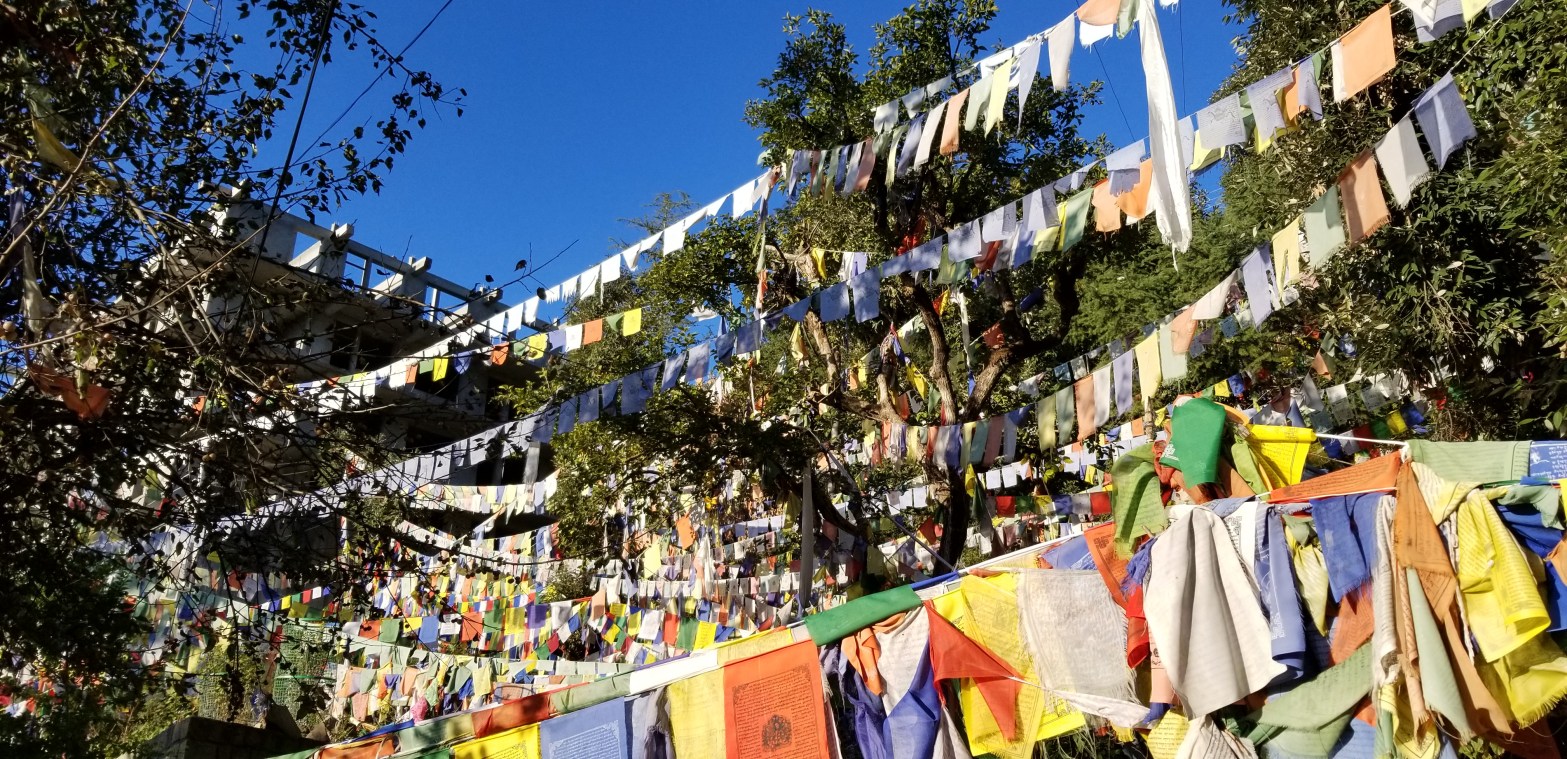
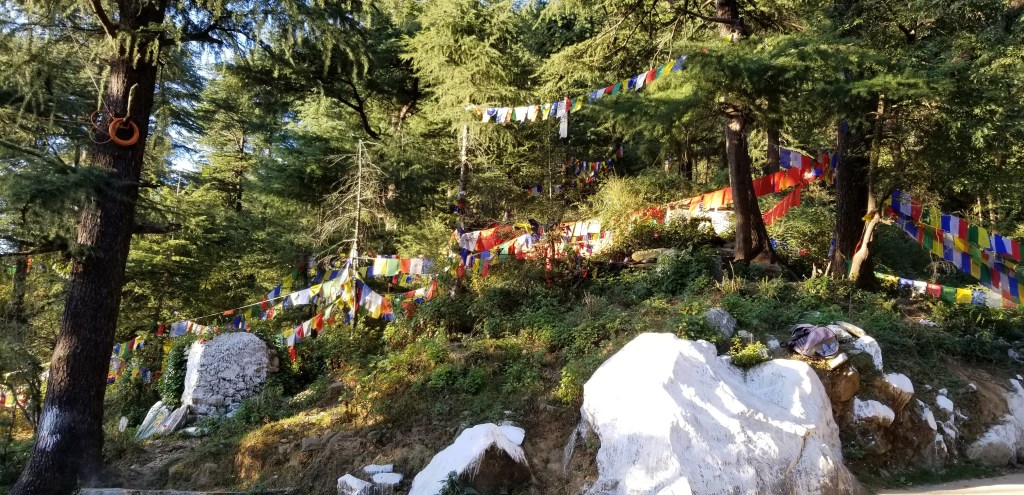
Prayer flags hung throughout
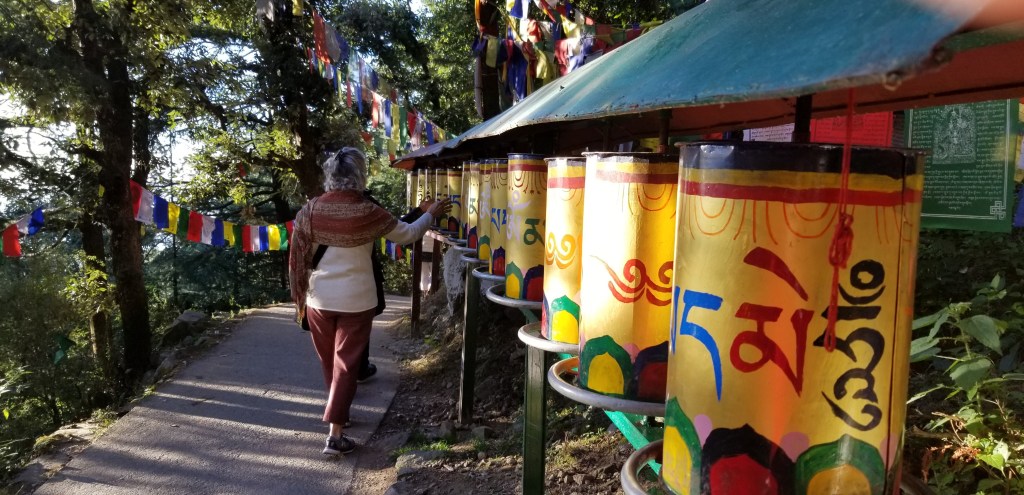
Prayer flags were strewn among the trees and rocks, the number
and density intensifying around each bend, closing in on the temple. Prayer
wheels lined the path itself, at least a couple hundred, wide and thin, brass
and painted tin, twelve inches and twelve feet, with bells and without; we spun
each and every one clockwise by the wooden handles at the bottom when found at
a standstill or by our placing our palms in the middle to help continue the
rotation. Our layers of clothes were being shed one piece at a time as we
climbed further along the concrete path.
One set of the hundreds of prayer bells in the park
The path itself, although not narrow, meant you were walking on the edge of a precipice. No guard rails, and only trees to stop you, a step too far to the left and you could disappear down the side. It was also not immune from beggars. A man, possibly Hindi, was on his haunches whisking the concrete with a straw thatch, clearing our pathway while his wife begged from a squat position and the children looked up at you with their pleading eyes and mucus dripping noses. More beggars, most with some physical deformity, awaited the people at the end before entering back into the city streets.
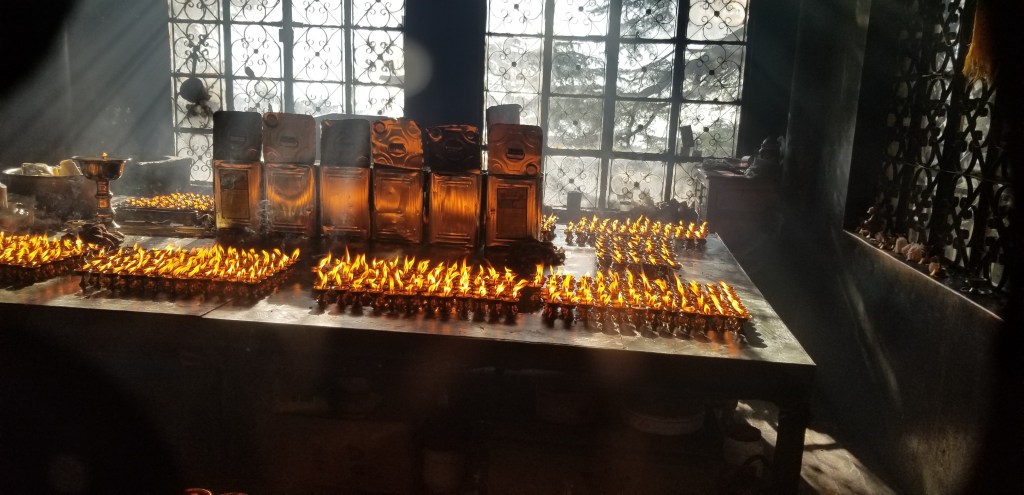
Eventually we wound our way to the top where the complex appeared and as we continued along the path, the sound of chanting could be heard from above. The group decided to enter the complex which contained the home of the Dalai Lama and a temple of worship, separated by a court yard for gathering and contemplation.
The chanting drew us to the upper level where two rows of monks were facing two more rows across an aisle in the temple, reading 3 by 18 inch stack of musical cards in their laps, chanting in baritone voices, largely in unison, bells at the ready, ringing at specified times, led by two more senior monks with their headsets sitting at an elevated level. You could observe from the open end or enter the temple itself, without your shoes and sit quietly on the floor.
People moved about and the chanting continued unabated. Suddenly as if the tape player became tangled and slowed to a stop, the sound of a deep moooooooooo ended the piece. The musical cards were flipped, a loud hummmmmm and chanting began in earnest again. I left the temple at this point, making room for others, sat in the courtyard collecting thoughts and notes when a louder than usual ringing burst into music. The chanting was now accompanied by the banging of a gong, the pounding of a drum, the blast of temple horns, and the call of ceremonial shell conches. I began to watch from the open end as the monks continued their two, maybe three, note chant, a ringing of bells and the chorus of instruments. The pattern went on for several minutes, then the moooooooooo end. It was over.
Monks leaving the temple
Wrap up the musical cards, a pretend washing of hands, and the monks get up to leave. The whole scene was mystical and mysterious and very human. Most were engaged but some of the young were yawning, another was rubbing his eyes and head, there were smiles of inward laughter at an apparent miscue. And when it finished, many jumped up and left like the recess bell went off. It brought a smile to my face.
Oh those monks can ring those bells. Hail, hail, hail.
Our destination was a hotel in Mcleod-Ganj, a suburb of
Dharamshala, further up the mountain. Mcleod-Ganj has been the home of the
Dalai Lama since 1959 and is headquarters to the Government of Tibet in exile. It
is possible to get a meeting with the Dalai Lama provided you make the
arrangement several months in advance. I don’t believe anyone in our group
attempted; besides, he was not expected to be at his home. Apparently the Dalai
Lama had business abroad.
The growth in the Tibetan population from an influx of refugees and the establishment of several Buddhist monasteries has created a town dominated by Tibetan arts and culture. Mcleod-Ganj has become almost a pilgrimage for the believers and his presence has increased the tourist industry. The many Tibetan craft shops are certainly trying to cash in on the increase of Westerners to the city.
Before getting to Dharamshala, our group stopped at a village where a special program is set up to preserve the crafts of Tibet. You can watch as artists paint, weave, screen print, and punch metal to create traditional Tibetan pieces. There is a temple at the end of the beautiful gardens, and of course, a shop to purchase many unique works. Further up the road, we visited a nunnery for female monks and were permitted to enter the temple.
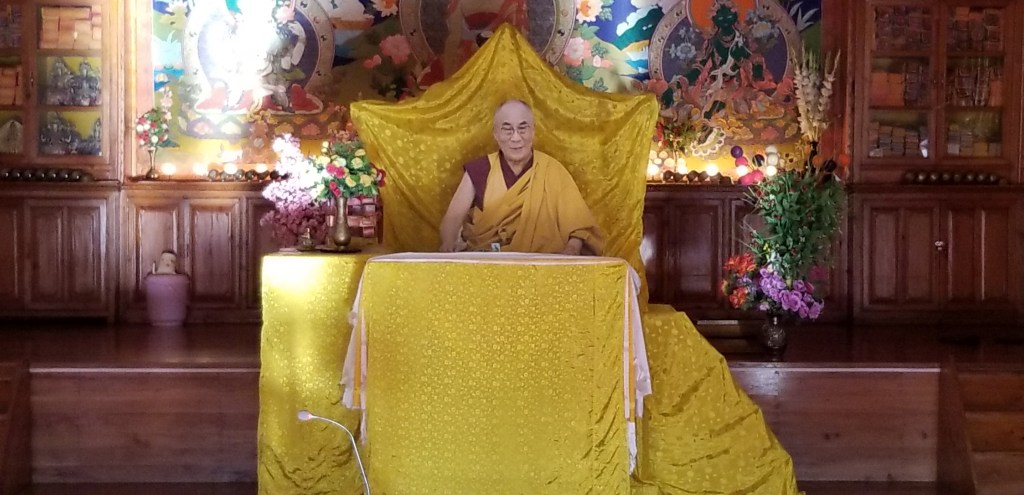
And there he was, a life-size photo replica, from the waste
up of the Dalai Lama, situated at the front. The picture cut-out was of high quality
and appeared very real. The group was mesmerized and thought the presence a
little creepy. A few pictures and we headed to our vehicle to make the last,
long climb to Mcleod-Ganj.
Here he appears at the nunnery
When we arrived at the hotel, there he was in lobby again, a picture hanging high above anything else. Indeed, you will find a photo of the Dalai Lama in many of the establishments. He was in the restaurant for our supper; in a number of shops in town; at one store, we received a 4 X 5 black and white glossy picture of him in a relaxed pose, smiling, just for making a purchase. He seems to be everywhere in this town, just not in the flesh.
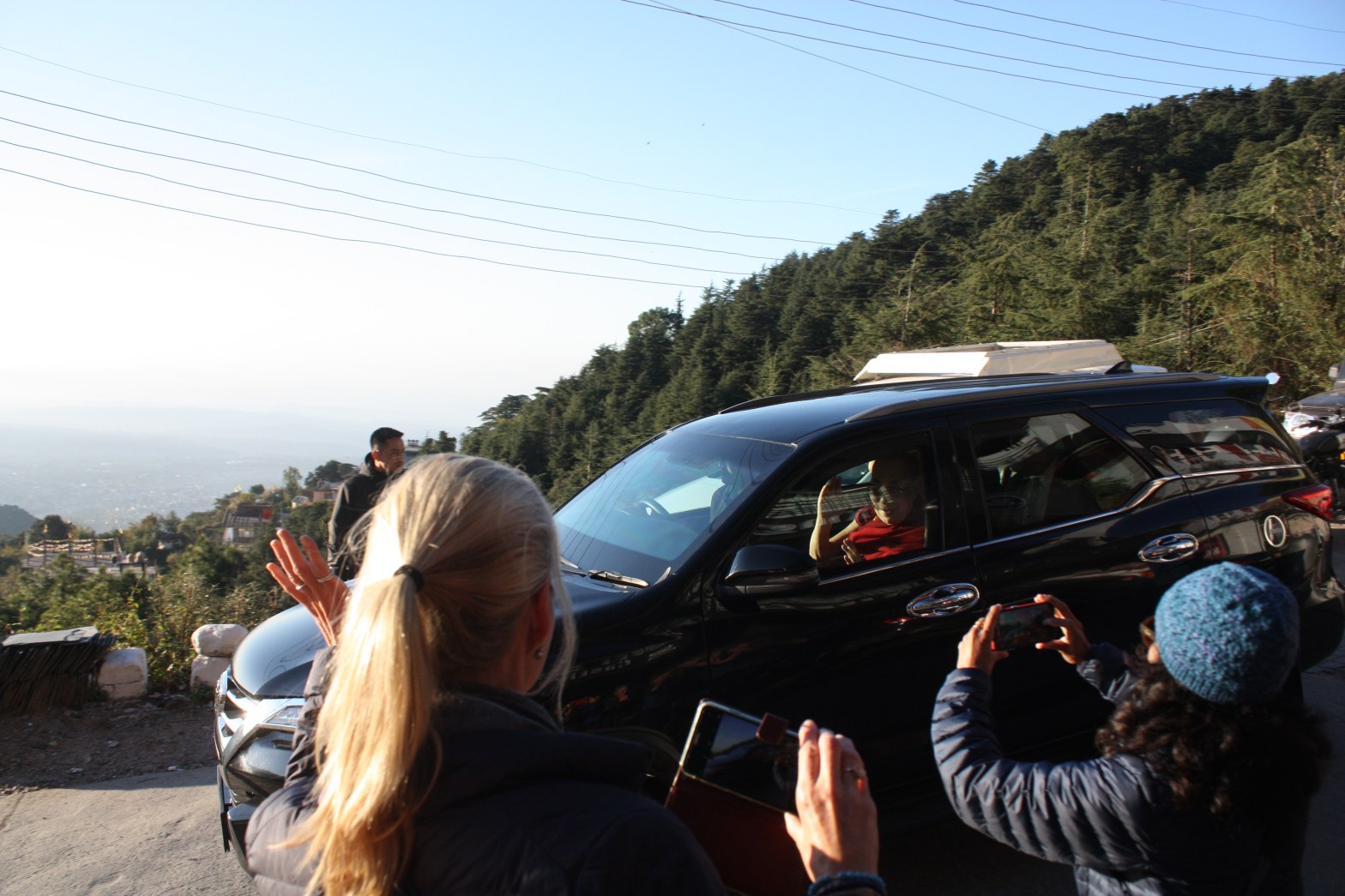
This morning the group planned a walk around the temple through the prayer park. It is a short distance around the bend, downhill from the hotel. As we were just about to head up to the entrance of the path, an officious gentleman, with excellent English, asked us to wait by the side, the Dalai Lama was going to be driving by soon.
Really? The man himself? Coming down this road?
Off to side, cameras in hand, our mini paparazzi waited. A hard topped jeep could be seen with lights flashing. Is that him? No. The vehicle moved past. Hmmph.
Then a series of black cars appeared at the top of hill. One of them must have the Dalai Lama in the passenger seat. (He doesn’t drive himself? Does he?) Cameras ready and as the caravan approaches, I am pointing my DSLR directly at the advancing parade, looking through the scope, dial set on athletic exposure, and then snapping madly….click,click,click,click,click,click,click,click.
And then he was gone.
Or at least I think it was him. I could not actually see through my lens, I was so obsessed with pointing it in the right direction and clicking away hoping one would capture him. Others in the group who seemed to be a little closer confirmed yes, that was an official sighting of the Dali Lama. The trip is now complete.
Where was he going? Will we able to see him again?
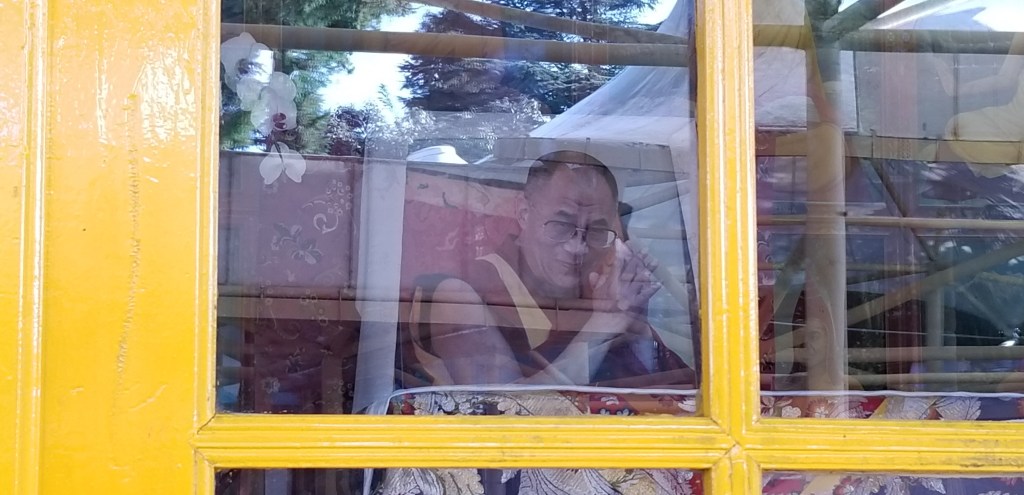
Behind glass, at his own temple…but only a picture
Well, his pictorial presence continued to dominate the rest of our day; at the temple, behind glass; at the meditation centre, a huge face right next to the speaker; at the restaurant, watching us eat our dinner. And he occupied our minds as we continued to talk about our unbelievable luck. I checked my camera later to see if my efforts were fruitless. I found one possible. If I keep focusing, pump it up on the computer, sharpen the image, a decent portrait might emerge.
We have one more day here. I will keep searching for another opportunity at a sighting of the Dalai Lama.
We said goodbye this morning to our wonderful hosts and staff at the Basunti Lodge to make a trek to Dharamshala. The entire day was one of traveling up and down and around, left and right, a swerve here, a quick move there, with a stop at a Tibetan arts centre and a nunnery for female monks.
The sites are breathtaking as we moved closer and eventually climbed the mountains; sightings of another kind also provide some amusement or curiosity. In no particular order, these are the exact wording of signs (not exactly billboards; just a little poetic license) recalled from our journey.
Obey Traffic Rules
These words of advice from the local police would seem to be
obvious but to think so means you have never driven in India. There appears, in
fact, to be no rules. We drove through dozens of villages, and the occasional
one had a stop sign at a juncture. No one stopped. Vehicles do stop randomly to
shop from a roadside vendor, marginally pulling over and blocking traffic from
behind, who then honk, veer into oncoming traffic who also honks and steers
away, around the motorcycle passing in between. Difficult to obey something
which does not appear to exist.
No Helmet. No Petrol.
One of our rest stops was adjacent to an Indian Oil gas
station which hung this sign. Motorcycle drivers are required to wear a helmet
according to Indian law, although you would never know based on a random sample
of drivers in the street. If anything, you would think donning a helmet was a
voluntary or prudent option which many decide otherwise. Even more bizarre, is
that passengers do not require a helmet. I don’t understand the logic. I
watched five motorcycle’s enter the station, four of them had a helmet and the
fifth was served even with out one. Obeying your own rules also appears to be
optional.
Plz do’nt touch!!!
Shops line the streets and everyone appears to be either selling or shopping. The closer we got to Dharamshala, the number of signs in English increased as did the number of people who were obvious tourists. The town caters to the visiting crowds and the relative wealth of the area reflects the increased activity.
We serve Indian,
Chines, South Indian, Israeli, Italian
Food choices also begin to cater to the Western palate, adding some variety although I am not sure who are the Chines or their style of food. This evening we ate Nick’s Italian Eatery. Tomorrow we could add some variety and eat at Jimmy’s Italian Eatery just a few doors down.
Be it women or men,
all become literate
The inclusiveness is important and certainly, the goal is
desirable if not easily attainable. It sounds more like a motto and to be fair,
I saw this only in passing so I cannot provide the context.
Come to Learn. Go to
serve.
This motto was part of a school displayed in big letters on the gate leading into the grounds. I expect it does not matter who is served but it struck me as counter to our expectation for education to provide the basis for leadership. I would agree, however, more attention to service would make the world a better place.
Save our leopards
Some of that learning hopefully involves an understanding on the interdependency of our world. We learned about the decline of the leopards from our hosts of the Basunti Lodge. As a result the monkey population has fewer natural enemies and has grown to threaten the livelihood of fruit farms. I saw only one of these signs and it appeared randomly buried amongst numerous others.
Brain and Spine Clinic
Storefront clinics are common, situated along the street
beside grocers, dress shops, jewellery stores, and sewing machine repair garages.
X-rays, cancer examinations, other procedures are all available. I thought
medicine related to the brain might be a little more specialized and be run out
of a hospital but perhaps convenience is more important.
Stick no Bills
I save this one for last as it exists, perhaps, as a plea to
keep signs to a minimum.
“Signs, signs, everywhere there are signs. Blocking out the
scenery, breaking my mind. Do this, don’t do that, can’t you read the signs.”
So says the Five Man Electrical Band from outside Ottawa,
Canada.
The condensation on the window this morning was probably the
first clue.
It could have been the stars overhead in yesterday’s night
sky, but we know how the weather can change before dawn; or the previous
crimson sunset could have foreshadowed the next day, but a hint of morning red
suggested another possible outcome, determined by the toss of coin.
Heads, we win.
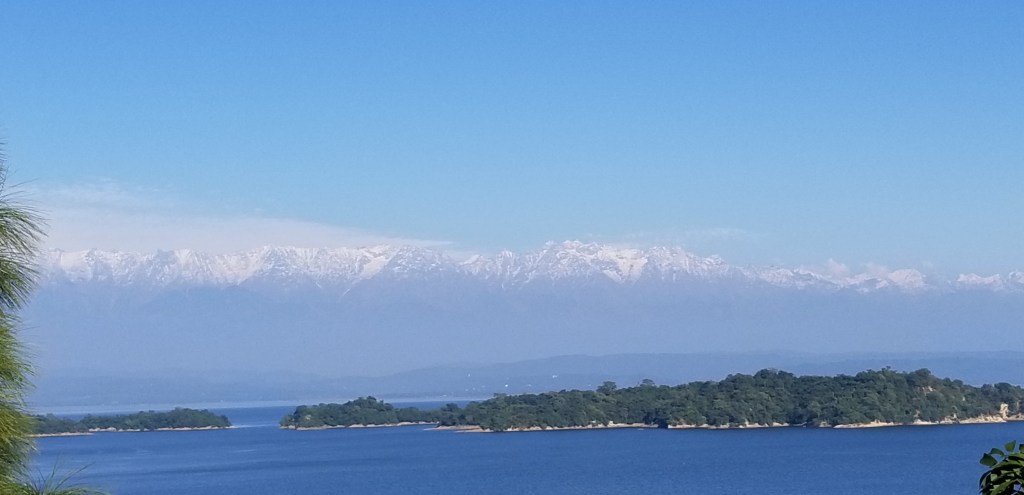
the mountains this morning
As the morning grew, the prospect of a beautiful day became clearer. Normally during this quiet time I indulge myself with some reading, accompanied by a few cups of coffee. I decided to forego the last one and take time out from the next chapter of my book in order to drink in the warmth of the oncoming day. To the top of the main building I climbed, careful not to slip on the dew wet stairs, where the three quarter moon hung in the western clear blue sky and the rising east sun was beaming it’s welcome rays. The mountains in the north were clearer than any day so far, providing a painted backdrop to the lake’s green islands, while wispy clouds decorated the southern sky. For the first time this week, the cock trumpeted almost in time with the early morning music bouncing off the waters from across the bay while a flock of birds streaked through the picture.
The staff were busy making their preparations, arranging the
lounge chairs by the pool, laying out blankets, fluffing up the pillows in
anticipation of everyone’s hunger for the sun. The large, skittish fish in the
ponds floated to the brightest corner seeking the warmth, no longer fleeing underneath
the lily pads at the hint of a passersby, just to bask for another minute
longer.
It was a perfect day for a fishing boat ride.
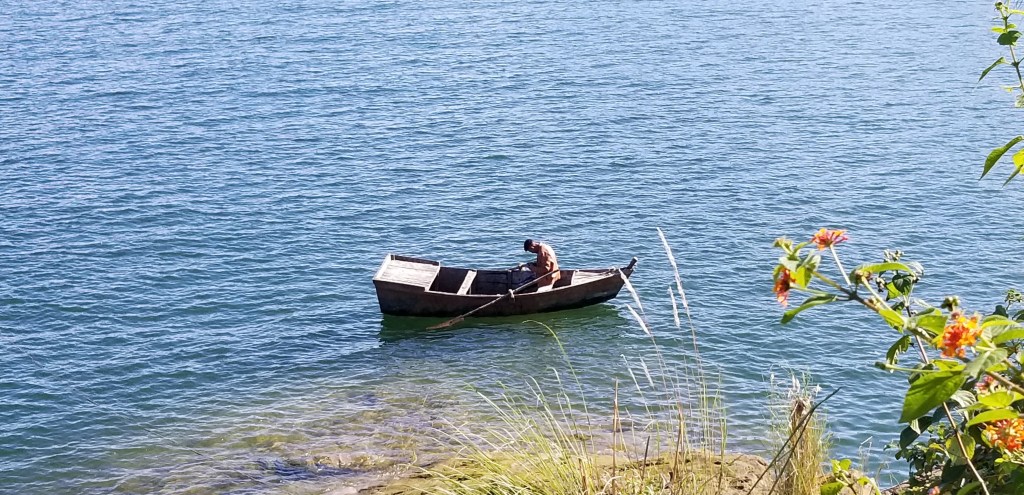
my gondola from a distance
Rescheduled from yesterday, five people had originally signed up for the trip, which was reduced to three by breakfast, when two more abandoned ship leaving me with a solo voyage. Raju guided me down the steep embankment to the waters where my Indian gondola awaited. From a distance, I saw an old man hunched over in his vessel, biding his time till the passengers arrived. As I climbed in, my gondolier was a young twenty-something, steadying the boat and ensuring his cellphone did not fall off his seat into the rainwater of the hull.
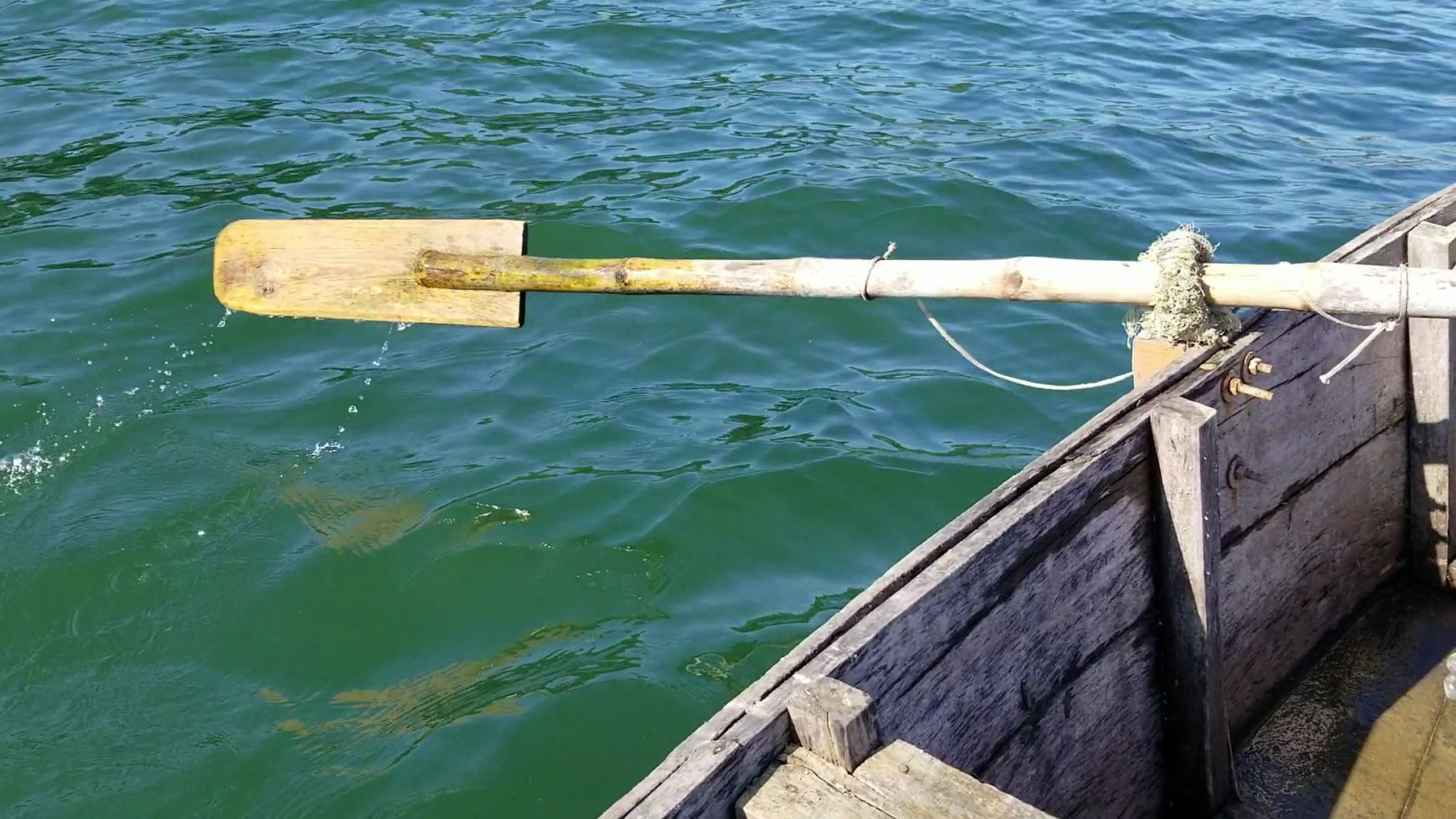
He introduced himself as Goli (my spelling and probably my misunderstanding since I found out later it means bullet in Hindi, but we will go with that regardless), but did not speak any English. After some instructions from Raju, we set a sail. The boat was made of weathered, coarsely hewn planks; the oars were bamboo with a fan-like board as a paddle. We glided closer towards the bay with every pull on the oars, the view never changing but the particulars coming clearer in focus, a touch faster when the waters stilled even more.
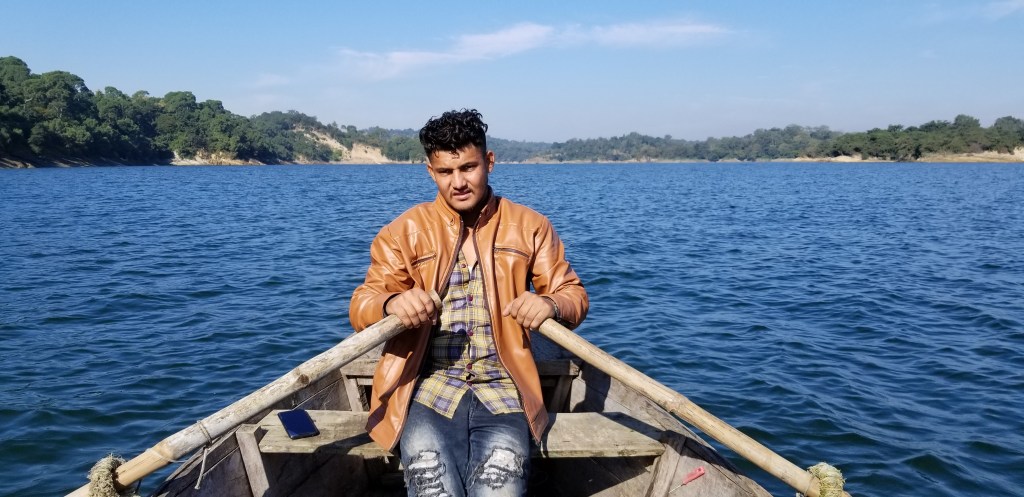
my gondolier
My back was to the blazing sun as I watched Goli dressed in
a thin, tanned faux(?) leather jacket over a yellow and grey checkered shirt
and a white under garment. Combined with the fashionably ripped jeans the entire
ensemble belied my notion of a local fisherman. I was perspiring with only a
shirt; he could only be boiling in his outfit. Nevertheless, it remained on,
intact, for the entire voyage.
As we floated closer, Goli kept looking over his shoulder,
sometimes rowing with one hand, sometimes letting go entirely, scanning the
water, peering deeper into the bay. Then without warning, three swift strategic
strokes and we were heading back. This time the oars were dipped deeper, the
back hunched a little further, the pull a might stronger.
The silent ride was broken by my request for a picture. When I indicated the need for two, he said “three” giving me hope Goli knew more English than originally thought. A follow up question about his home in the village was answered with a simple “uh” ending any further attempts at conversation. Never mind, it was a peaceful, scenic ride, watching a flock of birds fly directly overhead, and another couple battling over one fish, while monkeys played on one shore, and a butterfly floated past presumably headed for the other. We had a very pleasurable trip.
Back at our point of departure, a handshake, a Namaste, an
exchange of smiles and Goli and I went our separate ways.
Spiving. You’ve never heard of the term? Not doing what you are supposed to be doing.
True. Sort of.
We came to India because Olga wanted to complete an international
yoga retreat. We had never been to India, so it seemed like the perfect
opportunity to plan a vacation. Twenty-two days in total, with sightseeing
wrapped around eight days at the retreat. On those days, participants would be
involved with yoga early in the morning and then later again in the afternoon.
I would read and relax, have coffee in the morning, maybe a drink in the
afternoon. My notion of rest. I had never participated in yoga, (except for a
couple times when Olga needed to practice teaching – someone had to be the
guinea pig to help with timing), had no plans of starting and would be
perfectly content with the down time. That was the plan.
A band of disparate individuals with interest in yoga as the common thread, half from Canada, half from the UK, our group bonded quickly at the first stop in Amritsar: visiting sites, crammed together for tuktuk rides in the rain; sharing meals at Mrs. Banduri’s guest house with the cows and intermittent hydro; experiencing the Golden Temple during the day and night; fretting guiltily over accidentally leaving one member behind in the city (we turned sheepishly back to get her). By the time we arrived at Basunti Lodge, everyone was looking forward to the yoga sessions, hoping there would be a session that afternoon. Except me.
You’re not going to
yoga?
No, I had never done yoga before. Don’t worry about me, I am going to read.
And off they went for two hours. On that warm evening, I sat outside, under the veranda, alone. Supper began shortly afterward and naturally the place was abuzz, talking about the session, asking questions of each other, and eventually venturing into other topics. People were kind, made sure I was not left out of the conversation, but suddenly I did not feel wholly part of the group.
hibiscus flower found all around
There was never any pressure from anyone, but I decided that evening, before I went to bed, to try my hand at yoga, to be with the rest of the team. The next morning, I was dressed in appropriate attire, went downstairs at the ringing of the bell at 7:00 am, downed a few small cups of coffee and followed the group to the outdoor pavilion. Determined not to be a bother, I staked my territory at the back (admit it Henry, you always sit at the back!) with enough room around me so as not to disturb the other, experienced practitioners.
The first session was familiar because many of the moves and
poses I had learned from those teaching practice sessions with Olga. I felt
proud of myself.
How was it? Did you
enjoy the yoga? Are you going again this afternoon?
Yes I did, thank you, jokingly saying I was a little sore. People were encouraging. Don’t worry, everyone is sore the first few times. You need to persevere and soon you will come to enjoy it more and more. I attended the afternoon session, again understanding the moves and the direction, stretching this way and that, breathing in and extending the exhalation, grounding the various parts of the anatomy, feeling how the poses affect my body, understanding which ones feel good. I was even able to comment how the exercises around the heal were beneficial for our hike over the undulating, rocky terrain.
grass in water of our swimming location
By the end of the second day’s afternoon session, the impact
had worn off. The weather had turned and the air was damp and cold especially
after the sun went down. The moves and the poses were increasingly unfamiliar.
Lying down, I couldn’t see what is happening and was too proud to ask for
clarification. My knees were sore from the stretching. I just wanted to sit by
the end. I did not want to continue.
And I didn’t. For the next three days.
Members of the group continued to encourage, suggesting
small doses, maybe only do the morning, others suggested the afternoon; most
importantly, they did not make me feel guilty. I did that to myself.
Okay. I will give yoga another shot and attend the morning
sessions. After all, that is the time I would exercise (should I ever get back into
that habit) and I can see how the stretching of yoga would be of tremendous
benefit. Just do it.
And I did. For less than an hour.
I quietly extricated myself, feeling ill, headed back to my room to recover before breakfast. I have not dressed for the yoga times since.
moss
I do have an increased admiration for my fellow travelers on this trip. They are a dedicated, hearty lot of practicing yogites, rolling out their mats on the cold marble floor of the outdoor pavilion, through the unexpected damp and sometimes cold weather, every day, twice a day, to engage in the craft and the philosophy of their brand of yoga. They are very kind and gentle group, devoted, passing no judgement, continually encouraging, believing there will be a time when yoga will find a place in my life. With Olga’s guidance, and patience, how could it not?
It welcomed us on the day of our arrival, opening up the land around, sharing the colours of the foliage, parading the snow capped mountains in the distance. The second day teased us with more warmth to accompany a walk to the lake, enticing a dip into the still waters, with early fall like temperatures for a soothing, gentle swim. And then the sun went away.
A cyclone on the Bay of Bengal, thousands of kilometres in the south east, had churned the air and folded in the northern cold with the ground moisture, ushering in a mass of clouds mixed with spots of rain. The temperatures hover around 20 degrees but the morning chill of the damp air brought out layers of clothing to be peeled away come mid-afternoon, and drawn in more tightly for the evening supper.
The tiny moments of rain were mere teardrops compared to the buckets poured over the city of Amritsar a week ago. But there would be no slowing down; the people barreled on, unabated. Heads down, backs bent leaning forward, slicing through the curtain of water, averting pools of water and navigating the narrow passages through the town.
And we do the same; slower, more deliberate, knowing our
time is short, capturing the sensations of this idyllic little oasis.
Butterflies and birds abound. We watch the fluttering tiny yellow wings amidst the lush greenery, the larger ones with white spotted wings hovering over each flower, or the taste of a rainbow flapping and floating through the vines. We listen to the twill of birdsong, the chorus of replies, the swish of air from the flock in showcase formation over the lake.
You turn your head quickly to the right because in the periphery a branch in the distance sways dramatically, followed by frantic cackles. The troops of monkeys appear to be demarcating their territory, fortifying their stake on this plot with the eviction of all others.
Or maybe they are reacting to the leopard. We have been
warned by the villagers that one is in the vicinity. Their children have been
instructed to only venture out as a group and to carry their walking sticks. Before
we return to our rooms, the hosts advises the group to use the same
precautions.
Each night we retire to our tastefully decorated rooms, a
very comfortable refuge from these recent damp days except….there are two twin
beds rather than the queen we have grown accustomed. The amount of space is the
same but the division is clear with a dividing gap in between making close
quarters in the middle uncomfortable. So we sleep together, but separate.
The wonderful memories continue to accumulate. We cherish it all, lock, stock and ….
The destination of “a road runs through it” is the Basunti Lodge, where the yoga retreat, the impetus for our trip to India, is taking place for eight days.
sculptures, pottery, and local artifacts abound
Basunti Lodge is the ever evolving manifestation of a vision of David Butterworth and his wife Izzy to create a home and a small paradise in the northwestern corner of India. Painstakingly designing each little detail, planting with trial and error, employing local labour to support the community, growing food organically, boring a well for clean water; the couple has built a tranquil peace on earth, perfect as a respite from the rest of the world. David, with his swashbuckle voice and equally exotic background, regales with stories of India, the people, the history, and most especially the ecology and nature of the area. Izzy completes with insights into the arts and craft of the people, and provides insights into the art of living amongst her countryman, in the country side, in this country.
natural pool and gardens
The meals are vegetarian, which I must admit, was not something I considered. The Simpson’s episode where Bart and Homer are dancing in a conga line, singing, “you don’t win friends with salad, you don’t win friends with salad” reverberated through my mind. How much salad can a person eat? And a whole week? When the menu was discussed with the group, I jokingly talked about foraging through the jungle (apparently the local name for the forest) hunting for meat while the rest of the crew would be practicing yoga. Cows were off limits, but other beasts would be fair game.
your friendly, neighbourhood cow
However……the food here has been delicious. Much of it is harvested from the gardens on the premises and is locally sourced from the farmers. David has carefully planned a variety of dishes, some spiced with a touch of chili, simple combinations of exotic and standard vegetables. I now laugh and proclaim a desire to join the cause. David has promised fresh fish from the lake for the last meal here, for anyone interested. The taste should be the antidote to restore my carnivorous predilection.
And the people on this yoga retreat have been a welcome source of friendship and companionship, travelers all, with experiences in almost every part of the world. Their interests and curiosity and respect for others is heart warming, affirming my belief in the merits of travel and restoring my faith in the importance of understanding and empathy.
two of the village children curious about the people walking past their home
The Basunti Lodge is situated in the countryside, surrounded by small towns and villages, at the edge of dam created lake. David has taken the group through several trails all of which end at the water where one can swim and enjoy the vegetation, the birds, the sounds, the calm. One of the walks takes you to the end of the road to a tiny village of, maybe, ten houses living off the animals and fruit it can grow. The proliferation of monkeys, however, has made the latter increasingly difficult, threatening their livelihood and consequently their ability to remain on the land.
communal tap which marks the centre of the village
The lake itself is a wonder, the product of a dam built in 1976 which forced some 80,000 inhabitants of the once thriving meadows to be relocated to another part of the state, leaving behind walled towns forever lost to the bottom with only the tip of a tower peaking above the water line as evidence of their existence. On one of our walks to the lake, we were joined by a newlywed couple and the brides parents on a pilgrimage of sorts. The father’s family once lived in the valley. In a sort of baptism, the family washed their hands, their arms, and their face with the water as they viewed span of water burying their ancestral home. We were touched by the scene and felt privileged to witness their homage.
the meditation platform, our favourite spot
From the meditation platform, overlooking the lake, Olga and I read and write and reflect.