Centrale Begraafplaats West, Hoflan 150, Tilburg. Section 16,Grave number 10402483. Father Kees de Cock was buried there January 8, 1981. You will not find a stone; it was removed in 2002. If you visit the website and type his name in the search field, no results will appear. I wrote to an address listed in the contact section asking for any information. An administrator responded immediately, provided the coordinates and a set of pictures to guide me. The spot is immediately behind a couple, Henricus and Allegonda, the woman buried in 1991. In the Netherlands, you don’t purchase a plot, you rent it. Clearly the van Belkom and/or the Berens family have kept up the payments, usually in 20 year increments.
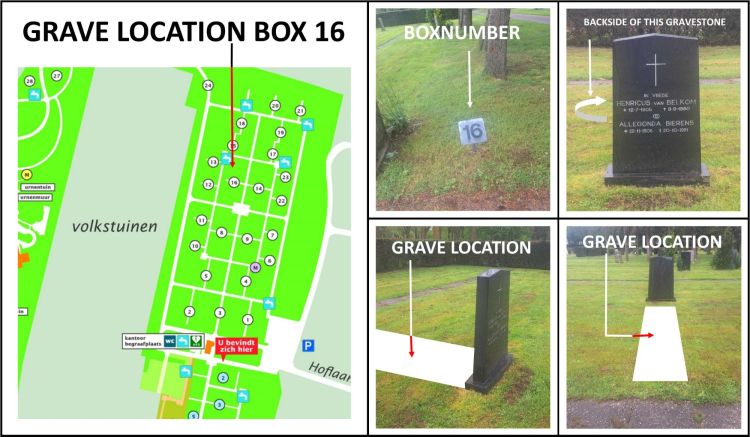
I am assured the body was not removed and it is still in the same place. The stone was Zwart Graniet. The coffin was hermetically sealed, metal lined, hard wood, flown by air aboard KL902, to Amsterdam Airport, with an outer protective wrapping of hessian. Inside, the Reverend Fr. Cornelis Johannes de Cock was dressed in his religious vestments.
I had been thinking about Uncle Kees’s burial place during my March-April visit to the UK-Netherlands, after the funeral for Fr. Fons Eppink in Oosterbeek. The small chapel was filled with family, clergy and close friends. I watched the Dutch mass in the overflow lounge with an even larger number of people. Two priests and two seminarians flew from Cameroon, the former concelebrated the service, the four contributed a traditional hymn at the end. The entire congregation followed the processional cross approximately 300 yards to a secluded cemetery nestled in the wooded surroundings of Missiehuis Sint Josef. Everyone took their turn scooping a hand shovel of dirt onto the coffin before leaving the family with their final prayers. I returned later for a closer look at the grounds, at the final resting place for these Mill Hill missionaries.
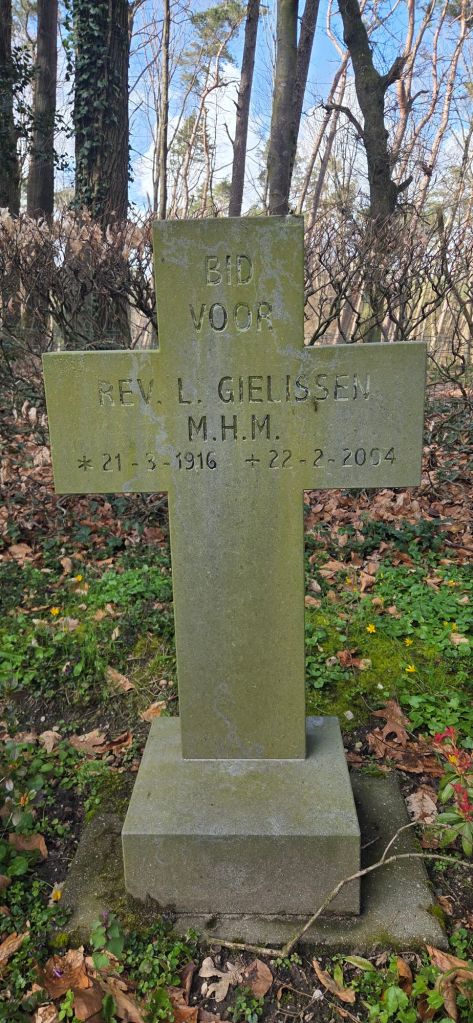
I found the names of seven 1947 classmates of Uncle Kees, including his close friend Fr. Jan van de Laar, spread towards the rear, placements corresponding to the date of death. Fr. Herman Hofte, a fellow travel companion on the very first journey aboard the Boschfontein, Fr. Joseph Willigers, the first Bishop of the Jinja Diocese, and Fr. Gielissen, an older priest who acted as a mentor are also among the approximately 600 Mill Hill missionaries there. I discovered many other names from my archival research who had been stationed in Uganda. Had Uncle Kees spent his retirement years in Oosterbeek, or in the Netherlands, he would have found a place here, marked by a simple stone engraved with only birth and death dates, the briefest of details. Visitors searching for his particular grave would have found it listed on the board. I would have been able to pay my respects in front of his headstone. Had Uncle Kees died in Uganda while serving as pastor in the Kamuli parish, I suspect there would have been a monument on the grounds to commemorate his service instead of his name fading on the walls of the catechist training hall.
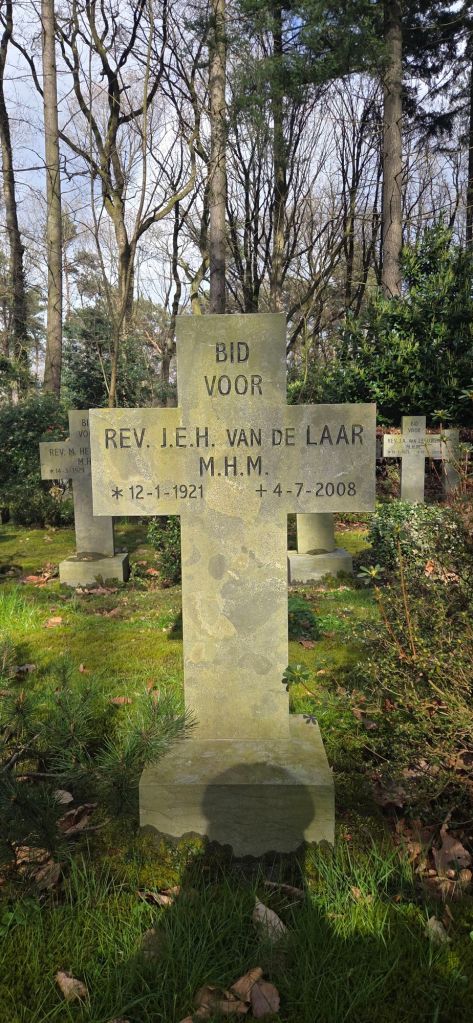
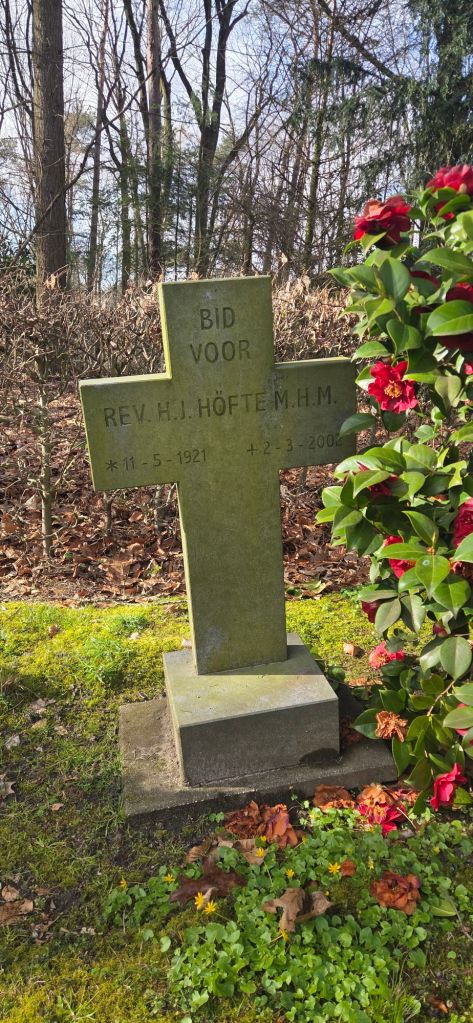
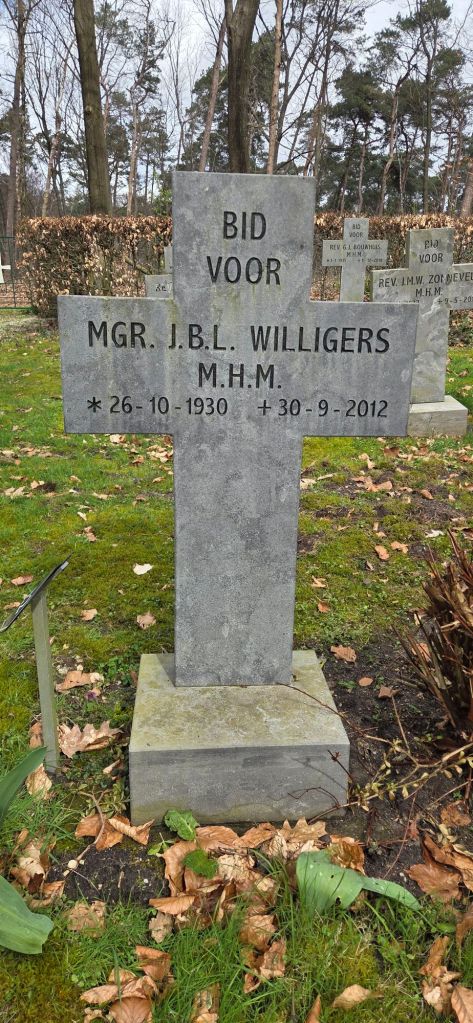
Mill Hill Missionary’s policy is for the body to be buried in the place of death. Fr. Kees de Cock was found at 11;45 am slumped in a chair, Breviarium Romanium II open in his lap, awaiting for surgery in London, England on January 2, 1981. Official cause of death: Coronary thrombosis due to atheroma. “He was in good form while he was [at St. Joseph House] and enjoyed his Christmas very much. Everyone took to his unassuming manner and good-hearted ways. I believe he stayed up for the New Year Eve’s party. He went to bed at twelve midnight…. On New Year’s Day he was present for the small New Year’s Party in the Superior General’s room and Kees still had two beers that morning. In the afternoon he was taken to the clinic in preparation for the operation.”1 He had missed meeting family in Brussels as part of a stopover because of flight delays. The last of his relatives to see him were Corrie and Henriette because they made the trip to London before Christmas.
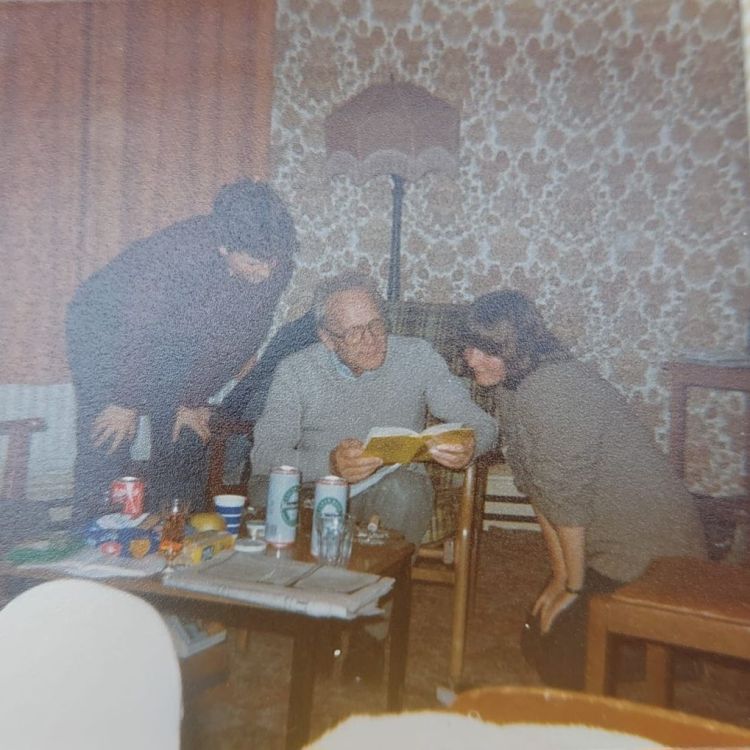
Under ordinary circumstances, Fr. Kees de Cock would have been buried in the cemetery adjacent to the Mill Hill House in London, England, lost, for all intents and purposes, to everyone who knew him. The building has since been sold, the plots remain. Instead, the de Cock family insisted his coffin and body be shipped to Tilburg where a funeral was arranged at O.L. Vrouw Koningin van de Vrede and buried in the public cemetery nearby. The viewing, the funeral, the burial, all taken place within several blocks of the old family home on Herstalsestraat. The majority of the remaining de Cock family live within a half-hour radius except of course for those of us in Canada. I expect my aunt, Tante Toos, probably the closest to Uncle Kees, the only sibling to visit him in Uganda, spearheaded all the arrangements and worked with the others to pay a considerable portion of the costs. Already reeling from the devastating news of the imminent death of Tante Jo, only 51, from cancer, Tante Toos would have wanted to keep Uncle Kees close to the remaining family regardless of the expense, drawing him back into the circle living around Tilburg, bringing him back home.
The decision to not renew the display of the headstone was likely a collective one, in keeping with that of other relatives, including my grandparents. You won’t find them or Uncle Kees, or anyone else, I suspect, who passed away earlier than 2006, assuming there is a grave site. In a country of limited land and high population density, the practical value of short tenure for signage and the ability to reuse the space has a utilitarian logic. Apparently, earlier renters are not necessarily evicted if a new tenant pays to occupy the same spot. The previous occupants can stay, without a sign on the mailbox, just another six feet deeper.
Given the reality of diminishing visitations with each passing year, perhaps the Dutch are right. If Uncle Kees was buried in England, I suspect the only visit would have been the time of the burial, or maybe on the occasion of an anniversary. Oosterbeek would be “close enough to make the effort, far enough to make excuses”,2 analogous to my own relationship with the burial site of my parents, 160 kilometres away. Their headstone, however, is permanent whether anyone cleans up the lilies planted in front or not, The space was a purchase, not a rental. They are there with places of birth and death included with the dates on the stone itself. The best documentation of my parents’ lives exist in photo albums, stored in boxes in my basement. They are scanned, digitized on my computer, available while I am still around. I cannot vouch for what happens afterwards.
One of my other objectives to return to Herbert House in England was to donate two albums of old photographs of Uncle Kees in Uganda which were part of my parents’ collection. They have been digitized so I have a record to share with anyone interested. I know the originals are in a safe place, stored and catalogued in the archives, a permanent record available in the future. When my research is complete, I will ensure all other documents find a place in Fr. Kees de Cock’s file in the Mill Hill archives. You will be able to find him there. My postings in Wonderings serve as a digital record, searchable on the internet, an electronic source for the curious and the interested, perhaps even more attainable with AI. The work is my small contribution to his legacy.
In truth, however, neither the tombstone nor the pictures nor the other varied documents match the memories shared by the people whose lives Fr. Kees de Cock touched. My efforts to uncover the story of his life in Uganda has generated stories of laughter and tears, love and gratitude, warmth and generosity of heart. I last met Uncle Kees in 1972, when I was 12, reminded only because of a handful pictures and the sparse stories from my Dad, stories of a memory. In my encounters with other family, with fellow missionaries, with colleagues, with friends, and with Kamuli parishioners, I have come to learn of his impact on others. In one those conversations, Brother Wubbels said if everyone tries to be a little bit like your Uncle, the world will be a better place.
Maya Angelou captures it best: “People will forget what you said, people will forget what you did, but people will never forget how you made them feel.” If the memories, the stories and the feelings Fr. Kees de Cock engendered are transformed into our own interactions with our immediate world, then his life will have risen to some permanency, his soul will live forever.
Going Home
On the wings of angels
Going Home
On the wings of a snow white dove
Going Home
On the wings of angels
Going Home
On the wings of love
Going Home, the BoDeans, from the album Black, White and Blood Red

1 Letter to the Jinja Diocese, dated January 15, 1981. Retrieved from archives
2 Line from Spirit of the West song, Keeping Up with the Joneses


Nicely written.
LikeLike