10:55 am. Time to lock up and head over to the chapel, a quick jaunt across the small parking lot between the archives and the Herbert House residence.
I am back in Freshfield, England almost two years to the day, combing through the files of the Mill Hill Missionary Society which may hold more information to fill in the empty chasms of knowledge about my uncle, Fr. Kees de Cock. On this occasion, Fr. Stephen Giles, the archivist, has pulled boxes of material from the Mill Hill magazines published from 1947 to 1981, Aanalen for the Netherlands, St. Joseph’s Advocate for Ireland, as well as documents from the schools in Tilburg, Haelen, Roosendaal and London. A fellow, amateur Dutch historian found valuable material for her uncle missionary priest in Aanalen and suggested it as a source for my research. My challenge is translating the contents of Aanalen into English. I eyeball the pages for familiar words: Oeganda, Kamuli, de Cock, other names of fellow missionaries. If an article appears helpful, I utilize the camera on the Google translate app, read a paragraph to assess potential applicability, then scan with another app on my phone, turn the page and continue. The procedure is laborious. Published six times a year, thirty pages each, 33 years – you do the math. This search will require considerable time.
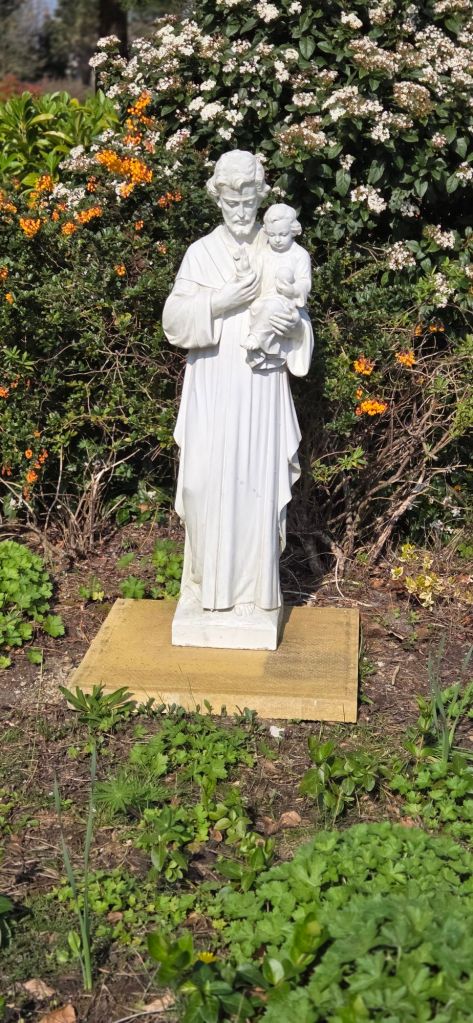
It is March 19, the Feast of St. Joseph, patron saint of workers, patron of the Mill Hill Missionaries. An important day for the society, celebrated with a mass at 11:00 am followed by a social soiree and an invitation to a special, hot lunch. I had donned my black corduroy pants, pink shirt and beige suit jacket, packed for these kind of circumstances, to attend the early morning breakfast, allowing me to efficiently continue my work in between scheduled events without stopping for a change of clothes.
The small chapel is near full so I am forced to find a lone seat at the front, followed by eyes looking up from prayer wondering about this outsider. The quiet ends when the entrance hymn is announced suddenly. I do not catch the number. Fr. McCluskey stands, begins singing. Everyone else joins. No music, no angelic voices, just a small group of elderly parishioners struggling to stay in tune. I know the hymn immediately from my days in the choir at Mary Immaculate Parish and begin to sing along. I cannot recall the title, cannot not find it in the hymnal, yet I know the words from memory all these forty plus years later: “…And I will raise you up , and I will raise you up, and I will raise you up on the last day…”. The celebrant walks down the center of the chapel, turns to face the congregation of fellow missionaries and external visitors, sings along until the five stanzas are complete. In the name of the Father, the Son, and the Holy Spirit. Amen. Mass has begun.
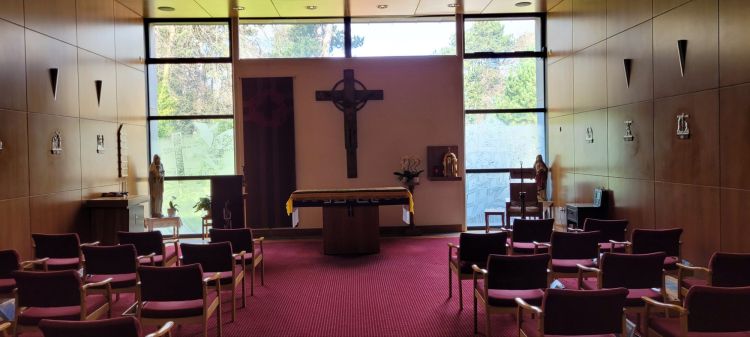
Inside the Herbert House chapel
The service is intimate, conducted in English (a change for me from the Ukrainian mass at St. Nicholas parish in Toronto), following the familiar proceedings. Without a prayer book, the content of the Reading and the Gospel, the scripture from which they are extracted, are quickly forgotten. Then Fr. Frank Gowan unfolds his papers, straightens them on the lectern, and begins the homily. His words are directed to his fellow missionaries although the message is broadly applicable. It is simple and effective, describing the characteristics and appeal of St. Joseph. He worked hard, stayed faithful, and through patience and endurance was able to serve his mission and his calling. Even though we don’t know many details of his life, we are inspired by his skills and his deeds. As Fr. Gowan speaks, I keep thinking of my Uncle Kees, how appropriate for him to have been a missionary for a society whose patron is St. Joseph. For the remainder of the mass, that feeling reverberates within my mind and my body.
At the end of the service, I make a brief stop to say hello to Fr. Jim Daley stationed at the front in his wheel chair. He does not remember me from the previous visit, his mind and physical state deteriorating. Jim still laughs and warmly holds my hands. Then I wander into the lounge where everyone has gathered for a glass of wine or liquor or beer or soft drink. I take my Guinness to a circle which includes Fr. Gowan. The conversation is about Fr. Vincent Oates, the rector, who succumbed to a sudden fall the day before, taken to hospital and kept overnight for observation. Fr. Gowan was pressed into service for today’s mass and scrambled to write the sermon. Eventually other topics ensued and as the gathering begins morphing into lunch, I approach Fr. Gowan, thank him for the homily and ask for his notes. He apologizes that they are a hodge podge of thoughts hastily assembled, but he will retrieve them for me.
After lunch, I return to the archival room to resume my search. I find almost nothing specifically about Uncle Kees. There are articles about life in Uganda from other missionaries; a fiftieth anniversary edition of Mill Hill in the Netherlands; pictures of the first African Bishop for the Torroro diocese. I stumble upon a section at the back of each edition of Aanalon from the early 1950s listing the initial of donors and the amount of Dutch guilders donated to specific missionaries. Here I see several for Fr. C. de Cock from G. de C., probably my grandfather; from J. v. d. W., perhaps his brother-in-law; from M.K. in Haelen, a complete unknown. The amounts are not insignificant for the time. I don’t see a pattern. Interesting yet they don’t reveal any insight into Uncle Kees.
Before supper ends, Fr. Gowan wanders over to our table to hand me a couple sheets, apologizing again, hoping I find them helpful. I don’t look and promptly place them in the inside jacket pocket, still on from this morning. Thank you. I really appreciate your generosity.
It’s not late. Jet lag is still lingering so rather than continue in the archives I retire to my spartan room for the evening, withdraw the folded paper and sit at the desk. There is no title or date to mark the occasion. No name to ascribe to the author. One and a half, large type written pages, with scribbles and hand written injections, underlined parts for emphasis. I re-read, listening to Fr. Gowan’s voice from the morning. and there, in the fourth paragraph, the line which struck me in the moment and now echoes loudly as perhaps the most profound statement reflecting Uncle Cees:
St. Joseph shows us that even quiet, hidden lives
can have a lasting impact when offered to God.
The statement is a perfect description of the work of Fr. Kees de Cock. I have learned as much about him in those few words as I have gathered in all the pages of archival research.
Words of guidance.
Words of encouragement.
Words of hope.

 Wonderings
Hi Henry,
When I was a teenage I corresponded with ome Kees. Mostly on day-to-day things (school, how everybody in the family was doing and as I collected stamps at that time, I always was nagging for stamps from Uganda). I still have an number of letters from him (1971 u/i 1975). Of course they are in Dutch. Shall I send you a copy of one by mail, so you can see his hand writing ?
Kind regards,
Kees Mommers
LikeLike
I have a deep admiration for the quest to understand past lives and the connections that tie us to our history. This journey resonates with my own memories, particularly the hymns I learned in church, both in Italian and English, which reflect my mother’s deep religious life. A visit to a town in Italy reinforced this sense of connection, as it felt like time had been preserved. Although I physically exist in the present, visiting graves and recognizing family names strengthens my bond with my family’s history. This experience parallels the narratives we are trying to construct through our research. During our travels to the places where our families originated, we uncover memories and insights, even as we recognize that much remains unknown and possibly unknowable. This acknowledgment drives our intellectual curiosity and helps us to broaden our perspectives through time, place and the insights and connections we make. Thank you for sharing this experience that resonated with something so meaningful.
LikeLiked by 1 person
Maria Ciampini
LikeLike