The Power of Love

The card arrived two weeks before Christmas, 1987.

The handwritten message from my Mom and Dad read, “Merry Christmas Henry, Olga, Nicholas & ?” The answer to the question mark was expected on December 25.

We had moved into 12 Sigmont Road on November 30 after selling the condominium, riding the wave of escalating values, leveraging the money for our first house. Nicholas was born in the two bedroom 9th floor West Mall condo, our home for three years, about to become too small had we remained much longer. Sigmont was in the same neighbourhood, an area we could afford by stretching our mortgage limit to the maximum at the comparatively cheaper 9.5% interest rate. Olga was working for Metro Children Services; I was in the midst of my first teaching contract at Seneca, hoping for another. Money was tight.
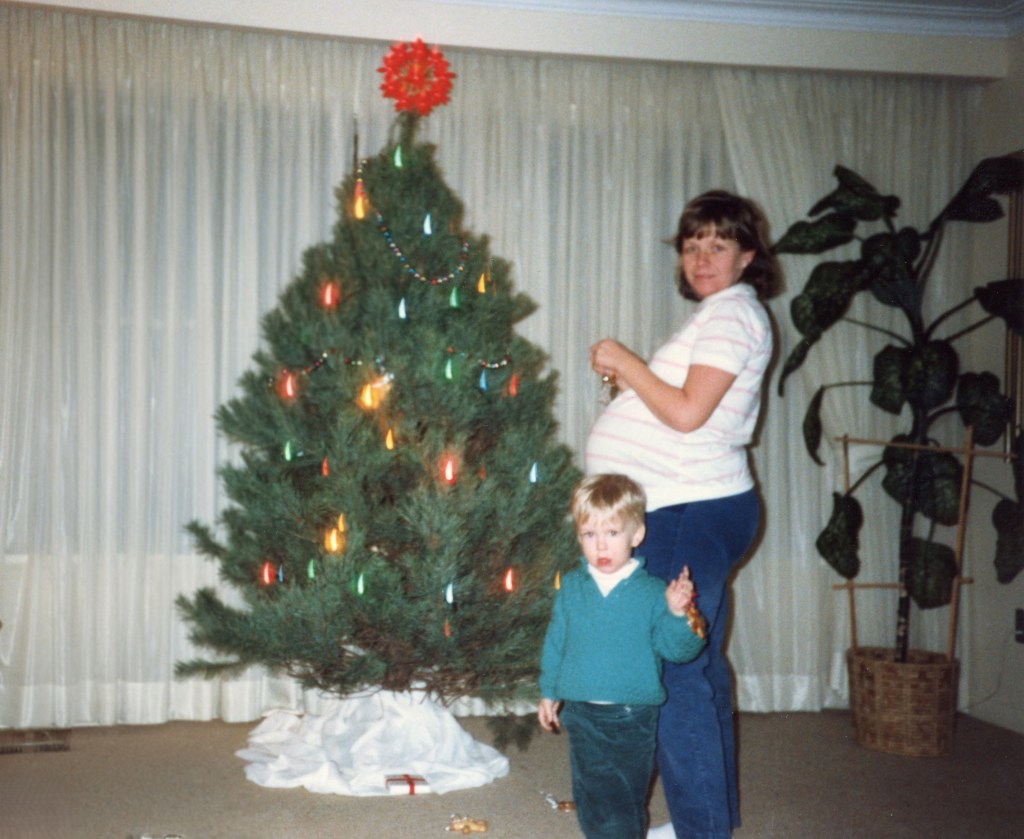
The furniture from the West Mall would need to suffice in the immediate months, spread amongst the additional rooms of the three bedroom bungalow. That old brown pull-out couch found its way to the narrow recreation room in the basement in front of our twenty inch TV. The deep red wing back chair became the main piece of our living/dining room accompanied by a crooked plant stand, a potted palm, and the walnut, cedar lined hope chest. The room was bare, plenty of room for lounging on the wall-to-wall carpet and lots of space for a real Christmas tree, tied strategically with fishing line to ensure the Scotch pine remained upright. The teddy bears of old and candy canes were among the paucity of ornaments spread among the branches, a circle of poinsettias as the topping.

Decorating the tree, 1987

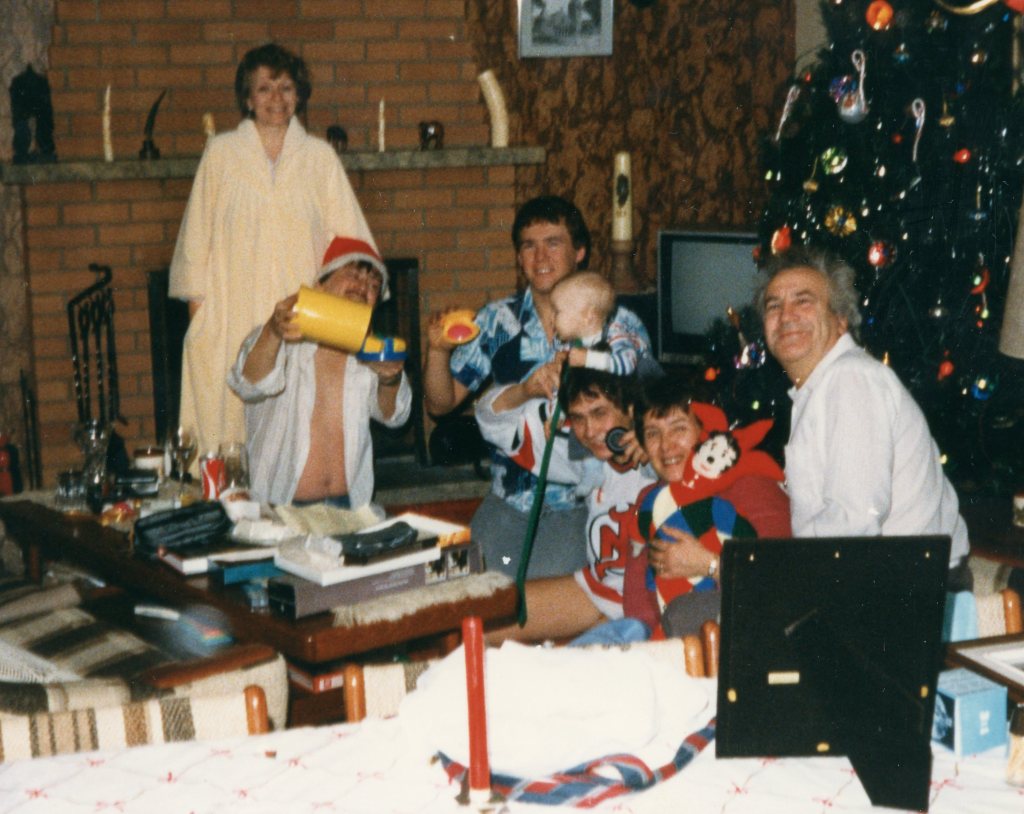
Past Christmases followed a particular rhythm, consisting of an evolving set of typical proceedings. Olga and I would sing and play at the early Christmas Eve mass of Mary Immaculate Parish in London as members of the choir. Afterwards, gifts were opened into the early morning hours at my parent’s house following the traditional Dutch feast of blende vinken. When we moved to Toronto, the pattern remained the same, except we found our seat among the congregation to enjoy the beauty of the music. Nicholas’s arrival altered the sequence of Christmas celebration, limiting the late night gift opening to one item and the content of the stockings. The remaining presents were shared with the Decock family in the morning spurred by the inevitable early awakening of a young child.

Opening presents with the Decock family on Christmas morning, 1985

Christmas of 1987 broke new ground. Olga was very pregnant, ready to give birth imminently. It would be the first year not visiting my parents for the holidays. Instead, the 24th would be an evening by ourselves, in our new Toronto home, wondering and waiting and anticipating. Olga was not examined with an ultra sound. It was not mandatory in those days and we wanted the sex of the child to be revealed at birth. We had a name picked out for a girl and were still debating one for a boy should Olga give birth to another. Olga was almost two weeks late with Nicholas, perhaps accounting for the hefty nine pound, twelve ounce size after 24 hours of labour. How would this experience be different? There were plenty of questions about the next baby.

On the night before Christmas, Nicholas was asleep, snuggled into bed as we gathered a couple chairs into the middle of the room, in front of the tree, to settle in for an evening of music. The radio dial of our cassette boom box was tuned into 102.1 CFNY for Don Berns’s Christmas Eve special. The station played alternative rock/punk, a genre appealing to our sensibilities albeit seemingly sacrilegious for the season. Renowned for being the Spirit of Radio, the playlist included old familiar classics such as Bing Crosby’s White Christmas, Canadian masterpiece God Rest Ye Merry Gentlemen/We Three Kings sung by the Barenaked Ladies/Sarah McLachlan, and the irreverent ditty, Christmas Wrapping by the Waitresses. In between, Don Berns would speak of joy and hope and love in his baritone voice, unscripted, expounding on his own emotions and experiences.

Then without introduction, sweet melodic sounds began to float from the speakers,
Ay, Ay, Ay
the unmistakable voice of Frankie Goes to Hollywood surrounded by uncharacteristic lusty orchestration.
I’m so in love with you, Dreams are like angels, They keep the darkness at bay
We looked at each other in silence. Surprised wonderment. We were familiar with the song, the ballad in sharp contrast to their popular bombastic sound. It was a hit years earlier. The band was incongruent with the season; and yet, it was perfect.
The power of love, A force from above, Cleaning my soul
I held Olga’s hand, resting on her protruding belly.
Make love your goal
A Merry Christmas. A kiss. A lasting memory.

Olena was born three days later, December 27, in the afternoon, after 12 hours of labour, a healthy 9 lbs 4 oz. The Decock family also arrived that day, in Toronto, to celebrate the new birth.

Last week, a Christmas greeting card arrived in the mailbox. They are increasingly rare and are, therefore,  ever more appreciated. This one engendered a broad smile of joy for both Olga and myself. It was addressed to Baba and Opa Decock.
Love with tongues of fire, Purge the soul
The salutation is a couple months premature although we are both glowing in anticipation, counting down the days.
Love is the light, Scaring the darkness away
The answer to the previous question mark is now expecting. This year, we are not waiting for Olena; we are waiting with her. And with Daniel, and Nicholas, and Chiu. Olga and I are not aware whether the grandchild will be a boy or a girl. We would rather not know.
Love is pure, the only treasure.

Make love your goal.

Future Baba and Opa waiting with Olena.

However you celebrate, I wish everyone a very Merry Christmas and a Happy Holidays shared with the people you love.

Creating Beauty

The first flowers I remember giving to you happened early in our dating days. I was playing hockey on Sunday mornings in the Dorchester Men’s No Body Contact League. You even drove out to the arena on occasion to watch. Helmets did not require cages and as a result, an inadvertent stick struck me in the mouth. No issues with the teeth but my lips were cut and swelled to twice normal size. The next day I dropped off a pot of red tulips at your apartment with a note: “These are for the two lips you will be missing.” Corny. I know. It made you laugh and smile; and when you smile your eyes sparkle.

In our first year of marriage, we had little money with you in full time attendance at Western and me working for Jansen’s Greenhouses delivering plants for $6.25 an hour. Purchasing flowers was a luxury we could not afford, as you well know.  Instead, on my Saturday delivery route, I would drive by our little apartment to drop off a potted mum or spring bulbs or a mixed pot, depending on what I knew would go unnoticed missing from the truck. The flowers added to the simplicity of our life together on Victoria Street in London.

When we moved to Toronto, I knew how much you loved to receive flowers so I found ways to purchase them spontaneously if there was a sale, purposely on special occasions, sometimes just because, never on Valentine’s Day because that would be too prosaic. And each time, you were as thrilled as the first time, smiling, finding the perfect vase to display them.

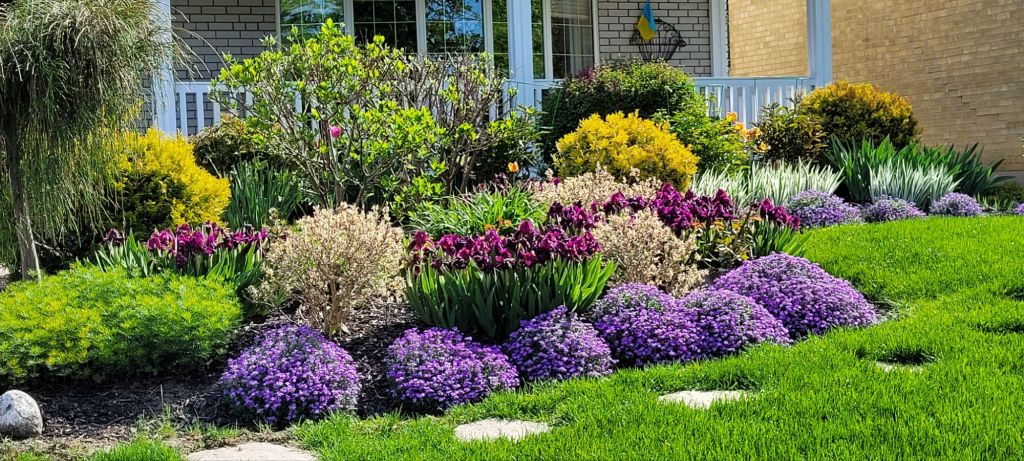
Back yard

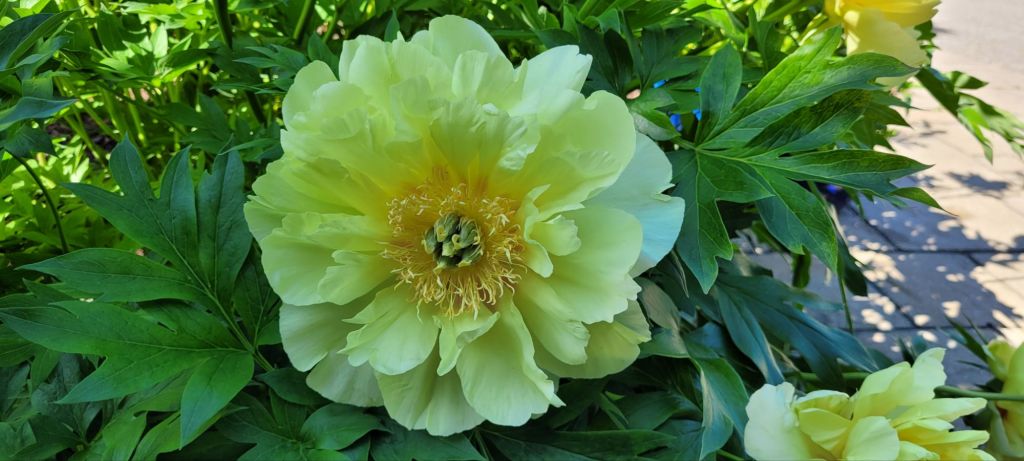
It would be in our yards at home, particularly this one on Mill Road, where we co-created ever expanding gardens so we could enjoy flowers from spring to fall. Planting, nurturing, pruning, replacing, watering, caring, admiring. My favourite moments were those weekend sunny mornings, warm and inviting, when you and I would walk with a coffee in our hand to tour the estate. “Look at how the peonies have blossomed, and the buds on the hydrangeas. Oh! The rose is in bloom!” And you would stop to smell, close your eyes, soak in the fragrance, invite me to do the same. Inevitably a butterfly would visit, a cardinal or a robin would fly into the yard, and a neighbour would walk by to declare we had the most beautiful garden on the block. You thanked them graciously and smiled.

For 42 years you and I have been creating beauty in each other, together, in our home, with our families, for our children and soon our children’s children.

I hope you enjoy the flowers arriving this morning and they make you smile. Just a little something to say I love you.

Happy Anniversary Olga.

Scrabble

I expect when Mom and Dad immigrated to Canada in 1958, their grasp of English would have been quite limited. Sure, they had learned some very elementary words years earlier in grade school, mandatory language lessons along with German and French. They may have even picked up a few classes in preparation for their flight across the Atlantic. In reality, however, their knowledge would have been scant. And like many immigrants, their early years were spent largely within the Dutch community, friends and employers.

When Dad began working at Kelco and the family moved to Kostis Avenue, the need to speak English became more pronounced. There is evidence of both enrolling in ESL classes at Clarke Road Secondary school which helped. Dad working in an English speaking environment forced a growing vocabulary. Mom on the other hand was a stay-at-home spouse with three children under the age of four, the last child arriving several years later. Her world was smaller, the opportunity to hear and practice English were few. Mom would need to acquire the language through radio and TV and the newspaper. She subscribed to Readers Digest, purchased a dictionary, and would complete the crossword puzzle in the London Free Press every day. She was a determined woman, a proud woman, a woman not to be deterred by the circumstances. At some point, Mom purchased the game of Scrabble.

Second only to Rikken, a popular Dutch card past time, Scrabble was her board game of choice. She attempted to engage Dad, but he did not have the patience to mount a real challenge. Mom would be frustrated by his lack of strategy, putting down words without any thought to the board. She would often play herself, picking tiles for two people, akin to a chess champion moving pieces from both sides of the board. I became her most willing and competitive match. She actively sought to engage me in a game for the spirited contest and the opportunity to improve.

Under official Scrabble rules, each player places a word on the board from the seven tiles selected blindly, connecting with the existing configuration. If the new word is questioned for the spelling or its existence, the dictionary is consulted as the arbiter. If the challenge is upheld, the perpetrator loses the points and the turn. Mom never played by these rules. For her, the dictionary was a tool to be consulted in a player’s attempt to maximize their score or complete their turn. Every person was encouraged to utilize the dictionary for the benefit of moving the game along, cleverly filling sections or opening up new ones. The dictionary was a tool for the benefit of the game, not a judgement on vocabulary. Over the years, Mom became the champion of the two letter words, even discovering the word, “qi”, which is the only combination with a “Q” not requiring a “U”. Look it up.

I would win the games in the beginning, my own competitive juices figuring out how to take advantage of the triple word or triple letter squares, less concerned with finding words within my tiles but finding spots on the board to accumulate points. Mom taught me that strategy. And I utilized the dictionary often, adding to my language advantage; nevertheless, she kept insisting on another game. Mom would win a game once in a while, a shot of encouragement. Eventually she would be successful more often, regularly emerging as victor. Yet Mom was a gracious player at the same time. modestly noting you need to have the letters regardless of how skilled, and explaining there is a bit of luck involved. When Olga began participating, Mom was generous in her support. Olga did not grow up with games in her house and consequently lacked the competitive zeal or strategy to score big points. Mom would often look at Olga’s tiles to suggest alternatives even to her own disadvantage. She wanted every participant to be within reach of a victory. Mom wanted a good game for everyone.

I think about Scrabble today and all that it represented in my Mom because it is the 20th anniversary of her untimely death. Scrabble has become the game of choice for Olga and myself. We remember Mom fondly for her quirks and generosity, her fierce thirst for learning, her love of family, and devotion to her children and to her children’s children. Her soul lives in both of us.

Welcome to the End of the World

Finesterre. It was the end of the world as they knew it. Back then.

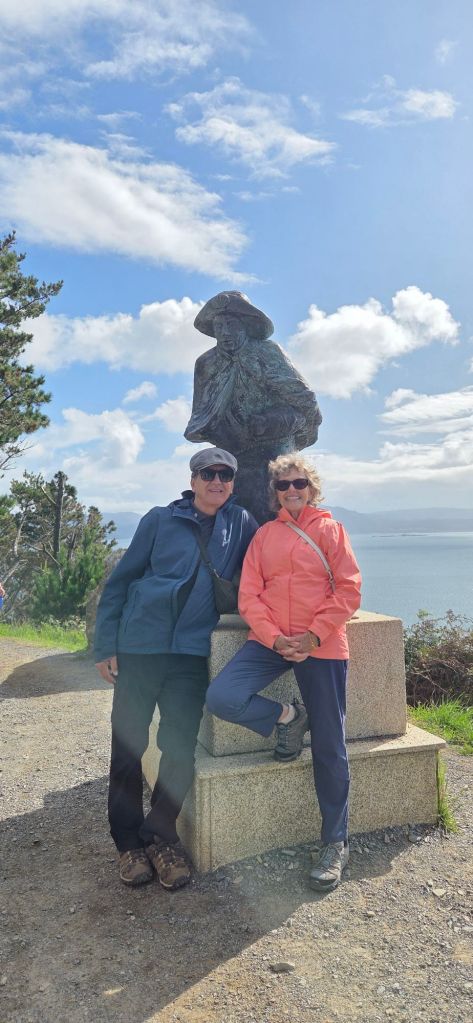
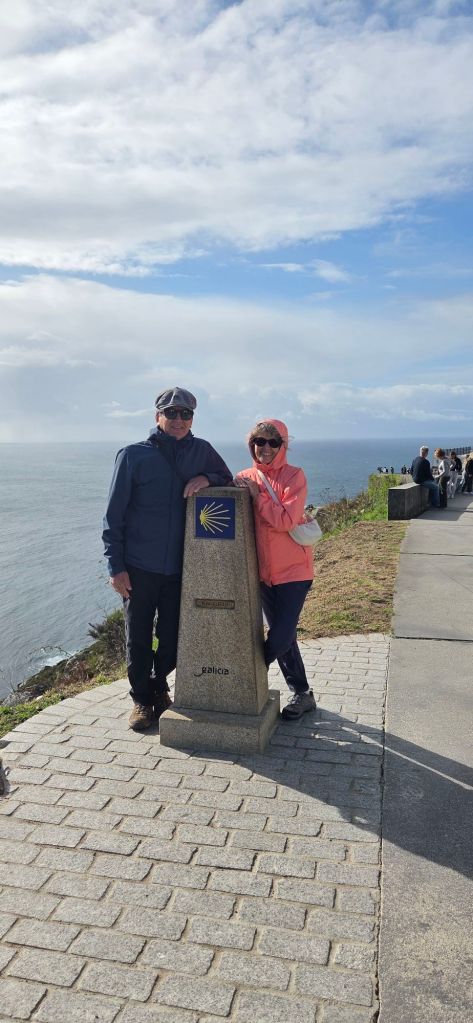
Predating Christianity, people journeyed to  Cape Fisterra on the Costa da Morte (Coast of Death) where they believed the sun died, bringing the worlds of the living and the dead closer together. Finisterre is now the traditional end of the Camino Santiago, although some will continue to Muxia. Maybe next time.

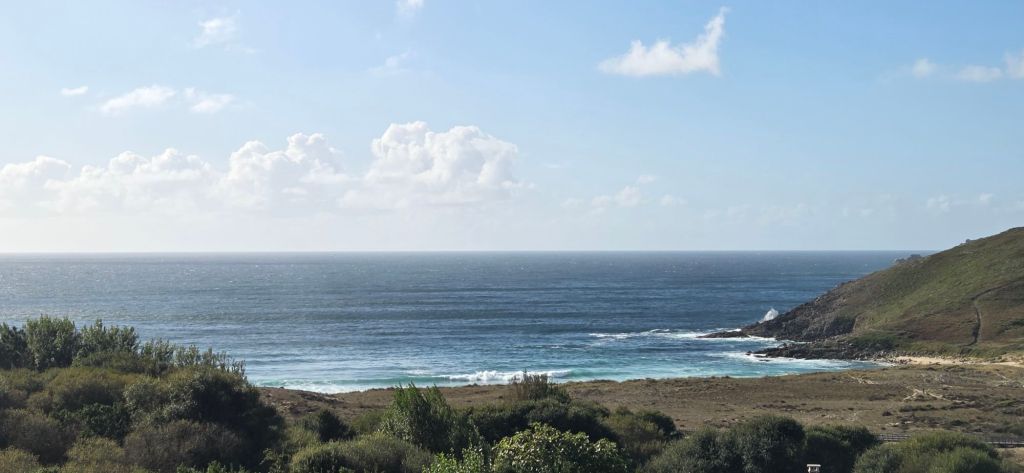
Santiago to Finisterre would have been an additional four day walk. We rode the 2.5 hour bus ride with numerous stops picking up and dropping off passengers along the way. Our destination was a small, six room boutique hotel, family run, attached to a restaurant priding itself on home grown vegetables, local beef, and fresh fish. Hotel Da Natureza Mar Da Ardora’s most appealing feature is the view of the ocean and the sunsets. We can lounge on our balcony, watch and listen to the waves crash the shore, and soak in the last remaining sunshine of the day. The restaurant next door fills with people and visitors from the town for a drink and a dinner and a view.

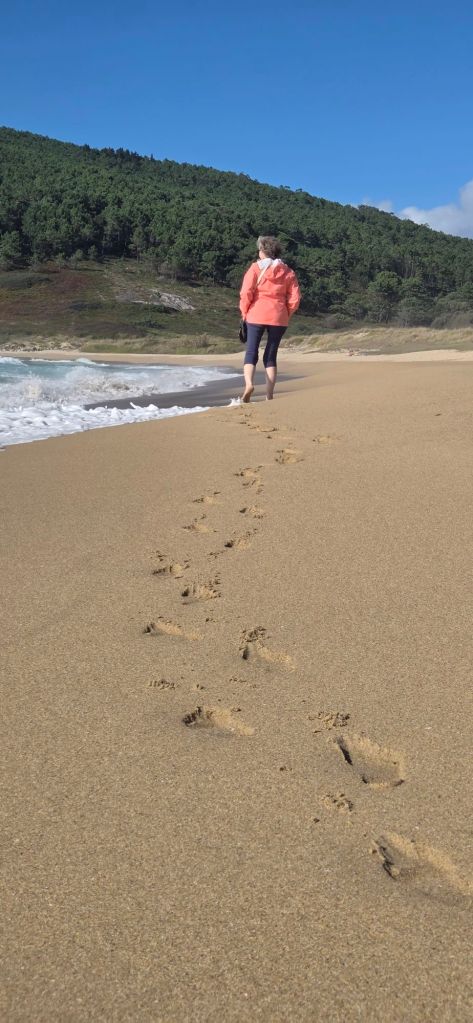
Olga and I retreated to Finisterre for a few days of nothing. Lazy hours filled with catching up on our journal writing, lounging in the hot sun, strolling down to the beach; an early evening drink followed by a delicious meal capped with a glorious sunset. The hotel also hosts a small spa with a hot tub, sauna and pool. We enjoyed  it’s pleasures.

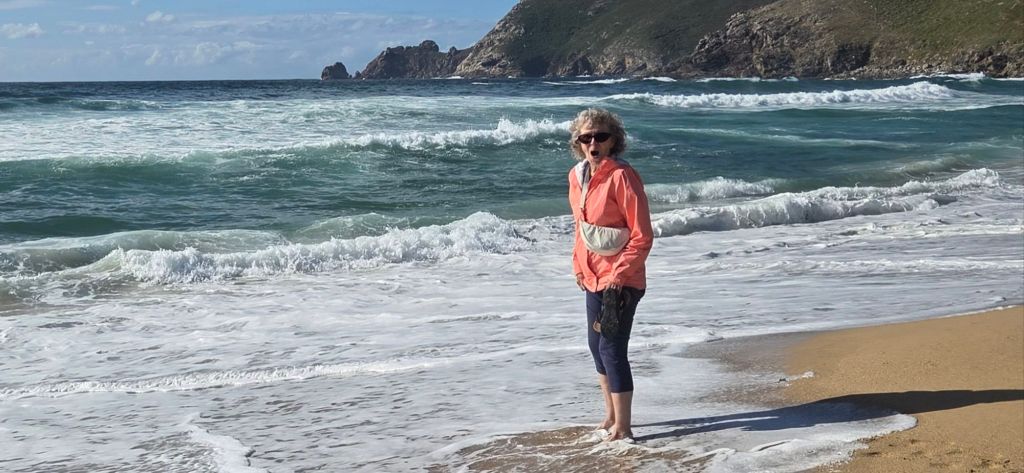
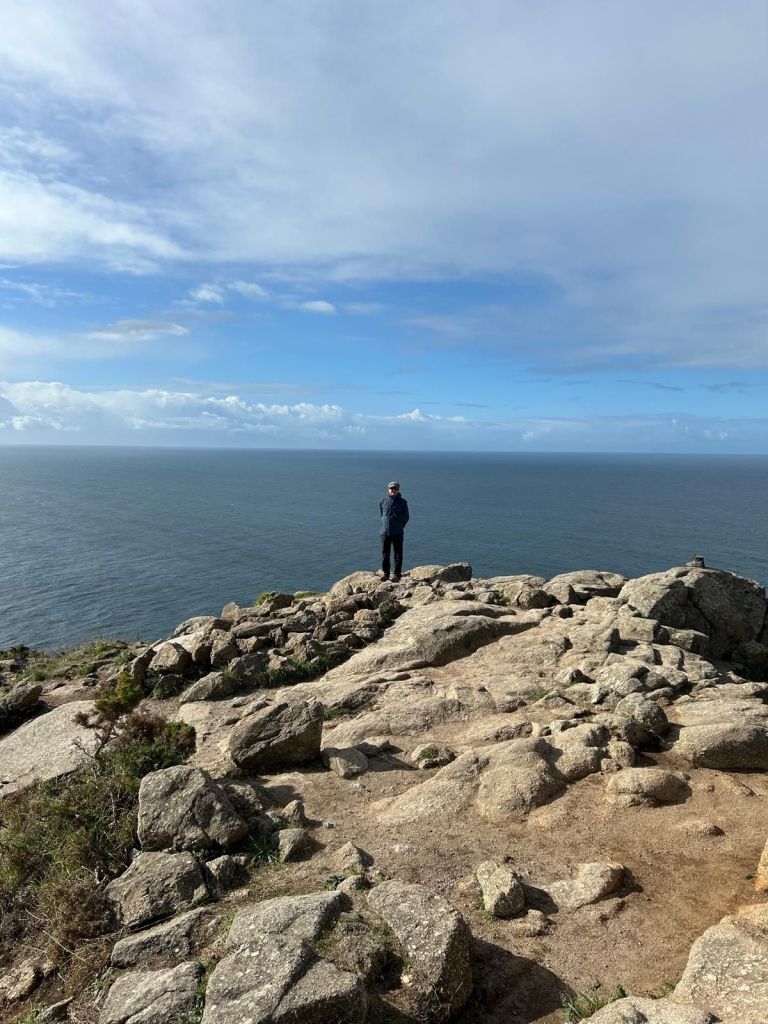
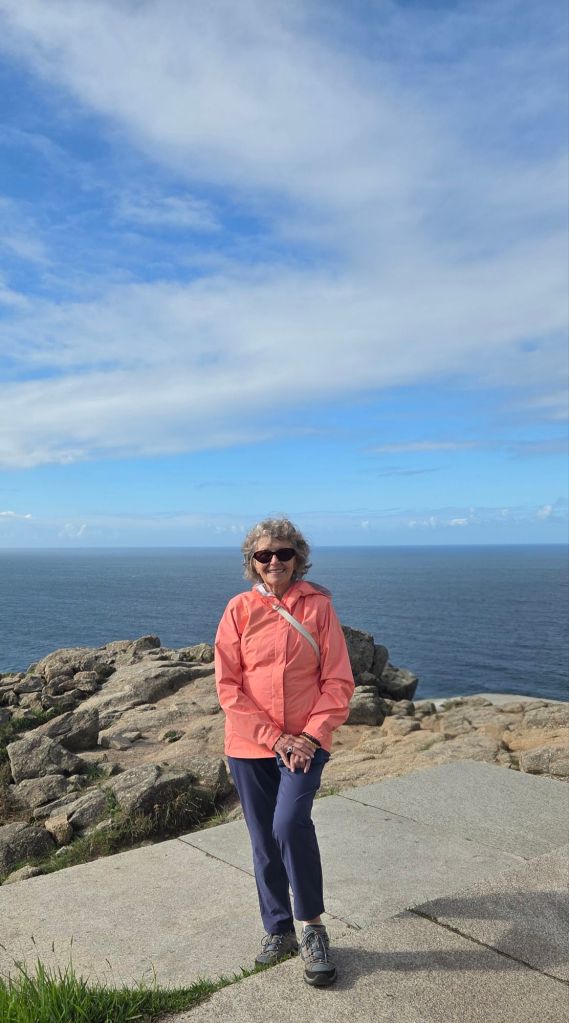
Today was our excursion to the lighthouse point, the end of the world. It is a rugged, rocky terrain overlooking the ocean, too treacherous to wander close to the water. Apparently pilgrims would burn their shoes to mark the conclusion of their journey. A bronze shoe is mounted on a boulder to signify the now defunct tradition.

Standing near the edge

I had been porting a stone unearthed in the stage walking towards Melide. A quartz boulder separated itself from the road’s ledge offering a trove of splinter pieces to the passing pilgrims. One muddy chunk molded into my hand and found a pocket in my cargo pants. Olga questioned the additional weight for walking. I planned to toss the stone here, at Cape Fisterra. I ventured as close to the edge as I dare and threw the stone into the ocean, releasing the weight, shedding the burden;  a symbolic end to our journey.

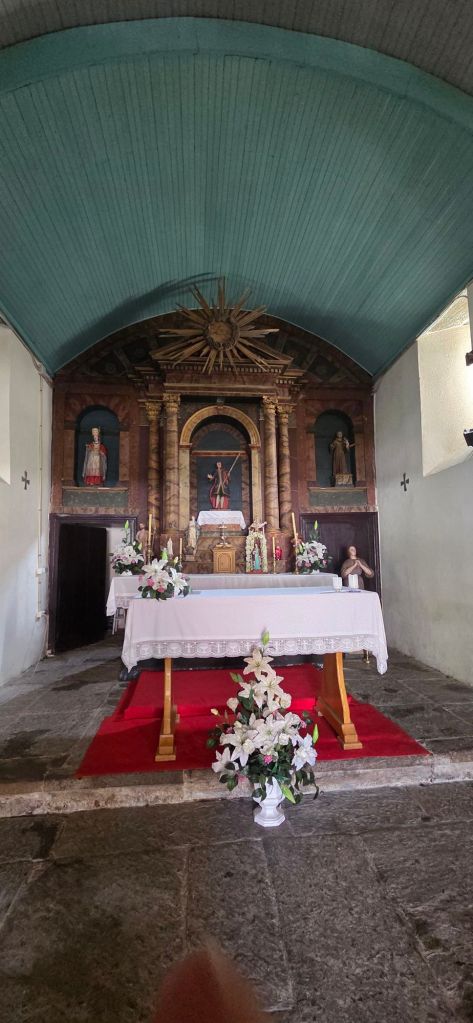
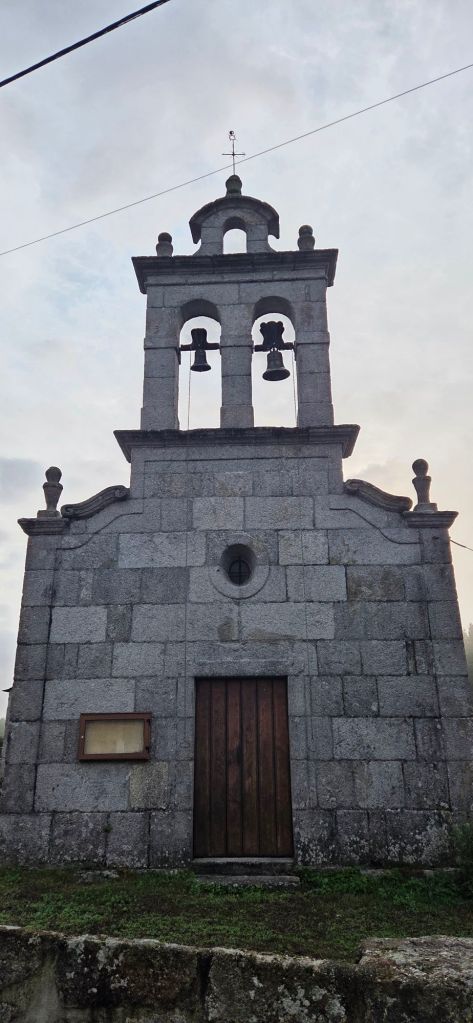
On our return from the end of the world, we joined a noon Sunday mass in progress at Santo Christo de Fisterre, a  deteriorating block structure holding about 60 people in unadorned walls of stone. The parishioners appeared to be responding to a series of statements about faith, typical of a ceremony involving one of the sacraments. From the back, searching between the standing congregation, we caught a glimpse of the priest pouring  water over the forehead of a dark haired baby, offered by the young mother and father. We were witnessing a baptism. Simple and intimate. At the end, the father raised the child in the air facing the congregation; a round of applause to welcome another birth into the community. A new beginning.

On Tuesday we begin our trek home leaving by bus to Santiago, then by train to Madrid for an overnight stay and a mid-morning flight back to Canada.

Nosotros comenzamos de nuevo.

Santiago de Compostela

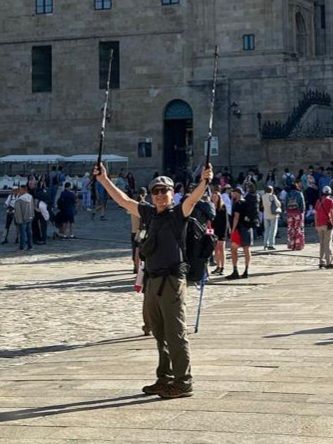
“We made it.”

My voice cracking, my eyes welling up, Olga crying in joy.

“We made it.”

An emotional moment that overwhelmed us.

“We made it.”

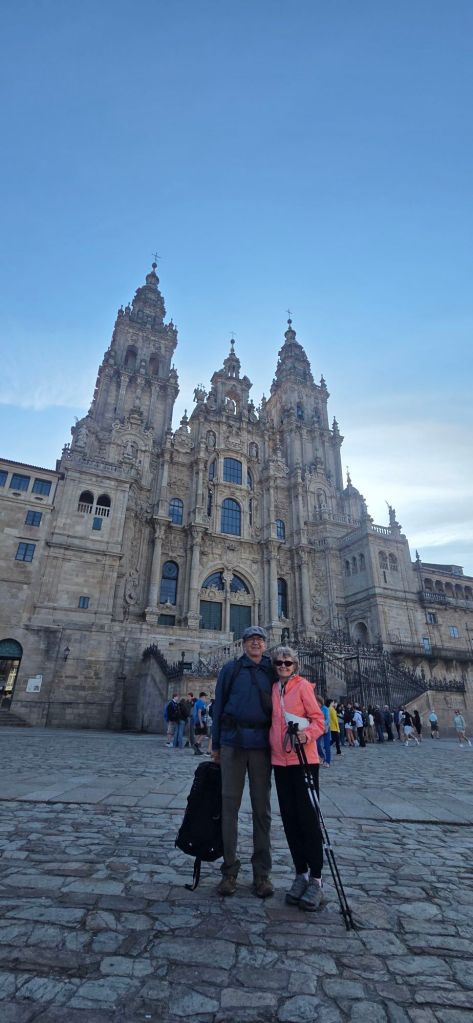
We asked a fellow pilgrim to snap a photo in that instant to capture the end of our journey so we could send it out immediately to our family. Then Olga and I found a spot in the glorious sun of a beautiful day to soak in the feeling for the next half hour. We spoke quietly, reverently. We made it.

Our approach to Santiago began the day before, a 23 km walk from Salceda to San Marco. The stretch was the least appealing to date, walking around an airport, groups of people behind and in front conversing unabashedly, constantly, shattering the silence. I was the Hare, hoping to break free from the crowds.

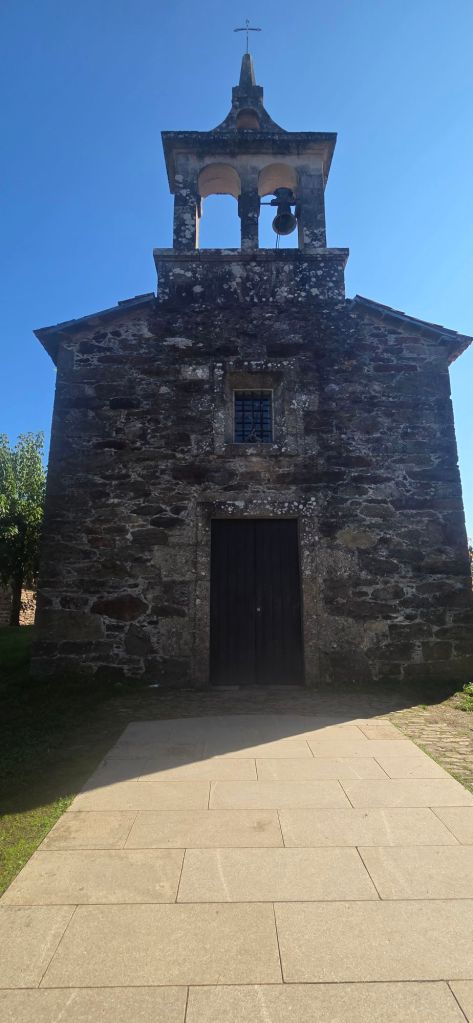
The morning is my best walking time; fresh energy, fresh air, fresh determination. After my cup of strong coffee at 8, I motored along at a heightened pace, stopping only to shed my jacket, forgoing my usual breakfast break. No church to visit and ring a bell, only a couple stamps from enterprising artisans. I rolled into San Pao at 11:30, 15.5 km along, deciding I do need to sit down for a rest and a bit of food. The first bar/cafe was crowded and noisy – no thanks. 200 m further on I spotted St. Ignatius Church, open, advertising the opportunity to visit and and obtain a sello (stamp). My kind of place.

An Italian volunteer was manning the table to imprint the small, decorative impression into my passport. It would be my last for the day, and the most coveted.  The church is tiny, simply adorned, quiet. Only a handful of others found their way inside. My donation was larger than usual.  “Gracias” and a sign of the cross; then I left. I wandered onto the grounds, sat on the low stone wall surrounding it, unburdened my backpack for some smoked sausages and water. I turned around ten minutes later. The church was closed up, the signs disappeared, the volunteer vanished.

I arrived in San Marco before 2:00 pm, surprising Olga who spotted me through the window of the coffee shop across from our hotel. San Marco is only 5.1 km from the Cathedral, purposely chosen for a short walk into Santiago in order to be assured enough time to attend the noon pilgrim mass the next day. The location had the additional advantage of allowing Olga the opportunity to walk the remaining distance if she had recovered sufficiently. Her ankle/shin have improved considerably but the initial long decline out of San Marco would be too difficult. Not a wise idea. Yet we wanted to fulfill her vision of walking into the square so conjured a plan to make it happen. I would leave, walking, at 8:30; Olga would order a taxi at 9:45. We would rendezvous on the grounds of the San Domingos convent in front of the Museo de Pabo Galego to continue and finish.

Olga and I walked the last kilometre, together, into the court yard of the Cathedral of Santiago de Compostela. 

“We made it.”

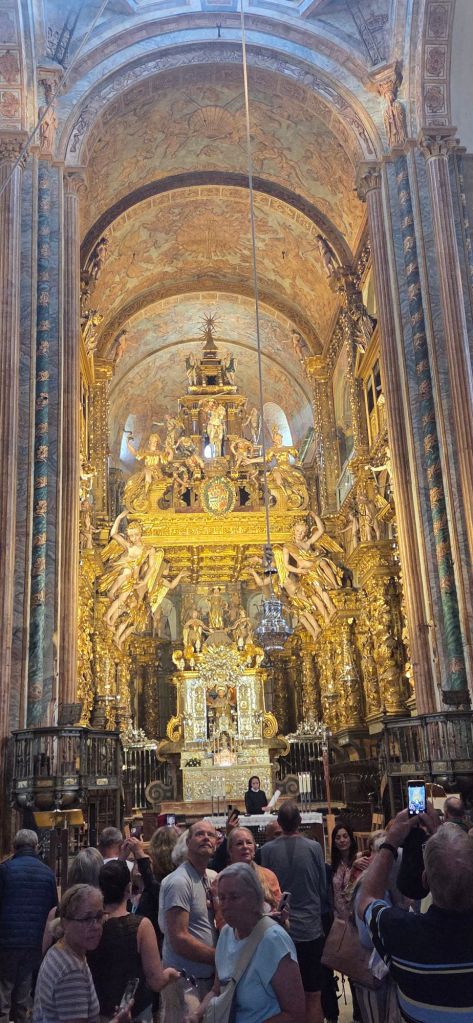
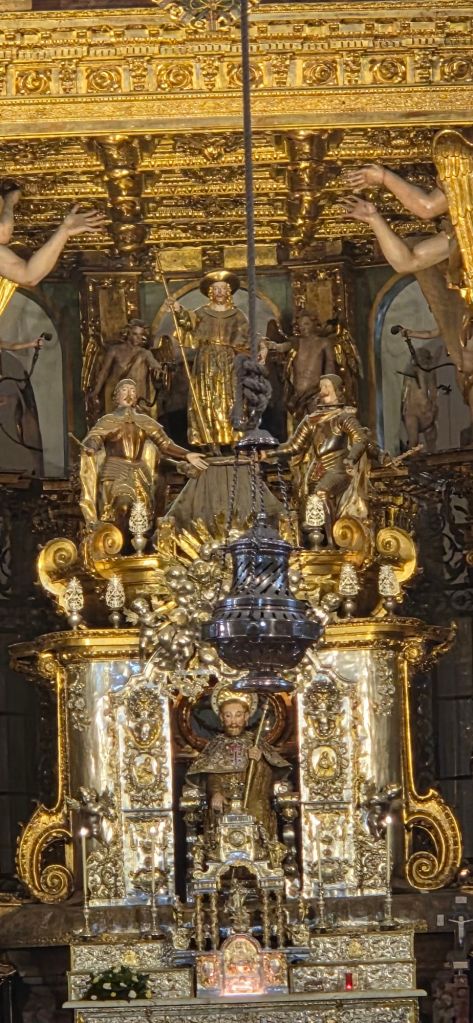
The noon mass was filled to capacity. Advice from a security guard to line up early helped us find a seat near the back of the section facing the altar directly. When the  Spanish mass ended, we assumed everyone would be streaming out. The famous swinging of the Botafumiero only occurs once a week, on special sacred church days, or for groups paying for the privilege. We didn’t expect it today. Suddenly the priests gathered in front of the altar, the thurible lowered and the incense began spewing as some monks started a rhythmic tugging of the rope. Swaying back and forth, higher and higher, the Botafumiero flew from side to side for several minutes, enchanting the people, in awe, cameras recording. The ceremony capped our visit. The vision was complete.

We have been moving almost every day on this journey. We will continue tomorrow by bus to Finisterre for a few days. Together.

Buen Camino

Friol to Melide to Salceda

The Camino has changed. The increased number of people have made the alone times less frequent, reduced even further after Melide when the Camino Frances melds with the Camino Primitivo. The earlier collective comraderie has narrowed to one’s immediate circle. The pilgrimmage is beginning to feel more like a long tourist walk through the countryside.

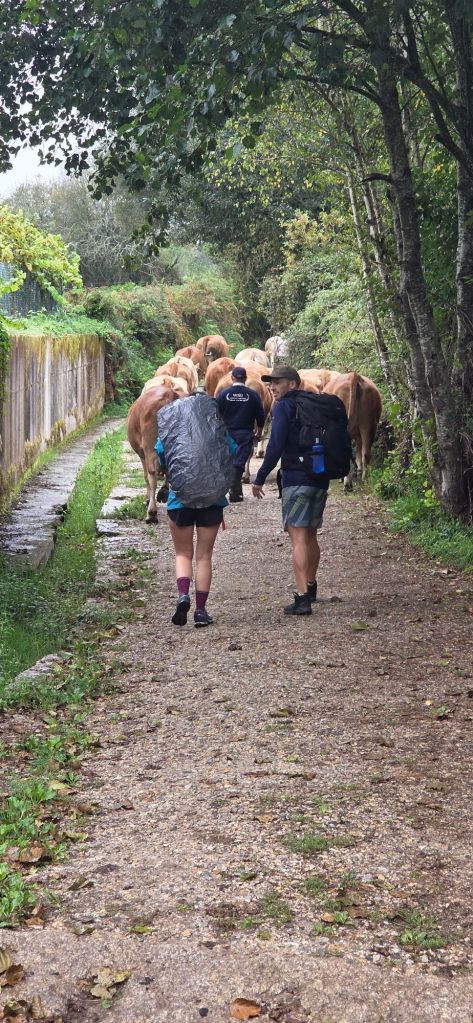
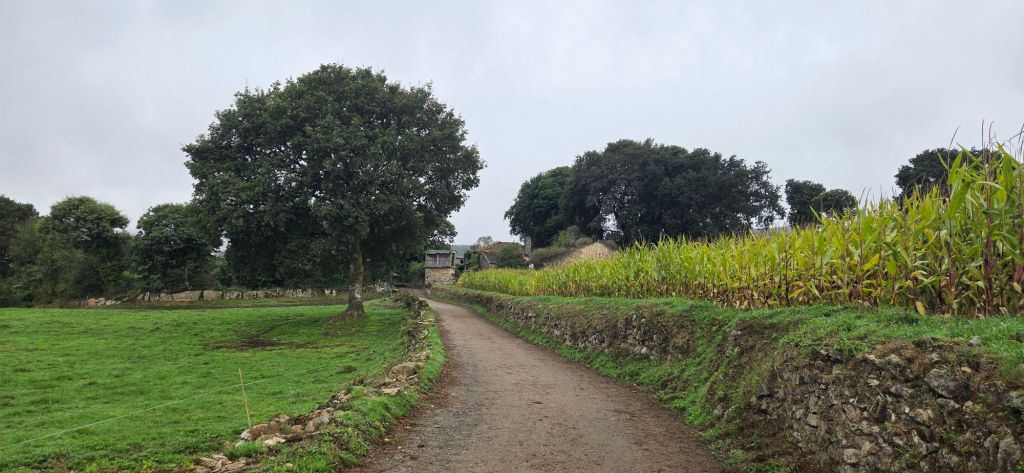
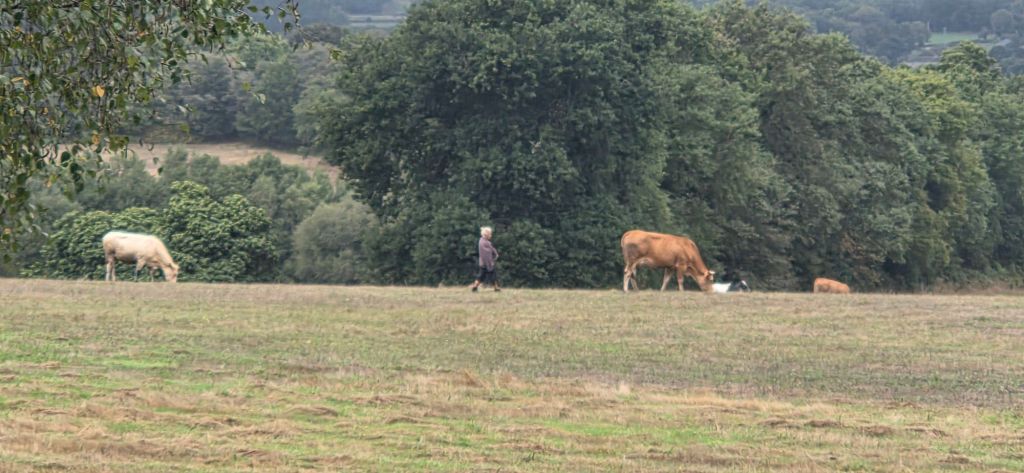
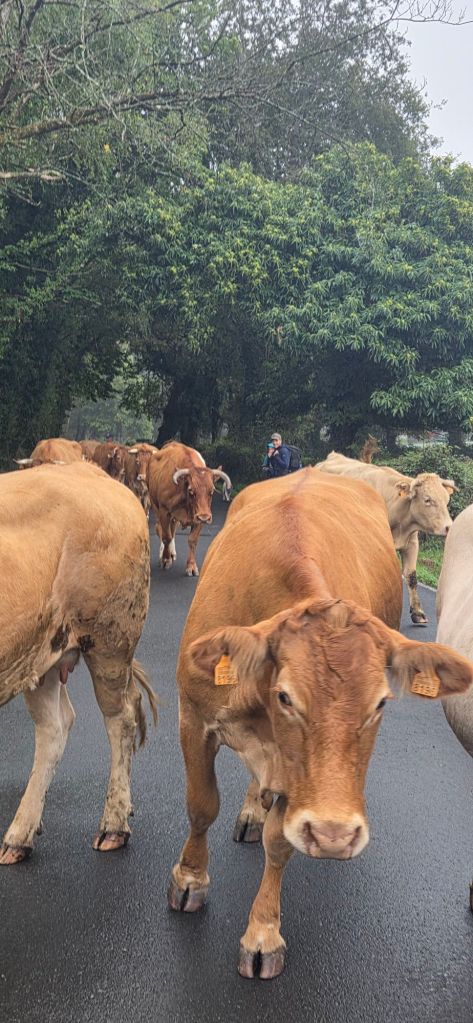
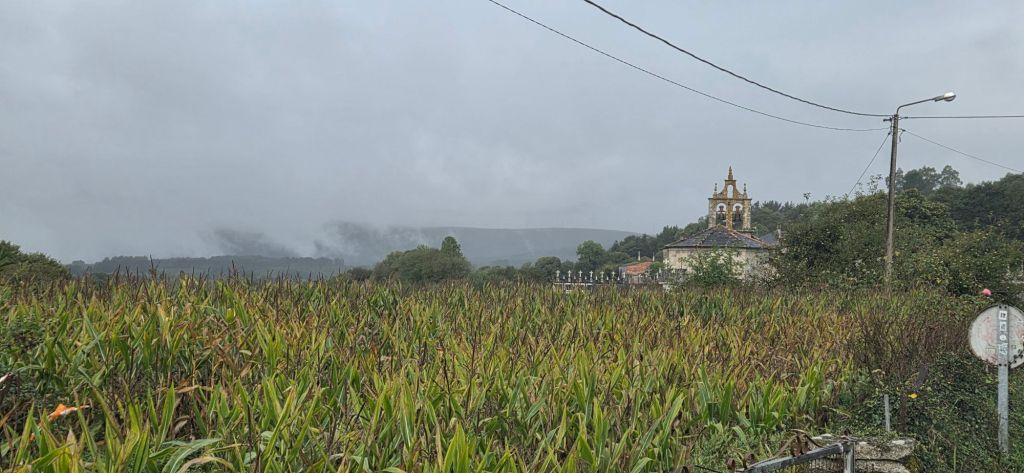
The scenery is more rolling hills than mountains, as to be expected; certainly easier on the legs. One can still overlook  valleys and vistas of fields and forests and streams. I do enjoy wading through the farming villages, stone houses, moaning cattle, and barking dogs. And take in that fresh…cough, cough…country air. Rainy weather mixed with the mud and manure made for slick pathways, all part of the experience. And there is nothing like joining a parade of cows.

I found myself greeting the animals in Spanish and English. “Buenos Dias. Good morning.How are you this fine morning. What are you doing out here on your own. No need to worry, just me.” The horses or sheep never respond verbally. The dogs and the cats and the cows on the other hand always seemed to acknowledge my presence.

My new challenge is to ring the bell atop as many churches as possible along the path. I approach them in hopes of finding a stamp as in the first three stages. Alas, the doors are now locked, the grounds filled with nichos to hold the deceased, and a chain hangs within reach. Sometimes one yank produces the desired sound; for others, several pulls get the bell to sway until the clacker strikes. I consciously strive for only one chime so as not to confuse the local residents. I was fortunate to ring two bells on each of the last three stretches. The road from Melide to Salceda revealed only two churches, both without a chain, another manner in which the Camino has changed.

And for reasons unknown, I kept singing to myself, “God is in the roses and thorns”, a song by Roseanne Cash on an album she released after her father died. I love the entire album yet this song comes to mind readily. As I look carefully at the lyrics, they don’t match my current circumstances; however, the notion there is some good to be found in all situations resonates. Yes, the Camino is crowded at time; most of the people respond with the obligatory, Buen Camino, many times muttered, lacking sincerity. I am annoyed at the vandals who have been writing gibberish on the official markers, a Carlos actively defacing them today. At the same time, kind and generous people have brightened the days.

My favourite moment occurred approximately halfway between Melide and Salceda, in the small city of Azúa. I had walked past an elderly Spanish couple, leathery faces of age, slowly trudging along, arm in arm, the woman helped by a walking stick. As usual, I conveyed a Buenas Dias, smiled; they returned the greeting. I walked on.

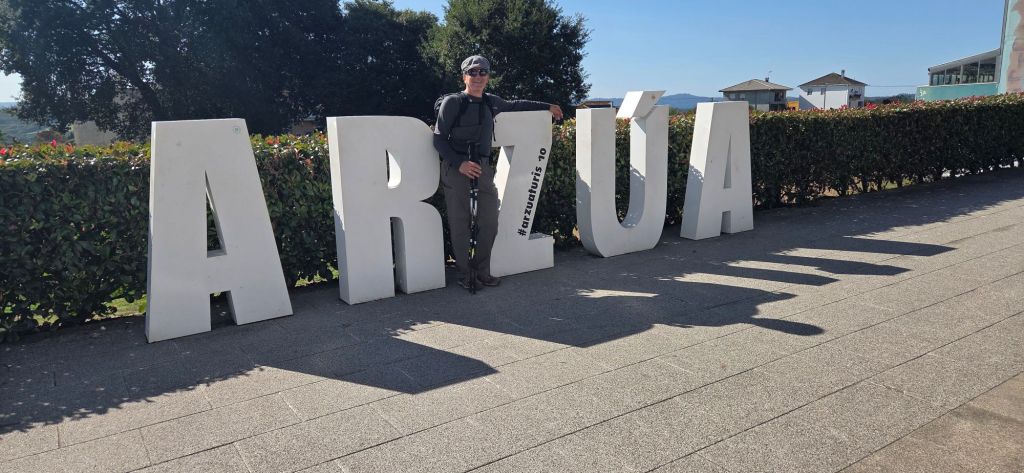
Approaching the centre is a display of large white letters spelling out the name of  the city. This signage is common in most tourist spots providing photo opportunities for visitors. I could see several people ahead posing. They were gone by the time I arrived and my attempts at a selfie proved fruitless. I looked around. The elderly Spanish  couple were plodding closer. I waited.

“Would you take my picture in front of the letters?” I pointed to the sign, to my phone, to him. The man understood and his face responded with enthusiasm, “Yes, I would be happy to help.” Okay, I made that up – neither of the two could understand or speak a word of English, but he was eager.

I handed him the camera, ready to point and click. The woman hobbled to the side, I moved into place, the man kept moving back to capture the whole word display. He looked up, looked into the camera, appeared to press the button several times and declared it done. He handed me the phone to ensure I was happy with the pictures. I checked. There was nothing, no new photos.

“Huh! Really? How is that possible?”, at least that is my interpretation of his body language and how his  Spanish words felt. “I will take another picture.” I set it up again, took my spot, he took his, aimed, pressed a couple times and handed the phone back. Still nothing.

By this time the man is befuddled, cannot figure out what is happening but insists to give it a third try. The woman waits patiently to the side, a hint of a smirk. I point to the button, which he claims to know. We go through the same routine. This time he has managed to snap a photo of the sidewalk. Determined he grumbles more in Spanish, admonishes himself and I hand the ready camera to him for a fourth attempt.

Hurrying the phone back to me, the man draws close, anxious to witness his efforts, as I open the photo gallery. Success. Two pictures. We both laughed heartily; he clasped his hand on my shoulder in celebration. The woman smiled broadly. “Gracias, gracias. Buenos Dias!” It was the best five minutes on the path in the last two days.

I walked a little lighter. God is in the roses and the thorns.

I arrived in Salceda at 3:00 pm, seven hours and 25.1 km later. Olga was waiting. We usually text each other along the way, keeping track of my pace and sharing pictures. These days are difficult for her given the constant movement from place to place, unprepared for the considerable downtime. Just one more long stretch tomorrow before we walk together to the cathedral in Santiago.

Buen Camino

Lugo to Friol

Lugo is 100 km from Santiago de Compostela which makes the city a popular starting place for people desiring the certificate at the end of their Camino. The trek today, as a result, was considerably busier with those just beginning and those continuing.

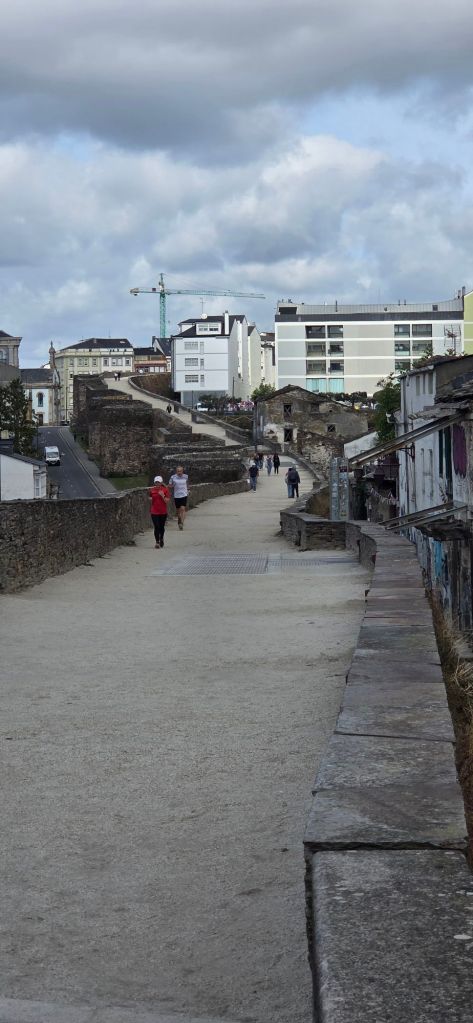
Lugo is a travel destination in its own right. Olga and I had spent an additional night in order to visit the Catedral de Santa María de Lugo in the heart of this walled city. Otherwise known as the Lugo Cathedral, it is a significant example of Romanesque, Gothic, Baroque, and Neoclassicist architecture, with its construction starting in the early 12th century.  I have always had difficulty distinguishing between the architectural differences, and most of the time it does not matter, from my perspective. You will find countless examples across Europe and if that is the only focus, one might become bored quickly. Ho hum, another Gothic or Boroque or Romanesque Cathedral.

We focus on the details, the paintings, the iconography, the statues, how they reflect the peculiarity of the region, the artist, the period. And if one element is noticed, we begin looking for the same in the next church or consider the differences. For example, on a chance visit to a church in Florence we discovered a crucifixion, sculpted by Michelangelo, with Jesus sans a loin cloth, completely naked, anatomically correct. We thought it would be the only such version until our visit to the museum of the Lugo Cathedral where a smaller but just as exposed Jesus was on display. Fascinating. Then there is the figure of a regal Mother Mary wearing the crown of a queen, holding a mature baby Jesus, also with a crown, who is placing his left hand on her unadorned left breast. And the title of this statue?  Our Lady of the Big Eyes. Intriguing. And there was much more which I would share here in pictures except there was a strict prohibition on the use of cameras. You will simply have to take me at my word.

These images were part of the swirling thoughts in my mind as I began the day’s walk just beyond the wall along a path lighted for the early morning pilgrims. Stillness was not going to be achieved today; moments of peacefulness were also rare with only a few short stretches without pilgrims. The one advantage of a Tortoise walker is the frequency of people passing, a quick Buenas Dias, or a Buen Camino, before they forge ahead. I think I am alone, plodding steady, rummaging through my brain, when the crunching sound of approaching steps get louder and moves on past. Buenos Dias. Buen Camino. At the first official resting spot, replete with several vending machines, I stopped to have breakfast and counted more pilgrims leaving and arriving than I had seen in the previous four stages combined.

The larger swarm of peregrinos also added to the increased number of English speaking participants, although judging by the languages spoken I believe the influx of Spaniards was largely responsible for the “crowded” paths. Among those English speakers was a couple, Maria and Geoff, from Northern England who we had encountered the night before in Lugo. They are avid walkers, in our age bracket I would guess, well practiced on the hilly terrain in their part of the UK. I have dubbed them the Grey Hares because they passed me on the road and quickly faded into the distant. I left at 8:00 am; they left at 9:00 am from the same hotel, and overtook me at 12:00 pm.

When I reached today’s destination after 22.1 km , Olga was waiting outside, smiling, arms wide open. She had already waved to the Grey Hares passing by earlier and had been engaged in conversations with an Australian woman, the owners, other visiting pilgrims, the local pets – generally just being Olga.

Tomorrow we carry on in the same manner. Olga wants to ensure her leg heals completely and not inflict any unnecessary further damage. She will proceed by taxi, me on foot, and together we will complete the hybrid Camino.

Castroverde to Lugo

The hope was for the swelling and pain in Olga’s ankle/shin to subside enough for her to resume walking. We would have four days of down time and skip the mountains to allow for the possibility. Castroverde would be an excellent place to start again as the path is mostly flat and the inevitable inclines and declines would be manageable.

We could not find a place for two nights in Castroverde, so we booked a room in A Fonsegrada, 32 km away. It was the best we could find on short notice. We arranged for a taxi; Estevo picked us up at the Palacio de Merás to begin the two hour, 80 km ride. It was rainy and miserable; good day to be driving.

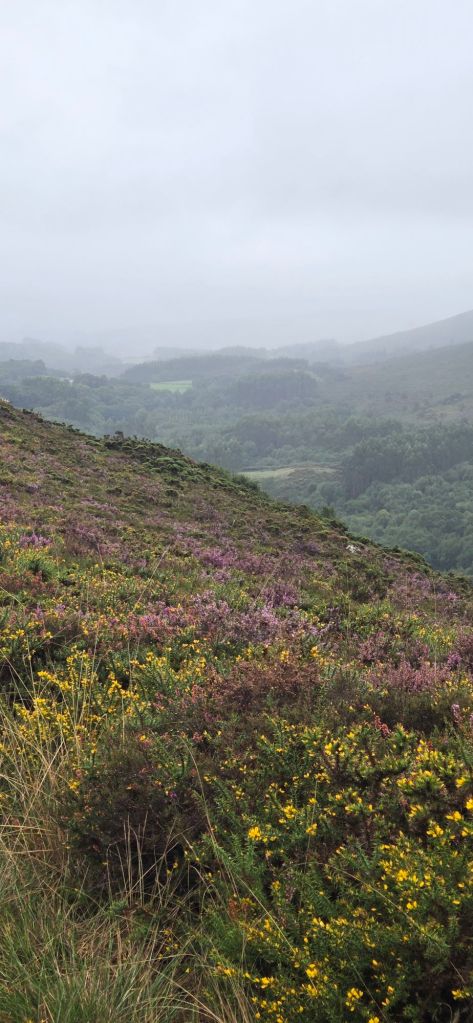
All along the route, Estevo pointed out key spots of the Primitivo as I followed along with my guide book. The taxi ride skipped four stages and a minimum of 34.5 hours of walking, along with sparing our bodies. The mountainous ride delivered us to the highest point on the trail, Puerto del Pala at 1147m. There were pilgrims draped in ponchos flattened against their bodies from the extensive rain, heads bent trudging against the wind. The ruggedness of the terrain and the difficulty of the route confirmed our decision. The beauty had me imagining what might have been and what might be.

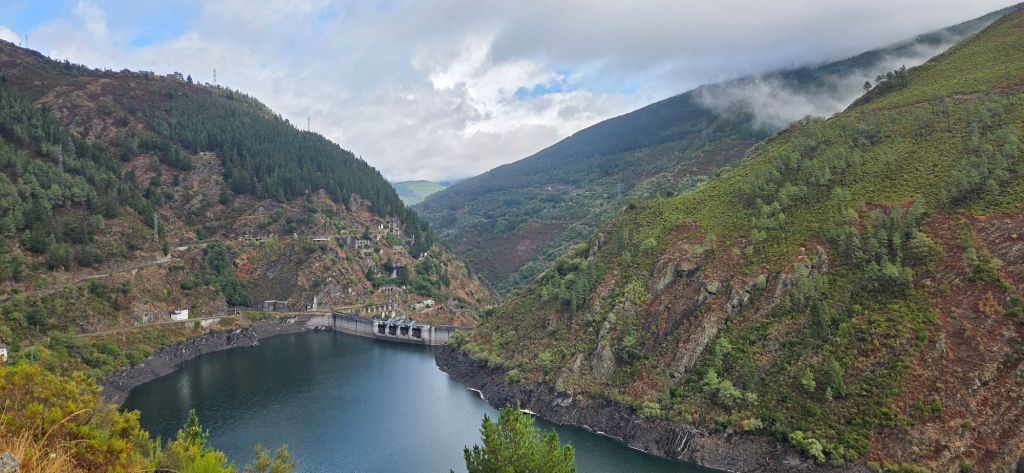
After a stop at the dam in Grandas de Salime, the van was climbing up a winding hill when Olga laughed, “Wouldn’t it be hilarious if we saw Izzy, she would be on this leg of the Primitivo. ” At that moment, ahead on the next curve, there she was standing in the sun amongst other young pilgrims sipping from a juice box, smiling, as we did. The Tortoise had now passed the Hare.

By the time we arrived at Casa de Lambranza, the weather had improved. Yanire, the 31 year old owner was cheery and talkative and spoke fluent English. The little enclave boasted a tiny church. When Yanire acquired the keys for a requested tour, it would be her very first time inside. It was a sweet conversation about religion and politics and family. The Plan B place turned out to be A delight.

Another day of rain as we entered Castroverde, skipping another stage. The Pension Roma is on the main drag, a natural stop and the perfect style of rooms for those one night peregrinos. The staff were delightful, Sylvia in particular. Mario, the owner, was a true gentleman; explaining in rapid Spanish into his phone for an English translation, helping out with a taxi, even trying to influence the local physiotherapist to squeeze in Olga for an appointment.

By this time thoughts of Olga resuming proved premature. The healing needs more time. “You can walk the Camino, Henry. We don’t need to do everything together. I will  move ahead to Lugo and meet you there.” And so it would be.

I left at 8:00 am, smaller backpack in tow, for the 22 km trek through rural farmland and agricultural villages. Overcast, cool, foggy, quiet. The four days of rest helped me as well, the pace a touch faster along the well trodden path of a flatter terrain. A pilgrim who I spotted in town caught up to me at a church in one of many tiny villages. James from New Zealand was scouting for a passport stamp; instead, we each rang the bell, one chime to mark our presence.

His wife had also injured herself approaching Tineo but decided to return to Oviedo, hang out with a friend while he carried on. They would meet up again in Santiago. James was on his first Camino. I admire him for his tenacity. We did not see each other again. My pace obviously slower. Indeed all 15 people I encountered motored past. I was alone for 98% of the time.

True to the guide book, the walk was considerably easier than the first three legs of the Primitivo. No longer in the mountains, the ascents and descents were gentle by comparison. The relative ease meant more time to think.

The previous evening, we were listening to an address by Father Richard Rohr, the Franciscan priest who I had been reading prior to our trip. He spoke of our minds spending 93% of the time thinking about the past, the future, current matters, latest issue; our minds racing around rather than being still, because it is in stillness we see God. In my walking today, I found myself thinking back on earlier posts, toward a future post, about plans changing, about future decisions, about scheduling the next stays. My mind was never still even with the ideal conditions of the morning walk. Peacefulness but not stillness. The moment for stillness would have been in those first few hours before the afternoon when I grew tired and kept thinking about the kilometres left.

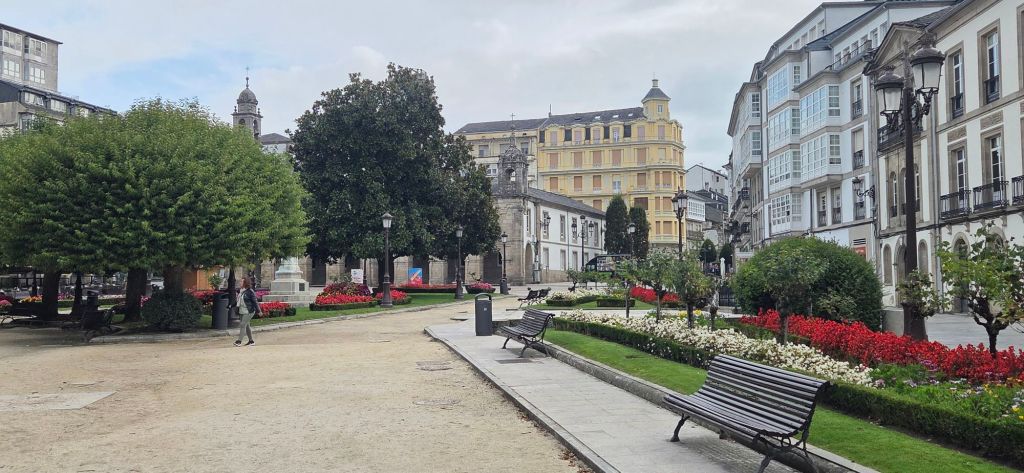
We are scheduled to spend two nights here in Lugo, visit the cathedral, tour the heart of the old centre, embrace the atmosphere of the old world. The next stage is 27 km, too much for Olga to attempt. She will meet me in the next town; I will walk again, perhaps with moments of stillness.

Buen Camino

Welcome to Lugo

Tineo

The planning for the Camino Primitivo was intended to be fluid. September is still considered the high season and the Facebook posts pointed to challenges  in finding space in the albergues. We were not inclined to sleep in these dormitory accommodations, preferring rather to find private rooms, hotel or otherwise. Believing we could manage the first three stages, I set to booking our resting spot in Grado, Salas and Tineo.

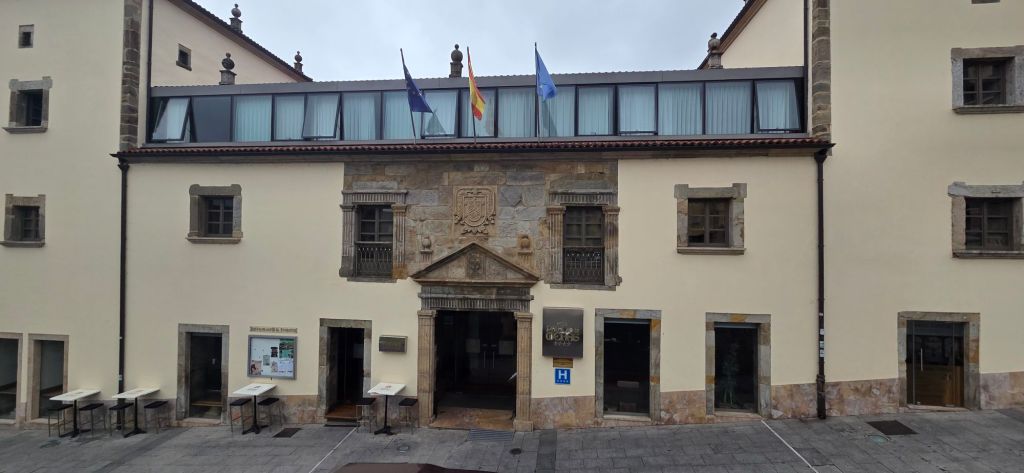
Tineo is a small town with very few options. The Palacio de Merás popped up in the search, rated 9.0 by 1200 users at $130 Cdn per night, with only a couple spots remaining. It met our criteria, the pictures were appealing, so we booked it for one night. Little did we know it would be our world for three nights, our only window to the town and the people.

We limped in early evening on a Sunday when every store was closed. Even the 24 hour vending machine was locked. The combination albergue/hotel operated a bar and restaurant so we were not going hungry; however, I was desperate for Epsom salt so Olga could soak her failing right leg. The next day was a holiday, Asturia day, the birthday of Mother Mary, making finding a pharmacy equally difficult. The woman at the bar/cafeteria introduced us to her friend, Carlos, who could drive me to the one shop allowed to be open for the holiday.

Carlos did not speak a word of English. Only the back seat behind the driver was available, the remainder of the vehicle filled with newspapers for delivery. A series of exchanges through Google Translate but no Epsom salt, no alternative, no suggestions from the pharmacist except check with the doctor. Carlos kindly drove me there as well. Closed. Then he drove me back. His help was the second day in a row of a spontaneous selfless act.

The remainder of the time was spent in our room, resting, reading (on the little hand-held screen), and writing. By six, Olga and I ventured down to the bar/cafeteria for something to eat except we are in Spain and food does not get served until 8:00 pm. So, cerveza and vino in a little nook by the window.

Kitty corner to us was a table of two men about 10 years younger and an elderly man in deep conversation about tomatoes. Not that we understood, except they were observing each one atop a glass, holding it, smelling it, commenting before examining another. Olga was facing them directly, smiling, relaying the story to me when the elder gentleman walked over with a tomato in hand. He must have noticed our curiosity. Without a word of English, he conveyed obvious pride when handing it to Olga, explaining in Spanish as she squeezed it, smelled it, then passed over to me to repeat. Yes, these are fabulous tomatoes. He returned with grapes for us to taste. We thought the man was a local farmer supplying the hotel with produce.

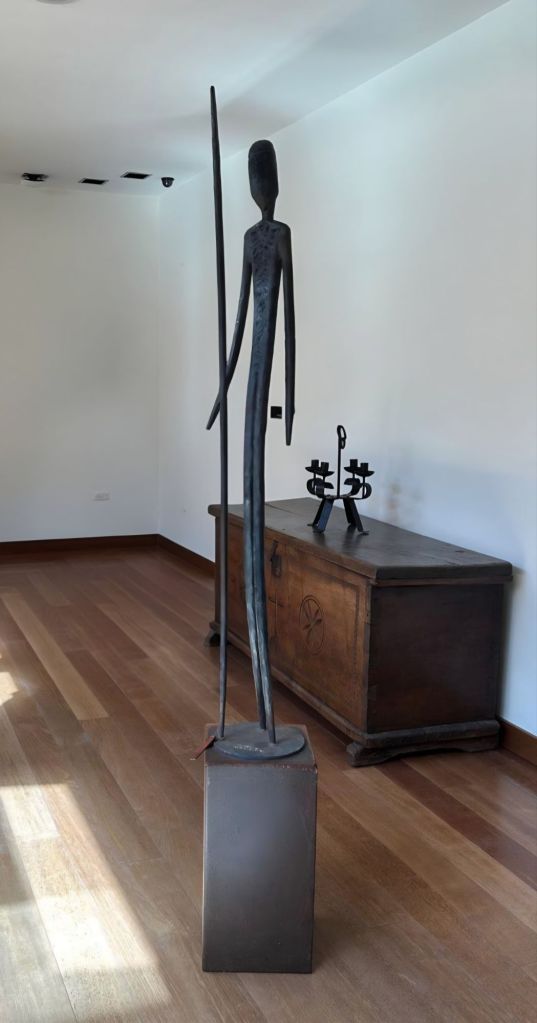
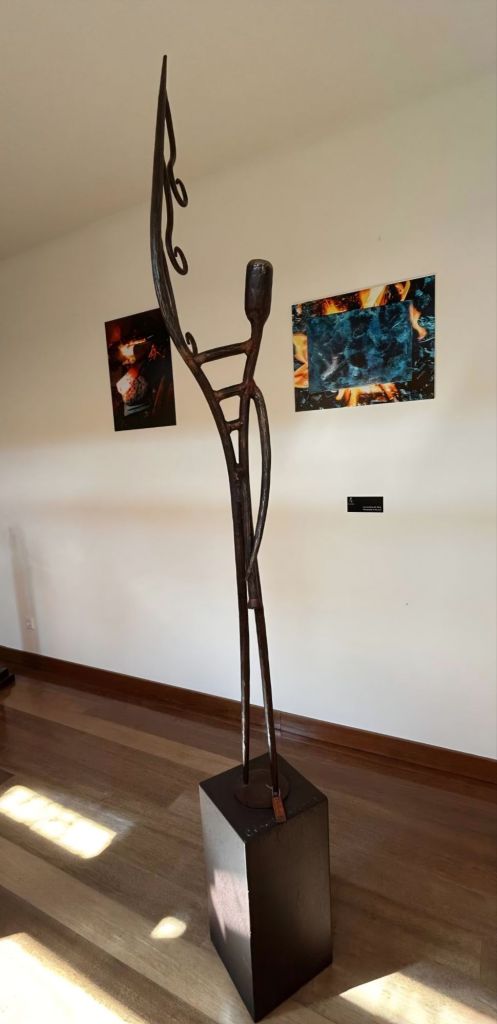
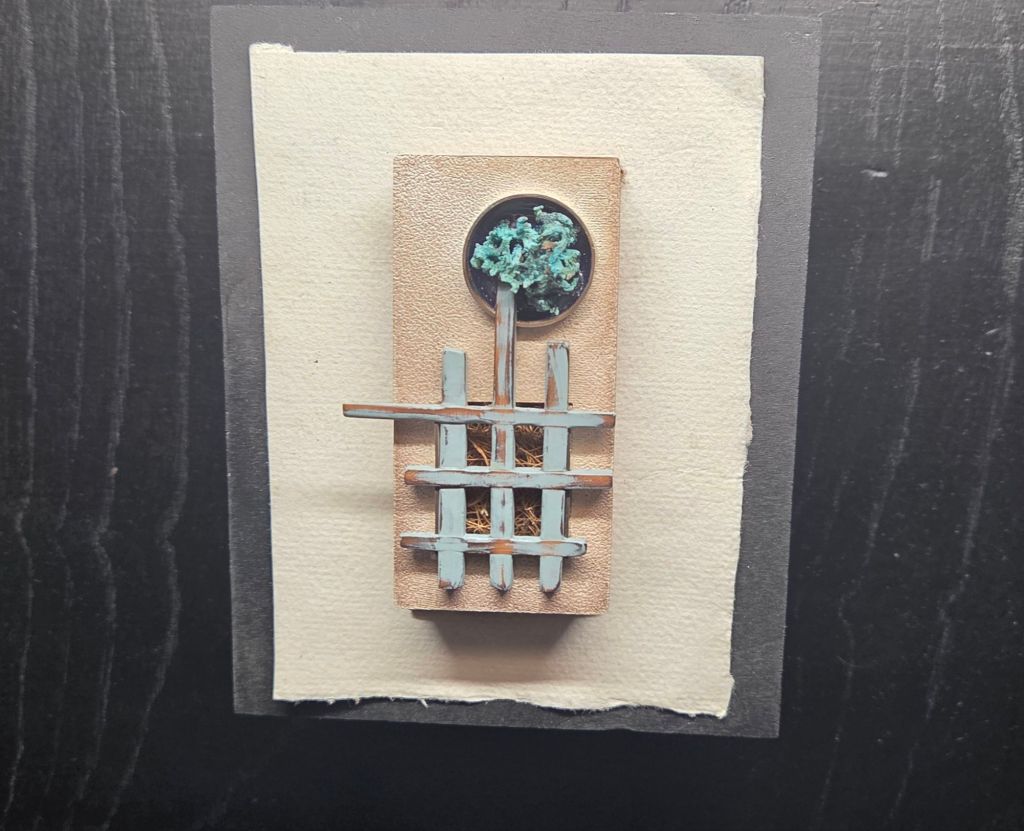
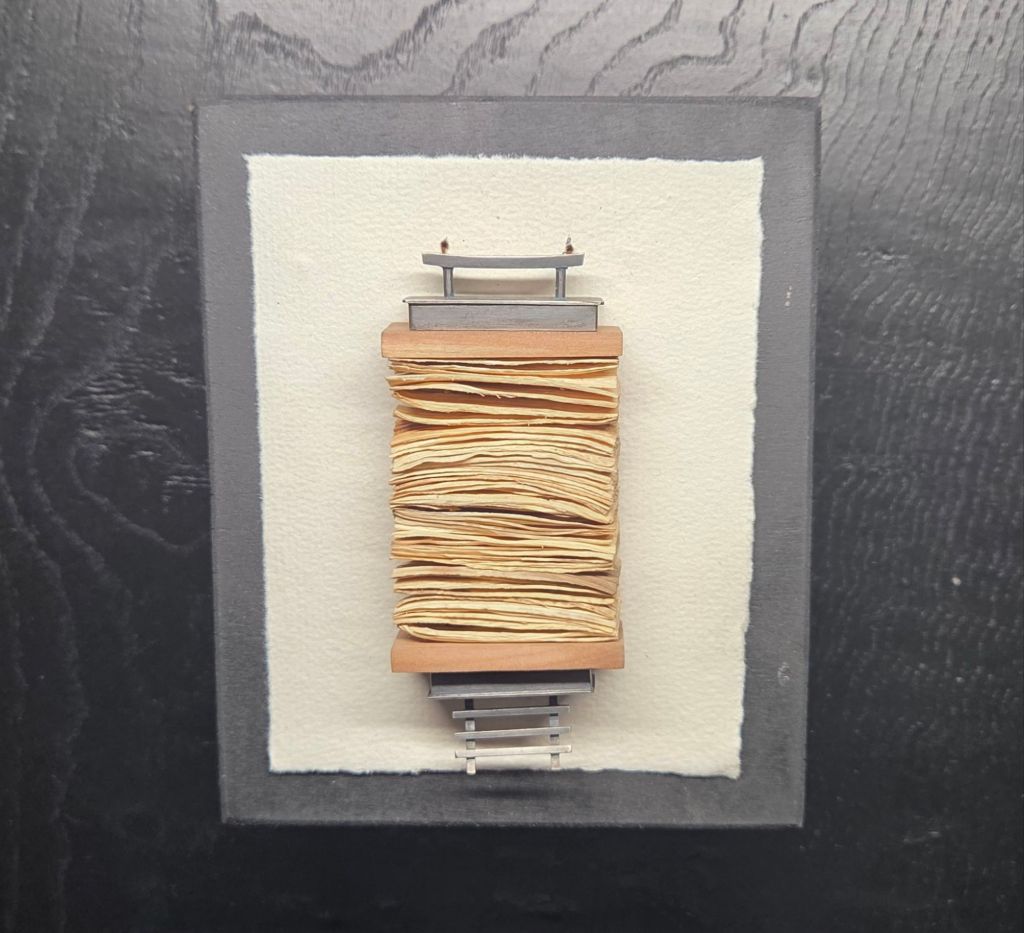
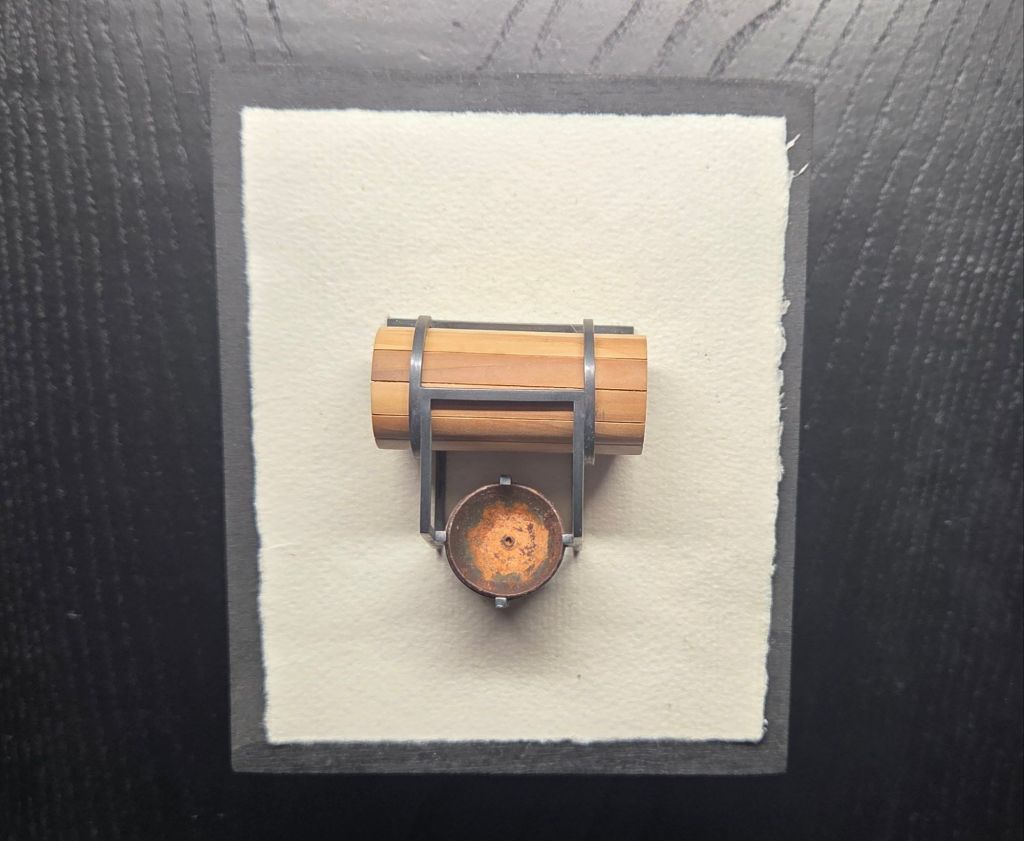
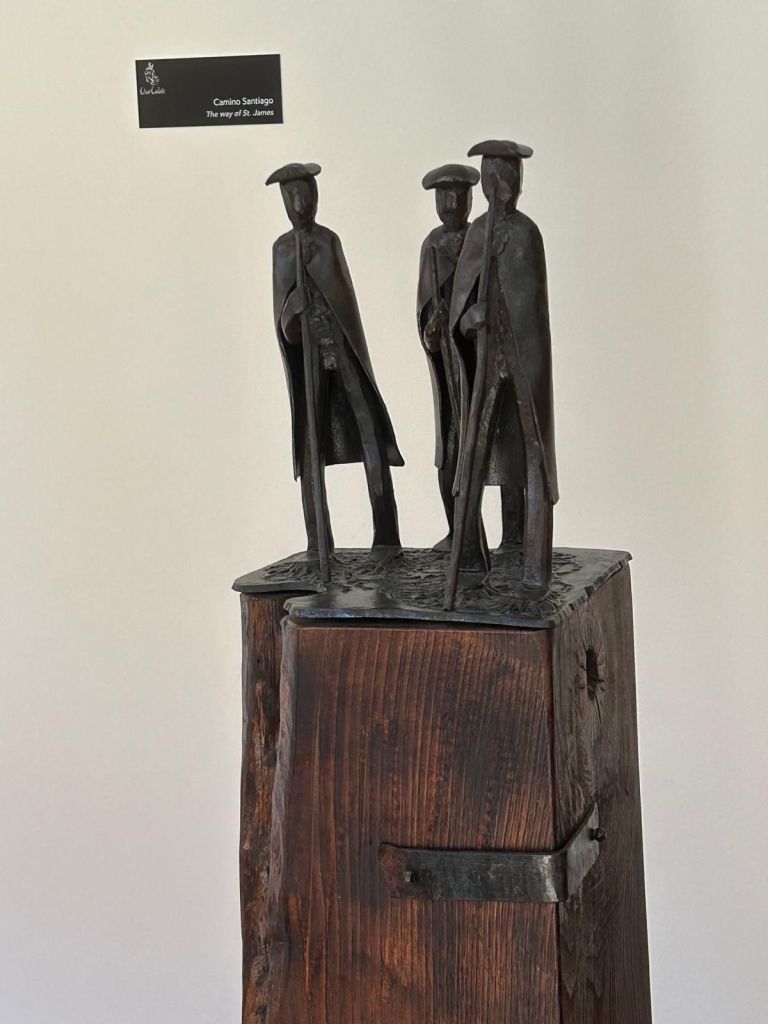
The burly man at the table got up to exit,  passing by ours.  Olga commented about how his father was very proud of his tomatoes. “He is not my father although he is like a father to me”. More English from any Spanish person to date, he introduced himself as Cesar, a blacksmith, whose iron art is displayed throughout the hotel as part of an exhibition celebrating the 500th anniversary of the Palacio de Merás. The elderly man is Benjamin, the owner of the hotel and a patron the Camino. The third man from the table, Lucas, the other artist with a special exhibition in the hotel, nudged into the conversation.

From broken English, poor Spanish, and Google Translate we learned how Benjamin himself had walked the Camino from Rome. Ever since his wife passed away, he promised to create a combination  hotel/albergue for the pilgrims passing through Tineo. The Palacio de Merás is his creation. We also spoke about our admiration of the art. When Olga noted her favourite was the bagpipe player because of the soulful message, Cesar hugged her. That piece was special to him; he had played the bagpipes.

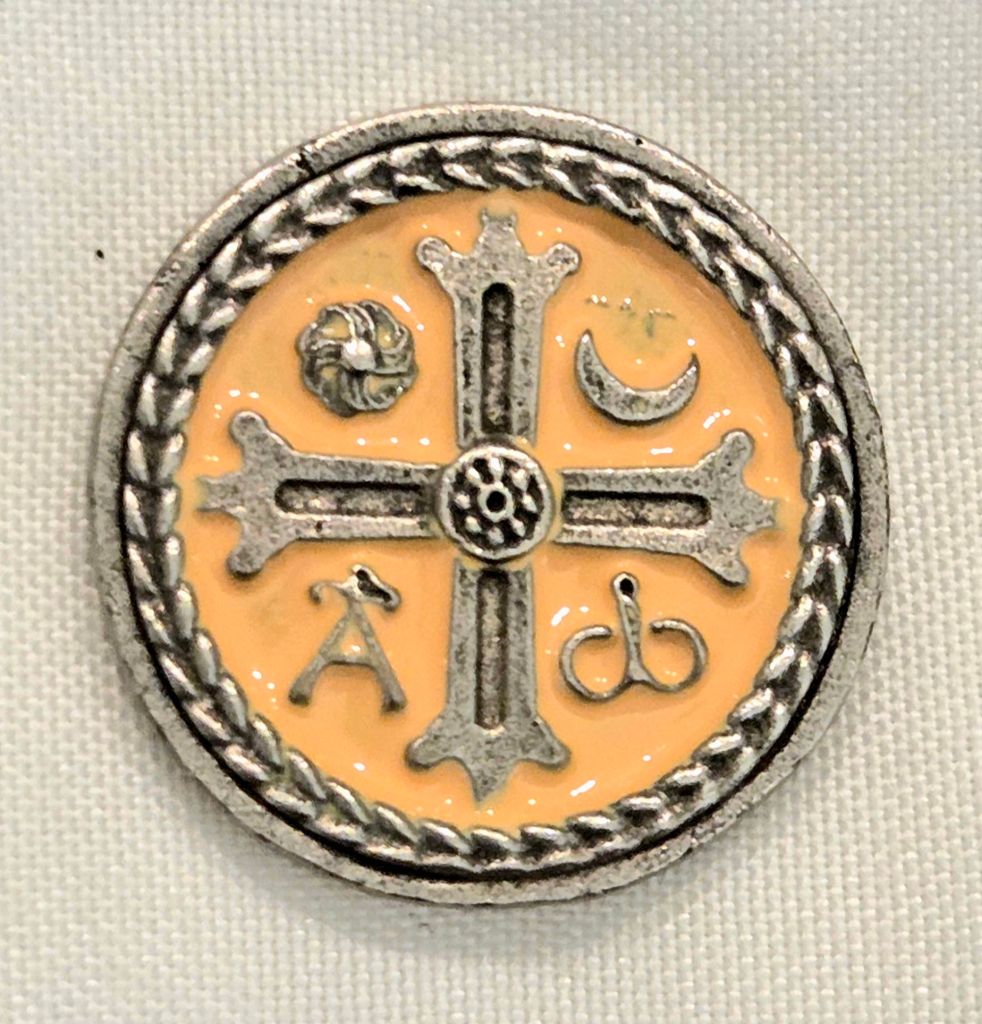
Lucas left quietly during that exchange and came back with two pins, one for each of Olga and myself. He proceeded to speak into my phone, in Spanish, in short sentences, so Google Translate could spill out the English explanation of the symbols  in the pin he created to commemorate the anniversary. It could not be bought in any store. Only Benjamin could bestow them upon pilgrims with whom he had engaged in his establishment.

If I had my wits about me, I would have recorded the meaning behind the Alpha and the Omega, the Sun and the Moon, the inclusion of the Asturian cross. I did, however, manage to copy and save the last part of Lucas’ explanation:

It’s a decoration in Santa María de Naranco, a pre-Romanesque decoration, and it’s a circle because, in the end, everyone who follows the Primitive Way wants to do it again. So you’ve just entered a circle from which you won’t be able to escape.

Olga and I were honored and touched by this generosity of spirit and kindness and friendship.

The 500th anniversary pin

I cannot forget mentioning Carlos, the only grocer open on the holiday who added a couple apples gratis to my grocery bag; Ariana, the front desk receptionist, always smiling, always patience with our many questions and requests; Eva, the busy service manager who secured us ice for Olga’s shin; and the waitress who dutifully served us every day for  breakfast. Finally, on the last morning, cleaning the tables, we asked her name. She was delighted for the question which was followed up with more about her place of residence, her work, her own travels – we complimented her English skills. She smiled, continued with her work and walked toward the kitchen, turned around and repeated: “My name is Belen”.

Olga’s shin and ankle are not progressing as quickly as we wish; however, we need to move on from Tineo and have decided to skip the mountain stages to hopefully pick up the Primitivo when the terrain is flatter.

Buen Camino

Salas to Tineo

When the children were young, our family enjoyed playing a board game entitled, The Tortoise, the Fox, and the Hare. The premise was simple: a race to the finish line, first one crossing wins. There was a pair of six sided dice for each contestant except the numbers were different. The Hare’s dice resembled a slugger in baseball; he is either going to bash a homerun or strike out. The Hare could roll a 6 or a 12 or 0, nothing in between. The Tortoise, on the other hand, could never roll a zero or a twelve. The value of each roll resulted in much smaller combinations, never higher than 6, but moved with every roll. The Fox was somewhere in between, the Goldilocks of the group.  It was a game of odds really, whereby any of the three could, and did win, the game.

The Camino is not a race and everyone wins in participation. The peregrinos walking the Primitivo, however, reminded me of this family memory. I started recalling the people we met earlier on the Way and those who we encountered today.  I kept imagining which one of the three animals they resembled and classified them accordingly.

Izzy, the young woman from Britain is a Hare. She spoke with us very early into the Grado to Salas stage and apologized before moving on; she had started late and needed to get to Salas. We never saw her again until the next morning, at our hotel, for breakfast. Olga and I were finding our seat when Izzy was doing the same. Hello, how are you, nice to see you again, then straight into her meal. She was gone before we finished. It would be our only sighting on the trail. Izzy is the type of walker who rolls double sixes regularly, the occasional six on a big hill, and only a zero at lunch time.

The Fox is represented by this German couple (never got to exchanging names) who we passed on the big climb, only her at first because he had taken a detour and would catch up. They passed us later,  then we passed them on their lunch break, then they caught up again and eventually we lost sight altogether.

Without question, Olga and I represent the Tortoise; slow and steady, rolling a variety of numbers yet always moving forward.

This third stage, Salas to Tineo,  begins with a long 5.7 km incline of 460m through a forest along a path of rocky terrain. The success of the previous day generated a bit of over confidence in our physical capabilities, forgoing stretches and ankle taping which had been an important element of the previous segment. Our dice rolls were a consistent 3 or 4, an occasional 2, but a generally steady climb befitting the pace of the amphibious creature.

The toll of day one, and the added length of day two caught up with us when we reached the top. The soreness in Olga’s ankle flared up, hurting to the extent we had to stop and give it attention. The tape which had been helpful the day before was now applied. Two Tylenol tablets were swallowed to address the pain. We would continue believing the shin would work itself out. The dice rolls were now a consistent 2. And there was still a long way to go.

Olga bravely hobbled along, persistent, deliberate. She needed to stop regulalry to alleviate the pain, which had the  advantage of being able to gaze longer at the glorious views from our elevated vantage point. We spoke to the cows and horses from the numerous farms, and greeted each pilgrim, by bike and by foot, who passed.

One such pair, coincidentally German, Tom and Lydia, commented on Olga’s perseverance in spite of the apparent strain; slow and steady they said, take your time, you will get to Tineo. They were the epitome of a Fox pilgrim, strolling, exploring, engaging. We caught up with them at a Camino path watering stop. Tom’s command of English was better than Lydia’s. He began asking questions of concern, offering medication, providing words of encouragement. We met them again later at a small church for a few moments of contemplation. “See”, he chuckled, “your not losing any time.” We did not see them again. Their rolls were always greater than our results.

Olga suggested contacting a taxi to take her into Tineo and I could walk the remainder to meet her at the hotel. This town would have been our last possibility before the final leg. I could not figure out how to connect with a company, my e-sim does not allow phone calls; besides my Spanish and their English is nonexistent. Let’s keep moving. We have time.

The dice rolls kept coming up as 1. Stop, rest the leg, injest some sustenance, carry-on. Ever slower. By the time we reached the edge of Tineo, still 1.5 km  away from our hotel, the dice could not be rolled any more. Olga could not continue. She leaned against the lamp post, head bent. Done. We were rescued by the mercy of an angel in the shape of an elderly Spanish man passing by, who, without a word of English, managed to convey the message that he would get his car to drive us the remainder of the way. We staggered into our room at the end of another long walk: 23.8 km, 33,374 steps.

I stumbled upon Izzy in the lobby. The Hare arrived at 2:00 pm, five hours faster than the Tortoise. She is going to continue again tomorrow, so sorry to hear about Olga’s shin, maybe we will meet again down the road.

I doubt it. Olga needs time to repair and recuperate. We need to adjust our plans and regroup. The climbs are only steeper and descents ever sharper in the next two stages of the Primitivo. A couple days here in Tineo will help clarify our next move.

As long as we are together, we will figure it out.

Buen Camino