The rhythm of the school year no longer beats with my daily song. The Tuesday following Labour Day marks the beginning of another academic session here in Canada for all levels of education. Were it not for advertisements about back-to-school sales while watching the ball game, this week would pass like every other. Truth be told, my awareness waned when Olga retired in 2015. She was a faculty member so our life and specifically vacation was scheduled around her responsibilities. My work was administrative, on the academic side of the ledger although untethered from the weekly regiments of the semester. Then when I retired in 2020, every week is made up of six Saturdays and a Sunday, obfuscating calendar precision. I am not always aware of the date, regularly reminding myself so as not to miss the next appointment. In a few years when Leo, our grandson, begins his educational journey, the rhythm will begin anew.
I think about school more this September in reviewing the many documents copied earlier this spring from the archives in Oosterbeek, Netherlands, home of retired Mill Hill missionaries. My uncle, Fr. Kees de Cock, began his 12 year journey to priesthood at a minor seminary in Tilburg 91 years ago, at St. Joseph Missiehuis, commonly known as de Rooi Pannen, Dutch for “the red tiles” to reflect the structure of its roof. It was built and opened in 1914, “somewhere outside [the city limits],far away” along the unpaved, unlit road, Tongerlose Hoefstraat, despite the efforts of the original Rector. My grandparents raised their six children in a two-and-a-half storey row house on the edge of Tilburg, probably built by the local textile mills where my grandfather worked from the age of 12 collecting cotton from underneath the machines, eventually becoming a weaver. Their doorstep opened unto a field and in the distance they could see The Rooi Pannen less than a kilometre away.
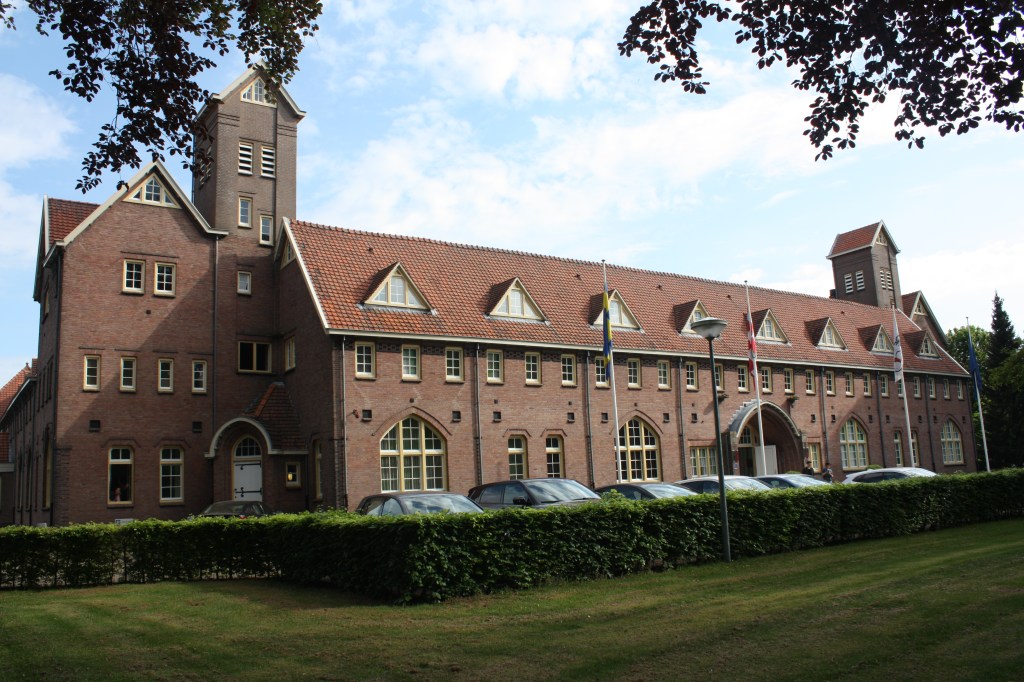
St. Joseph Missiehuis represented the equivalent of secondary school except boys would attend for six years starting at the age of 13. I had not understood that St. Joseph Missiehuis was a boarding school outside the public education system requiring annual payments for continued enrolment. When I had expressed my surprise to a few retired priests, they were confused with my reaction; natuurlijk, who else would have paid for the education?
I happened upon a list of names from 1939 showing receipt of fees from each student’s family, indicating the school had received f.281 Dutch Guilders for C. de Cock, along with approximately half of the 150 total students. The remainder had contributed varying amounts from as low as f.90 to f.171, with a large number at f.110, all listed without explanation. The f.281 would have represented a full years board, the equivalent of 3,723 Euros, $4,130 USD or $5,964 CAD today, which families were permitted to pay in three instalments. These boarding fees could be considered a feasible amount for a contemporary middle class family; however, f.280 Dutch Guilders in the 1930s would have accounted for one third of the annual salary of a weaver. The figure does not include charges for books (f.25), laundry and mending (f.12), own clothing and stationary, plus individual medicines, foods, or special medical treatment. “The Director is happy to make other arrangements so that no well-intentioned calling is lost.” I cannot imagine how the de Cock family could have afforded my Uncle’s missionary training without a large measure of sacrifice or some support from the local parish or some form of subsidization from the Mill Hill Society itself.
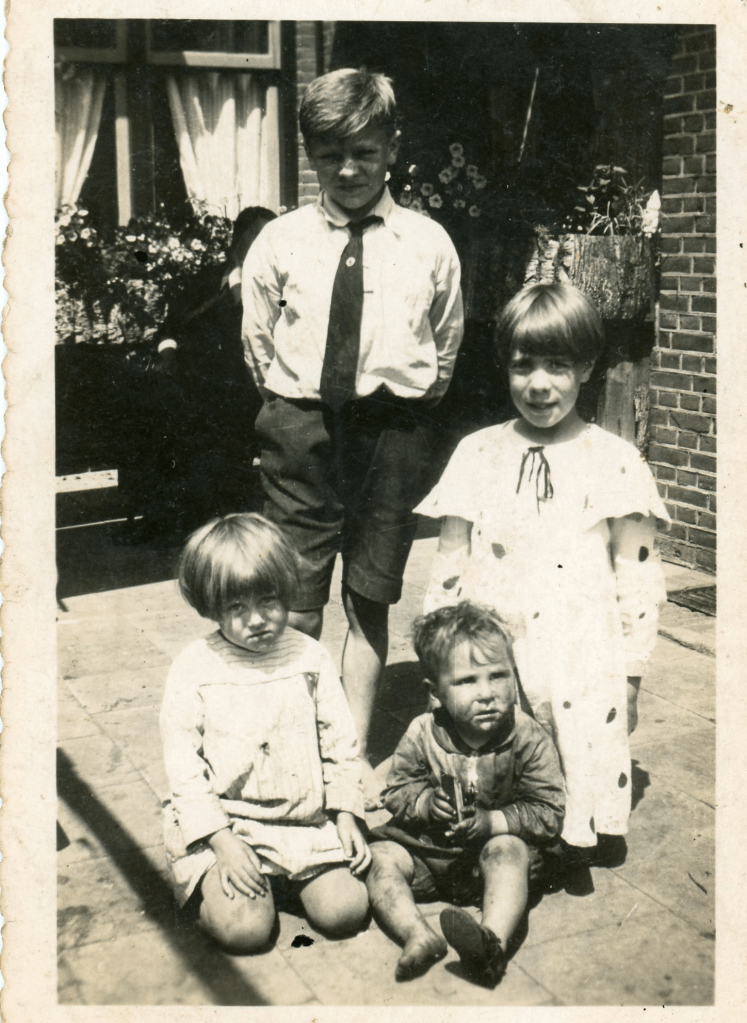
Learning a skilled trade would have been a measure of advancement for a weaver’s son or other similar working class occupations. My father became a machinist, beginning his apprenticeship at the age of 15. His younger brother, Uncle Geert, learned to be a pipe fitter. If a boy was interested in the classics, then priesthood was the most likely route. I don’t know if a humanities education was the impetus for Uncle Kees’ attendance or if being the eldest son, my grandparents were envisioning the associated status accrued to a family whose child(ren) entered the clergy. One way or another, for some spoken or unspoken reason, Cornelis de Cock would be enrolled at St. Joseph Missiehuis where the curriculum ensured graduates would be well versed in languages, history and religion. A schedule of classes for years 3 to 6 show four or five classes a day, six days a week, Maandag tot en met zaterdag, with Latin appearing for one period every single day; Greek three times a week; French, German, and English twice. There are classes in History, “General Society”, Geography, Algebra, and Geometry; Natural History and English Literature in the last year; “Bible” and Religion scattered throughout. A schedule of the daily activities included prescribed periods for walking and designated times for smoking.
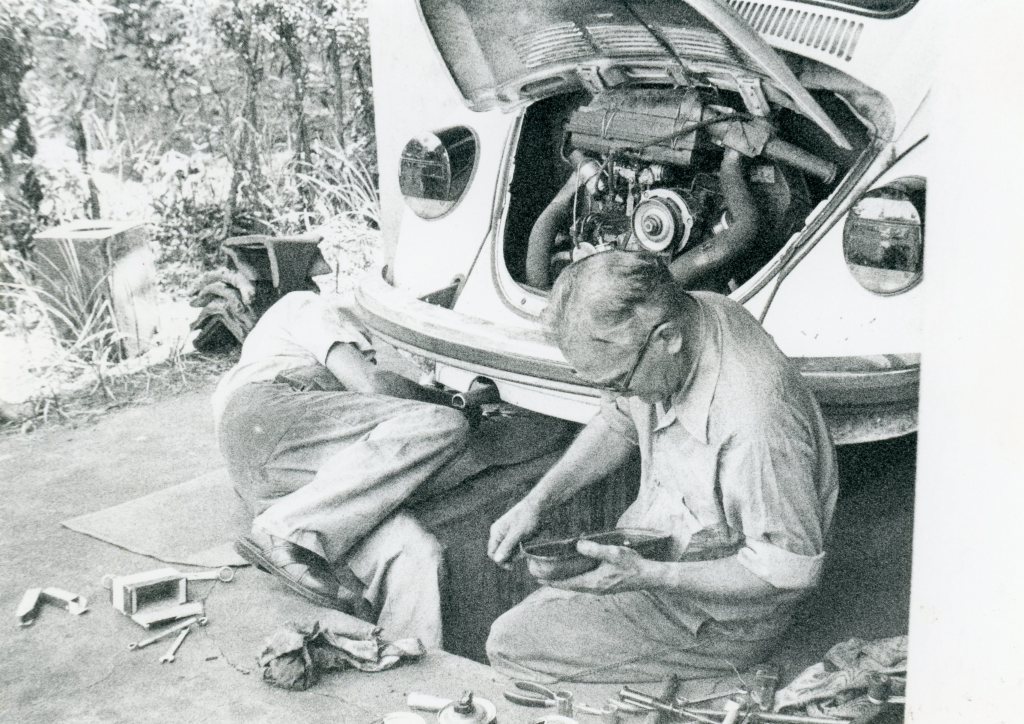
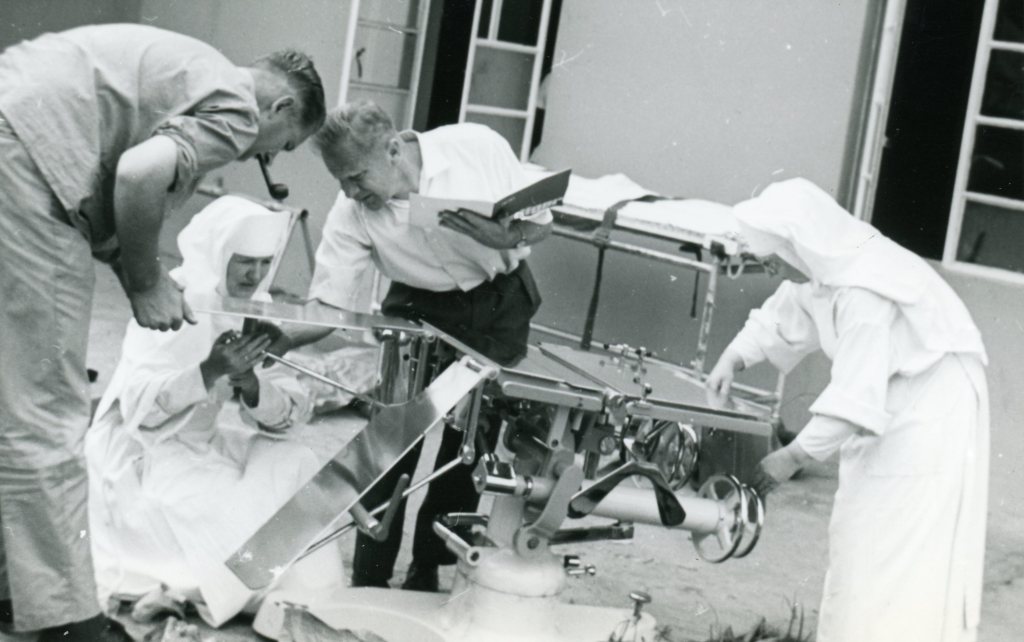
The irony is how Fr. Kees de Cock was as much remembered for the necessary manual and physical work of a missionary as for his priestly activities. The “Late Rev. Fr. C. De Cock’s Profile in Kamuli Catholic Parish” described him as possessing “many practical skills”, including, Engineer/Mechanic, Builder, Plumber and Hunter. Indeed, he was renowned for his building knowledge skills, in particular the seemingly profound form of construction by beginning with concrete pillars, then mounting a roof before completing the walls. “So he put strong pillars, standing, made of cement and iron, the proper thing because he knew all that was needed, and then a roof on it and the rest was for the people to finish.”
I think about my own secondary school education at Lord Dorchester in the 1970’s. My destiny was university so I did not feel the need to enrol in the shop classes for auto mechanics or woodworking or moulding, choosing to pick up typing and Spanish instead. (Probably the most useful class was my full year, optional Grade 11 English grammar course, taught by Mr. Packowsky, utilizing the 1961 second revised edition of Learning to Write, a book I still consult today.) In the same manner as my uncle, I learned the necessary skills of construction and repair later in life, out of necessity, using trial-and-error; tinkering with car engines, soldering leaky pipes, repairing noisy laundry dryers, and servicing faulty water heaters, because the funds weren’t available to hire an expert.
Perhaps the most eye-opening archival documents from the Rooi Pannen were the letters sent home to parents and a series of instructions for the teachers. They form a window into a budding seminarian’s school days of the 1930’s, radically different from today, certainly decades removed from my own experience. The exact words speak for themselves and paint the picture.
Before the students left for their summer vacation, a letter was sent home to the parents with guidance for their son’s “Protection”. “Since the well-being and calling of your little son, who came here to prepare himself as a missionary priest, is not only in our interest – the interest of the Catholic Church and the Missions – but also in your interest, we believe it is good to offer you this booklet.” The Rector provided a list of guidelines “which are actually self-evident”:
“1. Frequent Holy Communion, Daily Holy Mass and Rosary, Weekly Confession, and Benediction, whenever the opportunity arises.
2. Visit the Presbytery at the beginning and end of the vacation; the Pastor will most certainly take an interest in the report.
3. Cinema and other screenings and performances should not be attended unless they are organized by Catholic associations such as Patronages, and the Parish Priest approves that seminary students attend them.
4. Parents are requested to keep a watchful eye on what their son reads and with whom he associates.
5. We leave it to the Parents themselves to judge to what extent swimming can be permitted.
6. We consider the wearing of sports socks undesirable.
7. We consider consider camping or bivouacking undesirable, unless under spiritual guidance.”
And the list goes on. Then before the student returns another letter is sent to the parents reminding them of a few details. In one, the rules regarding visits is spelled out – only once a year, specifically during the summer semester an on either Pentecost Sunday or Whit Monday. They may also be picked up for the day on a Sunday or a Public Holiday of the summer trimester. In another correspondence, the list of do’s and don’ts for the upcoming term are itemized, including:
“3. Personal furniture is not permitted; an exception is made for a few small paintings, etc.
4. Only possession of books relating to the subjects of study is permitted.
6. Permission to go home is not granted for the weddings of brothers or sisters. An exception may be made for the parent’s silver wedding anniversary.”
Instructions for the teachers governing behaviour when the students return is rather lengthy with restrictive rules on activities both academic and “extra curricular”. For example,
“When the bell goes after study, everybody stops immediately, gets up, goes out of the bench to say the prayer and leaves the study-hall.”
“It is not allowed to keep a diary; the students of the 4 lower classes may not make a collection of poems and such like.”
“Once the students are inside [the recreation hall] they stay there till after having polished their shoes.”
“All the students have to play during free time… After the first bell they are to walk up and down, never to stand still. When walking they should be with three at least, never less. They should never have their hands in their trouser pockets; they may put them in the pockets of their jacket.”
“The students should never play a rough game; they are strictly forbidden to do any romping or even to touch or hang on one another.”
I imagine cell phones would also have been forbidden to own or to use.
Much of these rules and restrictions are a function of the time, the expectations of a boarding school and the practices of Catholicism. I don’t expect many of them survived the subsequent generations. Rules of my time in a public non-denominational secondary school were more restrictive than what our children experienced and what passes for regulations today. I remember a walkout at our high school to protest the requirement for girls to attend school in skirts even on the coldest days of the winter. The administration relented. I don’t believe any form of resistance was tolerated in Uncle Kees’ school given the measure of “positive” personal qualifications required of candidates “according to the constitutions” included “obedience: to Superiors, Rules”; the “negative” side of this coin would be “habitual neglect of Rules, criticisms & murmurings, open or secret, against Rules or Superiors, sowing discord in community”; grounds for expulsion.
I wonder how these rules manifested in the realities of Uganda, a world apart from anything else these young men would have encountered. I might speculate the experience of my Uncle would reflect my own reaction to those high school years – lessons lost on my current circumstances, irrelevant to my contemporary world, largely forgotten except for a small group of people and a handful of moments,
“Don’t do this and don’t do that
What are they trying to do? (Make a good boy of you)
And do they know where it’s at?
But don’t criticize, they’re old and wise
Do as they tell you to, don’t want the devil to
Come and put out your eyes”
School by Supertramp
“When I think back on all the crap I learned in high school,
It’s a wonder I can think at all “
Kodachrome by Paul Simon



I found this fascinating to read, and I think the question you raise at the end is much bigger than the rules themselves.
Reading them today, some are almost comical. No swimming without parental judgment, no sports socks, no diaries, no rough games, hands not in trouser pockets, and walking in groups of at least three. It is difficult not to smile at how thoroughly every aspect of these young men’s lives was being regulated.
But beneath the humour, I found myself wondering about the distinction between forming a person and controlling a person. I imagine the people who created these rules genuinely believed they were protecting the boys and preparing them for their vocation. They were trying to shape character through discipline, obedience and religious practice. Yet there is a point at which rules can become so comprehensive that there is little room left for the development of personal judgment.
And that makes your question about Uganda particularly compelling. These young men were being formed within an extraordinarily controlled environment and then sent into a world that must have been almost unimaginably different. I wonder what happened when the rules they had been taught collided with circumstances for which there could be no rule.
Perhaps that is where education ultimately reveals its limitations. We can teach people rules, obedience and expected behaviours, but eventually life puts us in situations where none of those things are enough. We have to think, discern, question, adapt and decide for ourselves.
I also loved your comparison with your own school experience. It is humbling to realize that the things that seemed so important and absolute to us at fifteen or sixteen can become almost completely irrelevant decades later. What survives is not necessarily what our teachers or institutions intended us to remember. Sometimes it is a handful of moments, a few people, a way of seeing the world, or perhaps even the impulse to question what we have been told.
And perhaps that is why the Supertramp lines fit so perfectly. There is something universal in that adolescent resistance to “don’t do this and don’t do that.” Yet I think there is an important difference between simply resisting rules and developing the capacity to understand which rules deserve to be followed, which deserve to be questioned, and why.
That, to me, is one of the great purposes of education.
Not simply to make a “good boy,” but to help create a thoughtful human being who can eventually stand on his own feet and make good judgments when nobody is there to tell him what to do.
And I suspect that may be the most interesting story hidden behind all those rules: not what the seminary intended these young men to become, but what they actually became when they stepped beyond the walls of that carefully controlled world.
LikeLiked by 1 person
Thank you very much for the thoughtful and insightful response. I hope people read it after the post because you add a dimension of reflection to fill out the piece.
LikeLike