The minus 18 temperature is not going to deter me. I have spent the last week coddling the ice, keeping the snow from accumulating, shoveling everyday, defining the contour with scrap wood, flooding the rink at dusk to take advantage of overnight cold. Grab the skates, stick and puck, pull down the toque a little further, head to the bench with Odin in tow. Time for a skate.
My brothers and I spent hours outside seeking adventure. In the winter we became Guy Lafleur, Bobby Clarke, Tony Esposito, and Paul Henderson, searching for patches of frozen water for a hockey game. We weren’t interested in a leisurely skate of endless casual circles. Our goal was a robust, vigorous entanglement of thrashing swings and bodily inducements, flailing arms and legs chasing pucks and combatants to jubilantly yell out “SCORE” and gloat in victory.
A popular spot was the creek, a trek of less than a kilometer across a snow strewn farmers field, close enough for a quick game after school before darkness settled in and it was time for supper. No shelter, no bench, no lights, no Zamboni. You sat on the banks to pull the laces tight of a used pair of skates, discarded clothing was tossed aside, the taller boots employed as goal posts at each end of the narrow passageway. A kid could get lost in all the excitement, unawares of the temperature. I remember being so cold once, my toes were frozen, my hands were frozen, I could not take off my skates. I was crying. Roger, an older boy from across the highway came to my rescue.
On Saturdays we carried along shovels and pails to clear accumulated snow and smooth out the surface. We hacked a hole in the ice, close to the edge, at a distance from the activity. Each boy would inch close to the opening, dip in the pail, port it to the rough spot and pour out the contents. Back and forth. On one occasion the ice collapsed, my left leg falling in up to my hip, becoming entirely frozen as I limped home to thaw out. It was all part of the experience.
I had not skated inside an arena until I was 15, the year Dad began working for 3M and we attended the Christmas party. In later years, a dozen boys from the neighbourhood would rent the rink behind Clarke Road Secondary School at two o’clock in the morning because that was the only time the ice wasn’t being used. I never played organized hockey until I was 19 when I signed up for the no body contact league in Dorchester. My first pair of new skates were bought as a young adult when Gary and I began playing in a league here in Toronto. Most of my skating and hockey occurred outdoors in my youth. It was accessible. It was available. It cost nothing.
I was inspired by the open-air experiences to build a rink in my own backyard when Nicholas and Olena were little. The yard behind our house on Sigmont Road looked level enough until I laid out the plastic within the wooden frame, and filled with water, half an inch on one end, six on the other. On Mill Road, I built a temporary extension to the deck, incorporated higher boards and connected the plastic sheets with red duct tape precisely at centre ice. As long as the thermometer read below zero, you could run the hose at night for a perfectly smooth surface to shoot a few pucks around. We enjoyed the freshness of the air, the tumbling down which comes from learning how to skate, the laughter of our success. The kids have grown, the winters are warmer, the yard is more garden than grass, hockey days are over, my skating escapades had disappeared.
Our newly built, four seasons cottage opened a whole new world of opportunity when we visited it for the first winter, January 2008. The temperature is typically five degrees colder than Toronto to the south. The lake was frozen, thick enough to be safe. I was excited to attempt a rink again. The conditions leading to that eventful day were ideal. The snow tends to be deeper and lasts much longer, although not a lot in that first year. I cleared what could be reasonably accomplished by one person, approximately 25 by 40 feet, to uncover a wind designed surface, rough but passable. Those early skates were reminiscent of the creek only this time I unraveled the garden hose from the external water tap to gradually smooth out the terrain. With my stick and my puck, I laced up my skates on the wooden bench each afternoon and circled within the tiny confines, forward and backward, dipsy doodling around and around solo, no opposition, raising my arms in the silent celebration of another imaginary goal. The joy of outdoor skating had returned.
The irony of making a rink on the lake is that it can be more difficult than the ones in your backyard. The trick is to not allow the snow to build up on the surface while the ice is safe enough to walk. Otherwise the surface is slush making snow removal difficult and impossible without your boots leaving a crater filled mess. My subsequent winters at the cottage have been lessons in how to manage the conditions. If we arrive later, then the task becomes too difficult for our usually short stay. The trickle of a garden hose was no longer sufficient so I graduated to a submersible pump with two and a half inch plastic piping, a fifty foot extension cord, and a manual ice auger. Last year the timing of our arrival and length of our visit meant a rink was not even attempted.
Our timing was impeccable this season. The lake had frozen before a significant amount of snow had fallen so when we arrived, there was only a couple inches. When cleared, the ice was solid and surprisingly smooth. I could skate the first day.
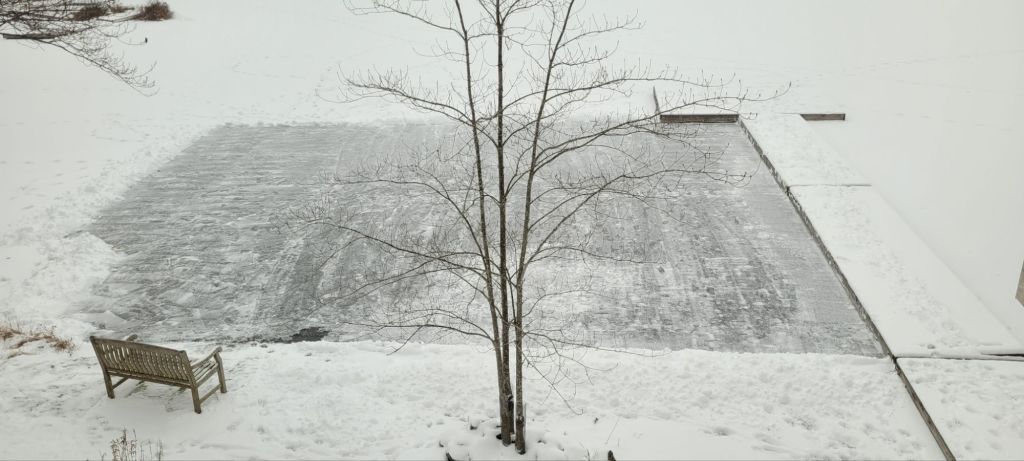
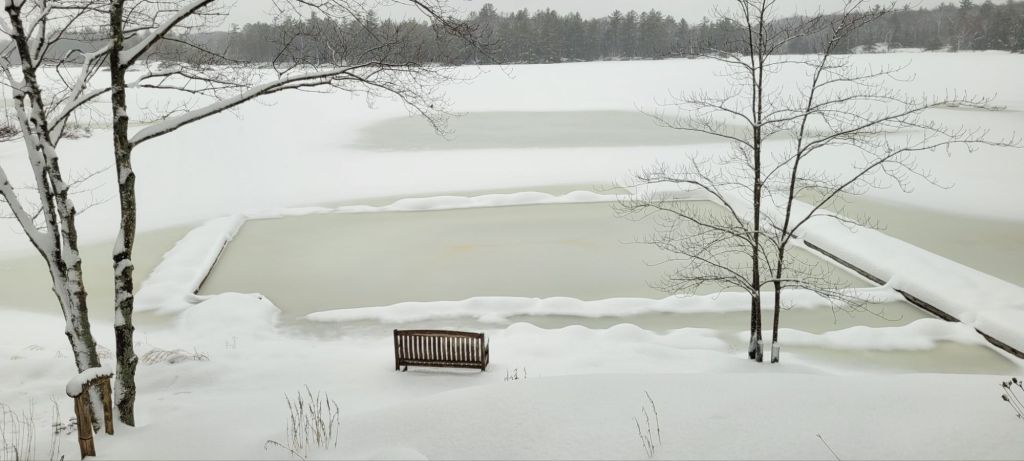
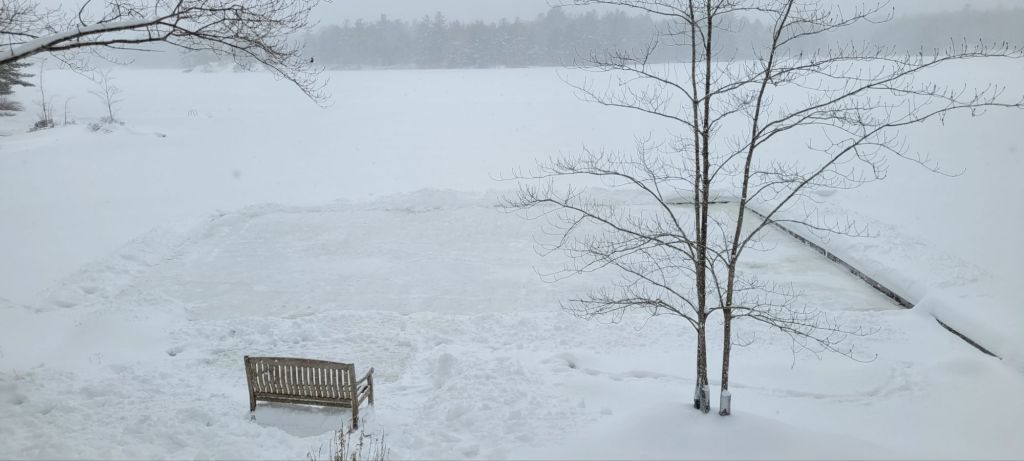

Large image: shape of rink after first coat of water.
Then the first winter storm of the season arrived. The snow was deep and heavy, the temperature went above zero melting portions, reeking havoc on the ice. Lake water was exposed in spots although the shape of the rink remained. Freezing on the following day began to solidify the surface again while the snow kept falling. Each morning I woke to yet more of the white stuff, and another hour removing it to avoid slush building. Finally a break. The forecast was for minus 12 overnight with no precipitation. It was time to flood the rink.
A tour of the results showed a marked improvement. Water finds its level, and given sufficient quantity will eventually level out the entire area. The corners were smooth as glass while the centre exhibited rough patches. It would need at least one more flooding. The temperature was dipping down even further, yet another ideal opportunity for improvement, nine days after our arrival.
I am wearing snow pants to cushion the cold. I have replaced my cap with a woolen hat. There is a gentle dusting of snow drifting down, not a sound except for the breathing, Odin’s and mine. He is a little curious, sitting, waiting patiently while I tighten the laces. Then I am off.
The ice is magnificent. Swish, swish, swish. Lean and turn, leg over leg. Swish, swish, swish. Pick up the puck, lean and turn, head up and fire the puck into the end board. The thud catches Odin’s attention and he slips onto the ice in pursuit of the black circular biscuit. Sharper turn, quicker movements, wind brushing my face. Odin barking, sliding when I make a sudden move. He is determined to grab that disc. Clack, clack, clack. Back and forth and back and forth. Odin lunges and misses. I slide the puck through the five hole and drag it to other end, Odin giving chase. He reaches out his paw, I attempt to slip it between his legs again except he has caught on and stops the puck, picks it up and parades around the edge of the rink in celebration before plunking the puck at my skates. I reward him with a snack, laughing, encouraging him for another round.
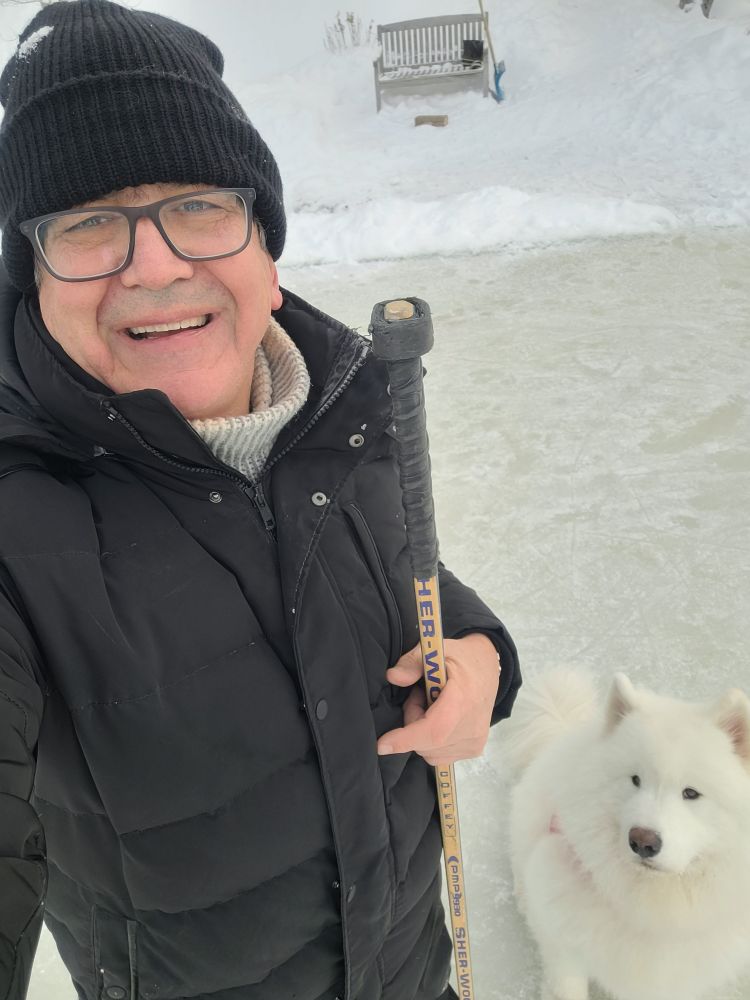
Olga has braved the elements to make an enthusiastic audience of one. Odin and I circle and chase and slip and slide. What he lacks in hockey abilities, he makes up for in effort. Him and me, me and him, up and down and around our little rink.
The snow keeps falling. Olga has since retreated to the cottage, Odin’s attention is waning and I am getting cold. It is time call it a morning, time to pack it in.
Tomorrow will be cold again.

 Wonderings
This sounds like hard work and great fun!
LikeLike
Lovely.
Bohdan Kordan, PhD
Professor Emeritus, Political Studies
St. Thomas More College l University of Saskatchewan
1437 College Drive l Saskatoon, SK l S7N 0W6
LikeLike