searching for the dalai lama

They said he wasn’t in town.

Our destination was a hotel in Mcleod-Ganj, a suburb of Dharamshala, further up the mountain. Mcleod-Ganj has been the home of the Dalai Lama since 1959 and is headquarters to the Government of Tibet in exile. It is possible to get a meeting with the Dalai Lama provided you make the arrangement several months in advance. I don’t believe anyone in our group attempted; besides, he was not expected to be at his home. Apparently the Dalai Lama had business abroad.

The growth in the Tibetan population from an influx of refugees and the establishment of several Buddhist monasteries has created a town dominated by Tibetan arts and culture. Mcleod-Ganj has become almost a pilgrimage for the believers and his presence has increased the tourist industry. The many Tibetan craft shops are certainly trying to cash in on the increase of Westerners to the city.

Before getting to Dharamshala, our group stopped at a village where a special program is set up to preserve the crafts of Tibet. You can watch as artists paint, weave, screen print, and punch metal to create traditional Tibetan pieces. There is a temple at the end of the beautiful gardens, and of course, a shop to purchase many unique works. Further up the road, we visited a nunnery for female monks and were permitted to enter the temple.

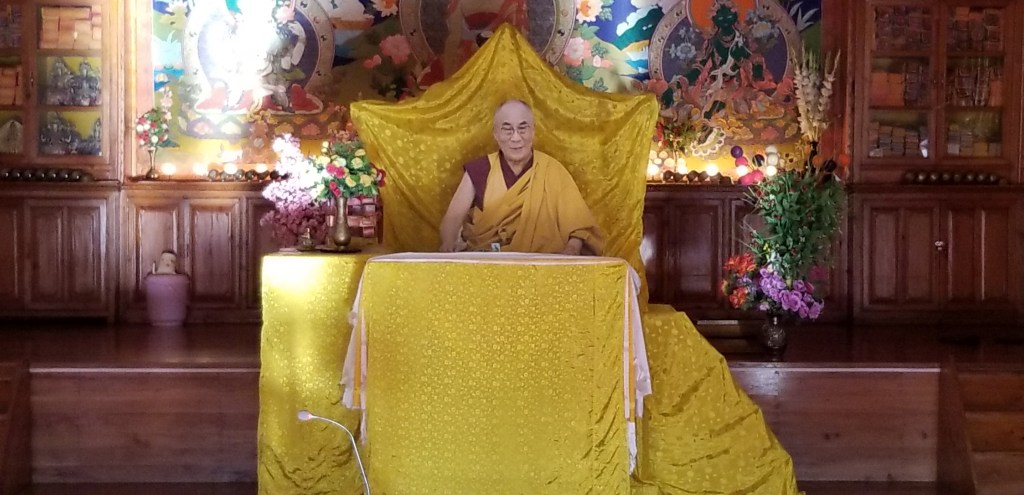
And there he was, a life-size photo replica, from the waste up of the Dalai Lama, situated at the front. The picture cut-out was of high quality and appeared very real. The group was mesmerized and thought the presence a little creepy. A few pictures and we headed to our vehicle to make the last, long climb to Mcleod-Ganj.

Here he appears at the nunnery

When we arrived at the hotel, there he was in lobby again, a picture hanging high above anything else. Indeed, you will find a photo of the Dalai Lama in many of the establishments. He was in the restaurant for our supper; in a number of shops in town; at one store, we received a 4 X 5 black and white glossy picture of him in a relaxed pose, smiling, just for making a purchase. He seems to be everywhere in this town, just not in the flesh.

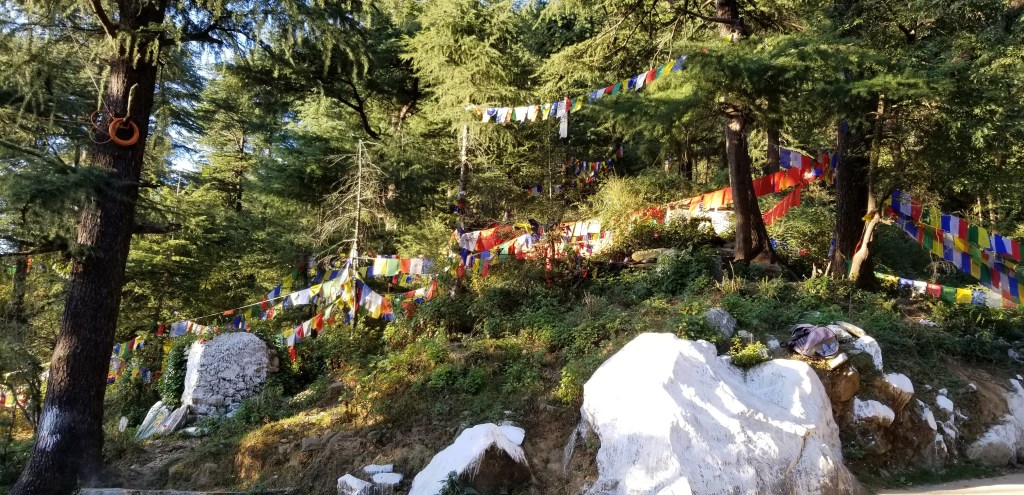
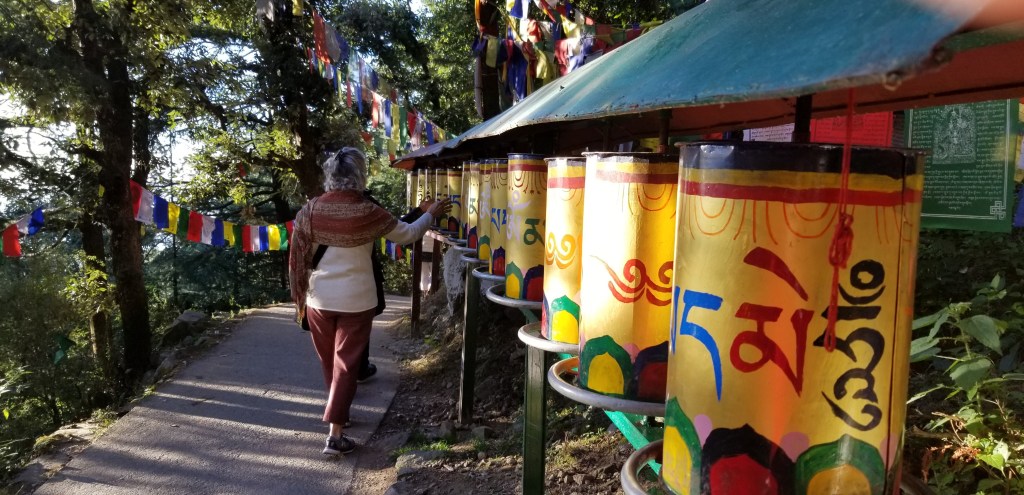
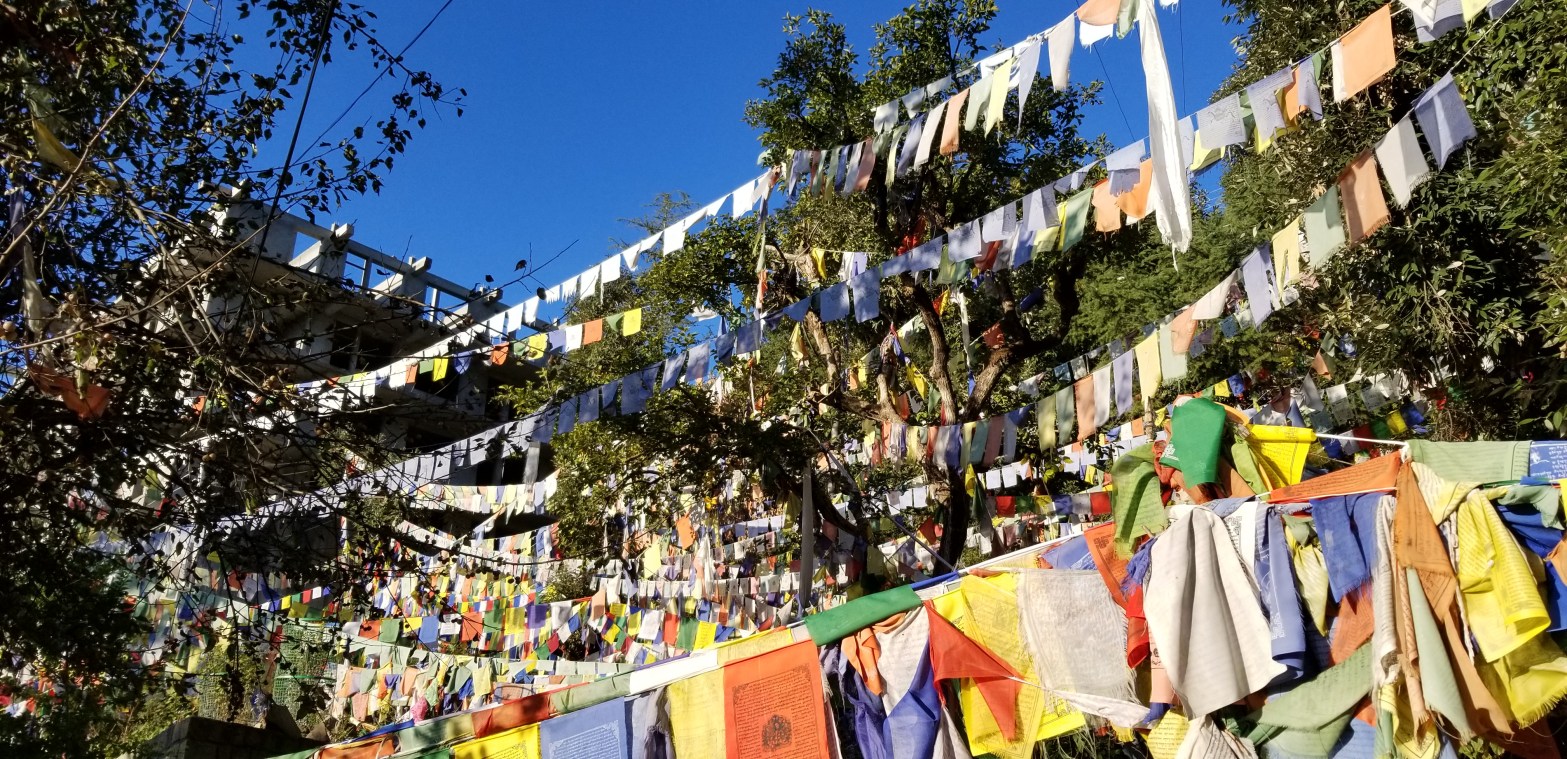
This morning the group planned a walk around the temple through the prayer park. It is a short distance around the bend, downhill from the hotel. As we were just about to head up to the entrance of the path, an officious gentleman, with excellent English, asked us to wait by the side, the Dalai Lama was going to be driving by soon.

Really? The man himself? Coming down this road?

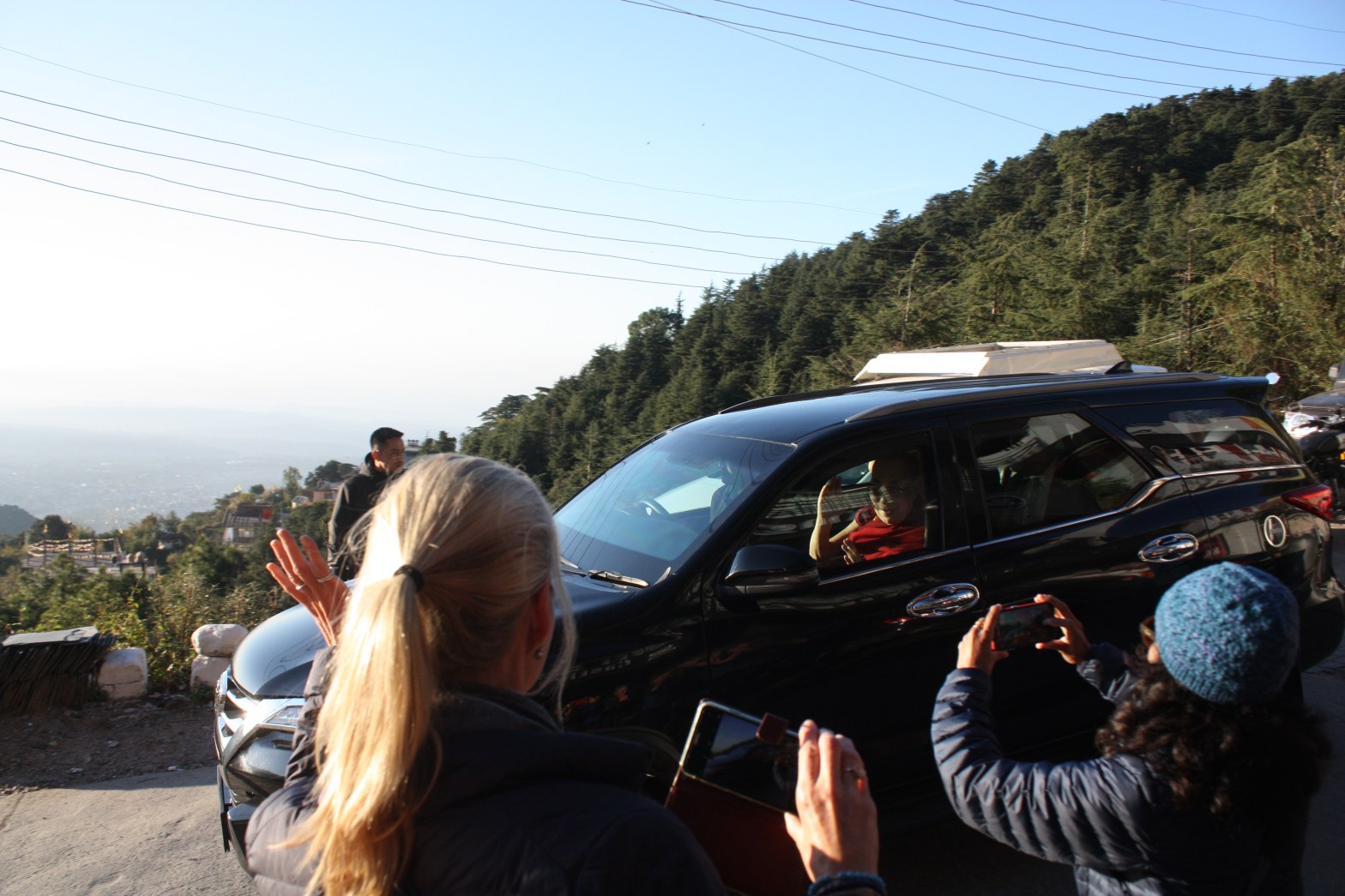
Off to side, cameras in hand, our mini paparazzi waited. A hard topped jeep could be seen with lights flashing. Is that him? No. The vehicle moved past. Hmmph.

Then a series of black cars appeared at the top of hill. One of them must have the Dalai Lama in the passenger seat. (He doesn’t drive himself? Does he?) Cameras ready and as the caravan approaches, I am pointing my DSLR directly at the advancing parade, looking through the scope, dial set on athletic exposure, and then snapping madly….click,click,click,click,click,click,click,click.  

And then he was gone.

Or at least I think it was him. I could not actually see through my lens, I was so obsessed with pointing it in the right direction and clicking away hoping one would capture him. Others in the group who seemed to be a little closer confirmed yes, that was an official sighting of the Dali Lama. The trip is now complete.

Where was he going? Will we able to see him again?

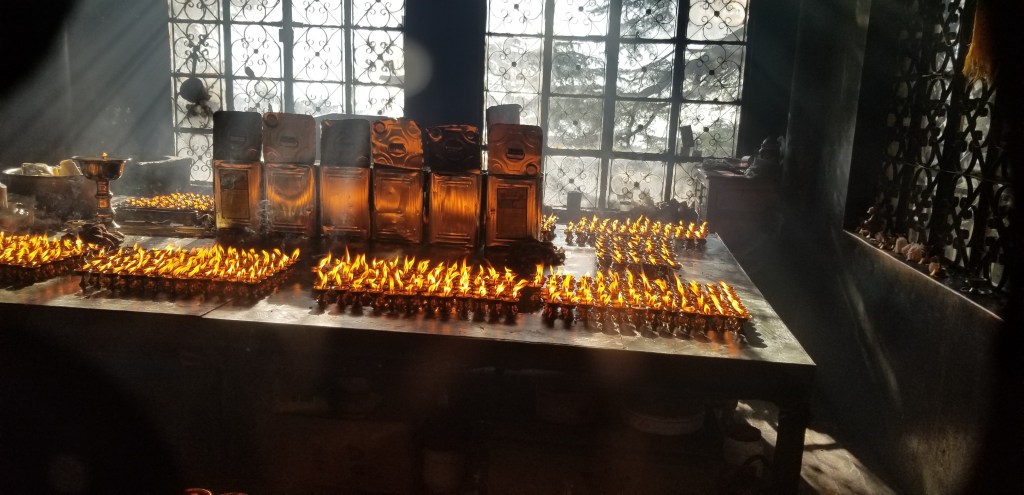
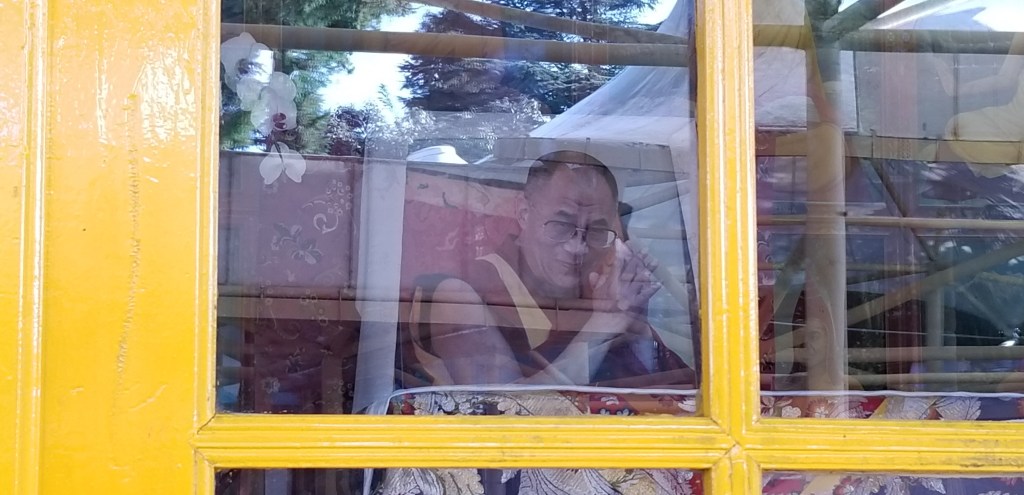
Behind glass, at his own temple…but only a picture

Well, his pictorial presence continued to dominate the rest of our day; at the temple, behind glass; at the meditation centre, a huge face right next to the speaker; at the restaurant, watching us eat our dinner. And he occupied our minds as we continued to talk about our unbelievable luck. I checked my camera later to see if my efforts were fruitless. I found one possible. If I keep focusing, pump it up on the computer, sharpen the image, a decent portrait might emerge.

We have one more day here. I will keep searching for another opportunity at a sighting of the Dalai Lama.

nine billboards outside dharamshala, india

We said goodbye this morning to our wonderful hosts and staff at the Basunti Lodge to make a trek to Dharamshala. The entire day was one of traveling up and down and around, left and right, a swerve here, a quick move there, with a stop at a Tibetan arts centre and a nunnery for female monks.

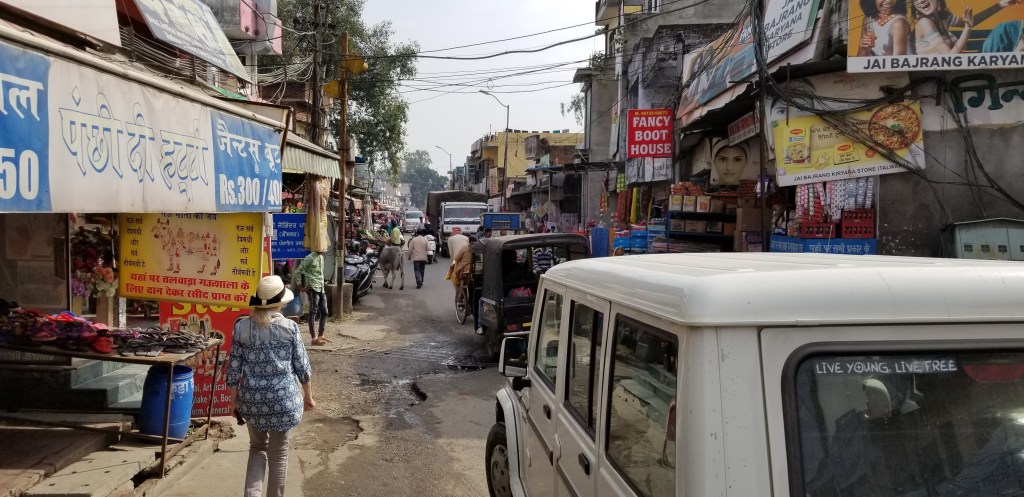
The sites are breathtaking as we moved closer and eventually climbed the mountains; sightings of another kind also provide some amusement or curiosity. In no particular order, these are the exact wording of signs (not exactly billboards; just a little poetic license) recalled from our journey.

Obey Traffic Rules

These words of advice from the local police would seem to be obvious but to think so means you have never driven in India. There appears, in fact, to be no rules. We drove through dozens of villages, and the occasional one had a stop sign at a juncture. No one stopped. Vehicles do stop randomly to shop from a roadside vendor, marginally pulling over and blocking traffic from behind, who then honk, veer into oncoming traffic who also honks and steers away, around the motorcycle passing in between. Difficult to obey something which does not appear to exist.

No Helmet. No Petrol.

One of our rest stops was adjacent to an Indian Oil gas station which hung this sign. Motorcycle drivers are required to wear a helmet according to Indian law, although you would never know based on a random sample of drivers in the street. If anything, you would think donning a helmet was a voluntary or prudent option which many decide otherwise. Even more bizarre, is that passengers do not require a helmet. I don’t understand the logic. I watched five motorcycle’s enter the station, four of them had a helmet and the fifth was served even with out one. Obeying your own rules also appears to be optional.

Plz do’nt touch!!!

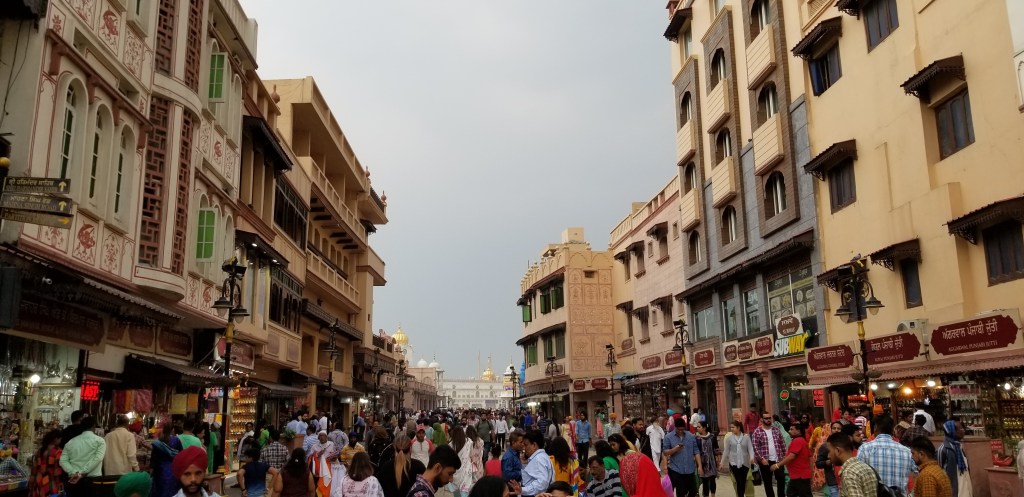
Shops line the streets and everyone appears to be either selling or shopping. The closer we got to Dharamshala, the number of signs in English increased as did the number of people who were obvious tourists. The town caters to the visiting crowds and the relative wealth of the area reflects the increased activity.

We serve Indian, Chines, South Indian, Israeli, Italian

Food choices also begin to cater to the Western palate, adding some variety although I am not sure who are the  Chines or their style of food. This evening we ate Nick’s Italian Eatery. Tomorrow we could add some variety and eat at Jimmy’s Italian Eatery just a few doors down.

Be it women or men, all become literate

The inclusiveness is important and certainly, the goal is desirable if not easily attainable. It sounds more like a motto and to be fair, I saw this only in passing so I cannot provide the context.

Come to Learn. Go to serve.

This motto was part of a school displayed in big letters on the gate leading into the grounds. I expect it does not matter who is served but it struck me as counter to our expectation for education to provide the basis for leadership. I would agree, however, more attention to service would make the world a better place.

Save our leopards

Some of that learning hopefully involves an understanding on the interdependency of our world. We learned about the decline of the leopards from our hosts of the Basunti Lodge. As a result the monkey population has fewer natural enemies and has grown to threaten the livelihood of fruit farms. I saw only one of these signs and it appeared randomly buried amongst numerous others.

Brain and Spine Clinic

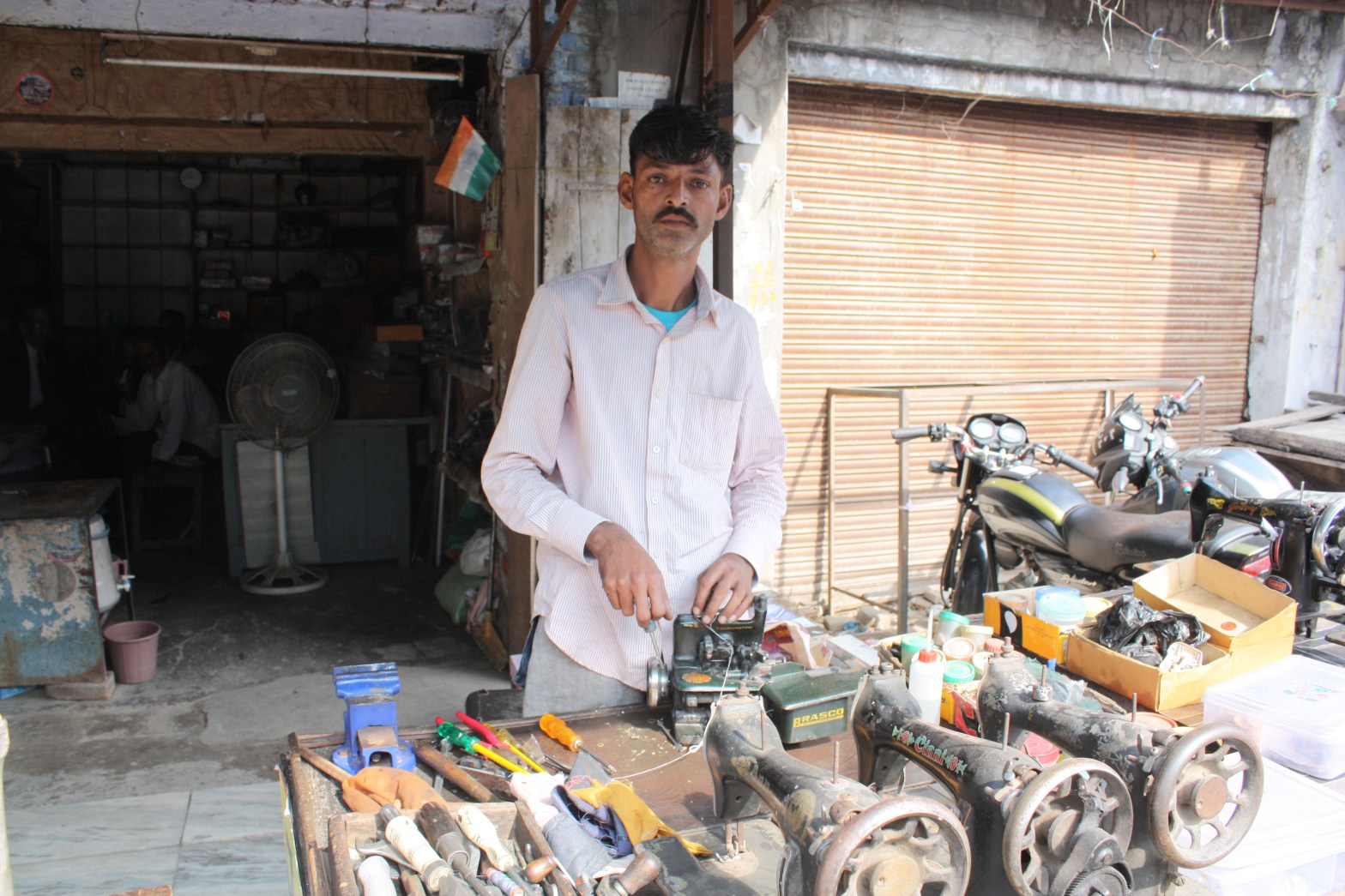
Storefront clinics are common, situated along the street beside grocers, dress shops, jewellery stores, and sewing machine repair garages. X-rays, cancer examinations, other procedures are all available. I thought medicine related to the brain might be a little more specialized and be run out of a hospital but perhaps convenience is more important.

Stick no Bills

I save this one for last as it exists, perhaps, as a plea to keep signs to a minimum.

“Signs, signs, everywhere there are signs. Blocking out the scenery, breaking my mind. Do this, don’t do that, can’t you read the signs.”

So says the Five Man Electrical Band from outside Ottawa, Canada.

a lot of miss sunshine

The condensation on the window this morning was probably the first clue.

It could have been the stars overhead in yesterday’s night sky, but we know how the weather can change before dawn; or the previous crimson sunset could have foreshadowed the next day, but a hint of morning red suggested another possible outcome, determined by the toss of coin.

Heads, we win.

the mountains this morning

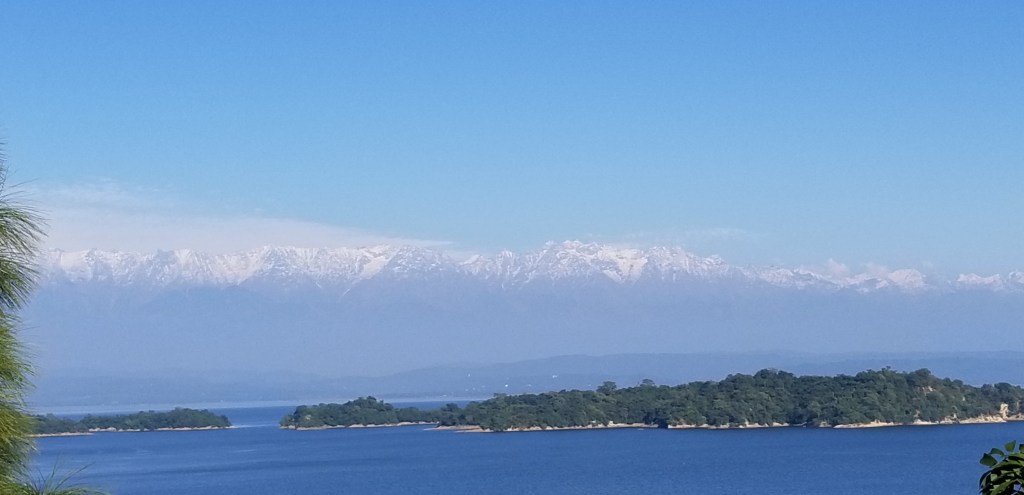
As the morning grew, the prospect of a beautiful day became clearer. Normally during this quiet time I indulge myself with some reading, accompanied by a few cups of coffee. I decided to forego the last one and take time out from the next chapter of my book in order to drink in the warmth of the oncoming day. To the top of the main building I climbed, careful not to slip on the dew wet stairs, where the three quarter moon hung in the western clear blue sky and the rising east sun was beaming it’s welcome rays. The mountains in the north were clearer than any day so far, providing a painted backdrop to the lake’s green islands, while wispy clouds decorated the southern sky. For the first time this week, the cock trumpeted almost in time with the early morning music bouncing off the waters from across the bay while a flock of birds streaked through the picture.

The staff were busy making their preparations, arranging the lounge chairs by the pool, laying out blankets, fluffing up the pillows in anticipation of everyone’s hunger for the sun. The large, skittish fish in the ponds floated to the brightest corner seeking the warmth, no longer fleeing underneath the lily pads at the hint of a passersby, just to bask for another minute longer.

It was a perfect day for a fishing boat ride.

my gondola from a distance

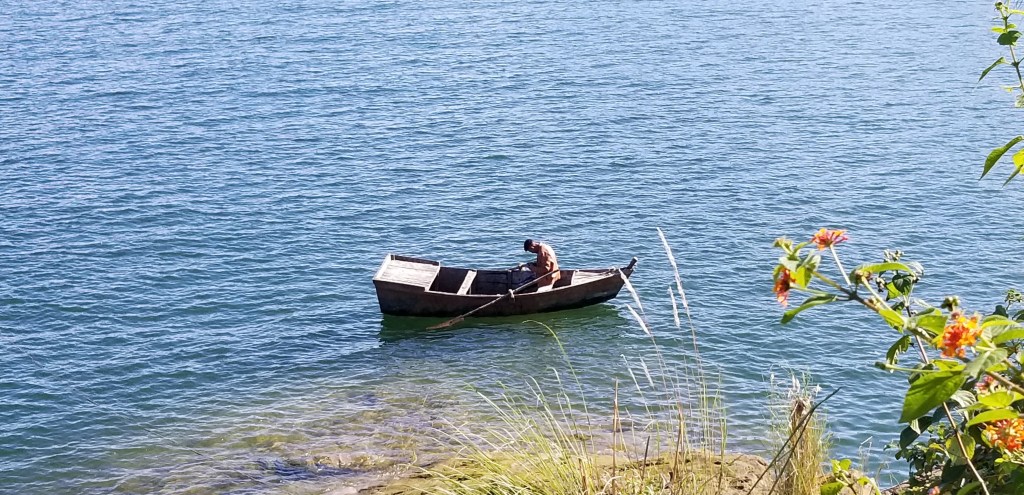
Rescheduled from yesterday, five people had originally signed up for the trip, which was reduced to three by breakfast, when two more abandoned ship leaving me with a solo voyage. Raju guided me down the steep embankment to the waters where my Indian gondola awaited. From a distance, I saw an old man hunched over in his vessel, biding his time till the passengers arrived. As I climbed in, my gondolier was a young twenty-something, steadying the boat and ensuring his cellphone did not fall off his seat into the rainwater of the hull.

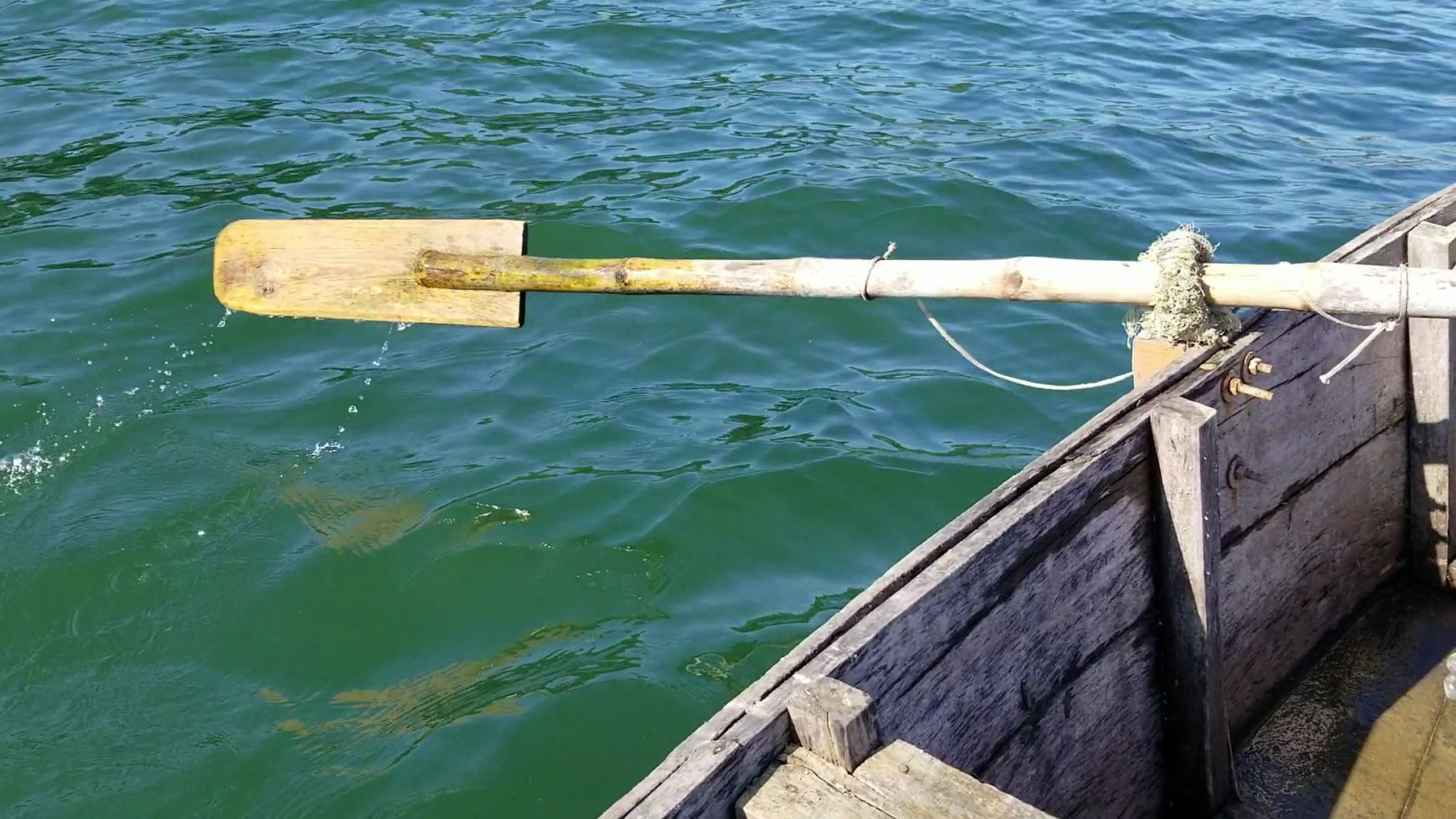
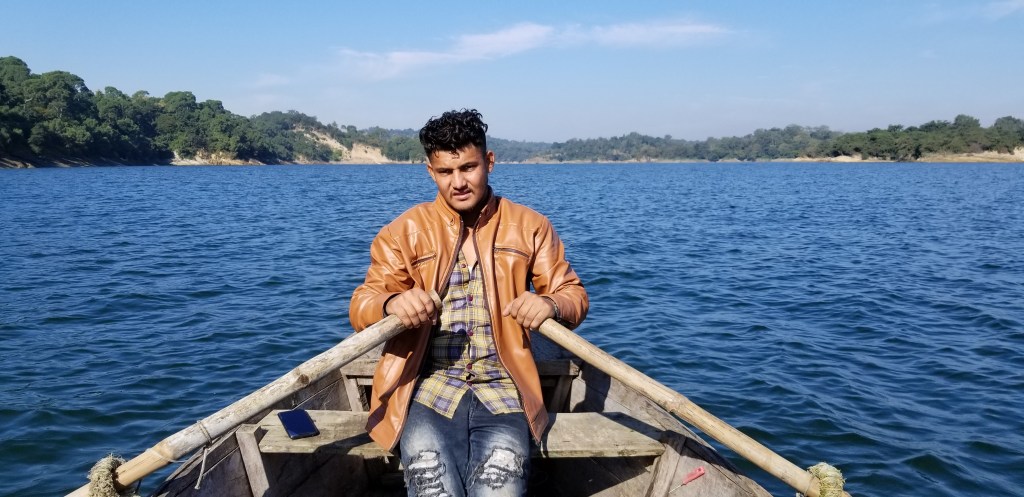
He introduced himself as Goli (my spelling and probably my misunderstanding since I found out later it means bullet in Hindi, but we will go with that regardless), but did not speak any English. After some instructions from Raju, we set a sail. The boat was made of weathered, coarsely hewn planks; the oars were bamboo with a fan-like board as a paddle. We glided closer towards the bay with every pull on the oars, the view never changing but the particulars coming clearer in focus, a touch faster when the waters stilled even more.

my gondolier

My back was to the blazing sun as I watched Goli dressed in a thin, tanned faux(?) leather jacket over a yellow and grey checkered shirt and a white under garment. Combined with the fashionably ripped jeans the entire ensemble belied my notion of a local fisherman. I was perspiring with only a shirt; he could only be boiling in his outfit. Nevertheless, it remained on, intact, for the entire voyage.

As we floated closer, Goli kept looking over his shoulder, sometimes rowing with one hand, sometimes letting go entirely, scanning the water, peering deeper into the bay. Then without warning, three swift strategic strokes and we were heading back. This time the oars were dipped deeper, the back hunched a little further, the pull a might stronger.

The silent ride was broken by my request for a picture. When I indicated the need for two, he said “three” giving me hope Goli knew more English than originally thought. A follow up question about his home in the village was answered with a simple “uh” ending any further attempts at conversation. Never mind, it was a peaceful, scenic ride, watching a flock of birds fly directly overhead, and another couple battling over one fish, while monkeys played on one shore, and a butterfly floated past presumably headed for the other. We had a very pleasurable trip.

Back at our point of departure, a handshake, a Namaste, an exchange of smiles and Goli and I went our separate ways.

It was the most glorious day of sunshine yet.

No contest.  

stretch by me

You’re the fellow who is spiving.

Excuse me? What do you mean?

Spiving. You’ve never heard of the term? Not doing what you are supposed to be doing.

True. Sort of.

We came to India because Olga wanted to complete an international yoga retreat. We had never been to India, so it seemed like the perfect opportunity to plan a vacation. Twenty-two days in total, with sightseeing wrapped around eight days at the retreat. On those days, participants would be involved with yoga early in the morning and then later again in the afternoon. I would read and relax, have coffee in the morning, maybe a drink in the afternoon. My notion of rest. I had never participated in yoga, (except for a couple times when Olga needed to practice teaching – someone had to be the guinea pig to help with timing), had no plans of starting and would be perfectly content with the down time. That was the plan.

A band of disparate individuals with interest in yoga as the common thread, half from Canada, half from the UK, our group bonded quickly at the first stop in Amritsar: visiting sites, crammed together for tuktuk rides in the rain; sharing meals at Mrs. Banduri’s guest house with the cows and intermittent hydro; experiencing the Golden Temple during the day and night; fretting guiltily over accidentally leaving one member behind in the city (we turned sheepishly back to get her). By the time we arrived at Basunti Lodge, everyone was looking forward to the yoga sessions, hoping there would be a session that afternoon. Except me.

You’re not going to yoga?

No, I had never done yoga before. Don’t worry about me, I am going to read.

And off they went for two hours. On that warm evening, I sat outside, under the veranda, alone. Supper began shortly afterward and naturally the place was abuzz, talking about the session, asking questions of each other, and eventually venturing into other topics. People were kind, made sure I was not left out of the conversation, but suddenly I did not feel wholly part of the group.

hibiscus flower found all around

There was never any pressure from anyone, but I decided that evening, before I went to bed, to try my hand at yoga, to be with the rest of the team. The next morning, I was dressed in appropriate attire, went downstairs at the ringing of the bell at 7:00 am, downed a few small cups of coffee and followed the group to the outdoor pavilion. Determined not to be a bother, I staked my territory at the back (admit it Henry, you always sit at the back!) with enough room around me so as not to disturb the other, experienced practitioners.

The first session was familiar because many of the moves and poses I had learned from those teaching practice sessions with Olga. I felt proud of myself.

How was it? Did you enjoy the yoga? Are you going again this afternoon?

Yes I did, thank you, jokingly saying I was a little sore. People were encouraging. Don’t worry, everyone is sore the first few times. You need to persevere and soon you will come to enjoy it more and more. I attended the afternoon session, again understanding the moves and the direction, stretching this way and that, breathing in and extending the exhalation, grounding the various parts of the anatomy, feeling how the poses affect my body, understanding which ones feel good. I was even able to comment how the exercises around the heal were beneficial for our hike over the undulating, rocky terrain.

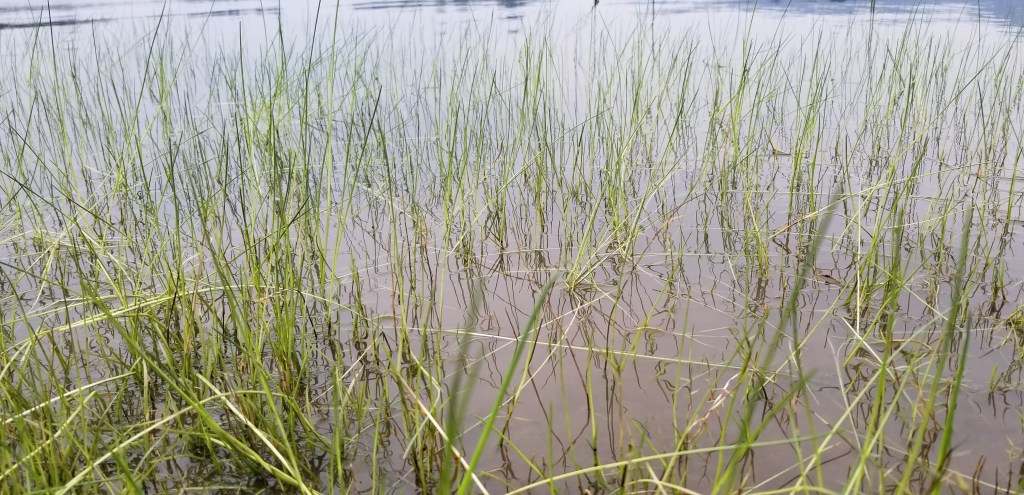
grass in water of our swimming location

By the end of the second day’s afternoon session, the impact had worn off. The weather had turned and the air was damp and cold especially after the sun went down. The moves and the poses were increasingly unfamiliar. Lying down, I couldn’t see what is happening and was too proud to ask for clarification. My knees were sore from the stretching. I just wanted to sit by the end. I did not want to continue.

And I didn’t. For the next three days.

Members of the group continued to encourage, suggesting small doses, maybe only do the morning, others suggested the afternoon; most importantly, they did not make me feel guilty. I did that to myself.

Okay. I will give yoga another shot and attend the morning sessions. After all, that is the time I would exercise (should I ever get back into that habit) and I can see how the stretching of yoga would be of tremendous benefit. Just do it.

And I did. For less than an hour.

I quietly extricated myself, feeling ill, headed back to my room to recover before breakfast. I have not dressed for the yoga times since.

moss

I do have an increased admiration for my fellow travelers on this trip. They are a dedicated, hearty lot of practicing yogites, rolling out their mats on the cold marble floor of the outdoor pavilion, through the unexpected damp and sometimes cold weather, every day, twice a day, to engage in the craft and the philosophy of their brand of yoga. They are very kind and gentle group, devoted, passing no judgement, continually encouraging, believing there will be a time when yoga will find a place in my life. With Olga’s guidance, and patience, how could it not?  

Maybe there is still hope for me.

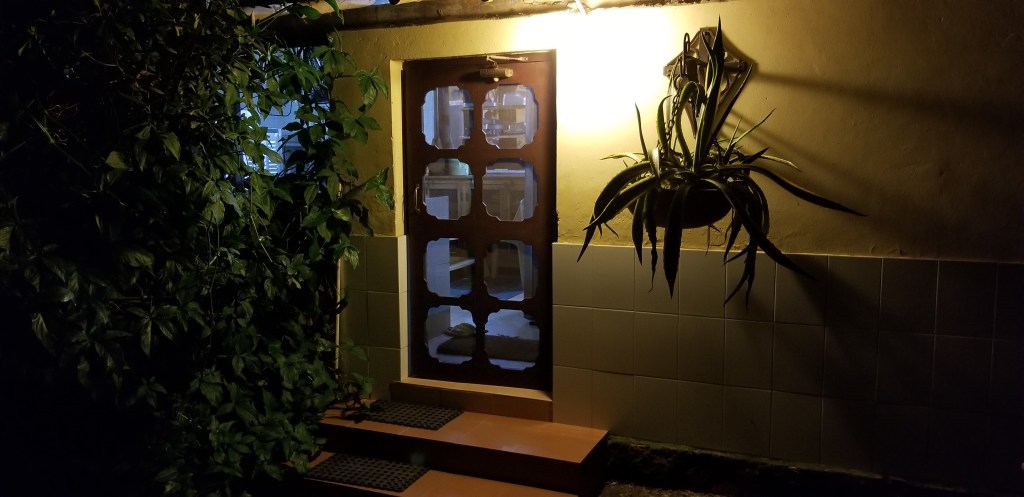
lock, stock, and two twin beds

We have not seen the sun for a few days.

It welcomed us on the day of our arrival, opening up the land around, sharing the colours of the foliage, parading the snow capped mountains in the distance. The second day teased us with more warmth to accompany a walk to the lake, enticing a dip into the still waters, with early fall like temperatures for a soothing, gentle swim. And then the sun went away.

A cyclone on the Bay of Bengal, thousands of kilometres in the south east, had churned the air and folded in the northern cold with the ground moisture, ushering in a mass of clouds mixed with spots of rain. The temperatures hover around 20 degrees but the morning chill of the damp air brought out layers of clothing to be peeled away come mid-afternoon, and drawn in more tightly for the evening supper.  

The tiny moments of rain were mere teardrops compared to the buckets poured over the city of Amritsar a week ago. But there would be no slowing down; the people barreled on, unabated. Heads down, backs bent leaning forward, slicing through the curtain of water, averting pools of water and navigating the narrow passages through the town.

And we do the same; slower, more deliberate, knowing our time is short, capturing the sensations of this idyllic little oasis.

Butterflies and birds abound. We watch the fluttering tiny yellow wings amidst the lush greenery, the larger ones with white spotted wings hovering over each flower, or the taste of a rainbow flapping and floating through the vines. We listen to the twill of birdsong, the chorus of replies, the swish of air from the flock in showcase formation over the lake.

You turn your head quickly to the right because in the periphery a branch in the distance sways dramatically, followed by frantic cackles. The troops of monkeys appear to be demarcating their territory, fortifying their stake on this plot with the eviction of all others.

Or maybe they are reacting to the leopard. We have been warned by the villagers that one is in the vicinity. Their children have been instructed to only venture out as a group and to carry their walking sticks. Before we return to our rooms, the hosts advises the group to use the same precautions.

Each night we retire to our tastefully decorated rooms, a very comfortable refuge from these recent damp days except….there are two twin beds rather than the queen we have grown accustomed. The amount of space is the same but the division is clear with a dividing gap in between making close quarters in the middle uncomfortable. So we sleep together, but separate.

The wonderful memories continue to accumulate. We cherish it all, lock, stock and ….

Well, maybe not everything.

the grand basunti lodge

The destination of “a road runs through it” is the Basunti Lodge, where the yoga retreat, the impetus for our trip to India, is taking place for eight days.

sculptures, pottery, and local artifacts abound

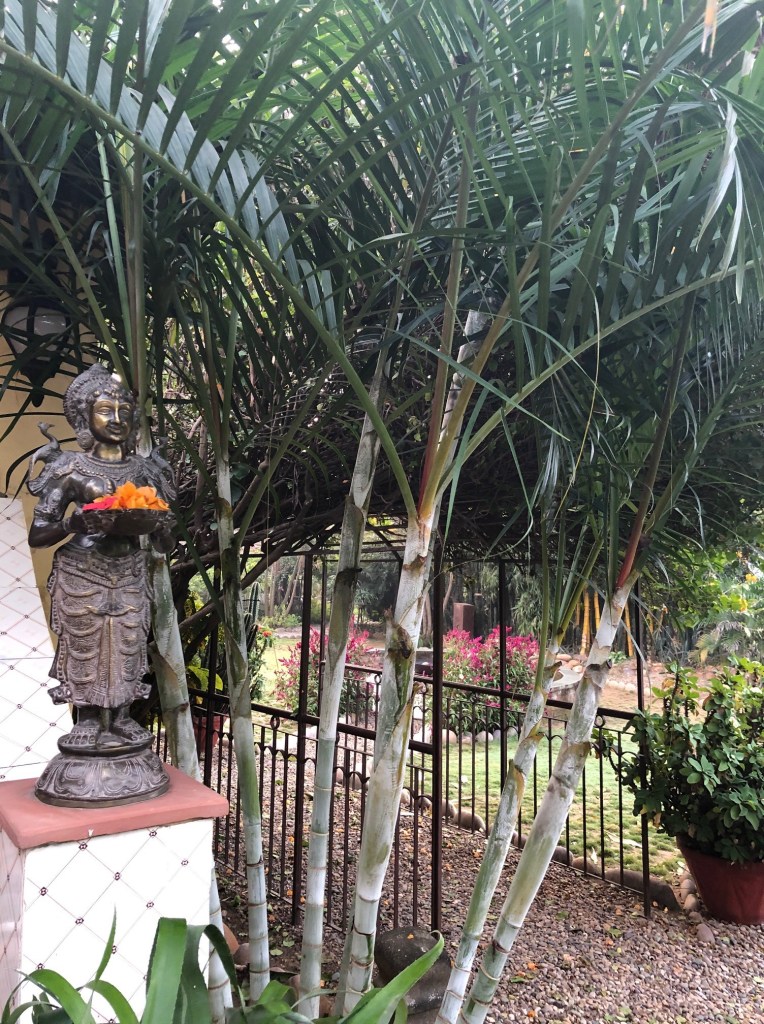
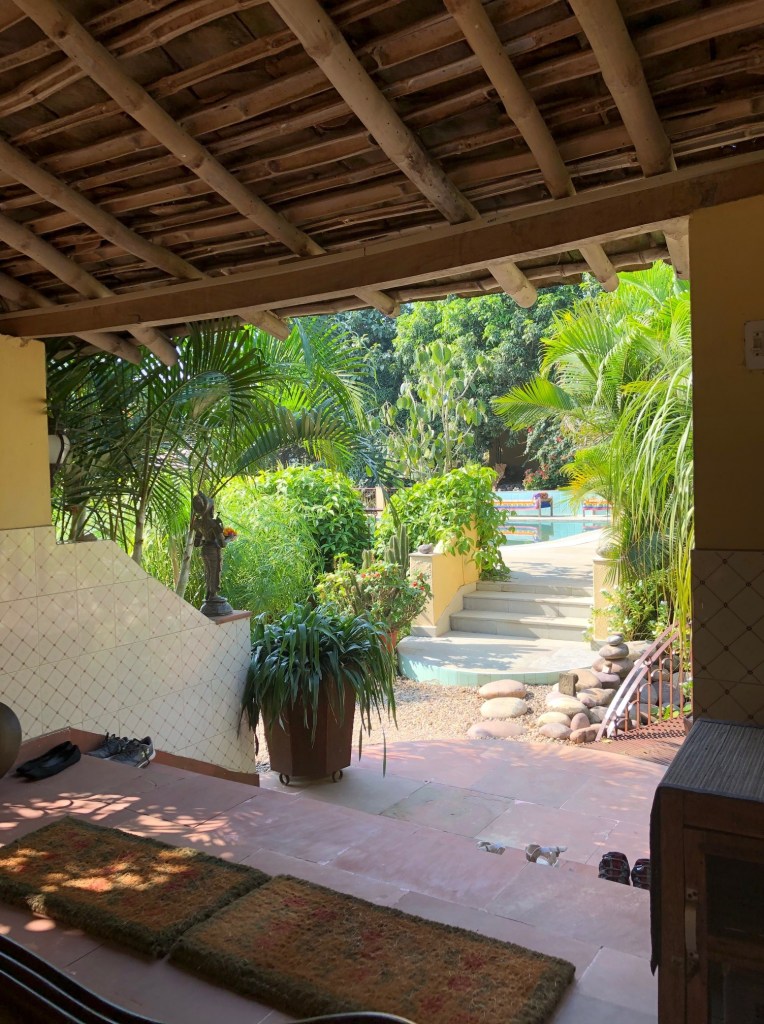
Basunti Lodge is the ever evolving manifestation of a vision of David Butterworth and his wife Izzy to create a home and a small paradise in the northwestern corner of India. Painstakingly designing each little detail, planting with trial and error, employing local labour to support the community, growing food organically, boring a well for clean water; the couple has built a tranquil peace on earth, perfect as a respite from the rest of the world. David, with his swashbuckle voice and equally exotic background, regales with stories of India, the people, the history, and most especially the ecology and nature of the area. Izzy completes with insights into the arts and craft of the people, and provides insights into the art of living amongst her countryman, in the country side, in this country.

natural pool and gardens

The meals are vegetarian, which I must admit, was not something I considered. The Simpson’s episode where Bart and Homer are dancing in a conga line, singing, “you don’t win friends with salad, you don’t win friends with salad” reverberated through my mind. How much salad can a person eat? And a whole week? When the menu was discussed with the group, I jokingly talked about foraging through the jungle (apparently the local name for the forest) hunting for meat while the rest of the crew would be practicing yoga. Cows were off limits, but other beasts would be fair game.

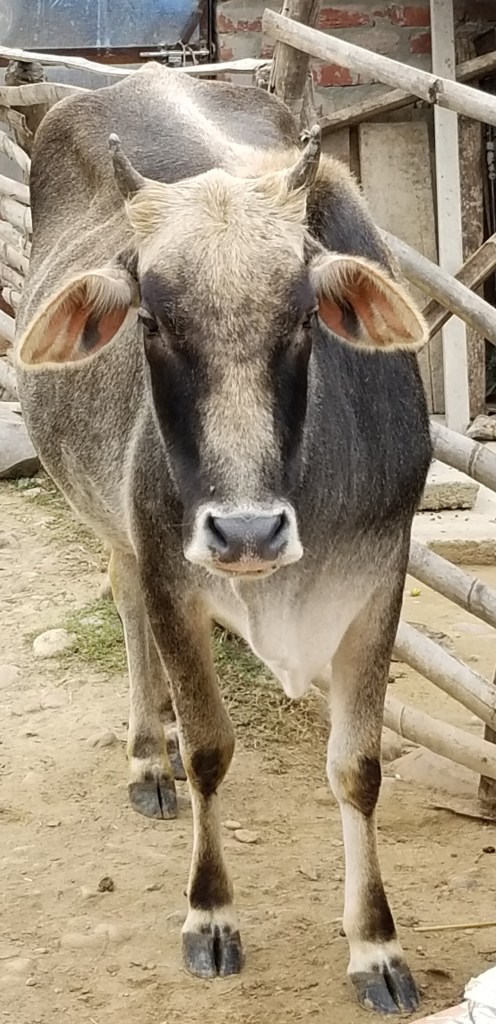
your friendly, neighbourhood cow

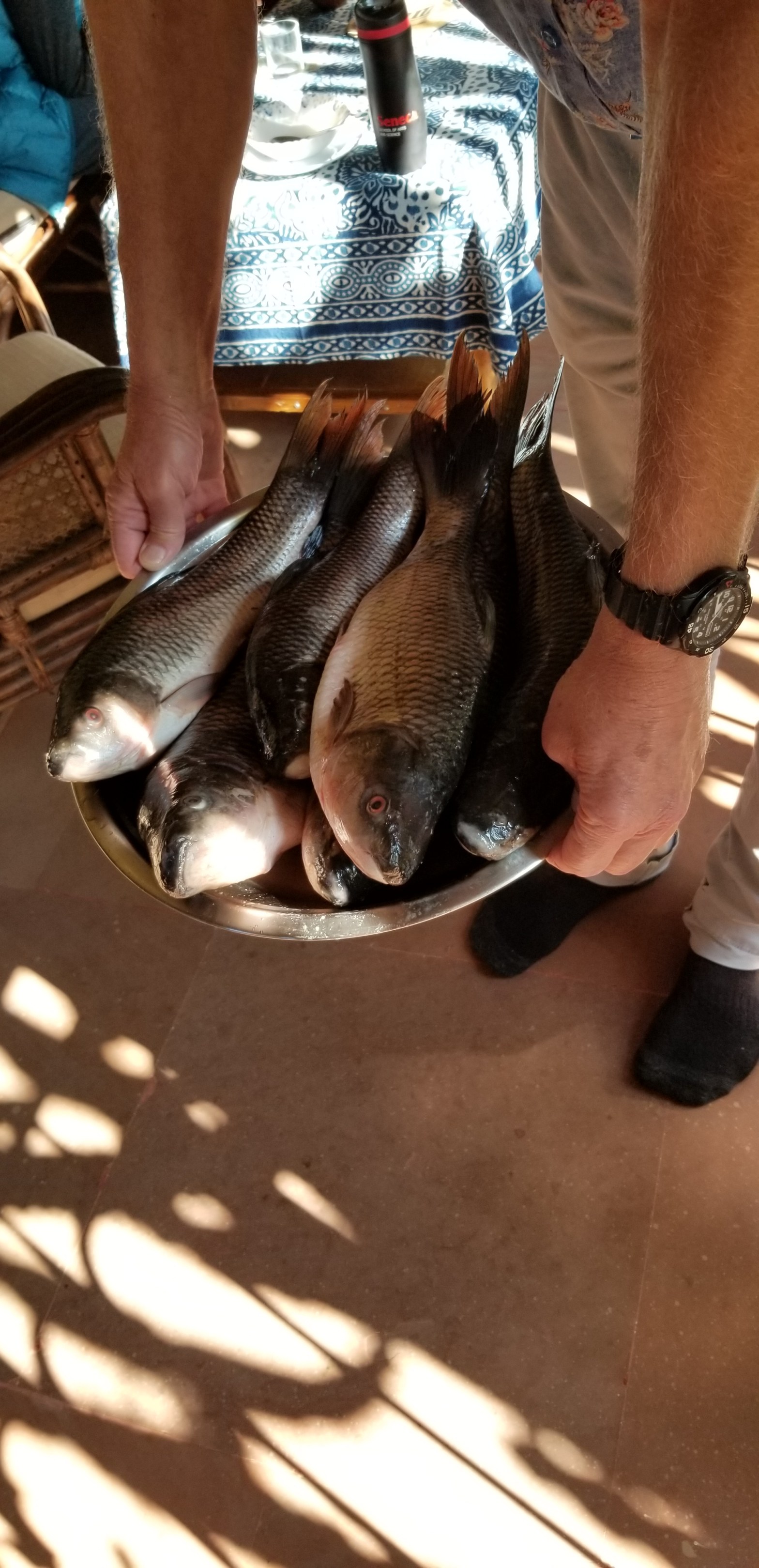
However……the food here has been delicious. Much of it is harvested from the gardens on the premises and is locally sourced from the farmers. David has carefully planned a variety of dishes, some spiced with a touch of chili, simple combinations of exotic and standard vegetables. I now laugh and proclaim a desire to join the cause. David has promised fresh fish from the lake for the last meal here, for anyone interested. The taste should be the antidote to restore my carnivorous predilection.

And the people on this yoga retreat have been a welcome source of friendship and companionship, travelers all, with experiences in almost every part of the world. Their interests and curiosity and respect for others is heart warming, affirming my belief in the merits of travel and restoring my faith in the importance of understanding and empathy.

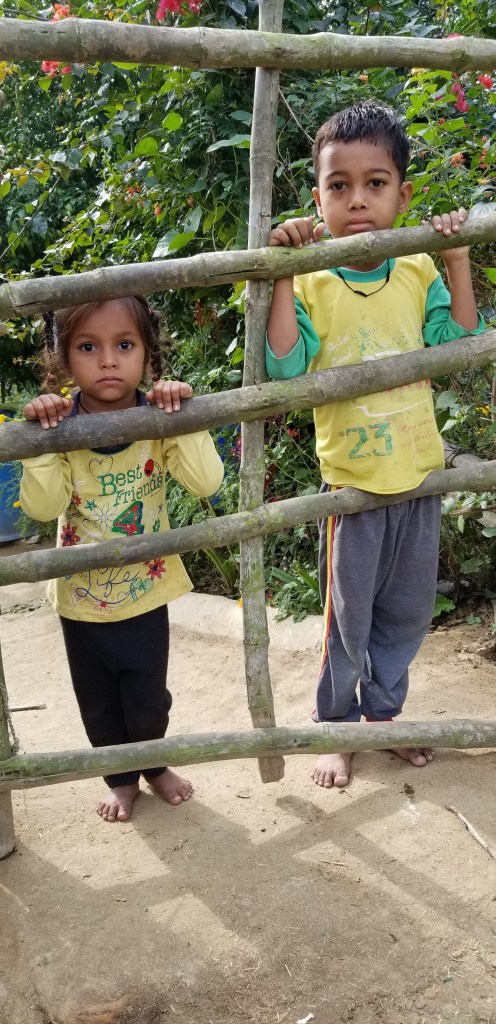
two of the village children curious about the people walking past their home

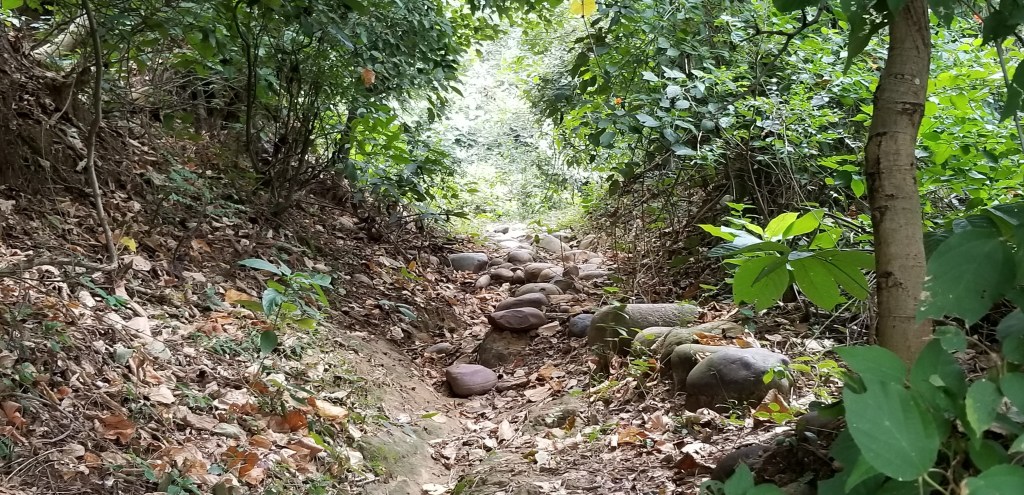
The Basunti Lodge is situated in the countryside, surrounded by small towns and villages, at the edge of dam created lake. David has taken the group through several trails all of which end at the water where one can swim and enjoy the vegetation, the birds, the sounds, the calm. One of the walks takes you to the end of the road to a tiny village of, maybe, ten houses living off the animals and fruit it can grow. The proliferation of monkeys, however, has made the latter increasingly difficult, threatening their livelihood and consequently their ability to remain on the land.

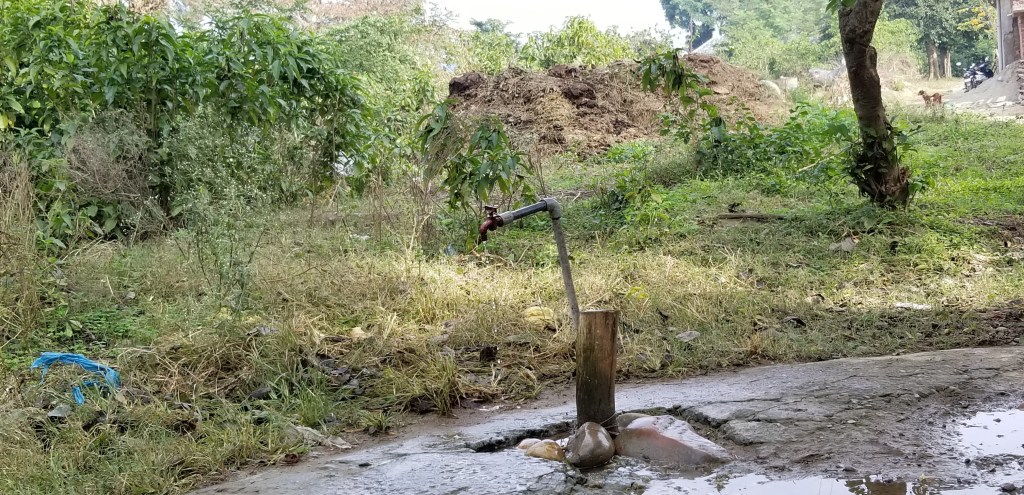
communal tap which marks the centre of the village

The lake itself is a wonder, the product of a dam built in 1976 which forced some 80,000 inhabitants of the once thriving meadows to be relocated to another part of the state, leaving behind walled towns forever lost to the bottom with only the tip of a tower peaking above the water line as evidence of their existence. On one of our walks to the lake, we were joined by a newlywed couple and the brides parents on a pilgrimage of sorts. The father’s family once lived in the valley. In a sort of baptism, the family washed their hands, their arms, and their face with the water as they viewed span of water burying their ancestral home. We were touched by the scene and felt privileged to witness their homage.

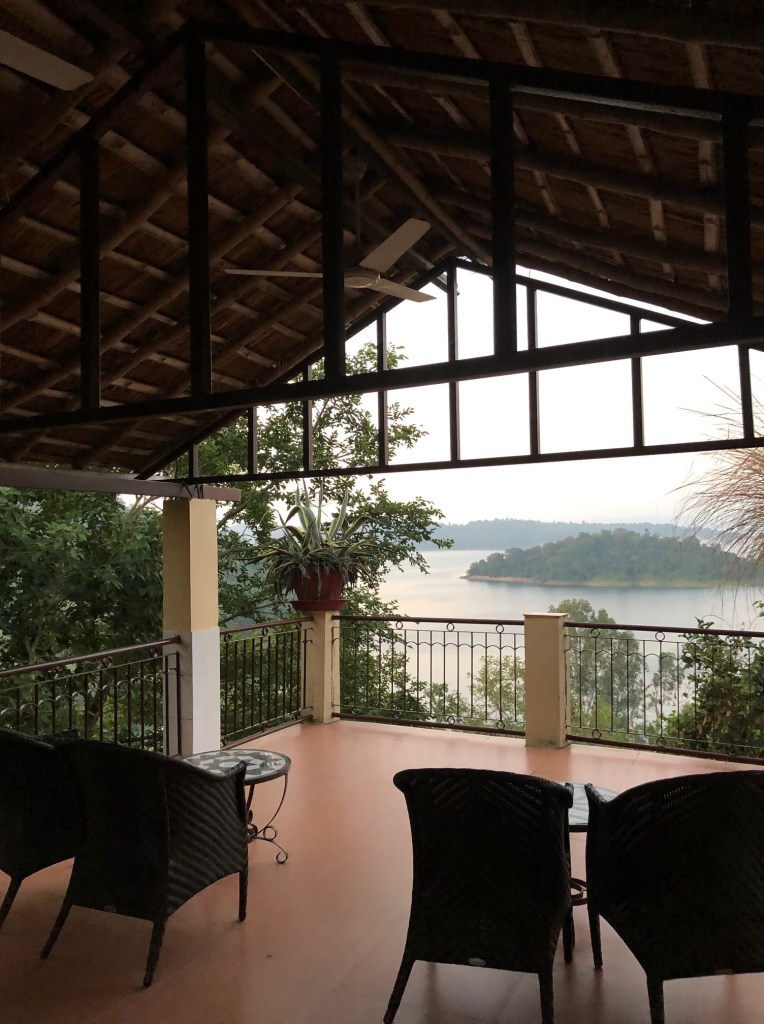
the meditation platform, our favourite spot

From the meditation platform, overlooking the lake, Olga and I read and write and reflect.

Is this heaven? No, it’s Basunti Lodge.

when harry met soumya

“How far is London from Toronto?”

“About two hours.”

“Two hours by bus?”

“Yes”

The border agent continued sorting through the documents, tapped more keys, looked at the screen. I thought it a bit of an odd question. Maybe it was a test, meant to see how I respond. My passport does show I was born in London, Ontario. Was he attempting to measure the veracity of my claim? The picture matches, but does he know the background.

“My son is studying at Western University”

“That is wonderful.”

“Is it a good school?”

“We both studied there, and our son attended Western. It is a good school. What is your son studying?”

“He is doing his Masters in information technology. Is there work there for him?”

“Oh yes, he is sure to find something when he graduates. It is a growing field”

Stamp. Stamp. Folds the papers into the passport and hands them back. Smiles.

“Welcome to India. Enjoy your trip.”

Our driver was standing with his sign among the throng of a dozen others waiting to identify their human cargo. Shorter than most, he was at the front, holding a piece of paper with Henricus and Olga in caps. I imagine there would be only one couple with that combination of names. A point and a nod and he scrambled to break free and meet us at the exit, beaming, despite us being an hour late; we were grateful someone was there.

“I take your bag. This way.”

Walking quickly to keep pace, looking both ways several times crossing the road, through the smog and smoke with the distinct smell of dried burning grass, around the bend and up those stairs. Once in the car, we head out into the traffic, idling at times despite the late hour.

“Half hour to hotel”

“Thank you. It is great to have arrived. Is it always this busy?”

“Police check. Looking for licences.”

Four lanes jammed into two with armed personnel standing around, not paying particular attention, on the phone as every vehicles honks and nudges and inches along until finally breaking free into the open field of asphalt.

“You are from Canada?”

“Yes. A long trip. Our flight was direct, 15 hours but it passed by faster than we thought. What is your name?

“Amarit”

“Hi Amarit. Are you from Delhi?”

“No. I work here. From Dharamsala.”

“We are going to Dharamsala as part of our trip.”

“I from small town near there. My family there. I work here during winter then go home in summer. Here too hot in summer. Much better home. There, see there, that where I live with other drivers. At home I have small farm.”

We continued to have a conversation about his work, his family, the weather, his background, our heritage, all the while eyeing the surroundings and Amarit pointing out the Canadian embassy to our left and navigating another round about. India has a population of 1.4 billion people in a country sometimes described as a continent with all the variations of language and culture, economics and wealth, climate and topography. Our encounters suggest English is not as common as one might have thought for a former British colony; and, there are very few, if any, other white people, particularly outside of the centres.

We were an oddity walking through the small town near the resort several days into the trip. Our hats contributed to the looks and head turnings. We sauntered past the rows of shops, owners behind their wares staring straight out; people trudging along, glancing around, avoiding the motorcycles; but occasionally you meet them eye-to-eye and then a glimpse of a smile, a nod, the folding of the hands and saying namaste.

In those moments you meet the people of India.

“Pic?”

The young man, around 18, dressed in a mix of traditional and contemporary attire, points to his phone, points at Olga.

“You want to take a picture with me? Okay.”

He quickly moves beside her, raises his arm straight out, smiles, snaps a shot, “Namaste!”, and moves on.

Half a block later, a young woman with a long dark braid wearing a pinkish sari, meets Olga’s eye and stops her.

“Picture? With you?”

Olga agrees again and this time I retreat a few steps to take one with our camera of yet another impromptu photo session.

I ask, “And what is your name?”

“Soumya”

“Pleasure to meet you Soumya.”

the road to partition

Preparation for this trip included reading literature (Canadian authors, of course) situated within or directly related to India. Many years ago, my first memorable exposure was Anita Rau Bandami’s, The Hero’s Walk. Paradoxically, I have a limited recollection of the plot but enough to recommend it to others. More recently, I was subsumed by Anosh Irani’s The Parcel a tough and difficult account of enslaved prostitution and The Song of Kanunsha the story of organized, exploitative begging in Bombay. This past summer was the perfect opportunity to tackle Rohinton Mistry’s more than 700 page opus, A Fine Balance. It’s story recounted the divisive caste system and the persistently discordant gender norms; it’s universal message for thriving, or at a minimum, a lesson in survival.

M.G. Vassanji’s latest novel, A Delhi Obsession, was released in September, providing one more book to contribute some understanding of our destination country. Numerous two page bed side reading evenings, including one re-start, amounted to only about thirty completed pages by the time our plane took flight. A late evening departure and the allure of in-house movies meant the first substantial reading happened here at Basunti Lodge, after a few days in Amritsar. The delay proved fortuitous because the experience of the city and it’s history, particularly it’s central place in the Partition, has enriched and illuminated M.G. Vassanji’s story.

In short, one protagonist, Munir Kahn, is a recently widowed writer whose Muslim family immigrated from Kenya, having escaped the city of Delhi. His wife was Scottish and they raised a daughter in a non-denominational Canadian home in the city of Toronto; early on in the book, she marries an American Jew. Seeking to rekindle a creative morass and rediscover his Indian heritage, Munir visits Delhi and encounters the second main protagonist, Mohini Singh, a Hindi woman in an unhappy marriage to a traditional business man. Their affair is the subject of much personal introspection with the backdrop of the growth of Indian nationalism under the baggage of the Partition.

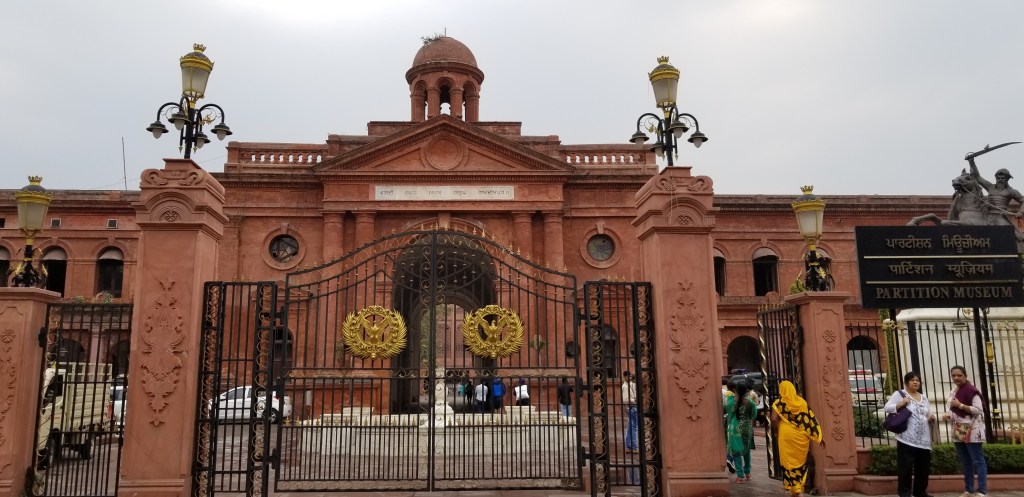
Entrance to the Partition museum

We learned the details of the Partition on our visit to the museum where the graphic details are displayed in texts and images, first hand accounts of Sikh and Hindi slaughter at the hands of the Muslims. With the independence of India from Britain, Pakistan to the west and Bangladesh to the east were created as Muslim states along semi-objective border lines, an announcement which precipitated the largest mass migration in history. Despite the depiction in the museum, the atrocities occurred on both sides. The constant reminder to Munir prompts him to respond, “no point in telling [them] that there was killing on both sides.” Estimates of the numbers, according to the 1996 edition of the Lonely Planet, informative reading here on the shelves of our Basunti hosts, range from a quarter to half a million dead. The shadow of the Partition remains long and the rise of nationalism, one of Vassanji’s motivation to write his book, can only resurrect the violence it brings.

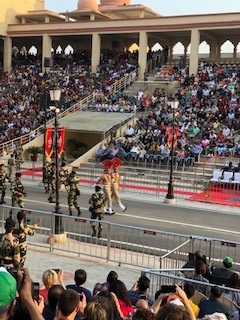
The stadium and crowd of India

Our second experiential lesson was a trip to the Wagah-Attari border, equidistant between Lahore in Pakistan and Amritsar. There is a mock display of posturing and strength between the respective armed militia separated by iron gates, in front of 30,000 people daily, to lower each country’s flag and ending in a quick handshake supposedly reminiscent of the agreement to draw the precise border line.

Marching before the crowds

Each side has a permanent u-shaped stadium to house an audience and atmosphere akin to a football (soccer) match. Raucous singing and chanting, pumped up by a circus master, drums and pulsating music, vendors selling drinks and popcorn. Each side takes turn parading out their soldiers and at other times competing with each other to be the loudest and most boisterous; all seemingly in good fun, and and in spite of the history of the Partition.

Whereas others in our party viewed the whole exercise harmless and a healthy form or country pride, Olga and I saw it as a prelude to the potential rallying of the troops in response to not unprecedented government aggression in the wake of rapidly rising nationalistic ideology.

Lest we forget.

guess who’s coming for breakfast

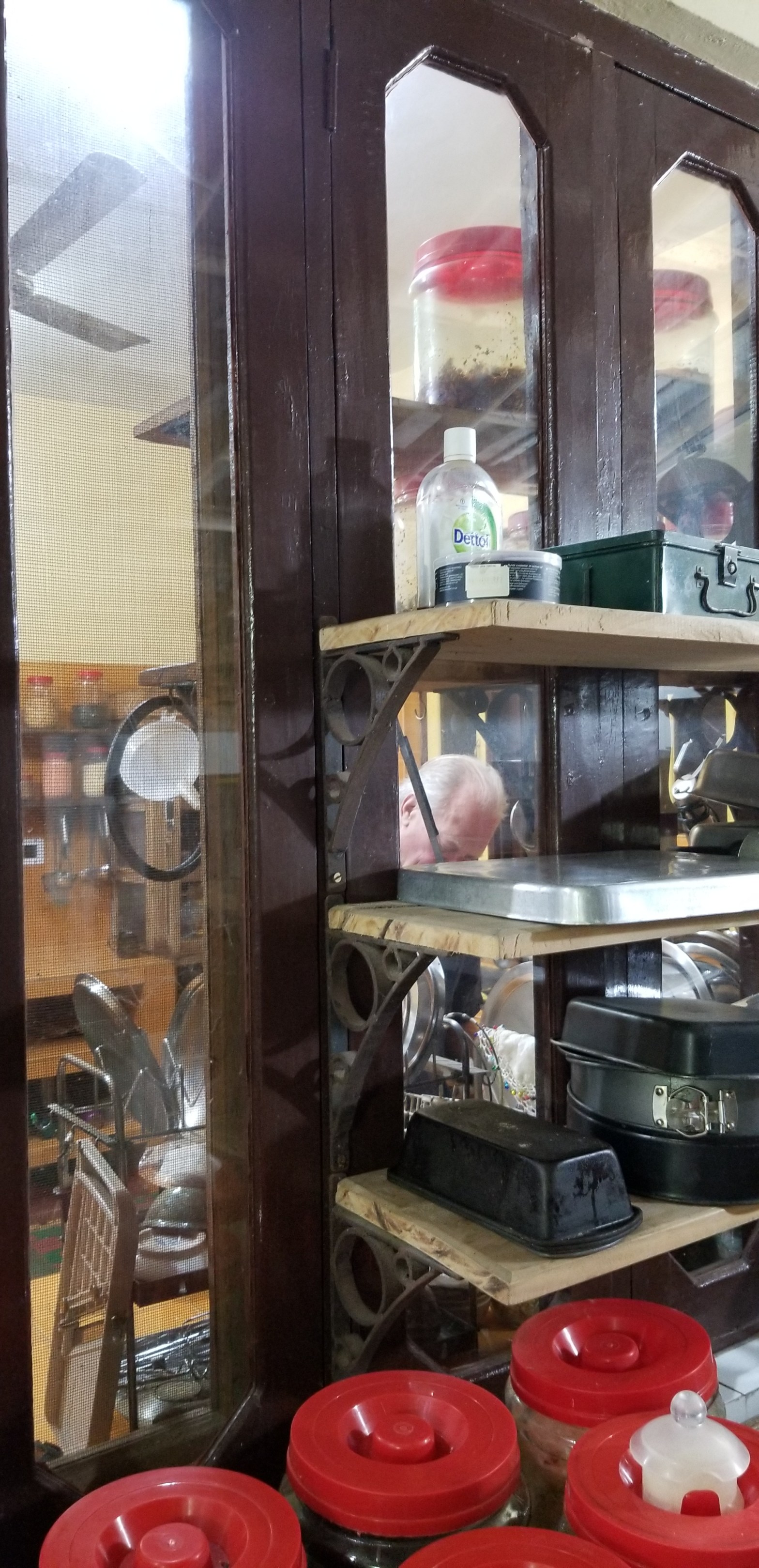
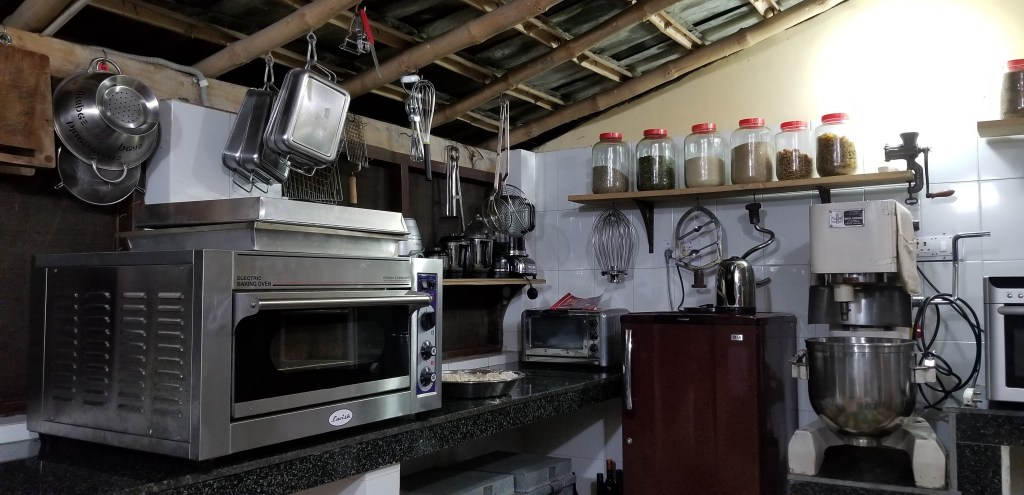
Entrance to the kitchen

4:30 am.

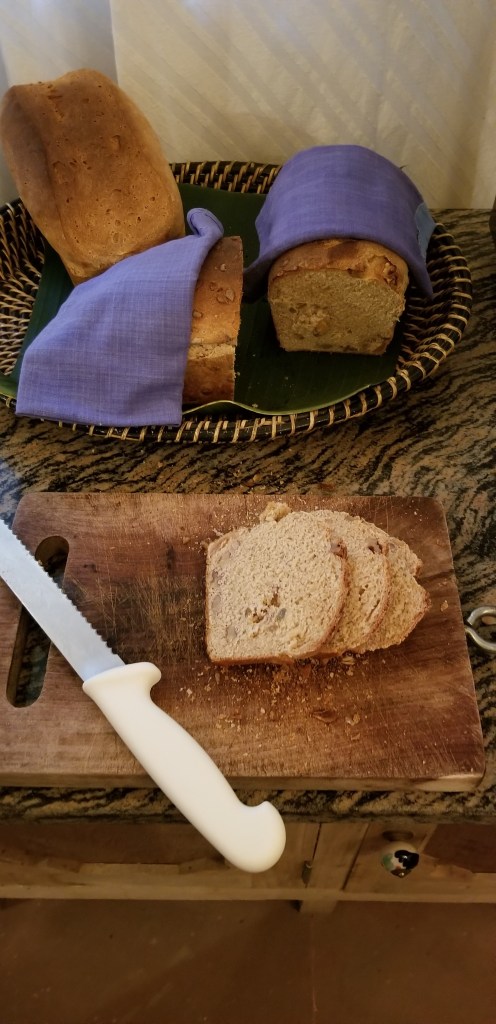
David welcomes me with a good morning, asks if I would like a tea. Every day begins in the kitchen in preparation for the upcoming meals of the day, including fresh baked loaves of bread, my reason for rising at this hour: to witness the work of our host here at the Basunti Lodge. David pours the water, adds the sugar and then starts gathering all the necessary material for baking.

Raju arrives, exactly on time, 4:40 am. He has been working for David’s family for thirty years, beginning with their tour company for the mountains, north of Dharamshala, Raju’s home. Familiar greetings in hushed voices; not whispering, just loud enough to be heard but not enough to disturb the morning. Raju begins with the fruit juice, cutting each in half, gathered from the trees grown on the property, squeezing them through the hand leveraged, sturdily built, Italian presser.

David sifts the flour to catch any extras which it may contain from the locally sourced, stone grist mill. He kneads the dough by hand on the beautifully non-stick granite counter, because the mixer makes too much noise for this time of the morning. The dough goes on top of the fridge where the heat from the motor will help it rise faster. Raju has since moved to the other room which appears to be the original with its brownish orange tiles while David remains in the other half, an apparent addition of screened windows, and a roof of thin slate supported by bamboo. Here sits most of the equipment and the exit to the cold shelter. The two don’t speak much; they know the routine.

Cleaning, peeling, slicing, dicing, chopping, shredding consume the next hour.

back kitchen

With my presence, David ventures into a number of different areas of discussion, largely to my probing, some to pertinent observations. Meals, he explains, have become more complex because food allergies are common. David attributes the phenomenon to the environment; I think it is the result of obsessively clean, protected living. That thought launches us into a recall of our upbringing where we were sent outside to play, fend for ourselves and come back for supper, or before dark. A question about the vegetarian diet at the lodge leads to a warning about eating meat in India because of the inconsistent supply of electricity to keep it adequately refrigerated. Meat is dubious; vegetables are safe. A reminder of the novice local electrician who eventually learned his trade after being sent flying across the room from shock.

The dough has risen allowing for the mixture of walnuts and raisin in one half of the severed mound, pumpkin seeds for the other. Nothing is measured; a handful of this, a tip of that, and a pinch here,  folded into the dough then plopped into the pan, seam side down and placed atop the warming convection oven for the next rise.

Time for the next cup of tea, one of which David will bring to his home for Izzy as she awakens.

The modern equipment has taken much preparation more predictable but the essence of bread making remains and not as complicated as others might suggest, or so says the finalist, winner of 100 British pounds, for the 1980 Sandwich Maker competition held at the Savoy Hotel in London. At 6:35 am, David has determined that the bread has risen to the perfect height and the loaves are popped into the oven.

David excuses himself as he heads outside to stem off a rogue monkey who has been eating from his garden and diminishing his salad crop. No luck in catching him; oh well, continue with the preparations.

Everything in place, on time, so the bell rings at exactly 7:00 am beckoning the guests to come for tea and coffee. I go to the top of the building to catch the sun rise, amidst the wafting fragrance of fresh, baking bread.

Another new day begins.

a road runs through it

Travel day.

We left the city of Amristar on the next leg, this part by vehicle. Our experience on the train, and the view from the road shows extensive flat lands in this part of the country. Not the wide open fields of Canada’s western provinces where the only sight across the long span of wheat is a grain elevator; rather, here the expanse is divided into numerous forms of vegetation, checkerboard fashion, defined by a furrow of dirt or a cropping of greens to walk in between. It is a country of proportions which can be managed with manual labour occasionally aided by an animal driven cart. Trucks are used; farming machinery exists; but the work is completed with the hoe and the knife and the shovel.

In between the roads run through small towns where the shops hug the edges; people and vehicular traffic navigate through the narrow passage, checking the wares, the blindspots, the gaps in flow, the opportunities for passing, the chance to make a move, the avoidance of the lights coming at you. Cows are more abundant, taking their rest here, there or in the middle, where it stares at the vehicles, not blinking, and cars swerving, not slowing.

Sign at the gas station pit stop.

Our vehicle emerged from one such village, and they appeared: the mountains. Suddenly, without warning, the flat lands colliding with the snow topped peaks in the distance. Now the trees appeared closer, the view was shorter, the roads more rugged. Slowly we began our ascent, winding along an increasingly rugged road crossing the border into another state, greeted by monkeys.

The first glimpse of our destination burst upon us crossing the dam; to the left a vast open valley divided by a river; to the right a broad span of water dotted with islands, back dropped by the Himalayans; above us wide open sunshine. Then the turn into, seemingly, a dirt driveway, except it kept going, and going. The road became a path, washed out in parts from the just finished rainy season, marred by rocks and holes and branches; curves around corners, teetering close to a precipitous drop, the van banging, rocking, swaying, inching forward. Stop, reverse and there, the sign, Basunti Lodge. Greeted warmly we found our spot for the next eight days in our room with a view.

The view from our room. Note the snow topped mountains just beyond the clouds.

We have arrived.