Are you feeling well today?
An easy one to begin the online eligibility questionnaire. Heck, if I wasn’t felling well, this blood donor appointment would have been rescheduled to another time. It will be the only question to which I answer “Yes” today.
In the last month have you taken Toctino, Hanzema or alitretinoin?
I don’t even know what those medications are for? Nor Proscar, Propecia or finasteride, Avodart, Jalyn or dutasteride. I seldom succumb to Tylenol or Aspirin and certainly not within three days of donating.
In the last 6 months have you consulted a doctor for a health problem, had surgery or medical treatment?
One of the reasons I have been able to give blood continuously is my good health. I have been fortunate, rarely visiting a doctor, using these blood donor appointments to track my blood pressure, at least when that testing was part of the procedure. The nurse would strap the device to my upper arm, pump in some pressure, then slowly release. 120 over 80. Pulse 63. I had no idea what the numbers meant but the nurses never appeared alarmed so I assumed all was good. The pulse has always been on the low side, a nurse asking once if I worked out because I had the count of an athlete. That comment made me smile. I don’t know why they stopped.
In the last 3 months, have you had a new sexual partner?
In the last 3 months, have you had more than one sexual partner?
In the last 6 months, have you had sex with a sex trade worker or anyone else who has taken money or drugs for sex?
What happens if a donor answers “yes” to any of these rather personal, seemingly intrusive questions? I have never found out, happily married for 41 of the 46 years in which I have been donating.
I donated my first pint of blood at 18, the minimum age in 1978. My dad drove me to a permanent clinic at the London Health Centre on Commissioners Road. He would roll up his sleeve regularly when the Red Cross set up a clinic at the 3M plant where Dad worked. He would boast that the workers from the plant would outnumber the donors from the office, as a testimony to the superior virtues of those in the working class. I don’t know how many units he donated or recall how long he continued to give.
My volunteering in the early years was scattered, relying primarily on King’s College at the University of Western Ontario to host a clinic which occurred in the Spring and Fall semesters. The waiting time in between donations was three months (now two), amounting to four possible donations (now six) in a calendar year and only if the first occurred in very early January. When Olga and I moved to Toronto in 1984, the nearby shopping mall, Sherway Gardens, regularly held a clinic in the round court in front of Hudson’s Bay. I attended inconsistently, depending on how the timing intertwined with my schedule.
In the last 3 months, have you travelled outside Canada and the US?
In the last 8 weeks have you travelled outside Canada?
Answering “yes” to these questions over the years has prevented me from giving more blood, accounting for some of the gaps in my donation history. Nurses would consult binders to ascertain the trouble spots, looking at each city I visited on trips to China. My excursions to African countries almost always lead to an additional three or six month wait, depending on the prevalence of malaria. Our yoga retreat vacation to India in 2019 had me sidelined for a full year afterwards.
A few more questions to answer.
I have not taken any illegal drugs with a needle, handled monkeys or their body fluids, have not been in jail within the last six months, or attempted a donation at Hema-Quebec. Check off that I have answered all questions truthfully. Done.
Now the nurse begins the next step: determining my hemoglobin count.
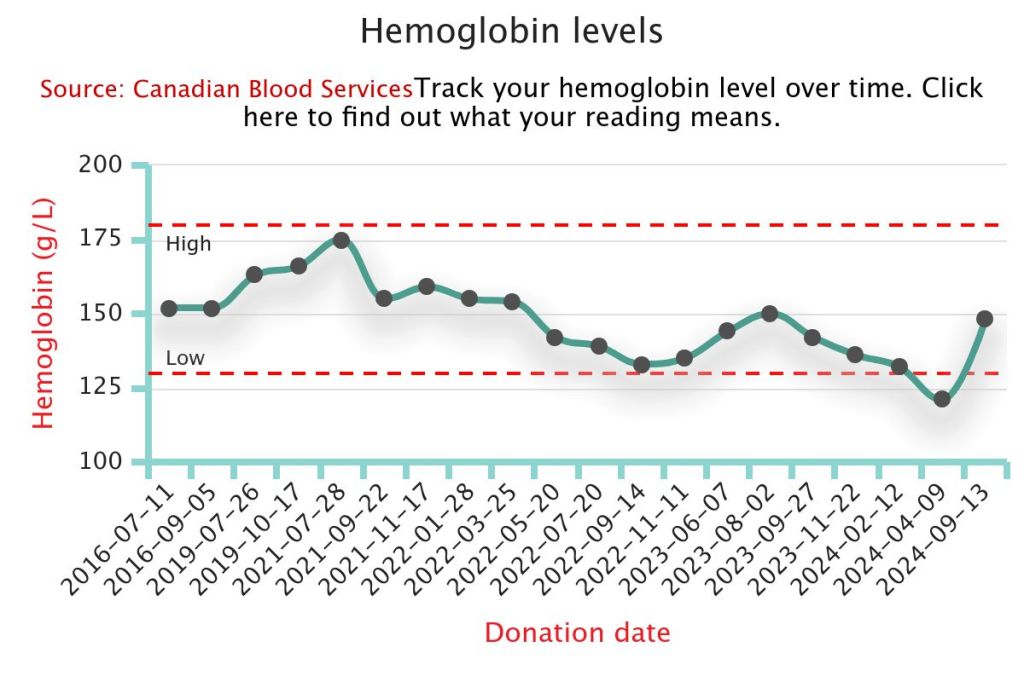
She pricks the tip of my left middle finger, squeezes a couple drops onto the plastic slat before sliding it into the tiny medical unit. Below 130 and males are unable to donate on that day, something that has tripped me up a couple times, the last in April. Not enough iron in the blood, sometimes a function of giving too often so I decided to take a break. Being a statistics guy who loves charts, I was excited to discover these numbers get posted on MyAccount, in a graph, so I can detect patterns. My hemoglobin bounced back in September. Today the count is 135. Good to go.
I am escorted to the next station and get comfortable in the reclining, lazy boy chair.
Would you like to use your left arm or your right arm?
“Whichever one you can find a vein?”
Audrey laughs.
She begins reviewing my particulars and realizes I have reached a milestone donation. Audrey gets excited…. and nervous, so she says…. because she wants to make sure the needle finds a good vein the first time. I never look. I just wait for the stab, then look over. Success. The blood snakes its way through the line to the waiting plastic bag oscillating up and down and up and down.

When Nicholas and Olena were young teens, I had attempted to generate interest in donating by asking them to accompany me on a few evenings at Sherway Gardens. The space was open so they could watch every step including the size of the needle shoved into the crux of the elbow. It is wide and imposing and if you are afraid of needles, as both my kids are, then this procedure will definitely scare you away. Neither have gotten into the practice.

At university, I had convinced Olga to join me at a clinic, you know, like every other dating couple. The nurses had difficulty finding a viable vein. Olga felt unwell through the process and needed help off the bed. She had such difficulty the nurses suggested not giving blood again as I supported Olga down the stairs to the parking lot for the drive back to her apartment. She has not attempted to give blood since.
I chit-chat with Audrey about her day, the weather, the news; all the while she draws several samples into glass tubes for testing, checks the flow, checks how I feel.
Seven minutes later and my 100th donation is complete.
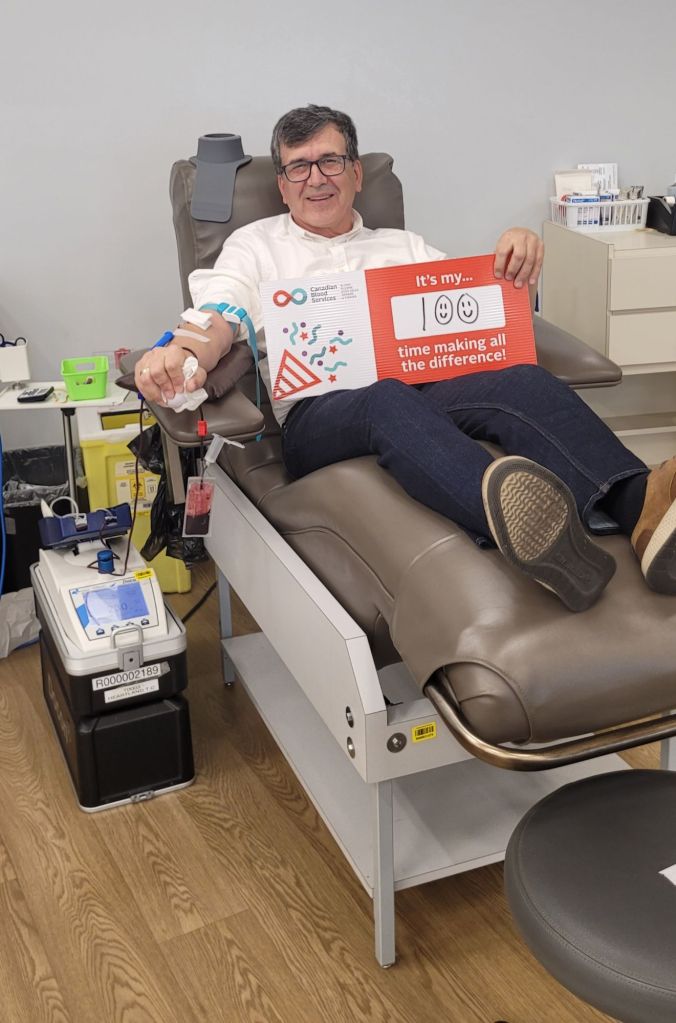
Time for some salty snacks, the one time I can eat potato chips for health reasons.
My blood type is O negative, one of the more rare possibilities, found among only 7% of the population. Those with O negative blood have been dubbed, Universal Donors, because 100% of people in Canada can receive it, a fact especially useful in an emergency. O negative donors represent “a small percentage with a huge impact”.
I don’t recall ever knowing the blood types of my parents. My dad had black hair and brown eyes. I am the only one of the four boys with black hair and brown eyes. My three brothers are all O positive, so given my other features, it stands to reason I had also inherited Dad’s blood type. Or maybe it was my mother’s blood passed down the line. It doesn’t matter.
I volunteer to donate because I can. The process is simple, involving an hour every couple months. My next appointment has already been scheduled for January. And given the rarity of my blood and its universal usage, I feel obligated.
Donating blood is one way I can be of service.
 Wonderings
Congrats on your milestone! I went once, didn’t have a problem with the needle, in fact I prefer to watch them insert it, but rather I apparently didn’t eat or drink enough and almost fainted. Should probably try again one of these days!
LikeLiked by 1 person
In fairness to your son, he proudly has “Donor – T5” marked on the back of his Ontario Health Card, which means it’s a fire sale on my organs when I shuffle off this mortal coil. I don’t smoke, so others can benefit from my lungs, but I drink like my grandfather so my liver may be of less value. I just don’t like needles.
LikeLiked by 1 person