Alight at Freshfield and turn right onto Victoria Road.
DO NOT cross the railway line.
It is a 200m walk to Herbert House on the left.
These are the last words of instruction on this now four and a half hour convoluted 354 km train ride from Heathrow airport involving six transfers and three different rail lines, with the purchase only one ticket. I spied carefully all 26 stops on the Underground afraid I was on the wrong train or would miss Euston; for the two and a half hours on the National railway train to Lime Street, I was nodding on and off, scrolling through Facebook, Sportsnet and CBC news in between before I embarked to find Central station and board the Mersey rail for the last leg of the journey into the suburbs of Liverpool.
Fr. Stephen Giles is waiting at the entrance, anticipating my arrival based the email message sent earlier. We had been in correspondence since last December talking about the content of the archives, how much it contains of documents relating specifically to my uncle, Fr. Cees de Cock, a Mill Hill missionary ordained in 1947 who died suddenly on January 2, 1981. He had spent 34 years in Uganda save for scheduled and ad hoc home leaves. I have been in search of material to uncover his work there, to produce a document to illuminate a life of service.
Stephen wasn’t aware of anything more than what his predecessor had sent me and suggested there may be value in sifting through the archives myself. The background material for Mission to the Upper Nile, a book on the history of Mill Hill in Uganda which mentions Fr. de Cock in a handful of places, was available along with 70 other boxes specific to the country. I was welcome to stay at the Freshfield facility for my research. I booked my flight in mid January.
Here I am. I made it.
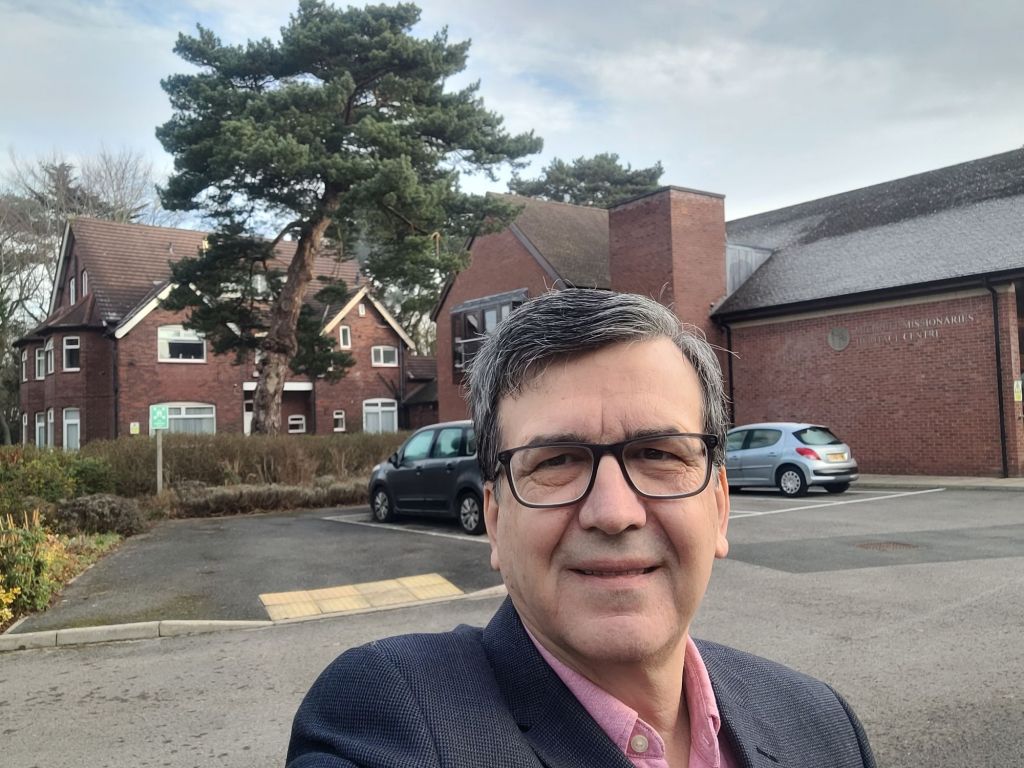
Stephen walks me to my room where I will stay for the next week, invites me into his mini apartment for a welcome cup of coffee and an acquainting conversation. He then tours me through the retirement home for Mill Hill missionaries and brothers, before I am introduced to the archives themselves, the dozen boxes Stephen has pulled aside and the reading room where I can examine the contents. Time to unpack the suitcase into my spartan room before supper at 6:00 pm, sharp.
I arrive five minutes early. A number of people are in the lounge, outside the dining room, waiting. Stephen introduces me to the rector, some priests, some brothers, explaining how my uncle was a Mill Hiller and I was here on research in the archives. I can overhear new arrivals inquiring about the outside person in their midst. The doors open at exactly 6 and everyone crowds into the room, lining up immediately at the food stations before heading directly to their seats. Those residents requiring a wheel chair are already in their place, food delivered to their spot, pills in a cup with their name on the label.
Father James Daley, Jim, is one who needs assistance. He sits at the opposite end of the rectangular table from my location, a spot at Stephen’s table. Fr. Frank Smith is the fourth. Greetings all round, questions back and forth, and it all wraps up by 6:30. The room is near empty as I say good night and then crash into bed until my alarm the next day.
After breakfast it’s time to begin digging. Stephen has provided me with a key to gain access to the building and the reading room at any time. I can work as long and as late as I wish. He had shown me Uncle Cees’ personal file and pulled from it his grades from the equivalent of secondary school and the first two years at the seminary. The paper got me excited for the possibility of even more revealing information so I eagerly open it for a closer examination. There are a handful of new documents, material regarding the cost of his medical care, letters of gratitude from the family for the care surrounding his death, correspondence with the necessary authorities to approve a compassionate leave to attend to his father’s, my grandfather’s funeral (I don’t recall my parents returning to Netherlands at that time). The remainder includes copies of obituaries and a death certificate, the same as what I had discovered in Uncle Cees’ file in the tiny archives at the retirement home in Oosterbeek several years ago. Alas, there is very little to advance my knowledge.
The background material to the Fr. Tom O’Brien’s book commemorating 100 years in Uganda also bears little fruit. Fr. Cees de Cock is mentioned in several places, always in relation to another priest, Fr. Jan van de Laar, a friend and a classmate. They travelled together to Uganda immediately after their ordination, they learned the Luganda language in the first six months, they were used as “spare wheels” bouncing from one assignment to another, and they travelled again together for the first home leave. All this information is based on Jan van de Laar’s correspondence with the author. Given the nature of the relationship between my uncle and Jan, (I have numerous pictures of them together) I was convinced there would be more than what was included in the final edit. I was hoping something similar would be discovered with Fr. Herman Hofte who was also a classmate. He travelled with Uncle Cees to Uganda and mentions as such in his story to Tom O’Brien. I find the correspondence from Jan van de Laar. It is a lengthy description including the many years after Uncle Cees’ death. There is no additional reference to Fr. Cees de Cock. I cannot find any material specific to Fr. Herman Hofte.
I begin to wonder if the trip here was based more on wishful thinking than real possibilities.
The next days are a repetition of the first. Breakfast at 8, lunch at 12:30, supper at 6, with Stephen, Jim and Frank for each meal. In between, I am alone in the reading room, poring through papers, managing two boxes a day because I am working after dinner until 9:30 pm before I retire to my room. The weather is cool and wet and damp, an easy excuse to spend all my time indoors. Every day, Stephen brings me coffee at 10:30 and 2:30, asking if I have found anything, sometimes answering a few questions, staying to chat if he is not busy.
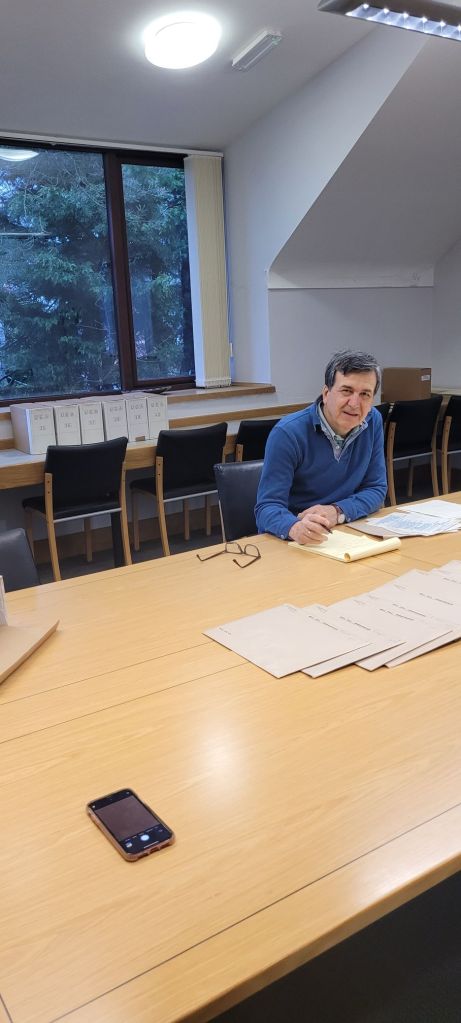
There is no pattern to the content. Material found consistently in early years are missing in the next batch of documents. The Regional Superior appears to conduct a visit to all the missions and issues a report to the Superior General describing the overall context and commenting on each priest. The individual assessments are pithy, sometimes only one word for Fr. Cees de Cock of Kamuli parish:
1959: an excellent and popular worker
1961: inclined to work too hard, put up several buildings for the Sisters
1962: happy
1963: a popular priest and worker
1965: a good humble priest
Nothing again until 1975 with a new Regional Superior: Cees de Cock has to take it calm on account of his heart. He is a very pleasant man who likes to tell his Tilburg jokes. He is very much liked by the people and he hopes to stay in Kamuli as long as possible.
No more reports are in the files as I work towards the 1981 box.
In 1966, a decision had been made to rearrange the boundaries for the existing dioceses to create the Jinja diocese. The move corresponds to Uganda’s independence in 1962 and the growing Africanization of the church. The question of whether an African priest should be appointed as the inaugural Bishop, in the same manner as the Kampala diocese is openly discussed. The priests of Jinja were asked their opinion by completing a ballot. Curiously, each returned ballot was signed, many times accompanied with a reasoning for their vote. Fr. Cees de Cock voted in favour of the appointment of an African bishop. His reasons were simple: the church had been moving in this direction and this change reflected the will of the people he served.
Fr. Cees de Cock was in the minority. I need time to consider the meaning, how his reasoning speaks to my Uncle’s mind, his beliefs, his thinking. I can find little else to help in the analysis.
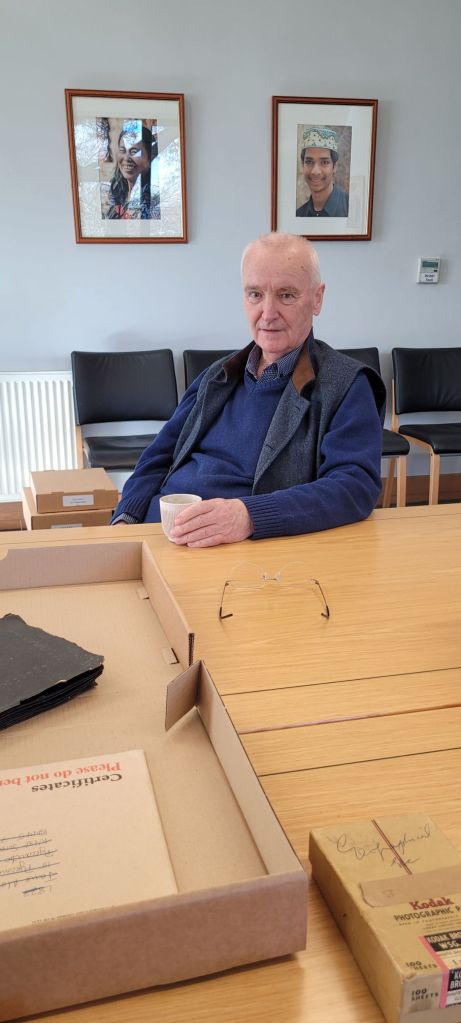
I am into the late seventies files, nearing the end of my time at Herbert House. Like clockwork, Stephen walks into the room with two cups of coffee for the afternoon break. He asks about the work and sits opposite to me at the table. I explain how I have scanned quite a number of documents about the church in Uganda, the political and economic context, the extreme challenges of living through the Idi Amin period. There is a paucity of items specific to Fr. Cees de Cock.
Stephen listens and then tells a short anecdote. The Superior General from 1947 to 1962, the Very Reverend Father Tom McLaughlin, was known to send the newly ordained priests off to the missions around the world with the words, remember to keep your files thin.
I thought how brilliantly that statement spoke to what the files did not say.
In combing through all these boxes, I have read more files than was necessary, including accounts of where priests and brothers were behaving in manners unbecoming the clergy, a small number of whom crossed the line. In the early years of my research time frame, those handful of situations correlated with the amount of memos or letters from the priest, the bishop, the Regional Superior, the Superior General discussing the allegations, the responses, the actions and the conclusions. It very much reflected my career as an administrator at a large post-secondary institution, in that 80 percent of your time was entangled with only 2o percent of the faculty or staff. The vast majority conducted themselves and their work in a manner becoming of their profession. I was not going to uncover the essence of Fr. Cees de Cock, the priest, the man, from these files. I need to learn from the people he touched, the parishioners he served, the friends he supported, the family he knew.
In the last box, there is a letter dated two weeks after his death which speaks about his last couple days and the loss to the community. It reads, in part,
Kees was really loved by everyone and his death is a great loss to our group of men in Uganda, and especially also to his parish and to the diocese…….He was in good form while he was here and enjoyed his Christmas very much. Everyone took to his unassuming manner and good-hearted way…..He was last seen by the nurses at 11:00. He was sitting in a chair, reading, and seemed quite normal. When the nurse cam to se him again at 11:45 he was sitting dead in chair.
My final day is spent skimming through boxes of photographs, scouring for an image which include my Uncle, a virtual needle in a haystack. Fr. Herman Hofte’s album includes photographs from his journey in 1947 aboard the Boschfontein passenger freighter and a group shot of returning and new priests. Fr. Cees de Cock is among them.
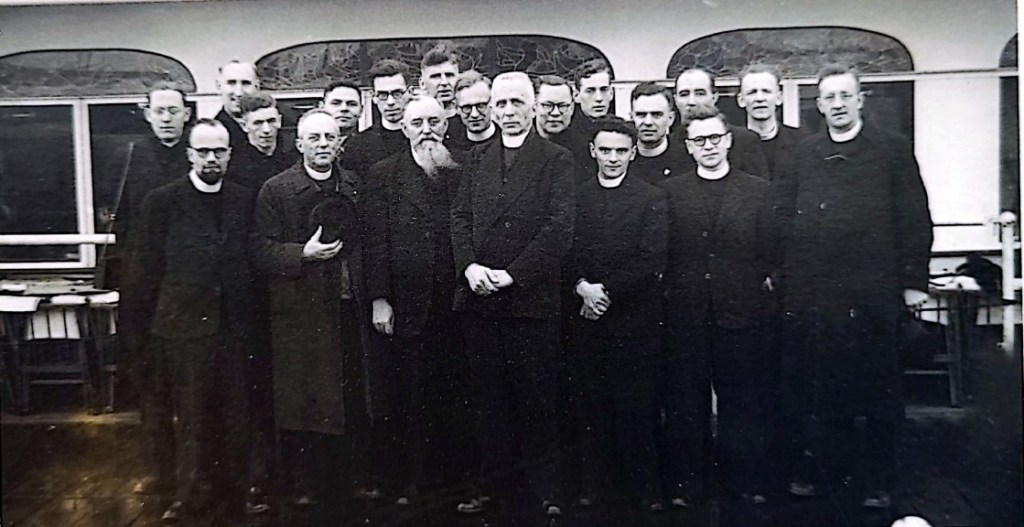
Stephen, Jim and Frank ask questions about my next travels, will I return to Herbert House, was my visit a success. I do hope to come back, meet with them again, listen to their stories. I also think there may be more to discover from the archives related to Uncle Cees’ schooling. I leave with a much better understanding of Fr. Cees de Cock’s movements during his time in Uganda. There was not as much as I had expected, but I have learned more than when I began, from the items that were found and those that were not.


 Wonderings